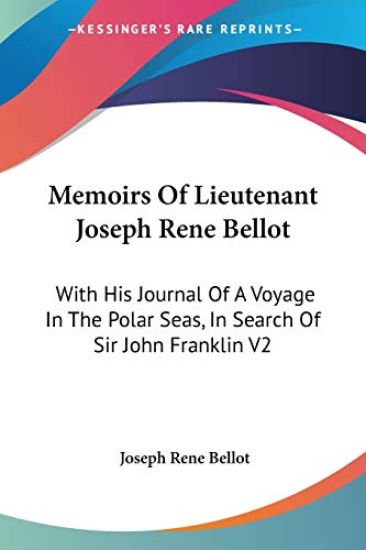
Joseph René Bellot (1826–53) was a French naval officer whose travels took him from Africa to the Arctic before his tragic death at the age of 27. In 1851 he joined a British expedition to search for the missing explorer Sir John Franklin (1786–1847), whose expedition to find the North-West Passage was last heard of in July 1845. Although the voyage was unsuccessful in its search, it explored previously unknown areas of the Arctic. Bellot kept extensive notes about his journey in this remote region; they originally appeared in French in 1854 and were translated into English in 1855 and published in two volumes. Volume 1 contains a biography of Bellot, who was regarded as a hero in both France and Britain, and the first part of his journal, which describes the ship's departure from Scotland, their arrival in Greenland and their encounters with the indigenous people there.
Joseph René Bellot (1826–53) was a French naval officer whose travels took him from Africa to the Arctic before his tragic death at the age of 27. In 1851 he joined a British expedition to search for the missing polar explorer Sir John Franklin (1786–1847), whose expedition to find the North-West Passage was last heard of in July 1845. Although the voyage was unsuccessful in its search, it explored previously unknown areas of the Arctic. Bellot kept extensive notes about his journey in this remote region; they originally appeared in French in 1854 and were translated into English in 1855 and published in two volumes. In Volume 2, Bellot, who was regarded as a hero in both France and Britain, describes how the crew survived the harsh climate of the Arctic winter, his exploration by dog-sledge of inland polar regions and his eventual return to Britain.
PR FACE Dans un ch teau des environs de Viviers, propri t s culaire de sa famille, demeurait, en l'ann e 1827, une femme d'une sensibilit d licate et de l'esprit le plus distingu , la marquise de V... N e en 1779, elle avait pous quinze ans un gentilhomme du Languedoc, d'excellente maison, lui aussi; et elle avait eu de lui un fils, son unique enfant. Mais, en 1827, elle demeurait seule dans son ch teau du Vivarais. Son mari, entr dans l'administration sous l'Empire, habitait Toulouse, o il remplissait les fonctions d'inspecteur des douanes. Son fils, officier de chasseurs, avait sa garnison l'autre bout du royaume. De telle sorte que, dans sa solitude, Mme de V... pouvait entretenir loisir le culte qu'elle avait vou depuis sa jeunesse l'auteur du G nie du Christianisme. Elle avait t de celles que l'apparition de ce livre, jadis, avait affol es d'enthousiasme Je serais embarrass de raconter avec une modestie convenable comment on se disputait un mot de ma main, comment on ramassait une enveloppe crite par moi, et comment, avec rougeur, on la cachait, en baissant la t te, sous le voile tombant d'une longue chevelure. (Chateaubriand, M moires d'Outre-Tombe.)]: toujours, depuis lors, elle continuait tre partag e entre son d sir de conna tre Chateaubriand et la crainte d'importuner celui-ci ou de lui d plaire. D j en 1816, profitant d'un s jour Paris, elle avait crit son grand homme; puis, au dernier moment, elle avait imagin un pr texte pour se dispenser de le rencontrer. Onze ans plus tard, propos de quelques mots lus dans le Journal des D bats sur une indisposition de Chateaubriand, elle s'enhardit lui crire de nouveau; et, cette fois, sa lettre fut le point de d part d'une correspondance qui devait durer sans interruption pr s de deux ans, jusqu'au mois de juin 1829. Au moment o s'ouvrit cette correspondance, Chateaubriand traversait une des p riodes les plus tristes et les plus inqui tes de sa vie.
Monsieur Rene has come upon a great idea. As the Permanent President of the International Brotherhood of Concierges and Hall Porters, he and his service industry brothers are privy to huge amounts of sensitive, exclusive information and gossip from heads of state, world leaders, diplomats, and the wealthy, which they happen to overhear while working in the rooms, dining halls, and elevators of Geneva's finest hotels. As waiters, porters, and servants, they are trusted to be silent about such weighty matters-top secret information that, in the wrong hands, could change the course of world events. A self-appointed revolutionary humanitarian, M. Rene gathers some of his trusted brothers to reveal his plan to form a secret conspiracy of distinguished servants who will record the conversations of their clients, gather their correspondences, and spy on their actions. M. Rene confides his plan, "It is always at a table that statesmen are at their most unguarded. Waiters have golden opportunities for this kind of work. . . . Who needs spies if they have concierges, waiters, and valets?" Is the purpose bribery or blackmail? Will the power be transferred to those who have none? Will the plan benefit the world, or place free countries in great danger? As these questions arise, the conspiracy brings to light assassinations, secret clauses in treaties, government conspiracies, and more. What unravels is a novel of suspense, intrigue, and danger, territory that Sir Peter Ustinov has mastered in this original literary triumph. If ever the workers of the world had better reason to come together and seize control of the establishment, this book is it.
Se cumplir n 106 a os exactos desde el d a de la abolici n de la esclavitud en Puerto Rico el 22 de marzo de 1879 al 22 de marzo de 1979 cuando falleci Ren Marqu s. No hare aqu alarde o manifestaci n alguna de que lo conoc , pues cuando yo nac apenas Rene hab a fundado el Teatro del Ateneo Puertorrique o. S conoc su obra durante mis a os escolares primarios y como un asiduo e incorregible lector me adentre en sus cuentos, no solo los escritos por el sino por sus contempor neos. Este libro es dedicado a la generaci n del siglo XXI quienes de seguro la mayor a nunca han visto una carreta con bueyes menos conocen lo que es un sol trunco. Pero como todo se aprende escudri ando quiz s este libro toque la sensibilidad de aquellos que buscan un poco del pasado de sus antepasados, de c mo eran las cosas que ahora ya no son. Adem s podr n ver la fruct fera creatividad de nuestro reconocido personaje y la internacionalidad de su trabajo literario que muchos hoy quisieran obtener. La mayor a de los escritores influyentes de cualquier pa s sea cual sea su g nero f sico y literario reflejan en sus escritos las condiciones de vida que les afectaron o disturban emocionalmente en su crecimiento intelectual y las que influyen durante su carrera como escritor. Para aquellos que no conocen he aqu a manera de presentaci n algunos de sus temas y pensares en su expresi n literaria: El fen meno nacionalista puertorrique o, la industrializaci n y sus consecuencias morales, psicol gicas y sociales, la participaci n del puertorrique o en la guerra de Corea, el Tiempo como problema filos fico y la soledad existencial del Hombre, el feminismo puertorrique o; adem s lo primordialmente urbano: calles, f bricas, edificios de apartamientos, postes de alumbrado p blico, hilos telef nicos, luces de ne n, anuncios comerciales, aeropuertos, tiendas, torres de acero, casuchas arrabaleras, hoteles para turistas, prost bulos, restaurantes, autobuses, bares, en fin, todo lo que se ofrece diariamente a la visi n del habitante de la ciudad, integra el "paisaje... etc.", as era la literatura de Ren Marqu s. Seg n Angelina Morfi qui n fue una de sus grandes amigas personales y literarias dice; "Ren Marqu s es uno de los escritores m s representativos de nuestro esp ritu nacional de los m s conscientes de los males de la colonia. Nos lega una obra importante, no s lo por su valor literario sino tambi n por lo que aporta al conocimiento de nuestro aut ntico modo de ser". Fue en ARECIBO, en cuyas costas el mar Atl ntico ha demostrado secularmente su furia nace Ren Marqu s el 4 de octubre de 1919. Desde ni o vive interesantes y agradables experiencias a trav s de familiares, paisanos en general, libros, espect culos, la tierra y el mar que rendir an su fruto en una rica obra literaria. El cine y el teatro los disfruta tempranamente por la afici n que les ten a su madre do a Pura Garc a Abreu. Las representaciones de dramas, comedias, operetas, zarzuelas y revistas espa olas se cuentan entre los est mulos iniciales que lo encaminaron al fascinante mundo del espect culo. Su padre Juan Marqu s prefer a pasar las noches en las tertulias nocturnas pero si hab a alg n encuentro de 'boxeo se desplazaba al cuadril tero en compa a de su unig nito. Acostumbraba tambi n llevarlo a las series dominicales de cine y al circo en su temporada de Arecibo. Ren Marqu s se grad a de agr nomo en 1942 en el Colegio de Agricultura y Artes Mec nicas. El mismo a o se casa con Serena Velasco. De la uni n nacen Ra l Fernando, Brunilda Mar a y Francisco Ren . El matrimonio queda disuelto tres lustros despu s. Los ltimos a os de su vida Ren Marqu s se a sla en una bella regi n campestre en Cubuy de Can vanas. El no y una densa vegetaci n circundaban la casa de elegante y sobrio dise o realizado por Jos Manuel Lacomba, su amigo inseparable. Muere el 22 de marzo de 1979 en el
Louis-Ren des For ts (1916-2000) devoted the last twenty-five years of his writing life to an innovative practice of autobiography, spanning poetry and fragmentary prose, and culminating in the key works Po mes de Samuel Wood (1987), Ostinato (1997) and the posthumously published Pas pas jusqu'au dernier (2001). Ian Maclachlan's study is the first to take this innovation in life-writing as its principal focus and to draw out the wider resonances of des For ts's distinctive project for the theory and practice of autobiography. Des For ts's unusual traversal of genres, formal experimentation, and sparseness of biographical detail give rise to a new mode of abstract, impersonal autobiographical writing. Echoing des For ts's own, earlier use of the term autobiographie int rieure in relation to his short-story collection La Chambre des enfants (1960), as well as his friend Georges Bataille's idiosyncratic notion of exp rience int rieure, this novel style of life-writing is explored here under the rubric of 'inner autobiography'.Ian Maclachlan is Professor of French Literature and Fellow of Merton College, University of Oxford.