Kirjojen hintavertailu. Mukana 11 717 486 kirjaa ja 12 kauppaa.

Kirjahaku

Etsi kirjoja tekijän nimen, kirjan nimen tai ISBN:n perusteella.

1000 tulosta hakusanalla Sharon Monteith

Rising Road

Rising Road

Sharon Davies

Oxford University Press Inc
2011
nidottu
It was among the most notorious criminal cases of its day. On August 11, 1921, in Birmingham, Alabama, a Methodist minister named Edwin Stephenson shot and killed a Catholic priest, James Coyle, in broad daylight and in front of numerous witnesses. The killer's motive? The priest had married Stephenson's eighteen-year-old daughter Ruth to Pedro Gussman, a Puerto Rican migrant and practicing Catholic. Sharon Davies's Rising Road resurrects the murder of Father Coyle and the trial of his killer. As Davies reveals with novelistic richness, Stephenson's crime laid bare the most potent bigotries of the age: a hatred not only of blacks, but of Catholics and "foreigners" as well. In one of the case's most unexpected turns, the minister hired future U.S. Supreme Court Justice Hugo Black to lead his defense. Though regarded later in life as a civil rights champion, in 1921 Black was just months away from donning the robes of the Ku Klux Klan, the secret order that financed Stephenson's defense. Entering a plea of temporary insanity, Black defended the minister on claims that the Catholics had robbed Ruth away from her true Protestant faith, and that her Puerto Rican husband was actually black. Placing the story in social and historical context, Davies brings this heinous crime and its aftermath back to life, in a brilliant and engrossing examination of the wages of prejudice and a trial that shook the nation at the height of Jim Crow. "Davies takes us deep into the dark heart of the Jim Crow South, where she uncovers a searing story of love, faith, bigotry and violence. Rising Road is a history so powerful, so compelling it stays with you long after you've finished its final page." --Kevin Boyle, author of the National Book Award-winning Arc of Justice "This gripping history...has all the makings of a Hollywood movie. Drama aside, Rising Road also happens to be a fine work of history." --History News Network
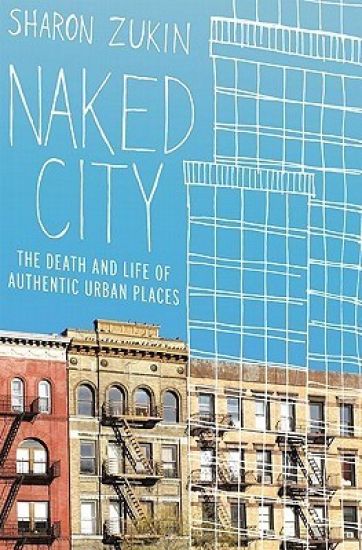
Naked City

Naked City

Sharon Zukin

Oxford University Press Inc
2011
nidottu
As cities have gentrified, educated urbanites have come to prize what they regard as "authentic" urban life: aging buildings, art galleries, and funky ethnic restaurants. But as Sharon Zukin shows in Naked City, the pervasive demand for authenticity has helped drive out the very people who first lent a neighborhood its authentic aura: immigrants, the working class, and artists. Through a guided tour of six archetypal New York City neighborhoods, Zukin shows how the emphasis on distinctiveness has become a tool of economic elites to drive up real estate values and force out the neighborhood "characters" that people often idealize. With a journalist's eye and the understanding of a longtime observer, Zukin's panoramic survey of the city explains how our desire to consume authentic experience has become a central force in making cities more exclusive.
Once and Future Giants

Once and Future Giants

Sharon Levy

Oxford University Press Inc
2013
nidottu
Until about 13,000 years ago, North America was home to a menagerie of massive mammals. Mammoths, camels, and lions walked the ground that has become Wilshire Boulevard in Los Angeles and foraged on the marsh land now buried beneath Chicago's streets. Then, just as the first humans reached the Americas, these Ice Age giants vanished forever. In Once and Future Giants, science writer Sharon Levy digs through the evidence surrounding Pleistocene large animal ("megafauna") extinction events worldwide, showing that understanding this history--and our part in it--is crucial for protecting the elephants, polar bears, and other great creatures at risk today. These surviving relatives of the Ice Age beasts now face an intensified replay of that great die-off, as our species usurps the planet's last wild places while driving a warming trend more extreme than any in mammalian history. Inspired by a passion for the lost Pleistocene giants, some scientists advocate bringing elephants and cheetahs to the Great Plains as stand-ins for their extinct native brethren. By reintroducing big browsers and carnivores to North America, they argue, we could rescue some of the planet's most endangered animals while restoring healthy prairie ecosystems. Critics, including biologists enmeshed in the struggle to restore native species like the gray wolf and the bison, see the proposal as a dangerous distraction from more realistic and legitimate conservation efforts. Deftly navigating competing theories and emerging evidence, Once and Future Giants examines the extent of human influence on megafauna extinctions past and present, and explores innovative conservation efforts around the globe. The key to modern-day conservation, Levy suggests, may lie fossilized right under our feet.
Biology for the Informed Citizen with Physiology Study Guide
Designed to work with Biology for the Informed Citizen with Physiology by Donna M. Bozzone and Douglas S. Green, this Study Guide provides students with brief summaries and step-by-step analyses of each chapter, additional review questions, and thoughtful advice and study tips. The Study Guide is authored by Sharon Gilman, who is also the author of the book's test item file, a resource for instructors that includes over 1200 questions for easy student evaluation.
Study Guide for Use with Biology for the Informed Citizen
Designed to work with Biology for the Informed Citizen by Donna M. Bozzone and Douglas S. Green, this Study Guide provides students with brief summaries and step-by-step analyses of each chapter, additional review questions, and thoughtful advice and study tips. The Study Guide is authored by Sharon Gilman, who is also the author of the book's test item file, a resource for instructors that includes over 1200 questions for easy student evaluation.
Nonviolent Struggle

Nonviolent Struggle

Sharon Nepstad

Oxford University Press Inc
2015
sidottu
From Gandhi's movement to win Indian independence to the Arab Spring uprisings of 2011, an expanding number of citizens have used nonviolent action to win political goals. While such events have captured the public imagination, they have also generated a new surge of scholarly interest in the field of nonviolence and civil resistance studies. Although researchers have produced new empirical data, theories, and insights into the phenomenon of nonviolent struggle, the field is still quite unfamiliar to many students and scholars. In Nonviolent Struggle: Theories, Strategies, and Dynamics, sociologist Sharon Nepstad provides a succinct introduction to the field of civil resistance studies, detailing its genesis, key concepts and debates, and a summary of empirical findings. Nepstad depicts the strategies and dynamics at play in nonviolent struggles, and analyzes the factors that shape the trajectory and outcome of civil resistance movements. The book draws on a vast array of historical examples, including the U.S. civil rights movement, the Indonesian uprising against President Suharto, the French Huguenot resistance during World War II, and Cesar Chavez's United Farm Workers. Nepstad describes both principled and pragmatic nonviolent traditions and explains various categories of nonviolent action, concluding with an assessment of areas for future research. A comprehensive treatment of the philosophy and strategy of nonviolent resistance, Nonviolent Struggle is essential reading for students, scholars, and anyone with a general interest in peace studies and social change.
Nonviolent Struggle

Nonviolent Struggle

Sharon Nepstad

Oxford University Press Inc
2015
nidottu
From Gandhi's movement to win Indian independence to the Arab Spring uprisings of 2011, an expanding number of citizens have used nonviolent action to win political goals. While such events have captured the public imagination, they have also generated a new surge of scholarly interest in the field of nonviolence and civil resistance studies. Although researchers have produced new empirical data, theories, and insights into the phenomenon of nonviolent struggle, the field is still quite unfamiliar to many students and scholars. In Nonviolent Struggle: Theories, Strategies, and Dynamics, sociologist Sharon Nepstad provides a succinct introduction to the field of civil resistance studies, detailing its genesis, key concepts and debates, and a summary of empirical findings. Nepstad depicts the strategies and dynamics at play in nonviolent struggles, and analyzes the factors that shape the trajectory and outcome of civil resistance movements. The book draws on a vast array of historical examples, including the U.S. civil rights movement, the Indonesian uprising against President Suharto, the French Huguenot resistance during World War II, and Cesar Chavez's United Farm Workers. Nepstad describes both principled and pragmatic nonviolent traditions and explains various categories of nonviolent action, concluding with an assessment of areas for future research. A comprehensive treatment of the philosophy and strategy of nonviolent resistance, Nonviolent Struggle is essential reading for students, scholars, and anyone with a general interest in peace studies and social change.
Thinking Socratically

Thinking Socratically

Sharon Schwarze; Harvey Lape

Pearson
2012
nidottu
ALERT: Before you purchase, check with your instructor or review your course syllabus to ensure that you select the correct ISBN. Several versions of Pearson's MyLab & Mastering products exist for each title, including customized versions for individual schools, and registrations are not transferable. In addition, you may need a CourseID, provided by your instructor, to register for and use Pearson's MyLab & Mastering products. Packages Access codes for Pearson's MyLab & Mastering products may not be included when purchasing or renting from companies other than Pearson; check with the seller before completing your purchase. Used or rental books If you rent or purchase a used book with an access code, the access code may have been redeemed previously and you may have to purchase a new access code. Access codes Access codes that are purchased from sellers other than Pearson carry a higher risk of being either the wrong ISBN or a previously redeemed code. Check with the seller prior to purchase. -- Critical Thinking Skills in Everyday Context – The Socrates Model Thinking Socratically is a treatment of critical thinking, rather than an informal logic textbook. It emphasizes a philosophical reflection on real issues from everyday life, in order to teach students the skills of critical thinking in a commonplace context that is easy to understand and certain to be remembered. Teaching and Learning Experience Improve Critical Thinking - Thinking Socratically contextualizes the presentation of critical thinking topics through easy-to-understand information, and shows, rather than just tells, students how to be critical thinkers by encouraging them to follow Socrates as a model. Engage Students – Thinking Socratically exposes students to a variety of readings listed after expository material, Venn diagrams, chapter-end summaries, etc. – in order to outline important concepts and learning tools needed for useful reasoning. Support Instructors - Teaching your course just got easier! You can create a Customized Text or use our Instructor’s Manual, or PowerPoint Presentation Slides. Plus, Thinking Socratically is organized around topics for ease of assignments, and uses standard terminology to eliminate student confusion.
Blood, Tin, Straw

Blood, Tin, Straw

Sharon Olds

Vintage
2000
pokkari
Sharon Olds divides this new book into five sections - 'Blood', 'Tin', ' 'Straw', ' 'Fire' and 'Light' - each made up of fourteen poems whose dominant imagery is drawn from one of these elements.
Unswept Room

Unswept Room

Sharon Olds

Vintage Publishing
2003
pokkari
The Unswept Room is a dazzling collection of poems that project a fresh spirit, a startling energy of language and rhythm, and a moving, elegiac tone shot through with humour.
Selected Poems

Selected Poems

Sharon Olds

Vintage
2005
pokkari
This rich selection - made by the author - exhibits those qualities in poem after poem, reflecting, moreover, an exciting experimentation with rhythm and language and a movement toward an embrace beyond the personal.
Stag's Leap

Stag's Leap

Sharon Olds

Vintage
2012
pokkari
Eliot Poetry PrizeStag's Leap, Sharon Olds' stunningly poignant new sequence of poems, tells the story of a divorce, embracing strands of love, sex, sorrow, memory, and new freedom.
An Image of God

An Image of God

Sharon M. Leon

University of Chicago Press
2013
sidottu
In the first half of the twentieth century, supporters of the eugenics movement offered an image of a racially transformed America by curtailing the reproduction of "unfit" members of society. Through institutionalization, compulsory sterilization, the restriction of immigration and marriages, and other methods, eugenicists promised to improve the population - a policy agenda that was embraced by many leading intellectuals and public figures. But Catholic activists and thinkers across the United States opposed many of these measures, asserting that "every man, even a lunatic, is an image of God, not a mere animal." In "An Image of God", Sharon M. Leon examines the efforts of American Catholics to thwart eugenic policies, illuminating the ways in which Catholic thought transformed the public conversation about individual rights, the role of the state, and the intersections of race, community, and family. Through an examination of the broader questions raised in this debate, Leon casts new light on major issues that remain central in American political life today: the institution of marriage, the role of government, and the separation of church and state. This is essential reading in the history of religion, science, politics, and human rights.
Impersonality

Impersonality

Sharon Cameron

University of Chicago Press
2007
sidottu
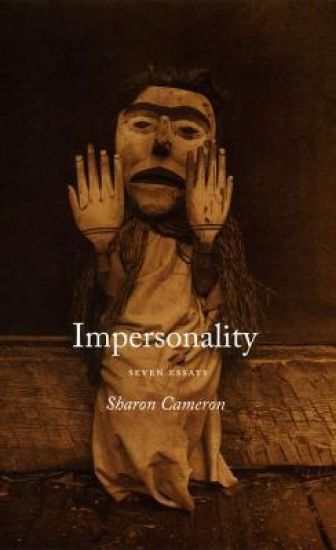
Philosophers have long debated the subjects of person and personhood. Sharon Cameron ushers this debate into the literary realm by considering impersonality in the works of major American writers and figures of international modernism—writers for whom personal identity is inconsequential and even imaginary. In essays on William Empson, Jonathan Edwards, Ralph Waldo Emerson, Herman Melville, T. S. Eliot, and Simone Weil, Cameron examines the impulse to hollow out the core of human distinctiveness, to construct a voice that is no one’s voice, to fashion a character without meaningful attributes, a being that is virtually anonymous. “To consent to being anonymous,” Weil wrote, “is to bear witness to the truth. But how is this compatible with social life and its labels?” Throughout these essays Cameron examines the friction, even violence, set in motion from such incompatibility—from a “truth” that has no social foundation. Impersonality investigates the uncompromising nature of writing that suspends, eclipses, and even destroys the person as a social, political, or individual entity, of writing that engages with personal identity at the moment when its usual markers vanish or dissolve.
Impersonality

Impersonality

Sharon Cameron

University of Chicago Press
2007
nidottu
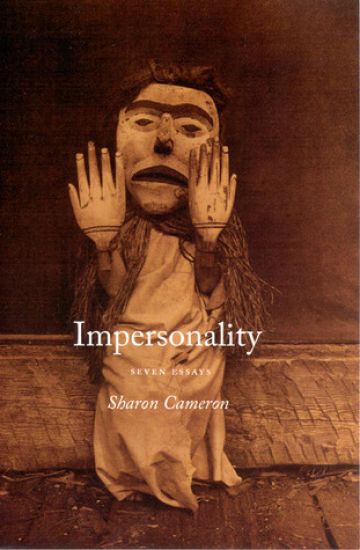
Philosophers have long debated the subjects of person and personhood. Sharon Cameron ushers this debate into the literary realm by considering impersonality in the works of major American writers and figures of international modernism—writers for whom personal identity is inconsequential and even imaginary. In essays on William Empson, Jonathan Edwards, Ralph Waldo Emerson, Herman Melville, T. S. Eliot, and Simone Weil, Cameron examines the impulse to hollow out the core of human distinctiveness, to construct a voice that is no one’s voice, to fashion a character without meaningful attributes, a being that is virtually anonymous. “To consent to being anonymous,” Weil wrote, “is to bear witness to the truth. But how is this compatible with social life and its labels?” Throughout these essays Cameron examines the friction, even violence, set in motion from such incompatibility—from a “truth” that has no social foundation. Impersonality investigates the uncompromising nature of writing that suspends, eclipses, and even destroys the person as a social, political, or individual entity, of writing that engages with personal identity at the moment when its usual markers vanish or dissolve.
Writing Nature

Writing Nature

Sharon Cameron

University of Chicago Press
1989
nidottu
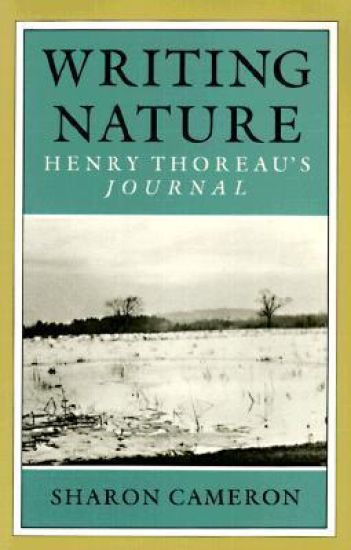
At his death, Henry Thoreau left the majority of his writing unpublished. The bulk of this material is a journal that he kept for twenty-four years. Sharon Cameron's major claim is that this private work (the Journal) was Thoreau's primary work, taking precedence over the books that he published in his lifetime. Her controversial thesis views Thoreau's Journal as a composition that confounds the distinction between public and private—the basis on which our conventional treatment of discourse depends.
Thinking in Henry James

Thinking in Henry James

Sharon Cameron

University of Chicago Press
1991
nidottu
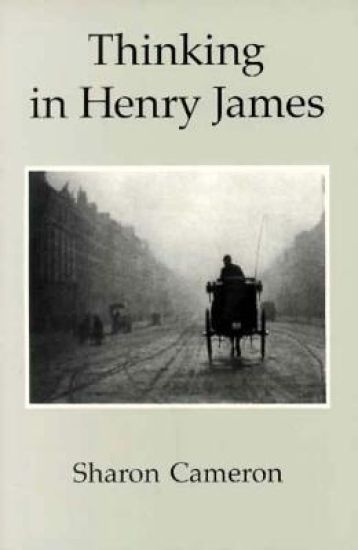
Thinking in Henry James identifies what is genuinely strange and radical about James's concept of consciousness—first, the idea that it may not always be situated within this or that person but rather exists outside or "between," in some transpersonal place; and second, the idea that consciousness may have power over things and people outside the person who thinks. Examining these and other counterintuitive representations of consciousness, Cameron asks, "How do we make sense of these conceptions of thinking?"