Kirjojen hintavertailu. Mukana 11 699 587 kirjaa ja 12 kauppaa.

Kirjahaku

Etsi kirjoja tekijän nimen, kirjan nimen tai ISBN:n perusteella.

1000 tulosta hakusanalla Sharon Stuart

Rollercoasters The Skin I'm In

Rollercoasters The Skin I'm In

Sharon G Flake

Oxford University Press
2007
nidottu
Maleeka Madison is a child with very low self-esteem due to the fact that she is darker skinned than most other black girls. In her new teacher, Miss Saunders, she encounters someone who, she feels, is worse off than she is, as Miss Saunders' skin is blotched with a rare skin condition. The teacher withstands the snickers and shouts from the students but can Maleeka accept friendship and accept the skin she's in?
Oxford Reading Tree: Level 8: Fireflies: Musician: Vanessa Mae
This book is part of the Oxford Reading Tree Fireflies series which offer a wide range of stimulating non-fiction titles for young children. It includes a variety of topics covering all areas of the curriculum, from science to citizenship. The books have a bright modern page design, and are illustrated with colour photographs. They are carefully graded across 10 levels and contain built-in progression and vocabulary repetition throughout. Each book includes notes for parents/carers and teaching assistants on the inside covers. Help with childrens reading development is also available at www.oxfordowl.co.uk. This book is also available as part of a mixed pack of 6 different books or a class pack of 36 books of the same ORT level. CD-ROM versions of Fireflies titles are also available as eFireflies.
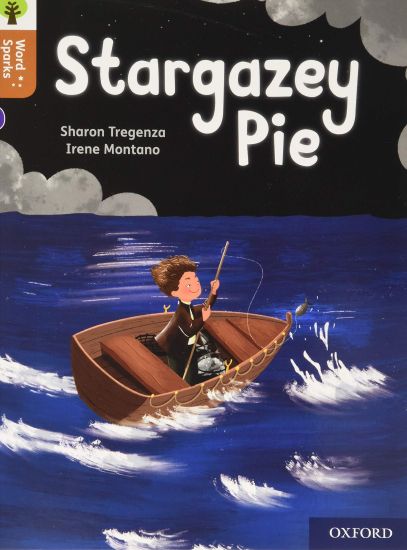
Oxford Reading Tree Word Sparks: Level 8: Stargazey Pie

Oxford Reading Tree Word Sparks: Level 8: Stargazey Pie

Sharon Tregenza

Oxford University Press
2020
nidottu
A huge storm leaves the village hungry, until Tom braves the waves. Using the world's largest known database of writing for and by children, our experts have defined 300 ambitious words to help children succeed at school. We've combined these with finelly levelled books that help you develop support comprehension and fluency, while inspiring and engaging your young readers.
Sexual and Marital Metaphors in Hosea, Jeremiah, Isaiah, and Ezekiel
Sharon Moughtin-Mumby considers the often unrecognised impact of different approaches to metaphor on readings of the prophtic sexual and marital metaphorical language. She outlines a practical and consciously simplified approach to metaphor, placing strong emphasis on the influence of literary context on metaphorical meaning. Drawing on this approach, she read Hosea 4-14, Jeremiah 2:1-4:4, Isaiah, Ezekiel 16 and 23, and Hosea 1-3 with fresh eyes. Her lucid new readings reveal the way in which scholarship has repeatedly stifled the prophetic metaphorical language by reading it within the 'default contexts' of 'the marriage metaphor' and 'cultic prostitution', which for so many years have been simply assumed. Readers are encouraged instead to read these diverse metaphors and similes within their distinctive literary contexts in which they have the potential to rise vividly to life, provoking the question: how are we to respond to these disquieting, powerful texts in the midst of the Hebrew Bible?
The Interplay of Morphology and Phonology

The Interplay of Morphology and Phonology

Sharon Inkelas

Oxford University Press
2014
sidottu
This book presents a phenomenon-oriented survey of the interaction between phonology and morphology. It examines the ways in which morphology, i.e. word formation, demonstrates sensitivity to phonological information and how phonological patterns can be sensitive to morphology. Chapters focus on morphologically conditioned phonology, process morphology, prosodic templates, reduplication, infixation, phonology-morphology interleaving effects, prosodic-morphological mismatches, ineffability, and other cases of phonology-morphology interaction. The overview discusses the relevance of a variety of phenomena for theoretical issues in the field. These include the debate over item-based vs. realizational approaches to morphology; the question of whether cyclic effects can be subsumed under paradigmatic effects; whether reduplication is phonological copying or morphological doubling; whether infixation and suppletive allomorphy are phonologically optimizing, and more. The book is intended to be used in graduate or advanced undergraduate courses or as a reference for those pursuing individual topics in the phonology-morphology interface.
The Interplay of Morphology and Phonology

The Interplay of Morphology and Phonology

Sharon Inkelas

Oxford University Press
2014
nidottu
This book presents a phenomenon-oriented survey of the interaction between phonology and morphology. It examines the ways in which morphology, i.e. word formation, demonstrates sensitivity to phonological information and how phonological patterns can be sensitive to morphology. Chapters focus on morphologically conditioned phonology, process morphology, prosodic templates, reduplication, infixation, phonology-morphology interleaving effects, prosodic-morphological mismatches, ineffability, and other cases of phonology-morphology interaction. The overview discusses the relevance of a variety of phenomena for theoretical issues in the field. These include the debate over item-based vs. realizational approaches to morphology; the question of whether cyclic effects can be subsumed under paradigmatic effects; whether reduplication is phonological copying or morphological doubling; whether infixation and suppletive allomorphy are phonologically optimizing, and more. The book is intended to be used in graduate or advanced undergraduate courses or as a reference for those pursuing individual topics in the phonology-morphology interface.
The Role of National Courts in Applying International Humanitarian Law
International law is increasingly applied in domestic courts. This can result in situations where the courts are being asked to rule on politically sensitive issues, especially issues which involve actions during armed conflicts. Domestic courts do not show a uniformity of approach in addressing cases concerning international humanitarian law, and can often be seen to differ markedly in their response. The book argues that different national courts demonstrate different functional roles in different countries. These can be situated on a scale from apology to utopia, which can be set out as follows: (1) the apologist role of courts, in which they serve as a legitimating agency of the state's actions; (2) the avoiding role of courts, in which they, for policy considerations, avoid exercising jurisdiction over a case; (3) The deferral role of courts, in which courts defer back to the other branches of the government the responsibility of finding an appropriate remedy (4) the normative application role of courts, in which they apply international humanitarian law as required by the rule of law; and (5) the utopian role of courts, in which they introduce moral judgments in favour of the protection of the individual, beyond the requirements of the law. The book investigates the rulings of five key domestic courts, those of the UK, the USA, Canada, Italy, and Israel, to understand how their approaches differ, and where their practice can be placed on the methological scale. This analysis has been assisted by the author's extensive field work, notably in Israel and in the Occupied Palestinian Territories. Providing a detailed understanding each court's function, the book offers a critical analysis of the courts' rulings, in which both the legal arguments and the political context of cases they have ruled on are examined. The book shows that the functional role of the national courts is a combination of contradictions and mixed attitudes, and that national courts are in the process of defining their own role as enforcing organs of international humanitarian law.
Classic and Contemporary Perspectives in Social Psychology

Classic and Contemporary Perspectives in Social Psychology

Sharon E. Preves; Jeylan T. Mortimer

Oxford University Press Inc
2010
nidottu
Classic and Contemporary Perspectives in Social Psychology illuminates the dynamic linkages among social organization, interaction processes, attitudes, and the self. It exposes students to the broad range of topics of interest to social psychologists and to the diverse methods that they use. Bringing together a wide variety of captivating classic and contemporary selections, this anthology includes work from a symbolic interactionist perspective as well as studies informed by expectation states theory, experimental social psychology, and life course sociology. The selections address the social psychological underpinnings and outcomes of group dynamics, social stratification, bureaucracy, deviant behavior, globalization, and technological change. The reader's innovative structure allows students to experience the foundational work of influential sociologists and psychologists through the lens of cutting-edge issues. This groundbreaking collection features brief excerpts from the classic literature of social psychology (by Emory Bogardus, Melvin Kohn, Stanley Milgram, Muzafer Sherif, Philip Zimbardo, and others). These texts are paired with explanatory comments by the editors and contemporary writings that show the earlier studies' relevance to contemporary social issues. Classic and Contemporary Perspectives in Social Psychology is enhanced by several pedagogical features, including introductory comments that highlight the connections between the classic and contemporary selections, highly engaging discussion questions for each article and unit, and a wide variety of supplemental resources (readings, websites, films, and radio programs). It is ideal for both undergraduate and graduate courses in social psychology.
Nonviolent Revolutions

Nonviolent Revolutions

Sharon Erickson Nepstad

Oxford University Press Inc
2011
sidottu
In the spring of 1989, Chinese workers and students captured global attention as they occupied Tiananmen Square, demanded political change, and then experienced a tragic crackdown at the hands of the Chinese army. Months later, East German civilians rose up nonviolently, bringing down the Berlin Wall and dismantling their regime. Although both movements used the tactics of civil resistance, their outcomes were different. In Nonviolent Revolutions, Sharon Erickson Nepstad examines these two movements, along with citizen uprisings in Panama, Chile, Kenya, and the Philippines. Through a comparative approach that includes both successful and failed cases, she analyzes the effects of movements' strategies along with the counter-strategies that regimes developed to retain power. Nepstad concludes that security force defections have a significant influence on revolutionary outcomes since those regimes that maintained troop loyalty were the least likely to collapse. Through a close analysis of these cases, she explores the reasons why soldiers defect or remain loyal and the conditions that increase the likelihood of mutiny. She also examines the impact of international sanctions, arguing that they sometimes harm movements by generating new allies for authoritarian leaders or by shifting the locus of power from local civil resisters to international actors. In conclusion, Nepstad finds that the dynamics of nonviolent revolution are not adequately captured by theories that have largely been derived from studies of armed struggles. Nonviolent Revolutions offers insights into the distinctive challenges that civil resisters face and it explores the reasons why some of these insurrectionary movements failed. As this form of struggle has increased in recent years--with the explosion of "color revolutions " in Serbia, Georgia, Ukraine, Lebanon, Kyrgyzstan and Burma--this book provides a valuable new framework for understanding civil resistance and nonviolent revolt.
Nonviolent Revolutions

Nonviolent Revolutions

Sharon Erickson Nepstad

Oxford University Press Inc
2011
nidottu
In the spring of 1989, Chinese workers and students captured global attention as they occupied Tiananmen Square, demanded political change, and then experienced a tragic crackdown at the hands of the Chinese army. Months later, East German civilians rose up nonviolently, bringing down the Berlin Wall and dismantling their regime. Although both movements used the tactics of civil resistance, their outcomes were different. In Nonviolent Revolutions, Sharon Erickson Nepstad examines these two movements, along with citizen uprisings in Panama, Chile, Kenya, and the Philippines. Through a comparative approach that includes both successful and failed cases, she analyzes the effects of movements' strategies along with the counter-strategies that regimes developed to retain power. Nepstad concludes that security force defections have a significant influence on revolutionary outcomes since those regimes that maintained troop loyalty were the least likely to collapse. Through a close analysis of these cases, she explores the reasons why soldiers defect or remain loyal and the conditions that increase the likelihood of mutiny. She also examines the impact of international sanctions, arguing that they sometimes harm movements by generating new allies for authoritarian leaders or by shifting the locus of power from local civil resisters to international actors. In conclusion, Nepstad finds that the dynamics of nonviolent revolution are not adequately captured by theories that have largely been derived from studies of armed struggles. Nonviolent Revolutions offers insights into the distinctive challenges that civil resisters face and it explores the reasons why some of these insurrectionary movements failed. As this form of struggle has increased in recent years--with the explosion of "color revolutions " in Serbia, Georgia, Ukraine, Lebanon, Kyrgyzstan and Burma--this book provides a valuable new framework for understanding civil resistance and nonviolent revolt.
Rising Road

Rising Road

Sharon Davies

Oxford University Press Inc
2011
nidottu
It was among the most notorious criminal cases of its day. On August 11, 1921, in Birmingham, Alabama, a Methodist minister named Edwin Stephenson shot and killed a Catholic priest, James Coyle, in broad daylight and in front of numerous witnesses. The killer's motive? The priest had married Stephenson's eighteen-year-old daughter Ruth to Pedro Gussman, a Puerto Rican migrant and practicing Catholic. Sharon Davies's Rising Road resurrects the murder of Father Coyle and the trial of his killer. As Davies reveals with novelistic richness, Stephenson's crime laid bare the most potent bigotries of the age: a hatred not only of blacks, but of Catholics and "foreigners" as well. In one of the case's most unexpected turns, the minister hired future U.S. Supreme Court Justice Hugo Black to lead his defense. Though regarded later in life as a civil rights champion, in 1921 Black was just months away from donning the robes of the Ku Klux Klan, the secret order that financed Stephenson's defense. Entering a plea of temporary insanity, Black defended the minister on claims that the Catholics had robbed Ruth away from her true Protestant faith, and that her Puerto Rican husband was actually black. Placing the story in social and historical context, Davies brings this heinous crime and its aftermath back to life, in a brilliant and engrossing examination of the wages of prejudice and a trial that shook the nation at the height of Jim Crow. "Davies takes us deep into the dark heart of the Jim Crow South, where she uncovers a searing story of love, faith, bigotry and violence. Rising Road is a history so powerful, so compelling it stays with you long after you've finished its final page." --Kevin Boyle, author of the National Book Award-winning Arc of Justice "This gripping history...has all the makings of a Hollywood movie. Drama aside, Rising Road also happens to be a fine work of history." --History News Network
Naked City

Naked City

Sharon Zukin

Oxford University Press Inc
2011
nidottu
As cities have gentrified, educated urbanites have come to prize what they regard as "authentic" urban life: aging buildings, art galleries, and funky ethnic restaurants. But as Sharon Zukin shows in Naked City, the pervasive demand for authenticity has helped drive out the very people who first lent a neighborhood its authentic aura: immigrants, the working class, and artists. Through a guided tour of six archetypal New York City neighborhoods, Zukin shows how the emphasis on distinctiveness has become a tool of economic elites to drive up real estate values and force out the neighborhood "characters" that people often idealize. With a journalist's eye and the understanding of a longtime observer, Zukin's panoramic survey of the city explains how our desire to consume authentic experience has become a central force in making cities more exclusive.
Once and Future Giants

Once and Future Giants

Sharon Levy

Oxford University Press Inc
2013
nidottu
Until about 13,000 years ago, North America was home to a menagerie of massive mammals. Mammoths, camels, and lions walked the ground that has become Wilshire Boulevard in Los Angeles and foraged on the marsh land now buried beneath Chicago's streets. Then, just as the first humans reached the Americas, these Ice Age giants vanished forever. In Once and Future Giants, science writer Sharon Levy digs through the evidence surrounding Pleistocene large animal ("megafauna") extinction events worldwide, showing that understanding this history--and our part in it--is crucial for protecting the elephants, polar bears, and other great creatures at risk today. These surviving relatives of the Ice Age beasts now face an intensified replay of that great die-off, as our species usurps the planet's last wild places while driving a warming trend more extreme than any in mammalian history. Inspired by a passion for the lost Pleistocene giants, some scientists advocate bringing elephants and cheetahs to the Great Plains as stand-ins for their extinct native brethren. By reintroducing big browsers and carnivores to North America, they argue, we could rescue some of the planet's most endangered animals while restoring healthy prairie ecosystems. Critics, including biologists enmeshed in the struggle to restore native species like the gray wolf and the bison, see the proposal as a dangerous distraction from more realistic and legitimate conservation efforts. Deftly navigating competing theories and emerging evidence, Once and Future Giants examines the extent of human influence on megafauna extinctions past and present, and explores innovative conservation efforts around the globe. The key to modern-day conservation, Levy suggests, may lie fossilized right under our feet.
Biology for the Informed Citizen with Physiology Study Guide
Designed to work with Biology for the Informed Citizen with Physiology by Donna M. Bozzone and Douglas S. Green, this Study Guide provides students with brief summaries and step-by-step analyses of each chapter, additional review questions, and thoughtful advice and study tips. The Study Guide is authored by Sharon Gilman, who is also the author of the book's test item file, a resource for instructors that includes over 1200 questions for easy student evaluation.
Study Guide for Use with Biology for the Informed Citizen
Designed to work with Biology for the Informed Citizen by Donna M. Bozzone and Douglas S. Green, this Study Guide provides students with brief summaries and step-by-step analyses of each chapter, additional review questions, and thoughtful advice and study tips. The Study Guide is authored by Sharon Gilman, who is also the author of the book's test item file, a resource for instructors that includes over 1200 questions for easy student evaluation.
Nonviolent Struggle

Nonviolent Struggle

Sharon Nepstad

Oxford University Press Inc
2015
sidottu
From Gandhi's movement to win Indian independence to the Arab Spring uprisings of 2011, an expanding number of citizens have used nonviolent action to win political goals. While such events have captured the public imagination, they have also generated a new surge of scholarly interest in the field of nonviolence and civil resistance studies. Although researchers have produced new empirical data, theories, and insights into the phenomenon of nonviolent struggle, the field is still quite unfamiliar to many students and scholars. In Nonviolent Struggle: Theories, Strategies, and Dynamics, sociologist Sharon Nepstad provides a succinct introduction to the field of civil resistance studies, detailing its genesis, key concepts and debates, and a summary of empirical findings. Nepstad depicts the strategies and dynamics at play in nonviolent struggles, and analyzes the factors that shape the trajectory and outcome of civil resistance movements. The book draws on a vast array of historical examples, including the U.S. civil rights movement, the Indonesian uprising against President Suharto, the French Huguenot resistance during World War II, and Cesar Chavez's United Farm Workers. Nepstad describes both principled and pragmatic nonviolent traditions and explains various categories of nonviolent action, concluding with an assessment of areas for future research. A comprehensive treatment of the philosophy and strategy of nonviolent resistance, Nonviolent Struggle is essential reading for students, scholars, and anyone with a general interest in peace studies and social change.
Nonviolent Struggle

Nonviolent Struggle

Sharon Nepstad

Oxford University Press Inc
2015
nidottu
From Gandhi's movement to win Indian independence to the Arab Spring uprisings of 2011, an expanding number of citizens have used nonviolent action to win political goals. While such events have captured the public imagination, they have also generated a new surge of scholarly interest in the field of nonviolence and civil resistance studies. Although researchers have produced new empirical data, theories, and insights into the phenomenon of nonviolent struggle, the field is still quite unfamiliar to many students and scholars. In Nonviolent Struggle: Theories, Strategies, and Dynamics, sociologist Sharon Nepstad provides a succinct introduction to the field of civil resistance studies, detailing its genesis, key concepts and debates, and a summary of empirical findings. Nepstad depicts the strategies and dynamics at play in nonviolent struggles, and analyzes the factors that shape the trajectory and outcome of civil resistance movements. The book draws on a vast array of historical examples, including the U.S. civil rights movement, the Indonesian uprising against President Suharto, the French Huguenot resistance during World War II, and Cesar Chavez's United Farm Workers. Nepstad describes both principled and pragmatic nonviolent traditions and explains various categories of nonviolent action, concluding with an assessment of areas for future research. A comprehensive treatment of the philosophy and strategy of nonviolent resistance, Nonviolent Struggle is essential reading for students, scholars, and anyone with a general interest in peace studies and social change.
Thinking Socratically

Thinking Socratically

Sharon Schwarze; Harvey Lape

Pearson
2012
nidottu
ALERT: Before you purchase, check with your instructor or review your course syllabus to ensure that you select the correct ISBN. Several versions of Pearson's MyLab & Mastering products exist for each title, including customized versions for individual schools, and registrations are not transferable. In addition, you may need a CourseID, provided by your instructor, to register for and use Pearson's MyLab & Mastering products. Packages Access codes for Pearson's MyLab & Mastering products may not be included when purchasing or renting from companies other than Pearson; check with the seller before completing your purchase. Used or rental books If you rent or purchase a used book with an access code, the access code may have been redeemed previously and you may have to purchase a new access code. Access codes Access codes that are purchased from sellers other than Pearson carry a higher risk of being either the wrong ISBN or a previously redeemed code. Check with the seller prior to purchase. -- Critical Thinking Skills in Everyday Context – The Socrates Model Thinking Socratically is a treatment of critical thinking, rather than an informal logic textbook. It emphasizes a philosophical reflection on real issues from everyday life, in order to teach students the skills of critical thinking in a commonplace context that is easy to understand and certain to be remembered. Teaching and Learning Experience Improve Critical Thinking - Thinking Socratically contextualizes the presentation of critical thinking topics through easy-to-understand information, and shows, rather than just tells, students how to be critical thinkers by encouraging them to follow Socrates as a model. Engage Students – Thinking Socratically exposes students to a variety of readings listed after expository material, Venn diagrams, chapter-end summaries, etc. – in order to outline important concepts and learning tools needed for useful reasoning. Support Instructors - Teaching your course just got easier! You can create a Customized Text or use our Instructor’s Manual, or PowerPoint Presentation Slides. Plus, Thinking Socratically is organized around topics for ease of assignments, and uses standard terminology to eliminate student confusion.