
Kirjahaku
Etsi kirjoja tekijän nimen, kirjan nimen tai ISBN:n perusteella.
1000 tulosta hakusanalla Benedict Boo
The Hymn of Hildebert and Other Mediaeval Hymns With Translations by Erastus C. Benedict.
Erastus Cornelius Benedict
University of Michigan Library
2006
pokkari


The Chief Works of Benedict De Spinoza
Benedictus de Spinoza; R. H. M. (TRN) Elwes
Kessinger Pub
2006
pokkari

The Chief Works of Benedict De Spinoza
Benedictus de Spinoza; R. H. M. (TRN) Elwes
Kessinger Pub
2006
pokkari



Life And Treason Of Benedict Arnold (1835)
Jared Sparks
KESSINGER PUBLISHING CO
2008
Tuntematon sidosasu




With typical eloquence and wisdom, in The Way of St Benedict Rowan Williams explores the appeal of St Benedict’s sixth-century Rule, showing it to be a document of great relevance to present day Christians and non-believers at our particular moment in history.For over a millennium the Rule – a set of guidelines for monastic conduct – has been influential on the life of Benedictine monks, but has also served in some sense as a ‘background note’ to almost all areas of civic experience: artistic, intellectual and institutional.The effects of this on society have been far-reaching and Benedictine communities and houses still attract countless visitors, testifying to the appeal and continuing relevance of Benedict’s principles.As the author writes, the chapters of his book, which range from a discussion of Abbot Cuthbert Butler’s mysticism to ‘Benedict and the Future of Europe’, are ‘simply an invitation to look at various current questions through the lens of the Rule and to reflect on aspects of Benedictine history that might have something to say to us’.With Williams as our guide, The Way of St Benedict speaks to the Rule’s ability to help anyone live more fully in harmony with others whilst orientating themselves fully to the will of God.

The life of Benedict Arnold, the American Revolutionary War general who attempted to surrender West Point to the British in 1780, didn't end after he betrayed his American compatriots. In the newly formed United States, he was condemned as a conspirator and in Britain, he was suspected of the same. He quickly left America, spent a short time in London, and largely operated in Canada and the Caribbean as a smuggler, a mercenary and a pariah. Although much has been written about Arnold's famous fall from grace, this book is the story of a charismatic man of vaulting ambition. With new research and photographs, it delves into his last twenty years. Arnold remains fascinating as a toppled hero and a flagrant traitor. Another American general wrote in the 1780s that Arnold "never does anything by halves"; indeed, he lived on a big scale. This study documents each of the various points of the globe where the restless Arnold operated and lived, pursuing wealth, status, and redemption.
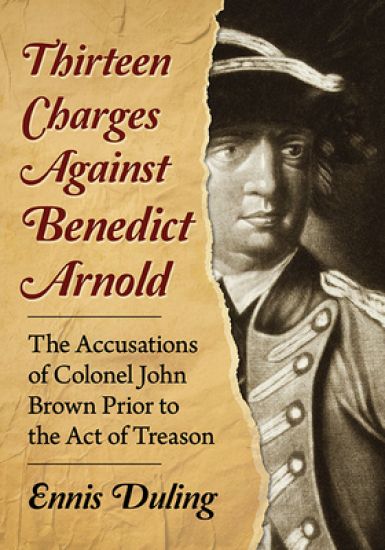
Years before General Benedict Arnold betrayed the American cause, a young officer and attorney named John Brown brought 13 charges of misconduct against him and called for his arrest, Brown was shuttled from one general to another, and finally to George Washington, before powerful politicians decided in Arnold's favor without hearing from Brown or any other witnesses. Historians have continued to ignore the accusations, finding Brown's charges to be false, and even absurd. In fact, some are unquestionably true, and all are worthy of investigation. John Brown was an early hero of the Revolution, a legislator, envoy, spy, and accomplished field officer. His charges and his many proposed witnesses are a starting point for a reevaluation of Arnold's conduct in the war--on his storied march up Maine's Kennebec River to Canada, during the winter siege of Quebec, and at the battles of Valcour Island and Saratoga. What emerges from Brown's charges is a story of deceit and misconduct, and of prominent leaders and historians turning a blind eye in order to maintain exciting myths.
The Essential Benedict Wight and other writings by Owen Baptiste
Owen Baptiste
Createspace Independent Publishing Platform
2012
nidottu

P. Duval was a missionary White Father in the Democratic Republic of Congo and Mexico, he is the author of more than thirty books. This book is a reflection on the evolution of the Catholic Church over the past 200 years, its successes but also failures.Pope Benedict XVI intends to solemnize the fiftieth anniversary of the Second Vatican Council, it will be the Year of Faith. Christians rejoice and expect fruitful outcomes, at a time which do not lack signs of a backward and neither of challenges. Diocesan and parish authorities are indeed now in the hands of men -still nothing more that men- who have not known the Church before the Council: how then could they appreciate what it brought, without having suffered from what has preceded it?The author is optimistic, even if you feel the disappointment of an elderly man who, like those of his generation, was never consulted on anything in an institution incorrigibly pyramidal; clearly indicating what seems to be warning signs, he hopes the Year of Faith will blow a new fresh breeze in a church where there are so many corners where to remove dust.This book strickes by the author's erudition and its knowledge experienced from the inside a church that is still looking 2000 years after Christ's teaching.
The Unheralded Adventures of Benedict Bryant Lukely: In the Incalculable Mistake of Philippe De Castagnet
Henry C. Fox
Createspace Independent Publishing Platform
2013
nidottu
Storm clouds are forming over Western Europe in early April 1940. Unknowingly, the Allies are only days away from the German invasion of France and a long, protracted war and yet a plan has been set in motion to bring Britain under Nazi rule without so much as a shot fired. A secret, a hidden document older than the Magna Carta, and a broken crown that could spell immediate victory for Germany. Britain's only hope? An overweight Chelsea dandy and a naive hill farmer from Wales.