Kirjojen hintavertailu. Mukana 12 390 323 kirjaa ja 12 kauppaa.

Kirjahaku

Etsi kirjoja tekijän nimen, kirjan nimen tai ISBN:n perusteella.

1000 tulosta hakusanalla Edmond Hamilton

Discours Prononcés, Le 8 Octobre 1883, Sur La Tombe de M. Edmond Pillet: Ancien Pharmacien
Discours prononces, le 8 octobre 1883, sur la tombe de M. Edmond Pillet: ancien pharmacien... / par M. Barnsby, ... et par M. Sainton, ...Date de l'edition originale: 1883Sujet de l'ouvrage: Pillet, EdmondAppartient a l'ensemble documentaire: Centre1Ce livre est la reproduction fidele d'une oeuvre publiee avant 1920 et fait partie d'une collection de livres reimprimes a la demande editee par Hachette Livre, dans le cadre d'un partenariat avec la Bibliotheque nationale de France, offrant l'opportunite d'acceder a des ouvrages anciens et souvent rares issus des fonds patrimoniaux de la BnF.Les oeuvres faisant partie de cette collection ont ete numerisees par la BnF et sont presentes sur Gallica, sa bibliotheque numerique.En entreprenant de redonner vie a ces ouvrages au travers d'une collection de livres reimprimes a la demande, nous leur donnons la possibilite de rencontrer un public elargi et participons a la transmission de connaissances et de savoirs parfois difficilement accessibles.Nous avons cherche a concilier la reproduction fidele d'un livre ancien a partir de sa version numerisee avec le souci d'un confort de lecture optimal. Nous esperons que les ouvrages de cette nouvelle collection vous apporteront entiere satisfaction.Pour plus d'informations, rendez-vous sur www.hachettebnf.fr
Monte-Cristo's DaughterSequel To Alexander Dumas' Great Novel, The "Count Of Monte-Cristo," And Conclusion Of "Edmond Dantès." (Edition1)
Monte-Cristo's daughter: Sequel to Alexander Dumas' great novel, The Count of Monte-Cristo and conclusion of Edmond Dant s explores the emotional inheritance of a young woman raised in a world shaped by justice, secrecy, and paternal legacy. Set against the cultured backdrop of Rome, the novel considers how the shadows of past triumphs and sacrifices inform present choices. Within this environment of constraint and expectation, it emphasizes the conflict between personal longing and familial duty. Education is portrayed not simply as refinement but as containment, and the urge to challenge these boundaries reveals a powerful undercurrent of desire and rebellion. As encounters with prestige, performance, and romantic fascination unfold, the narrative draws attention to the pressures of reputation and the allure of forbidden attachments. Through reflections on identity, social decorum, and emotional restraint, the story illuminates the struggle to define selfhood within the limits of name and blood. This continuation transforms inherited myth into intimate conflict, showing how even a celebrated lineage must wrestle with human vulnerability.
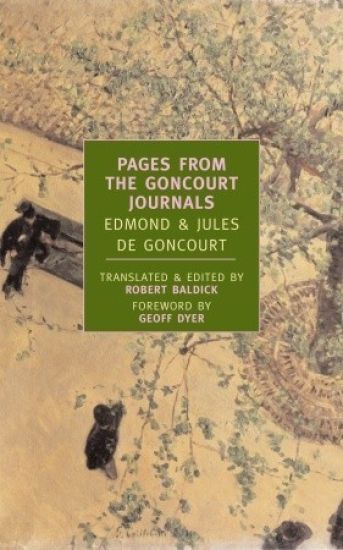
Pages From The Goncourt Journals
The journal of the brothers Edmond and Jules de Goncourt is one of the masterpieces of nineteenth-century French literature, a work that in its richness of color, variety, and seemingly casual perfection bears comparison with the great paintings of their friends and contemporaries the Impressionists. Born nearly ten years apart into a French aristocratic family, the two brothers formed an extraordinarily productive and enduring literary partnership, collaborating on novels, criticism, and plays that pioneered the new aesthetic of naturalism. But the brothers' talents found their most memorable outlet in their journal, which is at once a chronicle of an era, an intimate glimpse into their lives, and the purest expression of a nascent modern sensibility preoccupied with sex and art, celebrity and self-exposure. The Goncourts visit slums, brothels, balls, department stores, and imperial receptions; they argue over art and politics and trade merciless gossip with and about Hugo, Baudelaire, Degas, Flaubert, Zola, Rodin, and many others.And in 1871, Edmond maintains a vigil as his brother dies a slow and agonizing death from syphilis, recording every detail in the journal that he would continue to maintain alone for another two decades.
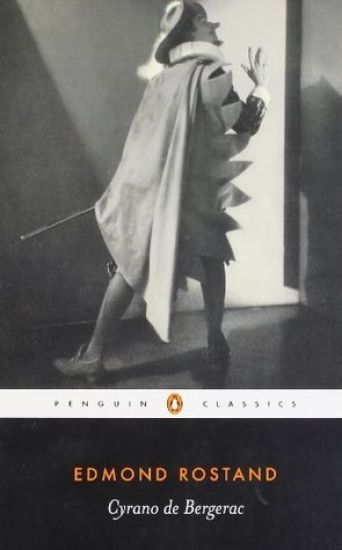
Cyrano de Bergerac

Cyrano de Bergerac

Edmond Rostand

Penguin Classics
2006
pokkari
Poet and soldier, brawler and charmer, Cyrano de Bergerac is desperately in love with Roxane, the most beautiful woman in Paris. But there is one very large problem - he has a nose of stupendous size and believes she will never see past it to return his feelings. So when he discovers that the handsome but tongue-tied Christian is also pining for Roxane, generous Cyrano offers to help by writing exquisite declarations of love for the young man to woo her with. Will she ever recognize who she is really falling in love with? Set during the reign of Louis XIII, Rostand's Cyrano de Bergerac (1897) was one of the great theatrical successes of its time and remains as popular today for its dramatic power and, above all, for its good-natured, passionate and swashbuckling hero.
Algebraic and Differential Topology of Robust Stability

Algebraic and Differential Topology of Robust Stability

Edmond A. Jonckheere

Oxford University Press Inc
1997
sidottu
In this book, two seemingly unrelated fields - algebraic topology and robust control - are brought together. The book develops algebraic/differential topology proceeding from an easily motivated control engineering problem, showing the relevance of advanced topological concepts and reconstructing the fundamental concepts of algebraic/differential topology from an application-oriented point of view. It is suitable for graduate students in engineering and/or applied mathematics, and academic researchers.
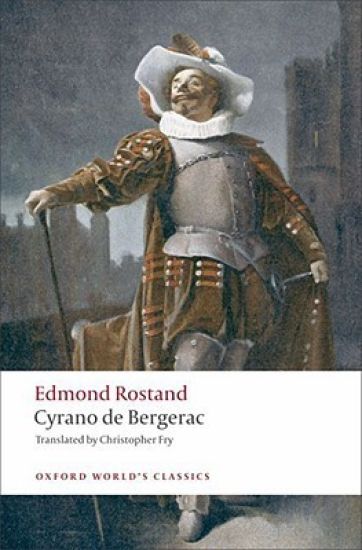
Cyrano de Bergerac

Cyrano de Bergerac

Edmond Rostand

Oxford University Press
2008
nidottu
`Tonight When I make my sweeping bow at heaven's gate, One thing I shall still possess, at any rate, Unscathed, something outlasting mortal flesh, And that is ... My panache.' The first English translation of Cyrano de Bergerac, in 1898, introduced the word panache into the English language. This single word summed up Rostand's rejection of the social realism which dominated late nineteenth-century theatre. He wrote his `heroic comedy', unfashionably, in verse, and set it in the reign of Louis XIII and the Three Musketeers. Based on the life of a little known writer, Rostand's hero has become a figure of theatrical legend: Cyrano, with the nose of a clown and the soul of a poet, is by turns comic and sad, as reckless in love as in war, and never at a loss for words. Audiences immediately took him to their hearts, and since the triumphant opening night in December 1897 - at the height of the Dreyfus Affair - the play has never lost its appeal. The text is accompanied by notes and a full introduction which sets the play in its literary and historical context. Christopher Fry's acclaimed translation into `chiming couplets' represents the homage of one verse dramatist to another. ABOUT THE SERIES: For over 100 years Oxford World's Classics has made available the widest range of literature from around the globe. Each affordable volume reflects Oxford's commitment to scholarship, providing the most accurate text plus a wealth of other valuable features, including expert introductions by leading authorities, helpful notes to clarify the text, up-to-date bibliographies for further study, and much more.
The Book of Margins

The Book of Margins

Edmond Jabes

University of Chicago Press
1993
sidottu
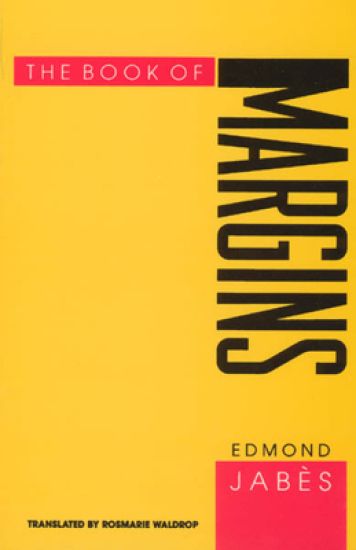
The death of Edmond Jabès in January 1991 silenced one of the most compelling voices of the postmodern, post-Holocaust era. Jabès's importance as a thinker, philosopher, and Jewish theologian cannot be overestimated, and his enigmatic style--combining aphorism, fictional dialogue, prose meditation, poetry, and other forms--holds special appeal for postmodern sensibilities. In The Book of Margins, his most critical as well as most accessible book, Jabès is again concerned with the questions that inform all of his work: the nature of writing, of silence, of God and the Book. Jabès considers the work of several of his contemporaries, including Georges Bataille, Maurice Blanchot, Roger Caillois, Paul Celan, Jacques Derrida, Michel Leiris, Emmanuel Lévinas, Pier Paolo Pasolini, and his translator, Rosmarie Waldrop. This book will be important reading for students of Jewish literature, French literature, and literature of the modern and postmodern ages. Born in Cairo in 1912, Edmond Jabès lived in France from 1956 until his death in 1991. His extensively translated and widely honored works include The Book of Questions and The Book of Shares. Both of these were translated into English by Rosmarie Waldrop, who is also a poet. Religion and Postmodernism series
The Book of Margins

The Book of Margins

Edmond Jabes

University of Chicago Press
1993
nidottu
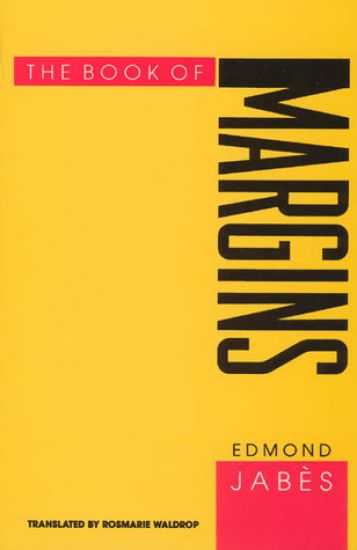
The death of Edmond Jabès in January 1991 silenced one of the most compelling voices of the postmodern, post-Holocaust era. Jabès's importance as a thinker, philosopher, and Jewish theologian cannot be overestimated, and his enigmatic style—combining aphorism, fictional dialogue, prose meditation, poetry, and other forms—holds special appeal for postmodern sensibilities. In The Book of Margins, his most critical as well as most accessible book, Jabès is again concerned with the questions that inform all of his work: the nature of writing, of silence, of God and the Book. Jabès considers the work of several of his contemporaries, including Georges Bataille, Maurice Blanchot, Roger Caillois, Paul Celan, Jacques Derrida, Michel Leiris, Emmanuel Lévinas, Pier Paolo Pasolini, and his translator, Rosmarie Waldrop. This book will be important reading for students of Jewish literature, French literature, and literature of the modern and postmodern ages. Born in Cairo in 1912, Edmond Jabès lived in France from 1956 until his death in 1991. His extensively translated and widely honored works include The Book of Questions and The Book of Shares. Both of these were translated into English by Rosmarie Waldrop, who is also a poet. Religion and Postmodernism series
Experience, Culture and Religion in Systematic Theology

Experience, Culture and Religion in Systematic Theology

Edmond Zi-Kang Chua

JAMES CLARKE CO LTD
2024
nidottu
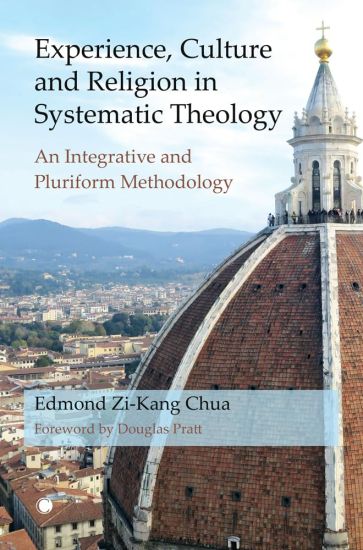
Most systematicians take as their starting point the nature of God, and scripture as the means by which God's nature is revealed, but what would a systematic theology look like that began with an experiential knowledge of God? Here, Edmond Chua offers a method for just such an approach. Beginning with realms of human experience including psychology, cultural diversity and religious plurality, he builds the framework of a systematic theology that is inclusive and pluriform, while retaining the core tenets of a Christian doctrine of God. Notwithstanding his novel methodology, Chua's argument remains biblically rooted and appreciative of the Christian tradition. In the latter half of the book he returns to the classical doctrines of the Trinity, Christology, evil, sin and salvation, allowing his inclusive view of the human religious experience to shed new light on the wisdom bequeathed by Paul, Augustine, Aquinas, Luther, Barth, and others. The result is a bold Christian vision that is culturally engaged and globally applicable, of interest to systematic theologians while contributing to interreligious dialogue.
Experience, Culture and Religion in Systematic Theology

Experience, Culture and Religion in Systematic Theology

Edmond Zi-Kang Chua

JAMES CLARKE CO LTD
2023
sidottu
Most systematicians take as their starting point the nature of God, and scripture as the means by which God's nature is revealed, but what would a systematic theology look like that began with an experiential knowledge of God? Here, Edmond Chua offers a method for just such an approach. Beginning with realms of human experience including psychology, cultural diversity and religious plurality, he builds the framework of a systematic theology that is inclusive and pluriform, while retaining the core tenets of a Christian doctrine of God. Notwithstanding his novel methodology, Chua's argument remains biblically rooted and appreciative of the Christian tradition. In the latter half of the book he returns to the classical doctrines of the Trinity, Christology, evil, sin and salvation, allowing his inclusive view of the human religious experience to shed new light on the wisdom bequeathed by Paul, Augustine, Aquinas, Luther, Barth, and others. The result is a bold Christian vision that is culturally engaged and globally applicable, of interest to systematic theologians while contributing to interreligious dialogue.
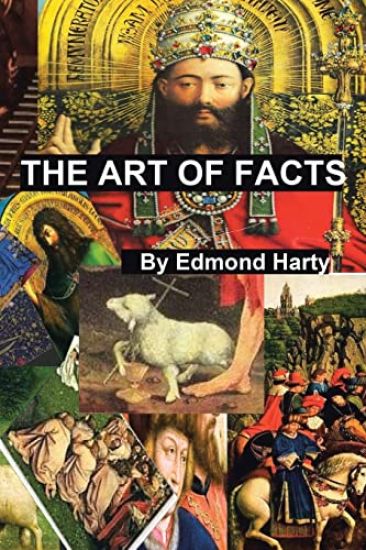
The Art of Facts

The Art of Facts

Edmond Harty

Tellwell Talent
2022
pokkari
Joe Mills, Canadian military investigator, is requested to investigate the murder of General Pikes. In pursuit of the truth, a conspiracy unfolds exposing a sinister crime syndicate of art thieves with one goal in mind: starting WWIII.
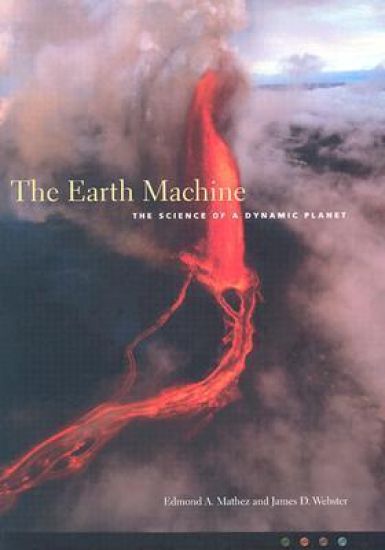
The Earth Machine

The Earth Machine

Edmond Mathez; James Webster

Columbia University Press
2004
sidottu
From the scorching center of Earth's core to the outer limits of its atmosphere, from the gradual process of erosion that carved the Grand Canyon to the earth-shaking fury of volcanoes and earthquakes, this fascinating book-inspired by the award-winning Hall of Planet Earth at New York City's American Museum of Natural History-tells the story of the evolution of our planet and of the science that makes it work. With the same exuberance and expertise they brought to the creation of the Hall of Planet Earth, co-curators Edmond A. Mathez and James D. Webster offer a guided tour of Earth's dynamic, 4.6-billion-year history. Including numerous full-color photographs of the innovative exhibit and helpful, easy-to-understand illustrations, the authors explore the major factors in our planet's evolution: how Earth emerged from the swirling dusts of a nascent solar system; how an oxygen-rich, life-sustaining atmosphere developed; how continents, mountain ranges, and oceans formed; and how earthquakes and volcanic eruptions alter Earth's surface. Traversing geologic time and delving into the depths of the planet--beginning with meteorites containing minuscule particles that are the solar system's oldest known objects, and concluding with the unusual microbial life that lives on the chemical and thermal energy produced by sulfide vents in the ocean floor-The Earth Machine provides an up-to-date overview of the central theories and discoveries in earth science today. By incorporating stories of real-life fieldwork, Mathez and Webster explain how Earth is capable of supporting life, how even the smallest rocks can hold the key to explaining the formation of mountains, and how scientists have learned to read nature's subtle clues and interpret Earth's ever-evolving narrative.
The Earth Machine

The Earth Machine

Edmond Mathez; James Webster

Columbia University Press
2007
pokkari
From the scorching center of Earth's core to the outer limits of its atmosphere, from the gradual process of erosion that carved the Grand Canyon to the earth-shaking fury of volcanoes and earthquakes, this fascinating book-inspired by the award-winning Hall of Planet Earth at New York City's American Museum of Natural History-tells the story of the evolution of our planet and of the science that makes it work. With the same exuberance and expertise they brought to the creation of the Hall of Planet Earth, co-curators Edmond A. Mathez and James D. Webster offer a guided tour of Earth's dynamic, 4.6-billion-year history. Including numerous full-color photographs of the innovative exhibit and helpful, easy-to-understand illustrations, the authors explore the major factors in our planet's evolution: how Earth emerged from the swirling dusts of a nascent solar system; how an oxygen-rich, life-sustaining atmosphere developed; how continents, mountain ranges, and oceans formed; and how earthquakes and volcanic eruptions alter Earth's surface. Traversing geologic time and delving into the depths of the planet--beginning with meteorites containing minuscule particles that are the solar system's oldest known objects, and concluding with the unusual microbial life that lives on the chemical and thermal energy produced by sulfide vents in the ocean floor-The Earth Machine provides an up-to-date overview of the central theories and discoveries in earth science today. By incorporating stories of real-life fieldwork, Mathez and Webster explain how Earth is capable of supporting life, how even the smallest rocks can hold the key to explaining the formation of mountains, and how scientists have learned to read nature's subtle clues and interpret Earth's ever-evolving narrative.