Kirjojen hintavertailu. Mukana 12 016 292 kirjaa ja 12 kauppaa.

Kirjahaku

Etsi kirjoja tekijän nimen, kirjan nimen tai ISBN:n perusteella.

1000 tulosta hakusanalla Edmundo LLAMAS ALBA
The Works of Edmund Spenser

The Works of Edmund Spenser

Edmund Spenser

Johns Hopkins University Press
2002
pokkari
Originally published between 1932 and 1945, the eleven-volume Works of Edmund Spenser collects The Faerie Queene along with Spenser's minor poems, prose works, and Alexander C. Judson's The Life of Edmund Spenser.
The Works of Edmund Spenser

The Works of Edmund Spenser

Edmund Spenser

Johns Hopkins University Press
2002
pokkari
Originally published between 1932 and 1945, the eleven-volume Works of Edmund Spenser collects The Faerie Queene along with Spenser's minor poems, prose works, and Alexander C. Judson's The Life of Edmund Spenser.
Edmund Husserl's "Origin of Geometry"

Edmund Husserl's "Origin of Geometry"

Jacques Derrida

University of Nebraska Press
1989
pokkari
Edmund Husserl's Origin of Geometry": An Introduction (1962) is Jacques Derrida's earliest published work. In this commentary-interpretation of the famous appendix to Husserl's The Crisis of European Sciences and Transcendental Phenomenology, Derrida relates writing to such key concepts as differing, consciousness, presence, and historicity. Starting from Husserl's method of historical investigation, Derrida gradually unravels a deconstructive critique of phenomenology itself, which forms the foundation for his later criticism of Western metaphysics as a metaphysics of presence. The complete text of Husserl's Origin of Geometry is included.
The Ojibwe Journals of Edmund F. Ely, 1833-1849

The Ojibwe Journals of Edmund F. Ely, 1833-1849

Edmund F. Ely

University of Nebraska Press
2012
sidottu
Twenty-four-year-old Edmund F. Ely, a divinity student from Albany, New York, gave up his preparation for the ministry in 1833 to become a missionary and teacher among the Ojibwe of Lake Superior. During the next sixteen years, Ely lived, taught, and preached among the Ojibwe, keeping a journal of his day-to-day experiences as well as recording ethnographic information about the Ojibwe. From recording his frustrations over the Ojibwe's rejection of Christianity to describing hunting and fishing techniques he learned from his Ojibwe neighbors, Ely's unique and rich record provides unprecedented insight into early nineteenth-century Ojibwe life and Ojibwe-missionary relations. Theresa M. Schenck draws on a broad array of secondary sources to contextualize Ely's journals for historians, anthropologists, linguists, literary scholars, and the Ojibwe themselves, highlighting the journals' relevance and importance for understanding the Ojibwe of this era.
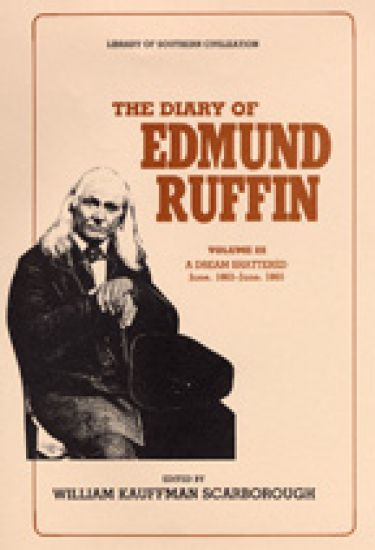
The Diary of Edmund Ruffin

The Diary of Edmund Ruffin

Edmund Ruffin

Louisiana State University Press
1977
sidottu
In this second of a projected three-volume edition of The Diary of Edmund Ruffin, the fiery southern nationalist records the events of the first two years of the Civil War -- from the aftermath of Fort Sumter (where Ruffin fired the first shot) to the simultaneous disasters at Gettysburg and Vicksburg that spelled doom for the Confederacy.From his advantageous position as the resident and former owner of two Virginia plantations, Ruffin was able to write a vivid eyewitness account of the early Federal campaigns against Richmond. Both of the Ruffin homesteads, Marlbourne and Beechwood, were overrun during McClellan's Peninsular Campaign of 1862, and the journal contains interesting observations about the conduct of Virginia slaves during this campaign, as well as the change it engendered in master-slave relations. Also included is a remarkable recollection of the Nat Turner revolt.The day-to-day descriptions of the Civil War in Virginia are laced with illumination comments about civil and military leaders on both sides, the prospect of foreign intervention, the increasing strain upon the southern economy, the effect of the Emancipation Proclamation, and the possibility of detaching the northwestern states from the East.Written by a man totally committed to the southern cause, The Diary of Edmund Ruffin is a literate, dependable source of information about the Civil War and its effects, as well as the political and social conditions in the South during the most critical period in its history. Meticulously edited by William Kauffman Scarborough, it will be of lasting value to anyone who wishes to study the Civil War from the insider's point of view.
The Diary of Edmund Ruffin

The Diary of Edmund Ruffin

Edmund Ruffin

Louisiana State University Press
1972
sidottu
Edmund Ruffin was one of the most significant figures in the Old South. A gentleman planter, writer, and political commentator, he made his greatest contribution as an agricultural reformer, but it was as a militant defender of slavery and champion of the southern cause that he gained his greatest fame. In his voluminous diary, Ruffin has left an invaluable primary account of the crucial years from 1856 to 1865. This volume, the first of a projected two-volume edition, covers the period from Ruffin's retirement from his Virginia plantation to the aftermath of the bombardment of Fort Sumter in April of 1861. Through the eyes of this outspoken secessionist, the reader views the chain of events which drove the nation steadily and inexorably toward disunion and civil war. An intelligent and astute commentator, Ruffin was personally acquainted with most of the prominent southern political leaders of the day, and his restless nature impelled him to be present at the most important events of the period.Ruffin attended several secession conventions, and as a member of the Palmetto Guard he was accorded the honor of firing the first shot on Fort Sumter. The diary contains vivid eyewitness accounts of the hanging of John Brown on December 2, 1859, and the activities and changing moods in Charleston during the hectic months of March and April of 1861. Ruffins' detailed description of the two-day bombardment of Sumter is unexcelled. The Diary of Edmund Ruffin is of supreme importance as a chronicle of political attitudes, moods, and motives in the South during the most critical period in its history. The journal also contains a wealth of information on travel conditions in the Old South, the reading habits and social customs of the planter aristocracy, and various aspects of the plantation-slave system.
The Diary of Edmund Ruffin

The Diary of Edmund Ruffin

Edmund Ruffin

Louisiana State University Press
1989
sidottu
In this last of the three-volume printed edition of The Diary of Edmund Ruffin, the celebrated Virginia agricultural reformer and apostle of secession chronicles the increasingly melancholy events of the last two years of the Civil War and of his own life. Apart from one brief sojourn in Charleston, Edmund Ruffin spent the last two years of the war in Virginia. Failing health and the course of the war prevented the devout Confederate from traveling to important battle sites and recording events there firsthand as he had done in the earlier years of the war. Unable to move about, Ruffin nonetheless continued to follow the war closely and to keep a daily commentary on contemporary events. This commentary provides a remarkably dispassionate and astute analysis of the declining military fortunes of the Confederacy as well as an illuminating portrait of deteriorating conditions on the home front. Yet this final volume of Ruffin's diary is more than a record of ""first impressions of public events,"" as Ruffin claimed. Ruffin comments on religion, race, class, and politics. The topics he discusses range from the controversy over the enrollment of black troops and the transition to free labor at war's end to an extended discourse on de Tocqueville's Democracy in America.As the final curtain fell on the Confederacy, the embittered southern nationalist, overwhelmed by physical maladies and familial misfortunes, resolved to take his own life. Only two months after Lee's surrender to Grant, and less than fifty miles from Appomattox, Ruffin fired the last shot in his own private war against the Yankees, a bullet through his head. Rich in detail as well as in Ruffin's personal beliefs, this carefully edited diary stands as one of the most valuable documents of the Civil War era.
Edmund Husserl

Edmund Husserl

Maurice Natanson

Northwestern University Press
1974
nidottu
The product of many years of reflection on phenomenology, this book is a comprehensive and creative introduction to the philosophy of Edmund Husserl. Natanson uses Husserl's later work as a clue to the meaning of his entire intellectual career, showing how his earlier methodological work evolved into the search for transcendental roots and developed into a philosophy of the life-world. Phenomenology, for Natanson, emerges as a philosophy of origin, a transcendental discipline concerned with consciousness, history, and world rather than with introspection and traditional metaphysical warfare.
Edmund Wilson

Edmund Wilson

Jeffrey Meyers

Cooper Square Publishers Inc.,U.S.
2003
pokkari
This comprehensive biography of prolific critic, essayist, historian, and novelist Edmund Wilson (1895-1972) posits, quite successfully, that the subject lived a life as romantic and chaotic as his friend F. Scott Fitzgerald's. Wilson suffered a nervous breakdown and the tragic death of his second wife (he was married four times, among them, Mary McCarthy); had affairs with numerous beautiful women, including Edna St. Vincent Millay; and was friend to literary giants such as John Dos Passos, Vladimir Nabakov, and W.H. Auden.
Edmund Wilson - American Writers 67

Edmund Wilson - American Writers 67

Berthoff Warner

UNIVERSITY OF MINNESOTA PRESS
1968
nidottu
Edmund Wilson - American Writers 67 was first published in 1968. Minnesota Archive Editions uses digital technology to make long-unavailable books once again accessible, and are published unaltered from the original University of Minnesota Press editions.
Edmund Burke and the Discourse of Virtue

Edmund Burke and the Discourse of Virtue

Stephen H. Browne

The University of Alabama Press
1993
sidottu
Edmund Burke (1729-1797) continues to command a major presence in the history and criticism of Western thought. A great deal of attention, accordingly, is paid to the philosophical and literary qualities of his writings. Such emphases, however, overlook what Browne argues to be Burke's most important legacy: his choice to engage principles through the media of public life. This achievement is illustrated by Burke's concern for virtue as a principle of civic action and responsibility. Browne seeks to restore Burke's reputation as an advocate and as an exemplar of public virtue by submitting key texts to detailed rhetorical analysis. By examining a variety of public genres, including party tracts, speeches and public letters, Browne aims to show that Burke consistently advances a discourse of virtue. This discourse, at once public and principled, is presented as a celebration of public life and the rhetoric by which that life is given expression. Browne presents a new, non-partisan way of interpreting Burke by providing close readings of his public discourse and political writings from a rhetorical perspective. This interpretation sets out to enrich our understanding of Burke in a variety of ways: first, by resisting the temptation to reduce his thought to merely theoretical propositions; and second, by expanding the analysis of his prose beyond mere statistics. Such an approach suggests, moreover, that rhetorical criticism is distinctly suited to the interpretation of political discourse.
Edmund Burke and the Discourse of Virtue

Edmund Burke and the Discourse of Virtue

Stephen Browne

The University of Alabama Press
2007
nidottu
This book provides close readings of Burke's public discourse and political writings.A singularly impressive scholarly work. As the author points out so deftly in his introduction, Burke's rhetoric has been too long ignored or simply used to serve other purposes, and it has never been subjected to the close textual analysis it receives in this work. The result of Browne's study is to present Burke and his work in a light that was clearly essential to Burke himself, one that illuminates the close connection between rhetoric construction and action that is so necessary to a fuller understanding of the man, his career, and his discourse.This book is an extremely important addition to Burke scholarship...Browne's demonstration of the textual/contextual connections is firmly rooted in historical, critical, and theoretical scholarship and evidences a firm and broad command of relevant literature. The essays stand as an exemplar of a rich interpretive approach to rhetorical texts, an approach that can be studied with profit by young and mature critics alike.
Edmund Ruffin and the Crisis of Slavery in the Old South

Edmund Ruffin and the Crisis of Slavery in the Old South

William M. Mathew

University of Georgia Press
2012
pokkari
In 1818, Edmund Ruffin, then a young Virginia planter, began conducting chemical and rotational experiments on his Coggin’s Point plantation on the James River. His findings became the basis for the most progressive and sophisticated reform proposals to be formulated in the slaveholding South. Tracing Ruffin’s passionate advocacy of both agricultural reform and slavery, William M. Mathew pinpoints in this book many of the contradictions that underlay the economic and social structures of the antebellum South.
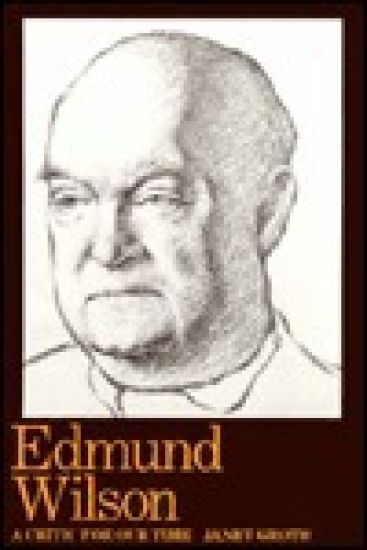
Edmund Wilson

Edmund Wilson

Janet Groth

Ohio University Press
1991
sidottu
In the course of a career that spanned five decades, Edmund Wilson’s literary output was impressive. His life’s work includes five volumes of poetry, two works of fiction, thirteen plays, and more than twenty volumes of social commentary on travel, politics, history, religion, anthropology, and economics. It is, however, his criticism for which Wilson is best known. To note a few of his accomplishments as a critic, Wilson furthered the understanding and appreciation of the poetry of W.B. Yeats and T. S. Eliot, promoted the enigmatic prose of Marcel Proust and James Joyce, and pioneered the study of women writers such as Harriet Beecher Stowe, Edith Wharton, and Kate Chopin. With the advent of contemporary concerns in literary criticism, the work of Edmund Wilson is frequently relegated to a lesser role. In this energetic and convincing study of one of America’s most distinguished literary critics, Janet Groth sets out to restore Wilson’s work to a place of prominence amongst current critical modes. She offers extended and rigorous treatments of Wilson’s most important critical works and traces his roots as a critic in the work of Matthew Arnold, Sainte-Beuve and Taine, demonstrating how Wilson used the work of Freud and Marx to update this tradition. Most importantly, however, Groth demonstrates that Wilson’s work has significance today and that lasting value in Wilson’s critical studies is his constant belief in the close relationship between life and literature.
From the Uncollected Edmund Wilson

From the Uncollected Edmund Wilson

Edmund Wilson

Ohio University Press
1995
sidottu
Many of Wilson's writings have been anthologized. But there is another body of work — over fifty fine essays on aspects of contemporary literature and ideas — that have been scattered in a variety of magazines, including The New Yorker, The New Republic, Vanity Fair, and The Nation. The editors, who recognize Wilson (1895-1972) as one of America's greatest men of letters of the twentieth century, also view his writing as a powerful antidote to late twentieth-century trends and fads and have collected his pieces here in the conviction that Wilson's writing is a permanently important model. Now a new generation of readers — as well as his loyal followers — will have access to this rich literary heritage in a single volume. The collection is organized chronologically and leads the reader through the journeyman writing at Hill School and Princeton, the essays on literary modernism and contemporary culture written in the 1920s, the socially-focused critiques of the 1930s, and the diverse assortment of book reviews of the late period. Across this full range of moods and literary styles. Wilson is a powerful spokesman for writers and a guardian of imagination and decency for the informed citizen.
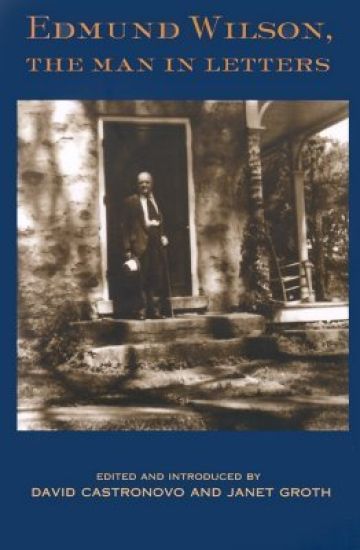
Edmund Wilson, the Man in Letters

Edmund Wilson, the Man in Letters

Edmund Wilson

Ohio University Press
2002
sidottu
Among the major writers of the Hemingway and Fitzgerald generation, Edmund Wilson defied categorization. He wrote essays, stories and novels, cultural criticism, and contemporary chronicles, as well as journals and thousands of letters about the literary life and his own private world. Here for the first time in print is Wilson's personal correspondence to his parents, lovers and wives, children, literary comrades, and friends from the different corners of his life. Various writers and thinkers—including Alfred Kazin, Vladimir Nabokov, and Isaiah Berlin—take their places alongside upstate New York neighbors in this gallery of letters that extends from the teens to the early 1970s. These letters complete the picture of Wilson the man, offering unguarded moments and flinty opinions that enrich our understanding of a complex and troubled personality. Four times married and many times in love; traveling through Depression America, the USSR, postwar Europe, the Middle East, and Haiti; and writing on a Balzacian scale, Wilson as a correspondent reveals the exhilaration and chaos of being himself. Arranged by correspondent and moving through the phases of his career, Edmund Wilson, the Man in Letters constitutes an exemplary autobiography cum cultural history. The writing itself is vintage Wilson—a blending of classical and conversational styles that stands as part of the modern American canon and is filled with the emotions and tastes of a master.
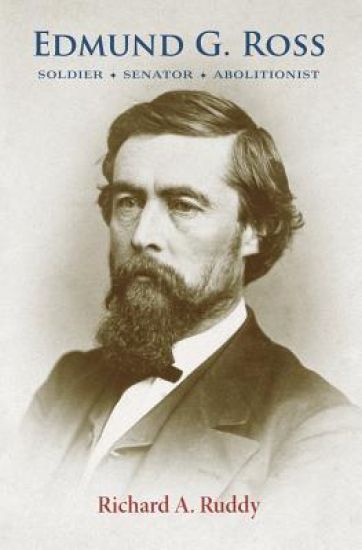
Edmund G. Ross

Edmund G. Ross

Richard A. Ruddy

University of New Mexico Press
2014
nidottu
Thanks to John F. Kennedy’s Profiles in Courage, most twenty-first-century Americans who remember Edmund G. Ross (1826–1907) know only that he cast an important vote as a U.S. senator from Kansas that prevented the conviction of President Andrew Johnson of “high crimes and misdemeanors,” allowing Johnson to stay in office.But Ross also served as a significant abolitionist, journalist, Union officer, and, eventually, territorial governor of New Mexico, where he proved instrumental in the fight for statehood, the improvement of educational standards, and the settlement of land-grant issues.In short, Ross’s career represents the changes that the nation experienced in the second half of the nineteenth century. This first full-scale biography of Ross reveals his influential role in the history of the United States and offers a portrait of a resolute individual who often paid a price for his integrity.