
Kirjahaku
Etsi kirjoja tekijän nimen, kirjan nimen tai ISBN:n perusteella.
1000 tulosta hakusanalla Frederic Greif
Portrait De Frederic Le Grand, Tire Des Anecdotes (1788)
Sebastien Frederic Bourdais
KESSINGER PUBLISHING, LLC
2009
pokkari
Le Predicateur Evangelique Ou Sermons De Jean-Frederic Nardin V2 (1821)
Jean-Frederic Nardin
KESSINGER PUBLISHING, LLC
2009
pokkari
An Essay on Musical Harmony, According to the Nature of That Science and the Principles of the Greatest Musical Authors. by Augustus Frederic Christopher Kollmann. ...
Augustus Frederic Christopher Kollmann
Gale Ecco, Print Editions
2010
pokkari


Memoirs of Corsica. Containing the natural and political history of that important island; ... By Frederic, son of Theodore late King of Corsica.
Colonel Frédéric
Gale Ecco, Print Editions
2010
pokkari

An Essay on Practical Musical Composition According to the Nature of That Science and the Principles of the Greatest Musical Authors. by Augustus Frederic Christopher Kollmann ...
Augustus Frederic Christopher Kollmann
Gale Ecco, Print Editions
2010
pokkari
An Essay on Musical Harmony, According to the Nature of That Science and the Principles of the Greatest Musical Authors. By Augustus Frederic Christopher Kollmann.
Augustus Frederic Christopher Kollmann
Gale Ecco, Print Editions
2018
sidottu
The 18th century was a wealth of knowledge, exploration and rapidly growing technology and expanding record-keeping made possible by advances in the printing press. In its determination to preserve the century of revolution, Gale initiated a revolution of its own: digitization of epic proportions to preserve these invaluable works in the largest archive of its kind. Now for the first time these high-quality digital copies of original 18th century manuscripts are available in print, making them highly accessible to libraries, undergraduate students, and independent scholars.The eighteenth-century fascination with Greek and Roman antiquity followed the systematic excavation of the ruins at Pompeii and Herculaneum in southern Italy; and after 1750 a neoclassical style dominated all artistic fields. The titles here trace developments in mostly English-language works on painting, sculpture, architecture, music, theater, and other disciplines. Instructional works on musical instruments, catalogs of art objects, comic operas, and more are also included. ++++The below data was compiled from various identification fields in the bibliographic record of this title. This data is provided as an additional tool in helping to insure edition identification: ++++British LibraryT146911Horizontal chain lines.London: printed by J. Dale, and sold at his music warehouse, 1796. xviii,128p.,40plates: engr.music; 2
Memoirs of Corsica. Containing the Natural and Political History of That Important Island; ... By Frederic, son of Theodore Late King of Corsica
Colonel Frédéric
Gale Ecco, Print Editions
2018
sidottu
The 18th century was a wealth of knowledge, exploration and rapidly growing technology and expanding record-keeping made possible by advances in the printing press. In its determination to preserve the century of revolution, Gale initiated a revolution of its own: digitization of epic proportions to preserve these invaluable works in the largest archive of its kind. Now for the first time these high-quality digital copies of original 18th century manuscripts are available in print, making them highly accessible to libraries, undergraduate students, and independent scholars.Rich in titles on English life and social history, this collection spans the world as it was known to eighteenth-century historians and explorers. Titles include a wealth of travel accounts and diaries, histories of nations from throughout the world, and maps and charts of a world that was still being discovered. Students of the War of American Independence will find fascinating accounts from the British side of conflict. ++++The below data was compiled from various identification fields in the bibliographic record of this title. This data is provided as an additional tool in helping to insure edition identification: ++++Bodleian Library (Oxford)T171547With a half-title. First published in London in 1768 in French, followed by an English version of the same year (DNB).Dublin: printed for J. Williams, 1769. 2], ix, 1],165, 3]p., plate: port.; 12
An Essay on Practical Musical Composition According to the Nature of That Science and the Principles of the Greatest Musical Authors. By Augustus Frederic Christopher Kollmann
Augustus Frederic Christopher Kollmann
Gale Ecco, Print Editions
2018
sidottu
The 18th century was a wealth of knowledge, exploration and rapidly growing technology and expanding record-keeping made possible by advances in the printing press. In its determination to preserve the century of revolution, Gale initiated a revolution of its own: digitization of epic proportions to preserve these invaluable works in the largest archive of its kind. Now for the first time these high-quality digital copies of original 18th century manuscripts are available in print, making them highly accessible to libraries, undergraduate students, and independent scholars.The eighteenth-century fascination with Greek and Roman antiquity followed the systematic excavation of the ruins at Pompeii and Herculaneum in southern Italy; and after 1750 a neoclassical style dominated all artistic fields. The titles here trace developments in mostly English-language works on painting, sculpture, architecture, music, theater, and other disciplines. Instructional works on musical instruments, catalogs of art objects, comic operas, and more are also included. ++++The below data was compiled from various identification fields in the bibliographic record of this title. This data is provided as an additional tool in helping to insure edition identification: ++++National Library of ScotlandN009362With a final advertisement leaf.London: printed for the author, and to be had of him; at Mr. Dale's; - at Messrs. Longman, Clementi, and Co.; - at Mr. Smart's; and at the other principal music shops; also at Mr. Low's, 1799. xx,106, 2]p.; 2

Jean Frederic Herbart and Education by Instruction
Gabriel Compayre
University Press of the Pacific
2002
pokkari

Harold Frederic, Collection novels
Harold Frederic
Createspace Independent Publishing Platform
2014
nidottu
Gloria mundi.NOVEL By: Harold Frederic (Original Version)
Harold Frederic
Createspace Independent Publishing Platform
2016
nidottu
Harold Frederic (born Harold Henry Frederick; August 19, 1856 - October 19, 1898) was an American journalist and novelist. Frederic was born in Utica, New York, to Presbyterian parents. After his father was killed in a railroad accident when Frederic was 18 months old, the boy was raised primarily by his mother. He finished school at age fifteen, and soon began work as a photographer. For four years he was a photographic touch-up artist in his hometown and in Boston. In 1875 he began work as a proofreader for the newspaper The Utica Herald and then The Utica Daily Observer. Frederic later became a reporter. Frederic married Grace Green Williams in 1877, and they had five children together. By 1882 he was editor of the newspaper The Albany Evening Journal in the state capital. In 1884 Frederic went to live in England as London correspondent of the New York Times, and worked at this position for the rest of his life. He brought his family to London by 1889. Afterward he met Kate Lyon, who became his mistress. Frederic and Lyon established a second household, living openly together; and they had three illegitimate children. Frederic wrote several early stories, but it was not until he published Illumination (1896), better known by its American title, The Damnation of Theron Ware; followed by Gloria Mundi (1898), that his talent as a novelist was fully realized. Critic Jonathan Yardley called Damnation "a minor classic of realism". Kate Lyon was a Christian Scientist. When Frederic suffered a stroke in 1898, she tried to cure him by faith healing. 3] 4] After his death, she was tried on charges of manslaughter brought by his wife Grace Frederic, and acquitted at trial.
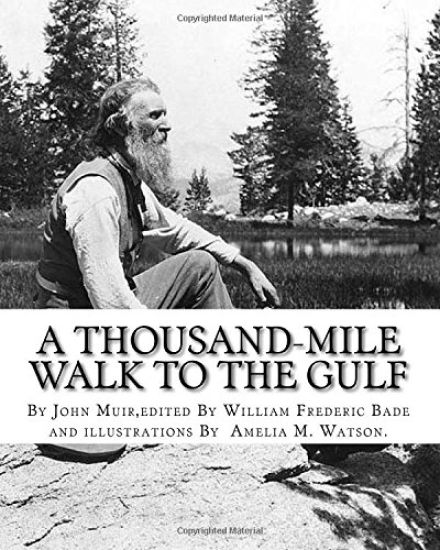
A thousand-mile walk to the Gulf, By John Muir, edited By William Frederic Bade: (January 22, 1871 ? March 4, 1936), and illustrated By Miss Amelia M.
William Frederic Bade; Amelia M. Watson; John Muir
Createspace Independent Publishing Platform
2016
nidottu
John Muir ( April 21, 1838 - December 24, 1914) also known as "John of the Mountains", was a Scottish-American naturalist, author, environmental philosopher and early advocate of preservation of wilderness in the United States. His letters, essays, and books telling of his adventures in nature, especially in the Sierra Nevada of California, have been read by millions. His activism helped to preserve the Yosemite Valley, Sequoia National Park and other wilderness areas. The Sierra Club, which he founded, is a prominent American conservation organization. The 211-mile (340 km) John Muir Trail, a hiking trail in the Sierra Nevada, was named in his honor.Other such places include Muir Woods National Monument, Muir Beach, John Muir College, Mount Muir, Camp Muir and Muir Glacier. In Scotland, the John Muir Way, a 130-mile-long route, was named in honor of him. In his later life, Muir devoted most of his time to the preservation of the Western forests. He petitioned the U.S. Congress for the National Park bill that was passed in 1890, establishing Yosemite National Park. The spiritual quality and enthusiasm toward nature expressed in his writings inspired readers, including presidents and congressmen, to take action to help preserve large nature areas.He is today referred to as the "Father of the National Parks"and the National Park Service has produced a short documentary about his life. Muir has been considered "an inspiration to both Scots and Americans".Muir's biographer, Steven J. Holmes, believes that Muir has become "one of the patron saints of twentieth-century American environmental activity," both political and recreational. As a result, his writings are commonly discussed in books and journals, and he is often quoted by nature photographers such as Ansel Adams."Muir has profoundly shaped the very categories through which Americans understand and envision their relationships with the natural world," writes Holmes.Muir was noted for being an ecological thinker, political spokesman, and religious prophet, whose writings became a personal guide into nature for countless individuals, making his name "almost ubiquitous" in the modern environmental consciousness. According to author William Anderson, Muir exemplified "the archetype of our oneness with the earth", 9] while biographer Donald Worster says he believed his mission was "...saving the American soul from total surrender to materialism." 10]:403 On April 21, 2013, the first ever John Muir Day was celebrated in Scotland, which marked the 175th anniversary of his birth, paying homage to the conservationist........... William Frederic Bade (January 22, 1871 - March 4, 1936), perhaps best known as the literary executor and biographer of John Muir, was a versatile scholar of wide interests. As an archaeologist, he led the excavation of Tell en-Nasbeh in Palestine, now believed on the basis of his work to be the biblical city of Mizpah in Benjamin. He was also an ordained Moravian minister, a professor of ancient languages, a theologian and bible scholar, a mountaineer, a conservationist and a naturalist. Born and raised in Minnesota, he studied at Moravian College and its seminary as well as other universities. He served on the faculties of Moravian Theological Seminary and then the Pacific School of Religion......... Amelia Montague Watson (1856-1934) illustrator

Miss Mapp. by: Edward Frederic Benson
Edward Frederic Benson
Createspace Independent Publishing Platform
2016
nidottu
Mapp and Lucia is a collective name for a series of novels by E. F. Benson, and also the name for two British television adaptations based on those novels The novels feature humorous incidents in the lives of (mainly) upper-middle-class British people in the 1920s and 1930s, vying for social prestige and one-upmanship in an atmosphere of extreme cultural snobbery. Several of them are set in the small seaside town of Tilling, closely based on Rye, East Sussex, where Benson lived for a number of years and (like Lucia) served as mayor. Lucia previously lived at Riseholme, based on Broadway, Worcestershire, from where she brought to Tilling her celebrated recipe for Lobster la Riseholme. "Mallards", the home of Miss Mapp-and subsequently Lucia-was based on Lamb House in Rye. The house had previously been lived in by Henry James and had a garden room overlooking the street (unfortunately a German bomb destroyed the Garden Room in World War II. The rest of the house is now a National Trust property.)
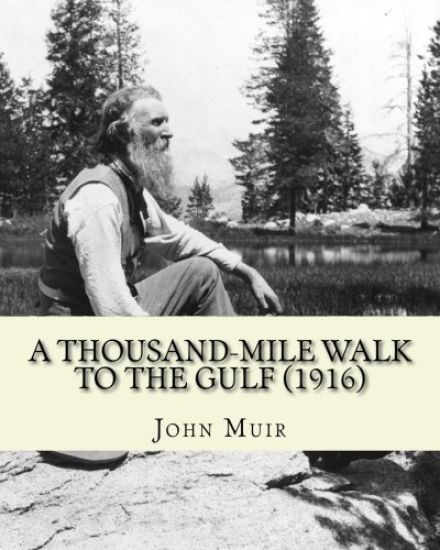
A Thousand-Mile Walk To The Gulf (1916). By: John Muir, EDITED By: William Frederic Bade: Illustrated
William Frederic Bade; John Muir
Createspace Independent Publishing Platform
2017
nidottu
Here is the adventure that started John Muir on a lifetime of discovery. Taken from his earliest journals, this book records Muir's walk in 1867 from Indiana across Kentucky, Tennessee, North Carolina, Georgia, and Florida to the Gulf Coast. In his distinct and wonderful style, Muir shows us the wilderness, as well as the towns and people, of the South immediately after the Civil War. John Muir ( April 21, 1838 - December 24, 1914) also known as "John of the Mountains", was a Scottish-American naturalist, author, environmental philosopher, glaciologist and early advocate of preservation of wilderness in the United States. His letters, essays, and books of his adventures in nature, especially in the Sierra Nevada of California and Nevada, have been read by millions. His activism helped to preserve the Yosemite Valley, Sequoia National Park and other wilderness areas. The Sierra Club, which he founded, is a prominent American conservation organization. The 211-mile (340 km) John Muir Trail, a hiking trail in the Sierra Nevada, was named in his honor. Other such places include Muir Woods National Monument, Muir Beach, John Muir College, Mount Muir, Camp Muir and Muir Glacier. In Scotland, the John Muir Way, a 130-mile-long route, was named in honor of him. In his later life, Muir devoted most of his time to the preservation of the Western forests. He petitioned the U.S. Congress for the National Park bill that was passed in 1890, establishing Yosemite National Park. The spiritual quality and enthusiasm toward nature expressed in his writings inspired readers, including presidents and congressmen, to take action to help preserve large nature areas.He is today referred to as the "Father of the National Parks" 4] and the National Park Service has produced a short documentary about his life. John Muir has been considered "an inspiration to both Scots and Americans".Muir's biographer, Steven J. Holmes, believes that Muir has become "one of the patron saints of twentieth-century American environmental activity," both political and recreational. As a result, his writings are commonly discussed in books and journals, and he is often quoted by nature photographers such as Ansel Adams. "Muir has profoundly shaped the very categories through which Americans understand and envision their relationships with the natural world," writes Holmes. Muir was noted for being an ecological thinker, political spokesman, and religious prophet, whose writings became a personal guide into nature for countless individuals, making his name "almost ubiquitous" in the modern environmental consciousness. According to author William Anderson, Muir exemplified "the archetype of our oneness with the earth", while biographer Donald Worster says he believed his mission was "...saving the American soul from total surrender to materialism."On April 21, 2013, the first ever John Muir Day was celebrated in Scotland, which marked the 175th anniversary of his birth, paying homage to the conservationist. William Frederic Bade (January 22, 1871 - March 4, 1936), perhaps best known as the literary executor and biographer of John Muir, was a versatile scholar of wide interests. As an archaeologist, he led the excavation of Tell en-Nasbeh in Palestine, now believed on the basis of his work to be the biblical city of Mizpah in Benjamin. He was also an ordained Moravian minister, a professor of ancient languages, a theologian and bible scholar, a mountaineer, a conservationist and a naturalist. Born and raised in Minnesota, he studied at Moravian College and its seminary as well as other universities. He served on the faculties of Moravian Theological Seminary and then the Pacific School of Religion. He also served as interim president and subsequently as dean of the Pacific School of Religion and was founding director of the school's Palestine Institute. He was president of the Sierra Club 1919-1922 and edited the Sierra Club Bulletin for 12 years.
Harold Frederic, best novels
Harold Frederic
Createspace Independent Publishing Platform
2017
nidottu