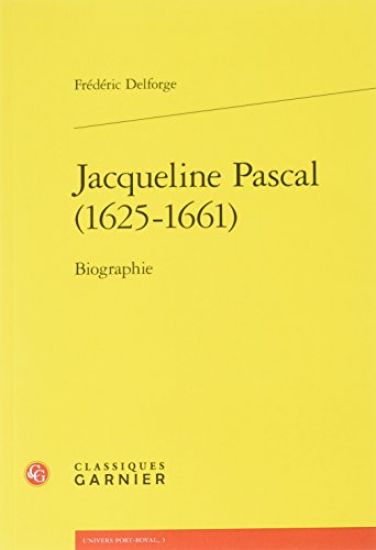
This work gives an overview of a woman who was, from 1652 to 1661, an unassuming nun at Port-Royal. Jacqueline Pascal lived her life in the shadow of her brother, Blaise. While their destinies were closely intertwined, they also differed markedly, and Jacqueline appears as one of the seventeenth century's most remarkable women.
Observera att förlaget som ger ut denna produkt baserar innehållet i sina produkter på fria källor som Wikipedia. Boken är med stor sannolikhet endast ett utdrag ur dessa informationskällor, alltså inte en vanlig bok i den bemärkelsen.
Observera att förlaget som ger ut denna produkt baserar innehållet i sina produkter på fria källor som Wikipedia. Boken är med stor sannolikhet endast ett utdrag ur dessa informationskällor, alltså inte en vanlig bok i den bemärkelsen.
Observera att förlaget som ger ut denna produkt baserar innehållet i sina produkter på fria källor som Wikipedia. Boken är med stor sannolikhet endast ett utdrag ur dessa informationskällor, alltså inte en vanlig bok i den bemärkelsen.
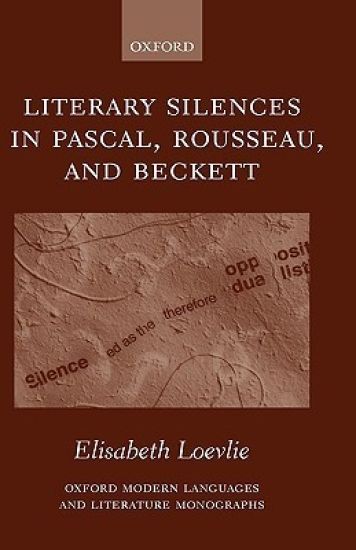
To explore literary silence is to explore the relationships between literary texts and the silence of the ineffable. It is to enquire what dynamics texts develop as they strive to 'say the unsayable', and it is to think literature as a silence that speaks itself. This study describes these literary and silent dynamics through readings of Pascal's Pensées, Rousseau's Rêveries, and Beckett's trilogy Molloy, Malone meurt, and L'Innommable. It contributes to our understanding of three major writers and challenges our idea of what silence is. The subject of silence and of the ineffable has a long philosophical and critical tradition. A careful study of this tradition reveals the dominance of a limiting dualistic understanding of silence and its relationship to noise or language: silence becomes the negative other, the beyond, about which there remains nothing to say. The study of literary silence seeks rather to trace a language that becomes its own silence. It compromises the attempt to think a silence that moves within and through texts, that is inherent to the literary expression. Central to this theoretical endeavour are thinkers like Derrida, Deleuze, Gadamer, and Vattimo (among several others). The theoretical understanding of silence permits an effective methodology for reading literary silence. Notions of repetition, the aporia and the implosion, which are developed in reference to Kierkegaard and Bataille, describe textual strategies of literary silence and structure the readings. Finally, the reading of literary silence has its point of reference in writers like Mallarmé, Blanchot, and Beckett. It is their texts that have taught us to become topological readers, to move in and out of texts' movements; they have shown us how the literary expression is irreducible to linear, meaning oriented language. As readers of such texts we have been prepared to read the dynamics of the unsayable, and finally to start discerning the silences of the literary.
This book is concerned with language skills and language understanding rather than programming methodology. No mention is made of testing, and no attention given to the environment in which programs must be entered, or executed. It is assumed that a reader will be familiar with these matters.
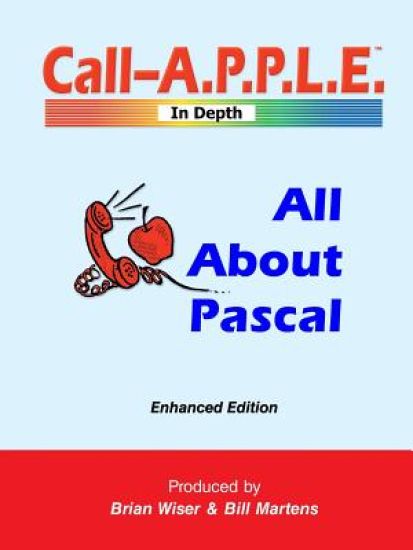
As a guide to the Pascal language for the Apple II, All About Pascal contains a wide range of useful programs and in-depth topics. This new Enhanced Edition, encompassing over 180 pages, is improved with new art, a glossary, and maintains most of the original layout with enhanced scans. It features many example programs, references, and how-to's - making it a great reference for Apple II programmers. Highlights Include:- Switching to and from BASIC and the Pascal environment.- Getting Started, the Structure of Pascal, and a Guide to Better Programs. - System Utilities for converting between DOS 3.3 and Pascal.- Disk Utilities for recovering and working with data on Pascal disks.- Decoding a compiled program and learning how to format text and programs.- The internal structure of Pascal, usage, and a memory map.- Tips for maximizing and interfacing hardware under Pascal.- Research subjects with a complete bibliography of Pascal resources.
To the Second Edition This book is designed both for introductory courses in computer problem solving, at the freshman and sophomore college level, and for individual self study. The first edition of this book has been used for teaching introductory classes at University of California San Diego (UCSD), University of California Irvine (UCI), and many other schools. This second edition is based on our experience using the text over the past six years with a broad range of students. We have taught the course using variations on Keller's Personalized System of Instruction (PSI). The organization of this book is conducive to this approach but does not require it. PSI methods allow slightly more material to be absorbed by the students than is the case with the traditional lecture/recitation presentation. PSI allows grading according to the number of chapter units completed. In a 10 week quarter, virtually all students who pass the course at UCSDand UCI complete the material covered in the first eleven chapters and the exercises associated with them. A substantial portion complete the entire fifteen chapters. For a conventional presentation under the semester system, the 15 chapters should present an appropriate amount of material for the average student.
Many students and programmers familiar with Pascal are now looking to upgrade their skills to a well-structured object-oriented programming language such as C++. This textbook provides such an "upgrade path" by presenting a course on C++ in the spirit of structured programming. Both authors teach this material to a wide variety of students and include numerous programming exercises to test a reader's understanding and to increase their confidence in programming in C++.
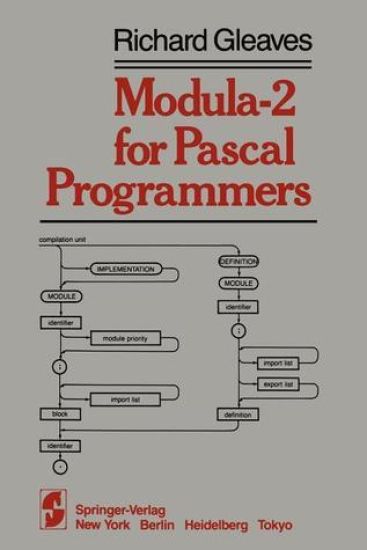
This book describes the programming language Modula-2. It is written for people who know the Pascal language and who wish to learn Modula-2 in terms of their knowledge of Pascal. The text is divided into three parts. Part 1 introduces concepts unique to Modula-2 and thus new to Pascal programmers. Part 2 describes differences from Pascal. Part 3 defines modules which provide basic programming facilities. The appendices include a glossary and syntax diagrams. Please note that this book does not offer a complete description of the Modula-2 language; it is intended to complement Niklaus Wirth's definitive book Programming in Modula-2 (Springer-Verlag, 1983). Some readers will recognize this book as being based upon the Volition Systems Modula-2 User's Manual. Enough has changed to merit its reappearance in this more dignified form: existing material has been reorganized to improve clarity; new material has been added to improve content. This book was written with the ASE text editor. The text was produced in camera-ready form on the Scenic LaserTezt composition system. I wish to thank the following people and organizations for their contributions to the development of this book: Volition Systems, for giving me the opportunity to write about Modula-2; Jim Merritt, for reviewing an early draft; the Institut far Informatik, ETH Zarich, for publishing a series of informative technical papers on Modula-2; and finally, all the pioneer users of Volition Systems Modula-2, for their patience and foresight and support.
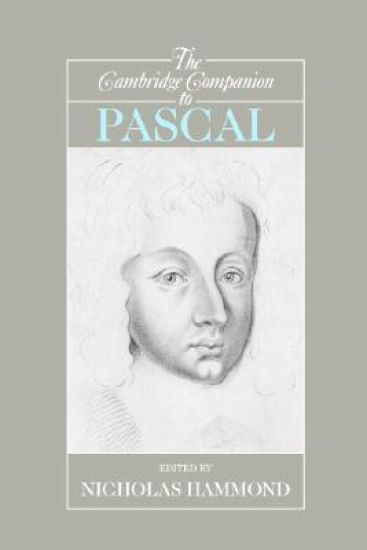
Each volume of this series of companions to major philosophers contains specially commissioned essays by an international team of scholars, together with a substantial bibliography, and will serve as a reference work for students and nonspecialists. One aim of the series is to dispel the intimidation such readers often feel when faced with the work of a difficult and challenging thinker. Blaise Pascal (1623–1662) occupies a position of pivotal importance in many domains: philosophy, mathematics, physics, religious polemics and apologetics. In this volume a team of leading scholars presents the full range of Pascal’s achievement and surveys the intellectual background of his thought and the reception of his work. New readers and nonspecialists will find this the most convenient and accessible guide to Pascal currently available. Advanced students and specialists will find a conspectus of recent developments in the interpretation of Pascal.
Published in 1941, The Secret of Pascal was intended by its author, H. F. Stewart, to be a complement to his previous study, The Holiness of Pascal, which contained the Hulsean Lectures delivered before the University of Cambridge in 1914–5. Having already examined Pascal's religious thought and attitude in those lectures, Stewart here focuses on three other aspects of Pascal's genius: his skill in debate, his moral teaching, and his poetic mastery of language. By addressing these subjects apart from questions of philosophy or religion, Stewart illuminates some of the subtler aspects of Pascal's person which contributed to the strength and longevity of his influence.
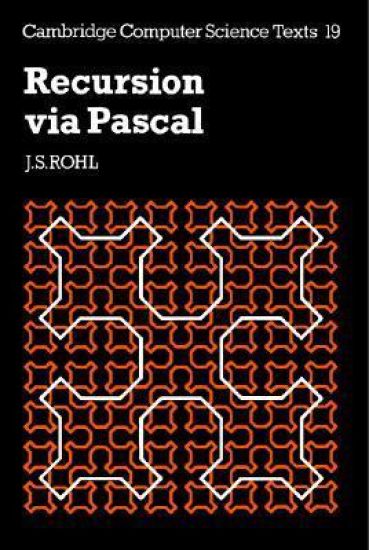
This book is devoted to recursion in programming, the technique through which the solution to a problem is expressed partly in terms of the solution to a simpler version of the same problem. Ultimately the solution to the simplest version must be given explicitly. In functional programming, recursion has received its full due since it is quite often the only repetitive construct. However, here the programming language used is Pascal and the examples have been chosen accordingly. It therefore makes an interesting contrast with the use of recursion in functional and logic programming. The early chapters consider simple linear recursion using examples such as finding the highest common factor of a pair of numbers, and processing linked lists. Subsequent chapters move up through binary recursion, with examples which include the Towers of Hanoi problem and symbolic differentiation, to general recursion, which covers examples such as drawing the cover design of this book. The book contains well over 100 examples. Recursion via Pascal will be a useful introduction to recursion for undergraduate students of computer science in universities and polytechnics.
Numerical Recipes: The Art of Scientific Computing was first published in 1986 and became an instant classic among scientists, engineers, and social scientists. In this book the original, time-tested programs have been completely reworked into a clear, consistent Pascal style. This represents a significant improvement to the immensely successful programs contained in the first edition, which were originally written in Fortran. The authors make extensive use of pointers, dynamic memory allocation, and other features utilized by this language. The explanatory text accompanying the programs replicates the lucid, and easy-to-read prose found in the original version, and incorporates corrections, improvements, and explanations of special Pascal features. The product of a unique collaboration among four leading scientists in academic research and industry, Numerical Recipes in Pascal fills a long-recognized need for a practical, comprehensive handbook of scientific computing in the Pascal language. The book is designed both for the Pascal programmer who wants exposure to the techniques of scientific computing, and for the working scientist, social scientist, and engineer. The scope of the book ranges from standard areas of numerical analysis (linear algebra, differential equations, roots) through subjects useful to signal processing (Fourier methods, filtering), data analysis (least squares, robust fitting, statistical functions), simulation (random deviates and Monte Carlo), and more. The lively, informal text combined with an underlying degree of mathematical sophistication makes the book useful to a wide range of readers, beginning at the advanced undergraduate level.
Each volume of this series of companions to major philosophers contains specially commissioned essays by an international team of scholars, together with a substantial bibliography, and will serve as a reference work for students and nonspecialists. One aim of the series is to dispel the intimidation such readers often feel when faced with the work of a difficult and challenging thinker. Blaise Pascal (1623–62) occupies a position of pivotal importance in many domains: philosophy, mathematics, physics, religious polemics and apologetics. In this volume a team of leading scholars presents the full range of Pascal's achievement and surveys the intellectual background of his thought and the reception of his work. New readers and nonspecialists will find this the most convenient and accessible guide to Pascal currently available. Advanced students and specialists will find a conspectus of recent developments in the interpretation of Pascal.