Kirjojen hintavertailu. Mukana 12 092 713 kirjaa ja 12 kauppaa.

Kirjahaku

Etsi kirjoja tekijän nimen, kirjan nimen tai ISBN:n perusteella.

1000 tulosta hakusanalla Philo

Philosophy of Social Science

Philosophy of Social Science

Oxford University Press
2014
sidottu
This is a much-needed new introduction to a field that has been transformed in recent years by exciting new subjects, ideas, and methods. It is designed both for students with central interests in philosophy and those planning to concentrate on the social sciences, and it presupposes no particular background in either domain. From the wide range of topics at the forefront of debate in philosophy of social science, the editors have chosen those which are representative of the most important and interesting contemporary work. A team of distinguished experts explore key aspects of the field such as social ontology (what are the things that social science studies?), objectivity, formal methods, measurement, and causal inference. Also included are chapters focused on notable subjects of social science research, such as well-being and climate change. Philosophy of Social Science provides a clear, accessible, and up-to-date guide to this fascinating field.
Philosophy of Social Science

Philosophy of Social Science

Oxford University Press
2014
nidottu
This is a much-needed new introduction to a field that has been transformed in recent years by exciting new subjects, ideas, and methods. It is designed both for students with central interests in philosophy and those planning to concentrate on the social sciences, and it presupposes no particular background in either domain. From the wide range of topics at the forefront of debate in philosophy of social science, the editors have chosen those which are representative of the most important and interesting contemporary work. A team of distinguished experts explore key aspects of the field such as social ontology (what are the things that social science studies?), objectivity, formal methods, measurement, and causal inference. Also included are chapters focused on notable subjects of social science research, such as well-being and climate change. Philosophy of Social Science provides a clear, accessible, and up-to-date guide to this fascinating field.
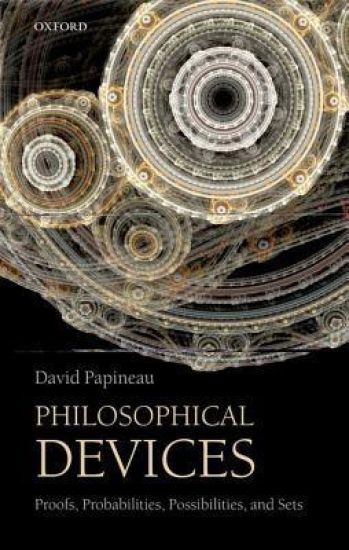
Philosophical Devices

Philosophical Devices

David Papineau

Oxford University Press
2012
sidottu
This book is designed to explain the technical ideas that are taken for granted in much contemporary philosophical writing. Notions like 'denumerability', 'modal scope distinction', 'Bayesian conditionalization', and 'logical completeness' are usually only elucidated deep within difficult specialist texts. By offering simple explanations that by-pass much irrelevant and boring detail, Philosophical Devices is able to cover a wealth of material that is normally only available to specialists. The book contains four sections, each of three chapters. The first section is about sets and numbers, starting with the membership relation and ending with the generalized continuum hypothesis. The second is about analyticity, a prioricity, and necessity. The third is about probability, outlining the difference between objective and subjective probability and exploring aspects of conditionalization and correlation. The fourth deals with metalogic, focusing on the contrast between syntax and semantics, and finishing with a sketch of Gödel's theorem. Philosophical Devices will be useful for university students who have got past the foothills of philosophy and are starting to read more widely, but it does not assume any prior expertise. All the issues discussed are intrinsically interesting, and often downright fascinating. It can be read with pleasure and profit by anybody who is curious about the technical infrastructure of contemporary philosophy.
Philosophical Devices

Philosophical Devices

David Papineau

Oxford University Press
2012
nidottu
This book is designed to explain the technical ideas that are taken for granted in much contemporary philosophical writing. Notions like 'denumerability', 'modal scope distinction', 'Bayesian conditionalization', and 'logical completeness' are usually only elucidated deep within difficult specialist texts. By offering simple explanations that by-pass much irrelevant and boring detail, Philosophical Devices is able to cover a wealth of material that is normally only available to specialists. The book contains four sections, each of three chapters. The first section is about sets and numbers, starting with the membership relation and ending with the generalized continuum hypothesis. The second is about analyticity, a prioricity, and necessity. The third is about probability, outlining the difference between objective and subjective probability and exploring aspects of conditionalization and correlation. The fourth deals with metalogic, focusing on the contrast between syntax and semantics, and finishing with a sketch of Gödel's theorem. Philosophical Devices will be useful for university students who have got past the foothills of philosophy and are starting to read more widely, but it does not assume any prior expertise. All the issues discussed are intrinsically interesting, and often downright fascinating. It can be read with pleasure and profit by anybody who is curious about the technical infrastructure of contemporary philosophy.
Philosophy and Probability

Philosophy and Probability

Timothy Childers

Oxford University Press
2013
sidottu
Probability is increasingly important for our understanding of the world. What is probability? How do we model it, and how do we use it? Timothy Childers presents a lively introduction to the foundations of probability and to philosophical issues it raises. He keeps technicalities to a minimum, and assumes no prior knowledge of the subject. He explains the main interpretations of probability-frequentist, propensity, classical, Bayesian, and objective Bayesian-and uses stimulating examples to bring the subject to life. All students of philosophy will benefit from an understanding of probability, and this is the book to provide it.
Philosophy and Probability

Philosophy and Probability

Timothy Childers

Oxford University Press
2013
nidottu
Probability is increasingly important for our understanding of the world. What is probability? How do we model it, and how do we use it? Timothy Childers presents a lively introduction to the foundations of probability and to philosophical issues it raises. He keeps technicalities to a minimum, and assumes no prior knowledge of the subject. He explains the main interpretations of probability-frequentist, propensity, classical, Bayesian, and objective Bayesian-and uses stimulating examples to bring the subject to life. All students of philosophy will benefit from an understanding of probability, and this is the book to provide it.
Philosophical Foundations of Discrimination Law
How do we understand and justify the particular partialities that discrimination law tries to protect against? Are different discrimination laws from around the world grounded in a single set of norms? And does discrimination law fail to treat people as individuals? The philosophical study around discrimination law in the private and public sector is a relatively young field of inquiry. This is owing to the fact that anti-discrimination laws are relatively new. It is arguably only since the Second World War that these rights have been adopted by countries in a broad sense, ensuring that all citizens have civil rights and the right to non-discrimination. Theory around discrimination law has until recently been threefold, doctrinal in its approach, questioning equality - why it matters and why should it influence legislatures in the design of policy - and thirdly focusing on the issue of affirmative action. This volume takes a fresh look at the philosophy of discrimination law, identifying points of discussion in need of further study. It addresses how we are to understand and justify laws prohibiting discrimination. For instance, how discrimination might be best conceived - as a personal wrong or as an unfair distribution of resources. The volume then turns to a number of meta-theoretical questions, whether different discrimination laws are coherent and grounded in collectively held beliefs or are instead a collection of very different rules that have no underlying coherence. Lastly, the authors focus on issues in discrimination law that are currently the topic of considerable political debate. The questions raised here are urgent and necessary and it is the hope of the authors that other academics and philosophers may join in their discussions.
Philosophical Foundations of Property Law
Property has long played a central role in political and moral philosophy. Philosophers dealing with property have tended to follow the consensus that property has no special content but is a protean construct - a mere placeholder for theories aimed at questions of distributive justice and efficiency. Until recently there has been a relative absence of serious philosophical attention paid to the various doctrines that shape the actual law of property. If the philosophy of property is to be more attentive to concepts lying between broad considerations of political philosophy and distributive justice on the one hand and individual rules on the other, what in this broad space needs explaining, and how might we justify what we find? The papers in this volume are a first step towards filling this gap in the philosophical analysis of private law. This is achieved here by revisiting the contributions of philosophers such as Hume, Locke, Kant, and Grotius and revealing how particular doctrines illuminate the way in which property law respects the equality and autonomy of its subjects. Secondly, by exploring the central notions of possession, ownership, and title and finally by considering the very foundations of conceptualism in property.
Philosophical Foundations of Criminal Law
Twenty-five leading contemporary theorists of criminal law tackle a range of foundational issues about the proper aims and structure of the criminal law in a liberal democracy. The challenges facing criminal law are many. There are crises of over-criminalization and over-imprisonment; penal policy has become so politicized that it is difficult to find any clear consensus on what aims the criminal law can properly serve; governments seeking to protect their citizens in the face of a range of perceived threats have pushed the outer limits of criminal law and blurred its boundaries. To think clearly about the future of criminal law, and its role in a liberal society, foundational questions about its proper scope, structure, and operations must be re-examined. What kinds of conduct should be criminalized? What are the principles of criminal responsibility? How should offences and defences be defined? The criminal process and the criminal trial need to be studied closely, and the purposes and modes of punishment should be scrutinized. Such a re-examination must draw on the resources of various disciplines-notably law, political and moral philosophy, criminology and history; it must examine both the inner logic of criminal law and its place in a larger legal and political structure; it must attend to the growing field of international criminal law, it must consider how the criminal law can respond to the challenges of a changing world. Topics covered in this volume include the question of criminalization and the proper scope of the criminal law; the grounds of criminal responsibility; the ways in which offences and defences should be defined; the criminal process and its values; criminal punishment; the relationship between international criminal law and domestic criminal law. Together, the essays provide a picture of the exciting state of criminal law theory today, and the basis for further research and debate in the coming years.
Philosophical Foundations of Language in the Law
This collection brings together the best contemporary philosophical work in the area of intersection between philosophy of language and the law. Some of the contributors are philosophers of language who are interested in applying advances in philosophy of language to legal issues, and some of the participants are philosophers of law who are interested in applying insights and theories from philosophy of language to their work on the nature of law and legal interpretation. By making this body of recent work available in a single volume, readers will gain both a general overview of the various interactions between language and law, and also detailed analyses of particular areas in which this interaction is manifest. The contributions to this volume are grouped under three main general areas: The first area concerns a critical assessment, in light of recent advances in philosophy of language, of the foundational role of language in understanding the nature of law itself. The second main area concerns a number of ways in which an understanding of language can resolve some of the issues prevalent in legal interpretation, such as the various ways in which semantic content can differ from law's assertive content; the contribution of presuppositions and pragmatic implicatures in understanding what the law conveys; the role of vagueness in legal language, for example. The third general topic concerns the role of language in the context of particular legal doctrines and legal solutions to practical problems, such as the legal definitions of inchoate crimes, the legal definition of torture, or the contractual doctrines concerning default rules. Together, these three key issues cover a wide range of philosophical interests in law that can be elucidated by a better understanding of language and linguistic communication.
Philosophy and the Novel

Philosophy and the Novel

Alan H. Goldman

Oxford University Press
2013
sidottu
Alan H. Goldman presents an original and lucid account of the relationship between philosophy and the novel. In the first part, on philosophy of novels, he defends theories of literary value and interpretation. Literary value, the value of literary works as such, is a species of aesthetic value. Goldman argues that works have aesthetic value when they simultaneously engage all our mental capacities: perceptual, cognitive, imaginative, and emotional. This view contrasts with now prevalent narrower formalist views of literary value. According to it, cognitive engagement with novels includes appreciation of their broad themes and the theses these imply, often moral and hence philosophical theses, which are therefore part of the novels' literary value. Interpretation explains elements of works so as to allow readers maximum appreciation, so as to maximize the literary value of the texts as written. Once more, Goldman's view contrasts with narrower views of literary interpretation, especially those which limit it to uncovering what authors intended. One implication of Goldman's broader view is the possibility of incompatible but equally acceptable interpretations, which he explores through a discussion of rival interpretations of Ernest Hemingway's The Sun Also Rises. Goldman goes on to test the theory of value by explaining the immense appeal of good mystery novels in its terms. The second part of the book, on philosophy in novels, explores themes relating to moral agency--moral development, motivation, and disintegration--in Jane Austen's Pride and Prejudice, Mark Twain's Huckleberry Finn, John Irving's The Cider House Rules, and Joseph Conrad's Nostromo. By narrating the course of characters' lives, including their inner lives, over extended periods, these novels allow us to vicariously experience the characters' moral progressions, positive and negative, to learn in a more focused way moral truths, as we do from real life experiences.
Philosophical Foundations of the Nature of Law
In recent years we have witnessed major developments in philosophical inquiry concerning the nature of law and, with the continuing development of international and transnational legal institutions, in the phenomenon of law itself. This volume gathers leading writers in the field to take stock of current debates on the nature of law and the aims and methods of legal philosophy. The volume covers four broad themes. The essays within the first theme address and develop the traditional debates between legal positivism, natural law theory, and Dworkinian interpretivism. Papers within the second theme focus on the power of coercion, often overlooked in contemporary legal philosophy. The third set of papers addresses the aims and methods of legal theory, and the role of conceptual analysis. The final section explores new methods and issues in the subject, and offers fresh starting points for future work in the field. Gathering many leading and up-and-coming writers in the subject, the volume offers a snapshot of the best current work in general jurisprudence.
Philosophy in the Islamic World

Philosophy in the Islamic World

Peter Adamson

Oxford University Press
2015
nidottu
In the history of philosophy, few topics are so relevant to today's cultural and political landscape as philosophy in the Islamic world. Yet, this remains one of the lesser-known philosophical traditions. In this Very Short Introduction, Peter Adamson explores the history of philosophy among Muslims, Jews, and Christians living in Islamic lands, from its historical background to thinkers in the twentieth century. Introducing the main philosophical themes of the Islamic world, Adamson integrates ideas from the Islamic and Abrahamic faiths to consider the broad philosophical questions that continue to invite debate: What is the relationship between reason and religious belief? What is the possibility of proving God's existence? What is the nature of knowledge? Drawing on the most recent research in the field, this book challenges the assumption of the cultural decline of philosophy and science in the Islamic world by demonstrating its rich heritage and overlap with other faiths and philosophies.
Philosophy of Law

Philosophy of Law

Raymond Wacks

Oxford University Press
2014
nidottu
The concept of law lies at the heart of our social and political life. Legal philosophy, or jurisprudence, explores the notion of law and its role in society, illuminating its meaning and its relation to the universal questions of justice, rights, and morality. In this Very Short Introduction Raymond Wacks analyses the nature and purpose of the legal system, and the practice by courts, lawyers, and judges. Wacks reveals the intriguing and challenging nature of legal philosophy with clarity and enthusiasm, providing an enlightening guide to the central questions of legal theory. In this revised edition Wacks makes a number of updates including new material on legal realism, changes to the approach to the analysis of law and legal theory, and updates to historical and anthropological jurisprudence. ABOUT THE SERIES: The Very Short Introductions series from Oxford University Press contains hundreds of titles in almost every subject area. These pocket-sized books are the perfect way to get ahead in a new subject quickly. Our expert authors combine facts, analysis, perspective, new ideas, and enthusiasm to make interesting and challenging topics highly readable.
Philosophical Foundations of Human Rights
What makes something a human right? What is the relationship between the moral foundations of human rights and human rights law? What are the difficulties of appealing to human rights? This book offers the first comprehensive survey of current thinking on the philosophical foundations of human rights. Divided into four parts, this book focusses firstly on the moral grounds of human rights, for example in our dignity, agency, interests or needs. 'Secondly, it looks at the implications that different moral perspectives on human rights bear for human rights law and politics. Thirdly, it discusses specific and topical human rights including freedom of expression and religion, security, health and more controversial rights such as a human right to subsistence. The final part discusses nuanced critical and reformative views on human rights from feminist, Kantian and relativist perspectives among others. The essays represent new and canonical research by leading scholars in the field. Each part is comprised of a set of essays and replies, offering a comprehensive analysis of different positions within the debate in question.The introduction from the editors will guide researchers and students navigating the diversity of views on the philosophical foundations of human rights.
Philosophical Foundations of Human Rights
What makes something a human right? What is the relationship between the moral foundations of human rights and human rights law? What are the difficulties of appealing to human rights? This book offers the first comprehensive survey of current thinking on the philosophical foundations of human rights. Divided into four parts, this book focuses firstly on the moral grounds of human rights, for example in our dignity, agency, interests or needs. Secondly, it looks at the implications that different moral perspectives on human rights bear for human rights law and politics. Thirdly, it discusses specific and topical human rights including freedom of expression and religion, security, health and more controversial rights such as a human right to subsistence. The final part discusses nuanced critical and reformative views on human rights from feminist, Kantian and relativist perspectives among others. The essays represent new and canonical research by leading scholars in the field. Each section is structured as a set of essays and replies, offering a comprehensive analysis of different positions within the debate in question. The introduction from the editors will guide researchers and students navigating the diversity of views on the philosophical foundations of human rights.
Philosophy of Law

Philosophy of Law

John Finnis

Oxford University Press
2013
nidottu
John Finnis has been a central figure in the fundamental re-shaping of legal philosophy over the past half-century. This volume of his Collected Essays shows the full range and power of his contributions to the philosophy of law. The volume collects nearly thirty papers: on the foundations of law's authority; major theories and theorists of law; legal reasoning; revolutions, rights and law; and the logic of law-making. The essays collected include Finnis' recent appreciations and root-and-branch critiques of Hart's legal and political theories, his engagements with other central figures and works in the field, including Dworkin's Law's Empire; Raz on authority and coordination; Coleman, Leiter and Gardner on legal positivism and naturalism; Aquinas as founder of legal positivism; Weber on the fact-value distinction and legitimation; Unger on indeterminacy in law; Posner on intention and economics; Kelsen and courts on revolutions; game-theory and rational-choice theory; with misinterpreters of Hohfeld on rights logic; John Paul II on voting for unjust laws; analogy's role in legal reasoning; the distribution of constitutional authority in the Empire and its dissolution; the judicial opportunism of separation of powers doctrine in the Australian constitution; the architecture of Blackstone's Commentaries; restitution in civil wrongs; and many other aspects of law and legal theory. Several papers bring to bear his extensive work as a constitutional adviser and lawyer on persistent problems of constitutional theory. Previously unpublished papers include two on critical or post-modern legal theory, and an introduction reflecting on legal philosophy's development and future.
Philosophy Bites Back

Philosophy Bites Back

David Edmonds; Nigel Warburton

Oxford University Press
2012
sidottu
Philosophy Bites Back is the second book to come out of the hugely successful podcast Philosophy Bites. It presents a selection of lively interviews with leading philosophers of our time, who discuss the ideas and works of some of the most important thinkers in history. From the ancient classics of Socrates, Plato, and Aristotle, to the groundbreaking modern thought of Wittgenstein, Rawls, and Derrida, this volume spans over two and a half millennia of western philosophy and illuminates its most fascinating ideas. Philosophy Bites was set up in 2007 by David Edmonds and Nigel Warburton. It has had over 12 million downloads, and is listened to all over the world.
Philosophy Bites

Philosophy Bites

David Edmonds; Nigel Warburton

Oxford University Press
2012
nidottu
Take 25 of the liveliest philosophers of our time. Talk to each about one of the most intriguing topics you can think of--from ethics to aesthetics to metaphysics. The result is a Philosophy Bite--a lively, informal conversation that brings the subject into focus. First made public on the enormously popular Philosophy Bites podcast, these entertaining, personal, and illuminating conversations are presented in print. The result is a book that is a taster for the whole enterprise of philosophy, and gives unexpected insights into hot topics spanning ethics, politics, metaphysics, aesthetics, and the meaning of life.
Philosophical Troubles

Philosophical Troubles

Saul A. Kripke

Oxford University Press Inc
2011
sidottu
This important new book is the first of a series of volumes collecting the essential articles by the highly influential philosopher Saul A. Kripke. It presents a mixture of published and unpublished articles from various stages of Kripke's storied career. Included here are seminal and much discussed pieces such as "Identity and Necessity," "Outline of a Theory of Truth," and "A Puzzle About Belief." More recent published articles include "Russell's Notion of Scope" and "Frege's Theory of Sense and Reference" among others. Several articles are published here for the first time, including both older works "Two Paradoxes of Knowledge," "Vacuous Names and Fictional Entities," "Nozick on Knowledge" as well as newer "The First Person" and "Unrestricted Exportation". "A Puzzle on Time and Thought" was written expressly for this volume. The publication of this volume--which ranges over epistemology, linguistics, pragmatics, philosophy of language, history of analytic philosophy, theory of truth, and metaphysics--represents a major event in contemporary analytic philosophy. When completed, this collection will be a testament to one of philosophy's greatest living figures.