Kirjojen hintavertailu. Mukana 11 717 486 kirjaa ja 12 kauppaa.

Kirjahaku

Etsi kirjoja tekijän nimen, kirjan nimen tai ISBN:n perusteella.

1000 tulosta hakusanalla Quentin Baxter Alison

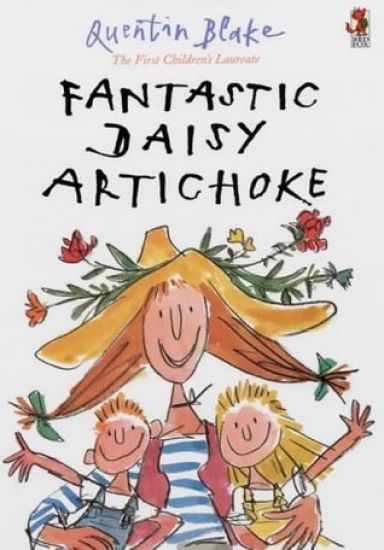
Fantastic Daisy Artichoke

Fantastic Daisy Artichoke

Quentin Blake

Red Fox
2001
nidottu
A bouncing, read-aloud rhyme about a very special friend, from the nation's favourite llustrator, Quentin Blake!Meet Fantastic Daisy Artichoke. She's got three fat cats we like to stroke and a pond in which she likes to soak. . . . She isn't quite like other folk!"Blake is beyond brilliant . . . I've never met a child who doesn't love Quentin Blake" - Daily TelegraphQuentin Blake is one of Britain's best-loved and most successful author-illustrators, and was made the first Children's Laureate in 1999. He has won the Whitbread Award, the Hans Christian Andersen Award for Illustration, and the Kate Greenaway Medal. among others.
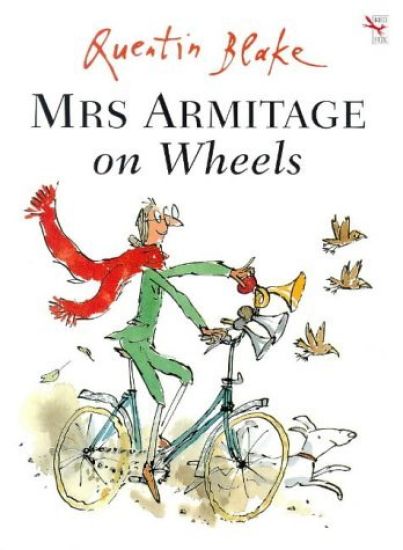
Mrs Armitage on Wheels

Mrs Armitage on Wheels

Quentin Blake

Random House Childrens Books
1999
pokkari
Mrs Armitage sets off for a quiet cycle with her faithful dog, Breakspear, but she just can't help thinking of ways to improve her bicycle. And by the time she has also added a seat for Breakspear, two umbrellas, a cassette player and a mouth-organ, Mrs Armitage is riding a very eye-catching contraption.
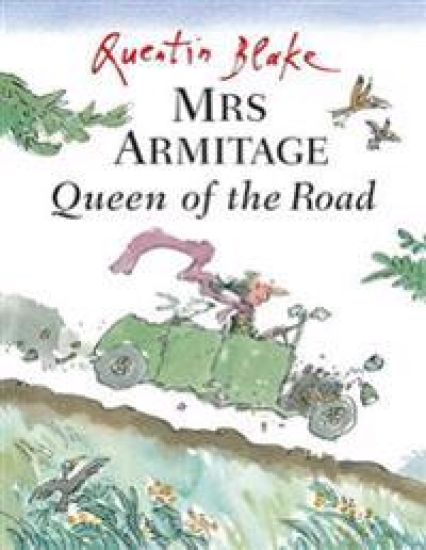
Mrs Armitage Queen Of The Road

Mrs Armitage Queen Of The Road

Quentin Blake

Random House Childrens Books
2004
pokkari
When Uncle Cosmo buys himself a motorbike and gives Mrs Armitage his boring old car, it soon becomes obvious that her driving skills leave a lot to be desired. As the bumper, the doors, the mudguard and even the roof disappear along the way, the car is transformed into a mean machine and Mrs Armitage becomes Queen of the Road!
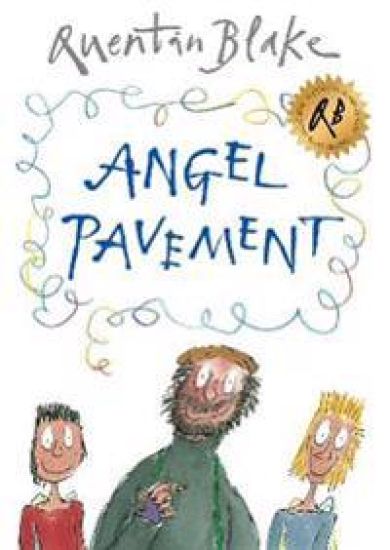
Angel Pavement

Angel Pavement

Quentin Blake

Penguin Random House Children's UK
2005
nidottu
Corky and Loopy are two perfectly normal girls. They like chocolate biscuits, fizzy drinks, screaming at one another and drawing. But they are also a LITTLE BIT special… because Corky and Loopy are angels.But, when Corky and Loopy decide to help a pavement artist named Sid, a very COLOURFUL adventure begins. Because ANYTHING can happen when you start drawing!Part of the iconic BBC animated series, Quentin Blake’s Box of Treasures. "I've never met a child who doesn't love Quentin Blake" - Daily Telegraph
All Join In

All Join In

Quentin Blake

Random House Childrens Books
1992
pokkari
For goodness sake!We ALL JOIN IN!'This book is a rumbustious, rollicking and above all noisy collection of seven exuberant poems, perfect for chanting aloud, that are brilliantly illustrated by the incomparable Quentin Blake.
Cockatoos

Cockatoos

Quentin Blake

Random House Childrens Books
1994
pokkari
When eccentric Professor Dupont tries to track down his troupe of brightly-coloured cockatoos, they're always just one step ahead of him. This counting book won the 1992 Smarties Children's Choice Award.
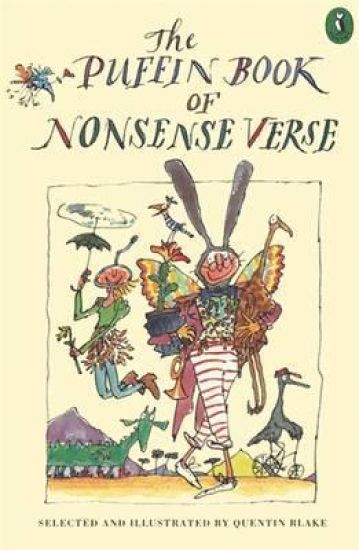
The Puffin Book of Nonsense Verse
Ever eaten Poodle Strudel? Slain a Jabberwock? Bathed in Irish Stew? Quentin Blake is one of the best loved of children’s illustrators. In this brilliant book he has selected and illustrated his favourite comic verse, making it pure entertainment for nonsense-lovers of all ages. His unique style of drawing brings a new perspective to every poem. Classic writers such as Lewis Carroll and Edward Lear are combined with more contemporary talents such as Roger McGough, Margaret Mahy and Russell Hoban. With fifteen wonderfully absurd sections, including Distracting Creatures, Sticky Ends, I Wish I Were a Jelly Fish, A Recipe for Indigestion and Chortling and Galumphing, here is a delightful collection of the topsy-turvy, the fantastical, the anarchic, the illogical and the utterly wonderful.
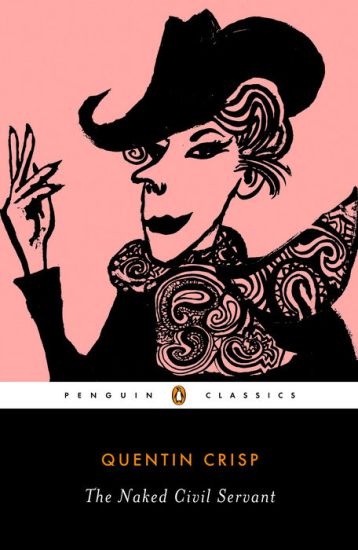
The Naked Civil Servant

The Naked Civil Servant

Quentin Crisp

PENGUIN CLASSICS
1997
nidottu
A comical and poignant memoir of a gay man living life as he pleased in the 1930s In 1931, gay liberation was not a movement--it was simply unthinkable. But in that year, Quentin Crisp made the courageous decision to "come out" as a homosexual. This exhibitionist with the henna-dyed hair was harrassed, ridiculed and beaten. Nevertheless, he claimed his right to be himself--whatever the consequences. The Naked Civil Servant is both a comic masterpiece and a unique testament to the resilience of the human spirit. For more than seventy years, Penguin has been the leading publisher of classic literature in the English-speaking world. With more than 1,700 titles, Penguin Classics represents a global bookshelf of the best works throughout history and across genres and disciplines. Readers trust the series to provide authoritative texts enhanced by introductions and notes by distinguished scholars and contemporary authors, as well as up-to-date translations by award-winning translators.
Forensic Shakespeare

Forensic Shakespeare

Quentin Skinner

Oxford University Press
2018
nidottu
Forensic Shakespeare illustrates Shakespeare's creative processes by revealing the intellectual materials out of which some of his most famous works were composed. Focusing on the narrative poem Lucrece, on four of his late Elizabethan plays (Romeo and Juliet, The Merchant of Venice, Julius Caesar and Hamlet) and on three early Jacobean dramas, (Othello, Measure for Measure and All's Well That Ends Well), Quentin Skinner argues that major speeches, and sometimes sequences of scenes, are crafted according to a set of rhetorical precepts about how to develop a persuasive judicial case, either in accusation or defence. Some of these works have traditionally been grouped together as 'problem plays', but here Skinner offers a different explanation for their frequent similarities of tone. There have been many studies of Shakespeare's rhetoric, but they have generally concentrated on his wordplay and use of figures and tropes. By contrast, this study concentrates on Shakespeare's use of judicial rhetoric as a method of argument. By approaching the plays from this perspective, Skinner is able to account for some distinctive features of Shakespeare's vocabulary, and also help to explain why certain scenes follow a recurrent pattern and arrangement. More broadly, he is able to illustrate the extent of Shakespeare's engagement with an entire tradition of classical and Renaissance humanist thought.
Machiavelli

Machiavelli

Quentin Skinner

Oxford University Press
2019
nidottu
Niccolò Machiavelli taught that political leaders must be prepared to do evil so that good may come of it, and his name has been a byword ever since for duplicity and immorality. Is his sinister reputation deserved? In answering this question Quentin Skinner traces the course of Machiavelli's adult life, from his time as Second Chancellor of the Florentine republic, during which he met with kings, the pope, and the Holy Roman Emperor; to the fall of the republic in 1512; to his death in 1527. It was after the fall of the Republic that Machiavelli composed his main political works: The Prince, the Discourses, and The History of Florence. In this second edition of his Very Short Introduction Skinner includes new material on The Prince, showing how Machiavelli developed his neo-classical political theory, through engaging in continual dialogue with the ancient Roman moralists and historians, especially Cicero and Livy. The aim of political leaders, Machiavelli argues, should be to act virtuously so far as possible, but to stand ready 'to be not good' when this course of action is dictated by necessity. Exploring the pivotal concept of princely virtù to be found in classical and Renaissance humanist texts, Skinner brings new light to Machiavelli's philosophy of a willingness to do whatever may be necessary - whether moral or otherwise -to maintain a position of power. ABOUT THE SERIES: The Very Short Introductions series from Oxford University Press contains hundreds of titles in almost every subject area. These pocket-sized books are the perfect way to get ahead in a new subject quickly. Our expert authors combine facts, analysis, perspective, new ideas, and enthusiasm to make interesting and challenging topics highly readable.
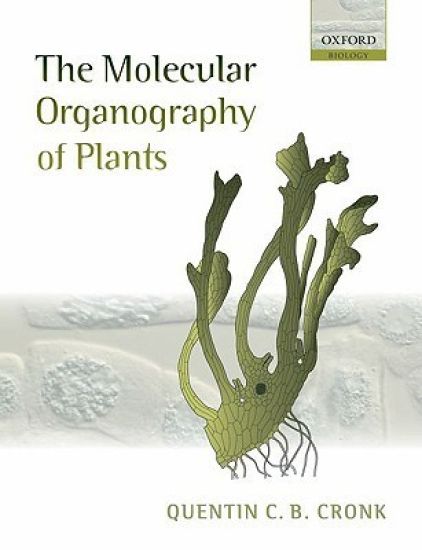
The Molecular Organography of Plants

The Molecular Organography of Plants

Quentin Cronk

Oxford University Press
2009
nidottu
From the cells of aquatic algae to the majestic redwoods towering 100 metres above the California coast, the history of plant evolution has been one of increasing complexity. The underlying rationale for this book is to answer the question: How, when land plant embryos at a few-celled stage are essentially comparable, do plants achieve such radically different adult phenotypes, from mosses to tree-ferns, and grasses to oak trees? The Molecular Organography of Plants chronicles the origin, and importance, of the complex plant organs that have allowed plants to shape the earth's biosphere, and seeks to explain why and how the genetic mechanisms governing these developmental trajectories have diverged so much. It provides a detailed account of the organs produced by land plants (stems, roots, leaves, seeds, flowers) into which is incorporated what is rapidly becoming known of the molecular mechanisms responsible. Plant organs are therefore discussed in the context of the evolution of development ("evo-devo"), and their basis in molecular developmental genetics is described. The result is a novel synthesis of classical morphology and molecular developmental biology that takes a broad look at the evolution of plant form.
Forensic Shakespeare

Forensic Shakespeare

Quentin Skinner

Oxford University Press
2014
sidottu
Forensic Shakespeare illustrates Shakespeare's creative processes by revealing some of the intellectual materials out of which some of his most famous works were composed. Focusing on the narrative poem Lucrece, on four of his late Elizabethan plays -- Romeo and Juliet, The Merchant of Venice, Julius Caesar and Hamlet -- and on three early Jacobean dramas, Othello, Measure for Measure and All's Well That Ends Well, Quentin Skinner argues that there are major speeches, and sometimes sequences of scenes, that are crafted according to a set of rhetorical precepts about how to develop a persuasive judicial case, either in accusation or defence. Some of these works have traditionally been grouped together as 'problem plays', but here Skinner offers a different explanation for their frequent similarities of tone. There have been many studies of Shakespeare's rhetoric, but they have generally concentrated on his wordplay and use of figures and tropes. By contrast, this study concentrates on Shakespeare's use of judicial rhetoric as a method of argument. By approaching the plays from this perspective, Skinner is able to account for some distinctive features of Shakespeare's vocabulary, and also help to explain why certain scenes follow a recurrent pattern and arrangement.
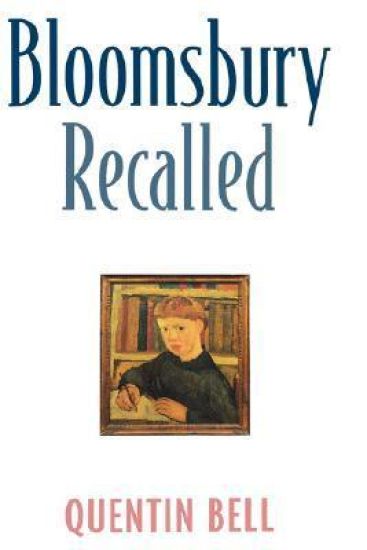
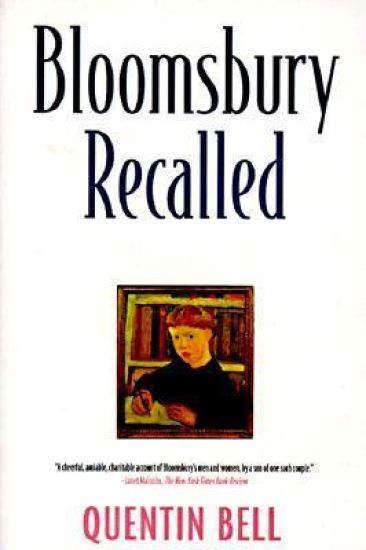
Bloomsbury Recalled

Bloomsbury Recalled

Quentin Bell

Columbia University Press
1996
sidottu
The author recounts anecdotes of his parents, Vanessa and Clive Bell, his aunt, Virginia Woolf, E.M. Forster, Maynard Keynes, Anthony Blunt, and other British writers and artists.
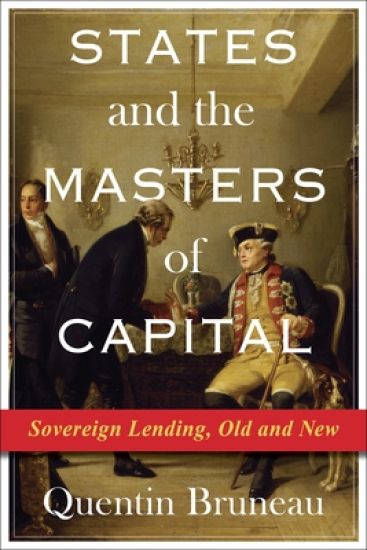
States and the Masters of Capital

States and the Masters of Capital

Quentin Bruneau

Columbia University Press
2022
sidottu
Winner, 2025 Francesco Guicciardini Prize for Best Book in Historical International Relations, Historical International Relations section, International Studies AssociationToday, states’ ability to borrow private capital depends on stringent evaluations of their creditworthiness. While many presume that this has long been the case, Quentin Bruneau argues that it is a surprisingly recent phenomenon—the outcome of a pivotal shift in the social composition of financial markets.Investigating the financiers involved in lending capital to sovereigns over the past two centuries, Bruneau identifies profound changes in their identities, goals, and forms of knowledge. He shows how an old world made up of merchant banking families pursuing both profit and status gradually gave way to a new one dominated by large companies, such as joint stock banks and credit rating agencies, exclusively pursuing profit. Lacking the web of personal ties to sovereigns across the world that their established rivals possessed, these financial institutions began relying on a different form of knowledge created to describe and compare states through quantifiable data: statistics. Over the course of this epochal shift, which only came to an end a few decades ago, financial markets thus reconceptualized states. Instead of a set of individuals to be known in person, they became numbers on a page. Raising new questions about the history of sovereign lending, this book illuminates the nature of the relationship between states and financial markets today—and suggests that it may be on the cusp of another major transformation.
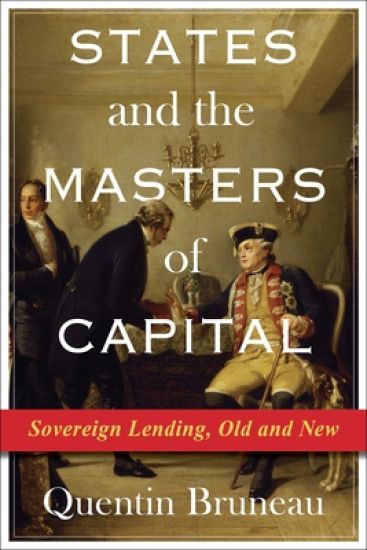
States and the Masters of Capital

States and the Masters of Capital

Quentin Bruneau

Columbia University Press
2022
pokkari
Winner, 2025 Francesco Guicciardini Prize for Best Book in Historical International Relations, Historical International Relations section, International Studies AssociationToday, states’ ability to borrow private capital depends on stringent evaluations of their creditworthiness. While many presume that this has long been the case, Quentin Bruneau argues that it is a surprisingly recent phenomenon—the outcome of a pivotal shift in the social composition of financial markets.Investigating the financiers involved in lending capital to sovereigns over the past two centuries, Bruneau identifies profound changes in their identities, goals, and forms of knowledge. He shows how an old world made up of merchant banking families pursuing both profit and status gradually gave way to a new one dominated by large companies, such as joint stock banks and credit rating agencies, exclusively pursuing profit. Lacking the web of personal ties to sovereigns across the world that their established rivals possessed, these financial institutions began relying on a different form of knowledge created to describe and compare states through quantifiable data: statistics. Over the course of this epochal shift, which only came to an end a few decades ago, financial markets thus reconceptualized states. Instead of a set of individuals to be known in person, they became numbers on a page. Raising new questions about the history of sovereign lending, this book illuminates the nature of the relationship between states and financial markets today—and suggests that it may be on the cusp of another major transformation.
Ethical and Religious Thought in Analytic Philosophy of Language
This book is the first to provide a critical history of analytic philosophy from its inception in the late nineteenth century to the present day. Quentin Smith focuses on the connections between the four leading movements in analytic philosophy—logical realism, logical positivism, ordinary language analysis, and linguistic essentialism—and corresponding twentieth-century theories of ethics and of religion. Through a critical evaluation of each school’s theoretical positions, Smith counters the widespread view of analytic philosophy as indifferent to important questions about right and wrong and human meaning. He argues that analytic philosophy throughout its history has revolved around the central issues of existence, and he offers a new ethics and philosophy of religion.The author develops a positive ethical theory based on a method of ethics first formulated by Robert Adams. Smith’s theory belongs to the tradition of perfectionism or self-realization ethics and builds on Thomas Hurka’s recent theory of perfectionism. In his consideration of philosophy of religion, Smith concludes that there is a sound "logical argument from evil" that takes into account Alvin Plantinga’s free-will defense and undermines monotheism, paving the way to a naturalistic pantheism.