Kirjojen hintavertailu. Mukana 12 016 292 kirjaa ja 12 kauppaa.

Kirjahaku

Etsi kirjoja tekijän nimen, kirjan nimen tai ISBN:n perusteella.

1000 tulosta hakusanalla Sharon Stuart

Thinking Socratically

Thinking Socratically

Sharon Schwarze; Harvey Lape

Pearson
2012
nidottu
ALERT: Before you purchase, check with your instructor or review your course syllabus to ensure that you select the correct ISBN. Several versions of Pearson's MyLab & Mastering products exist for each title, including customized versions for individual schools, and registrations are not transferable. In addition, you may need a CourseID, provided by your instructor, to register for and use Pearson's MyLab & Mastering products. Packages Access codes for Pearson's MyLab & Mastering products may not be included when purchasing or renting from companies other than Pearson; check with the seller before completing your purchase. Used or rental books If you rent or purchase a used book with an access code, the access code may have been redeemed previously and you may have to purchase a new access code. Access codes Access codes that are purchased from sellers other than Pearson carry a higher risk of being either the wrong ISBN or a previously redeemed code. Check with the seller prior to purchase. -- Critical Thinking Skills in Everyday Context – The Socrates Model Thinking Socratically is a treatment of critical thinking, rather than an informal logic textbook. It emphasizes a philosophical reflection on real issues from everyday life, in order to teach students the skills of critical thinking in a commonplace context that is easy to understand and certain to be remembered. Teaching and Learning Experience Improve Critical Thinking - Thinking Socratically contextualizes the presentation of critical thinking topics through easy-to-understand information, and shows, rather than just tells, students how to be critical thinkers by encouraging them to follow Socrates as a model. Engage Students – Thinking Socratically exposes students to a variety of readings listed after expository material, Venn diagrams, chapter-end summaries, etc. – in order to outline important concepts and learning tools needed for useful reasoning. Support Instructors - Teaching your course just got easier! You can create a Customized Text or use our Instructor’s Manual, or PowerPoint Presentation Slides. Plus, Thinking Socratically is organized around topics for ease of assignments, and uses standard terminology to eliminate student confusion.
Blood, Tin, Straw

Blood, Tin, Straw

Sharon Olds

Vintage
2000
pokkari
Sharon Olds divides this new book into five sections - 'Blood', 'Tin', ' 'Straw', ' 'Fire' and 'Light' - each made up of fourteen poems whose dominant imagery is drawn from one of these elements.
Unswept Room

Unswept Room

Sharon Olds

Vintage Publishing
2003
pokkari
The Unswept Room is a dazzling collection of poems that project a fresh spirit, a startling energy of language and rhythm, and a moving, elegiac tone shot through with humour.
Selected Poems

Selected Poems

Sharon Olds

Vintage
2005
pokkari
This rich selection - made by the author - exhibits those qualities in poem after poem, reflecting, moreover, an exciting experimentation with rhythm and language and a movement toward an embrace beyond the personal.
Stag's Leap

Stag's Leap

Sharon Olds

Vintage
2012
pokkari
Eliot Poetry PrizeStag's Leap, Sharon Olds' stunningly poignant new sequence of poems, tells the story of a divorce, embracing strands of love, sex, sorrow, memory, and new freedom.
An Image of God

An Image of God

Sharon M. Leon

University of Chicago Press
2013
sidottu
In the first half of the twentieth century, supporters of the eugenics movement offered an image of a racially transformed America by curtailing the reproduction of "unfit" members of society. Through institutionalization, compulsory sterilization, the restriction of immigration and marriages, and other methods, eugenicists promised to improve the population - a policy agenda that was embraced by many leading intellectuals and public figures. But Catholic activists and thinkers across the United States opposed many of these measures, asserting that "every man, even a lunatic, is an image of God, not a mere animal." In "An Image of God", Sharon M. Leon examines the efforts of American Catholics to thwart eugenic policies, illuminating the ways in which Catholic thought transformed the public conversation about individual rights, the role of the state, and the intersections of race, community, and family. Through an examination of the broader questions raised in this debate, Leon casts new light on major issues that remain central in American political life today: the institution of marriage, the role of government, and the separation of church and state. This is essential reading in the history of religion, science, politics, and human rights.
Impersonality

Impersonality

Sharon Cameron

University of Chicago Press
2007
sidottu
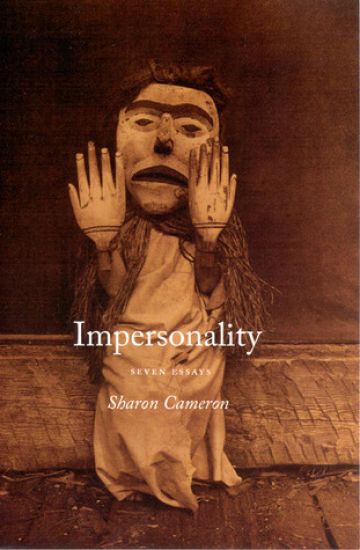
Philosophers have long debated the subjects of person and personhood. Sharon Cameron ushers this debate into the literary realm by considering impersonality in the works of major American writers and figures of international modernism—writers for whom personal identity is inconsequential and even imaginary. In essays on William Empson, Jonathan Edwards, Ralph Waldo Emerson, Herman Melville, T. S. Eliot, and Simone Weil, Cameron examines the impulse to hollow out the core of human distinctiveness, to construct a voice that is no one’s voice, to fashion a character without meaningful attributes, a being that is virtually anonymous. “To consent to being anonymous,” Weil wrote, “is to bear witness to the truth. But how is this compatible with social life and its labels?” Throughout these essays Cameron examines the friction, even violence, set in motion from such incompatibility—from a “truth” that has no social foundation. Impersonality investigates the uncompromising nature of writing that suspends, eclipses, and even destroys the person as a social, political, or individual entity, of writing that engages with personal identity at the moment when its usual markers vanish or dissolve.
Impersonality

Impersonality

Sharon Cameron

University of Chicago Press
2007
nidottu
Philosophers have long debated the subjects of person and personhood. Sharon Cameron ushers this debate into the literary realm by considering impersonality in the works of major American writers and figures of international modernism—writers for whom personal identity is inconsequential and even imaginary. In essays on William Empson, Jonathan Edwards, Ralph Waldo Emerson, Herman Melville, T. S. Eliot, and Simone Weil, Cameron examines the impulse to hollow out the core of human distinctiveness, to construct a voice that is no one’s voice, to fashion a character without meaningful attributes, a being that is virtually anonymous. “To consent to being anonymous,” Weil wrote, “is to bear witness to the truth. But how is this compatible with social life and its labels?” Throughout these essays Cameron examines the friction, even violence, set in motion from such incompatibility—from a “truth” that has no social foundation. Impersonality investigates the uncompromising nature of writing that suspends, eclipses, and even destroys the person as a social, political, or individual entity, of writing that engages with personal identity at the moment when its usual markers vanish or dissolve.
Writing Nature

Writing Nature

Sharon Cameron

University of Chicago Press
1989
nidottu
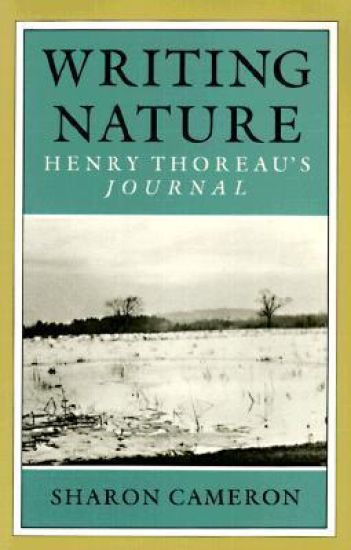
At his death, Henry Thoreau left the majority of his writing unpublished. The bulk of this material is a journal that he kept for twenty-four years. Sharon Cameron's major claim is that this private work (the Journal) was Thoreau's primary work, taking precedence over the books that he published in his lifetime. Her controversial thesis views Thoreau's Journal as a composition that confounds the distinction between public and private—the basis on which our conventional treatment of discourse depends.
Thinking in Henry James

Thinking in Henry James

Sharon Cameron

University of Chicago Press
1991
nidottu
Thinking in Henry James identifies what is genuinely strange and radical about James's concept of consciousness—first, the idea that it may not always be situated within this or that person but rather exists outside or "between," in some transpersonal place; and second, the idea that consciousness may have power over things and people outside the person who thinks. Examining these and other counterintuitive representations of consciousness, Cameron asks, "How do we make sense of these conceptions of thinking?"
Choosing Not Choosing

Choosing Not Choosing

Sharon Cameron

University of Chicago Press
1993
sidottu
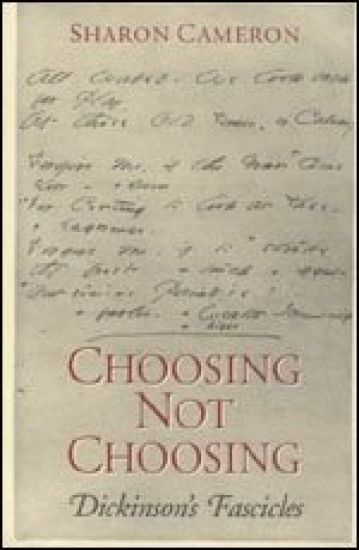
Although Emily Dickinson copied and bound her poems into manuscript notebooks, in the century since her death her poems have been read as single lyrics with little or no regard for the context she created for them in her fascicles. Choosing Not Choosing is the first book-length consideration of the poems in their manuscript context. Sharon Cameron demonstrates that to read the poems with attention to their placement in the fascicles is to observe scenes and subjects unfolding between and among poems rather than to think of them as isolated riddles, enigmatic in both syntax and reference. Thus Choosing Not Choosing illustrates that the contextual sense of Dickinson is not the canonical sense of Dickinson. Considering the poems in the context of the fascicles, Cameron argues that an essential refusal of choice pervades all aspects of Dickinson's poetry. Because Dickinson never chose whether she wanted her poems read as single lyrics or in sequence (nor is it clear where any fascicle text ends, or even how, in context, a poem is bounded), "not choosing" is a textual issue; it is also a formal issue because Dickinson refused to chose among poetic variants; it is a thematic issue; and, finally, it is a philosophical one, since what is produced by "not choosing" is a radical indifference to difference. Extending the readings of Dickinson offered in her earlier book Lyric Time, Cameron continues to enlarge our understanding of the work of this singular American poet.
Choosing Not Choosing

Choosing Not Choosing

Sharon Cameron

University of Chicago Press
1993
nidottu
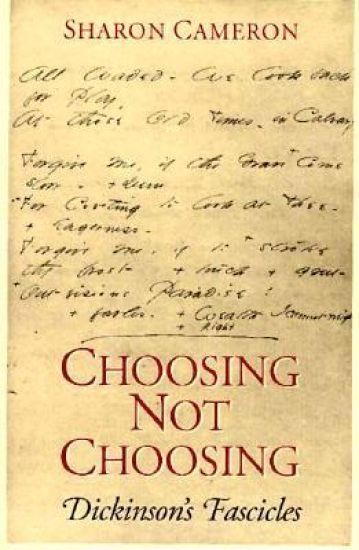
Although Emily Dickinson copied and bound her poems into manuscript notebooks, in the century since her death her poems have been read as single lyrics with little or no regard for the context she created for them in her fascicles. Choosing Not Choosing is the first book-length consideration of the poems in their manuscript context. Sharon Cameron demonstrates that to read the poems with attention to their placement in the fascicles is to observe scenes and subjects unfolding between and among poems rather than to think of them as isolated riddles, enigmatic in both syntax and reference. Thus Choosing Not Choosing illustrates that the contextual sense of Dickinson is not the canonical sense of Dickinson. Considering the poems in the context of the fascicles, Cameron argues that an essential refusal of choice pervades all aspects of Dickinson's poetry. Because Dickinson never chose whether she wanted her poems read as single lyrics or in sequence (nor is it clear where any fascicle text ends, or even how, in context, a poem is bounded), "not choosing" is a textual issue; it is also a formal issue because Dickinson refused to chose among poetic variants; it is a thematic issue; and, finally, it is a philosophical one, since what is produced by "not choosing" is a radical indifference to difference. Extending the readings of Dickinson offered in her earlier book Lyric Time, Cameron continues to enlarge our understanding of the work of this singular American poet.
Freedom Beyond Sovereignty

Freedom Beyond Sovereignty

Sharon R. Krause

University of Chicago Press
2015
sidottu
What does it mean to be free? We invoke the word frequently, yet the freedom of countless Americans is compromised by social inequalities that systematically undercut what they are able to do and to become. If we are to remedy these failures of freedom, we must move beyond the common assumption, prevalent in political theory and American public life, that individual agency is best conceived as a kind of personal sovereignty, or as self-determination or control over one's actions. In Freedom Beyond Sovereignty, Sharon R Krause shows that individual agency is best conceived as a non-sovereign experience because our ability to act and affect the world depends on how other people interpret and respond to what we do. The intersubjective character of agency makes it vulnerable to the effects of social inequality, but it is never in a strict sense socially determined. The agency of the oppressed sometimes surprises us with its vitality. Only by understanding the deep dynamics of agency as simultaneously non-sovereign and robust can we remediate the failed freedom of those on the losing end of persistent inequalities and grasp the scope of our own responsibility for social change. Freedom Beyond Sovereignty brings the experiences of the oppressed to the center of political theory and the study of freedom. It fundamentally reconstructs liberal individualism and enables us to see human action, personal responsibility, and the meaning of liberty in a totally new light.
Democratic Art

Democratic Art

Sharon Ann Musher

University of Chicago Press
2015
sidottu
Throughout the Great Recession American artists and public art endowments have had to fight for government support to keep themselves afloat. It wasn't always this way. At its height in 1935, the New Deal devoted $27 million - roughly $469 million today - to supporting tens of thousands of needy artists, who used that support to create more than 100,000 works. Why did the government become so involved with these artists, and why weren't these projects considered a frivolous waste of funds, as surely many would be today? In Democratic Art, Sharon Ann Musher explores these questions and uses them as a springboard for an examination of the role art can and should play in contemporary society. Drawing on close readings of government-funded architecture, murals, plays, writing, and photographs, Democratic Art examines the New Deal's diverse cultural initiatives and outlines five perspectives on art that were prominent at the time: art as grandeur, enrichment, weapon, experience, and subversion. Musher argues that those engaged in New Deal art were part of an explicitly cultural agenda that sought not just to create art but to democratize and Americanize it as well. By tracing a range of aesthetic visions that flourished during the 1930s, this highly original book outlines the successes, shortcomings, and lessons of the golden age of government funding for the arts.
The Bond of the Furthest Apart

The Bond of the Furthest Apart

Sharon Cameron

University of Chicago Press
2017
sidottu
In French filmmaker Robert Bresson's cinematography, the linkage of fragmented, dissimilar images challenges our assumption that we know either what things are in themselves or the infinite ways in which they are entangled. The "bond" of Cameron's title refers to the astonishing connections found both within Bresson's films and across literary works by Tolstoy, Dostoevsky, and Kafka, whose visionary rethinkings of experience are akin to Bresson's in their resistance to all forms of abstraction and classification that segregate aspects of reality. Whether exploring Bresson's efforts to reassess the limits of human reason and will, Dostoevsky's subversions of Christian conventions, Tolstoy's incompatible beliefs about death, or Kafka's focus on creatures neither human nor animal, Cameron illuminates how the repeated juxtaposition of disparate, even antithetical, phenomena carves out new approaches to defining the essence of being, one where the very nature of fixed categories is brought into question. An innovative look at a classic French auteur and three giants of European literature, The Bond of the Furthest Apart will interest scholars of literature, film, ethics, aesthetics, and anyone drawn to an experimental venture in critical thought.
The Bond of the Furthest Apart

The Bond of the Furthest Apart

Sharon Cameron

University of Chicago Press
2017
nidottu
In French filmmaker Robert Bresson's cinematography, the linkage of fragmented, dissimilar images challenges our assumption that we know either what things are in themselves or the infinite ways in which they are entangled. The "bond" of Cameron's title refers to the astonishing connections found both within Bresson's films and across literary works by Tolstoy, Dostoevsky, and Kafka, whose visionary rethinkings of experience are akin to Bresson's in their resistance to all forms of abstraction and classification that segregate aspects of reality. Whether exploring Bresson's efforts to reassess the limits of human reason and will, Dostoevsky's subversions of Christian conventions, Tolstoy's incompatible beliefs about death, or Kafka's focus on creatures neither human nor animal, Cameron illuminates how the repeated juxtaposition of disparate, even antithetical, phenomena carves out new approaches to defining the essence of being, one where the very nature of fixed categories is brought into question. An innovative look at a classic French auteur and three giants of European literature, The Bond of the Furthest Apart will interest scholars of literature, film, ethics, aesthetics, and anyone drawn to an experimental venture in critical thought.
And a Time to Die

And a Time to Die

Sharon R. Kaufman

University of Chicago Press
2006
nidottu
Over the past thirty years, the way Americans experience death has been dramatically altered. The advent of medical technology capable of sustaining life without restoring health has changed where, when, and how we die. In this revelatory study, medical anthropologist Sharon R. Kaufman examines the powerful center of those changes: the hospital, where most Americans die today. She deftly links the experiences of patients and families, the work of hospital staff, and the ramifications of institutional bureaucracy to show the invisible power of the hospital system in shaping death and our individual experience of it. In doing so, Kaufman also speaks to the ways we understand what it means to be human and to be alive. “An act of courage and a public service.”—San Francisco Chronicle “This beautifully synthesized and disquieting account of how hospital patients die melds disciplined description with acute analysis, incorporating the voices of doctors, nurses, social workers, and patients in a provocative analysis of the modern American quest for a ‘good death.’”—Publishers Weekly “Kaufman exposes the bureaucratic and ethical quandaries that hover over the modern deathbed.”—Psychology Today “Kaufman’s analysis illuminates the complexity of the care of critically ill and dying patients [and] the ambiguity of slogans such as ‘death with dignity,’ ‘quality of life,’ and ‘stopping life support.’ . . . Thought-provoking reading for everyone contemplating the fate of us all.”—New England Journal of Medicine