Kirjahaku
Etsi kirjoja tekijän nimen, kirjan nimen tai ISBN:n perusteella.
1000 tulosta hakusanalla Stuart G Yates


"Arabella Stuart: A Romance from English History" by G. P. R. James is a captivating historical romance set in 16th-century England, centered around the real-life figure Arabella Stuart. The novel intricately weaves royal intrigue and political drama, offering a rich portrayal of Tudor period court life. Through the lens of Arabella Stuart's story, James explores themes of love and ambition against a backdrop of social conflict and family loyalty. The narrative delves into the complexities of courtly relationships and the challenges faced by individuals caught in the web of historical events. James's depiction of the historical setting and the romantic adventure provides a compelling look at the personal and political stakes of the time. By blending historical figures with imaginative storytelling, "Arabella Stuart" captures the essence of English history while delivering an engaging and dramatic romance. The book stands out for its detailed portrayal of the era and its nuanced exploration of personal and political dynamics.

Studies in Tudor and Stuart Politics and Government: Volume 4, Papers and Reviews 1982–1990
G. R. Elton
Cambridge University Press
1992
sidottu
This collection features the publication of Sir Geoffrey Elton's articles and reviews, published between 1982 and 1990, in continuation of three previous volumes. Volume IV contains a group of pieces on sixteenth-century government and politics, and more especially on aspects of the Reformation, on the continent as well as in England, with some attention to Martin Luther and an essay on Lancelot Andrewes. Several pieces deal with parliament under the Tudors. A second group, 'on Historians', reprints an appraisal of Sir Herbert Butterfield and three substantial reviews on historiographical problems.

Studies in Tudor and Stuart Politics and Government: Volume 3, Papers and Reviews 1973–1981
G. R. Elton
Cambridge University Press
2003
pokkari
This volume continues the publication of Professor Elton’s collected papers on topics in the history of Tudor and Stuart England. All appeared between 1973 and 1981. As before, they are reprinted exactly as originally published, with corrections and additions in footnotes. They include the author's four presidential addresses to the Royal Historical Society and bring together his preliminary findings in the history of Parliament and its records. Several of them, which appeared in various collections and Festschriften, have been difficult to find, and some are taken from locations in Germany and the United States unfamiliar to English readers. The eight lengthy reviews here republished examine some of the major questions in the history of the age and throw light on the principles of investigation which underlie the author’s own research.
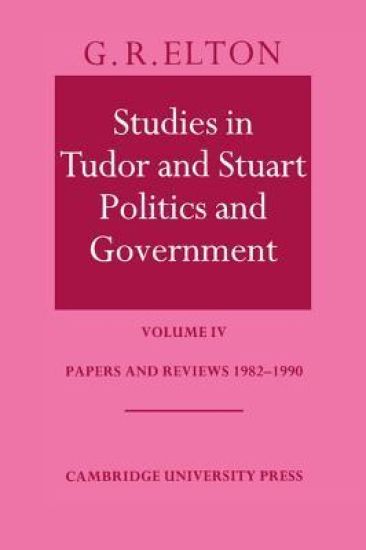
Studies in Tudor and Stuart Politics and Government: Volume 4, Papers and Reviews 1982–1990
G. R. Elton
Cambridge University Press
2003
pokkari
This collection features the publication of Sir Geoffrey Elton’s articles and reviews, published between 1982 and 1990, in continuation of three previous volumes. Volume IV contains a group of pieces on sixteenth-century government and politics, and more especially on aspects of the Reformation, on the continent as well as in England, with some attention to Martin Luther and an essay on Lancelot Andrewes. Several pieces deal with parliament under the Tudors. A second group, ‘on Historians’, reprints an appraisal of Sir Herbert Butterfield and three substantial reviews on historiographical problems.

Studies in Tudor and Stuart Politics and Government: Volume 1, Tudor Politics Tudor Government
G. R. Elton
Cambridge University Press
2003
pokkari
The papers collected in these volumes revolve around the political, constitutional and personal problems of the English government between the end of the fifteenth-century civil wars and the beginning of those of the seventeenth century. Previously published in a great variety of places, none of them appeared in book form before. They are arranged in four groups (Tudor Politics and Tudor Government in Volume I, Parliament and Political Thought in Volume II) but these groups interlock. Though written in the course of some two decades, all the pieces bear variously on the same body of major issues and often illuminate details only touched upon in Professor Elton’s books. Several investigate the received preconceptions of historians and suggest new ways of approaching familiar subjects. They are reprinted unaltered, but some new footnotes have been added to correct errors and draw attention to later developments.
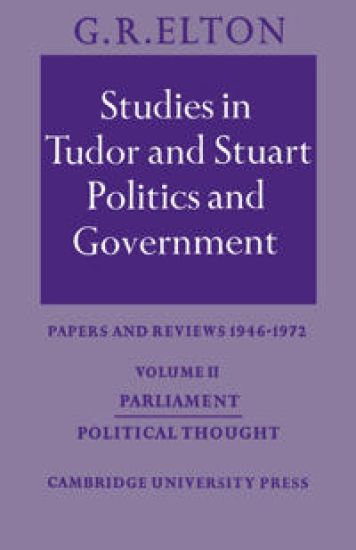
Studies in Tudor and Stuart Politics and Government: Volume 2, Parliament Political Thought
G. R. Elton
Cambridge University Press
2003
pokkari
The papers collected in these volumes revolve around the political, constitutional and personal problems of the English government between the end of the fifteenth-century civil wars and the beginning of those of the seventeenth century. Previously published in a great variety of places, none of them appeared in book form before. They are arranged in four groups (Tudor Politics and Tudor Government in Volume I, Parliament and Political Thought in Volume II) but these groups interlock. Though written in the course of some two decades, all the pieces bear variously on the same body of major issues and often illuminate details only touched upon in Professor Elton’s books. Several investigate the received preconceptions of historians and suggest new ways of approaching familiar subjects. They are reprinted unaltered, but some new footnotes have been added to correct errors and draw attention to later developments.
Freemasonry and the House of Stuart
Albert G. MacKey; William R. Singleton
Kessinger Pub
2005
pokkari
Sermon At The Ordination Of William G. Schauffler As Missionary To The Jews (1845)
Moses Stuart
KESSINGER PUBLISHING, LLC
2010
sidottu

First published in 1934, Late Tudor and Early Stuart Geography is a critical commentary on a chronologically arranged bibliography of nearly two thousand contemporary printed and manuscript works. Poets, preachers and philosophers, mathematicians, physicians and astrologers, sailors, merchants and company-promoters were contributors to the absorbing medley that comprises the geographical literature of the late Tudor and early Stuart period. For this was the fading twilight of that Golden Age of unspecialized learning when all knowledge lay within one man’s compass. This book will be of interest to historians, economists, sociologists and litterateurs.

First published in 1934, Late Tudor and Early Stuart Geography is a critical commentary on a chronologically arranged bibliography of nearly two thousand contemporary printed and manuscript works. Poets, preachers and philosophers, mathematicians, physicians and astrologers, sailors, merchants and company-promoters were contributors to the absorbing medley that comprises the geographical literature of the late Tudor and early Stuart period. For this was the fading twilight of that Golden Age of unspecialized learning when all knowledge lay within one man’s compass. This book will be of interest to historians, economists, sociologists and litterateurs.
Logic and Reality in the Philosophy of John Stuart Mill
G. Scarre
Kluwer Academic Publishers
1988
sidottu
'Nobody reads Mill today,' wrote a reviewer in Time magazine a few years ago. ! One could scarcely praise Mr Melvin Maddocks, who penned that remark, for his awareness of the present state of Mill studies, for of all nineteenth century philosophers who wrote in English, it is 1. S. Mill who remains the most read today. Yet it would not be so far from the truth to say that very few people pay much serious attention nowadays to Mill's writings about logic and metaphysics (as distinct from those on ethical and social issues), despite the fact that Mill put enormous effort into their composition and through them exerted a considerable influen ce on the course of European philosophy for the rest of his century. But the only sections of A System of Logic (1843) and An Examination of Sir William Hamilton's Philosophy (1865) to which much reference is now made comprise only a small proportion of those very large books, and the prevailing assumption is that Mill's theories about logical and meta physical questions are, with few exceptions, of merely antiquarian in terest. Bertrand Russell once said that Mill's misfortune was to be born at the wrong time (Russell (1951), p. 2). It can certainly appear that Mill chose an inauspicious time to attempt a major work on logic.
'Nobody reads Mill today,' wrote a reviewer in Time magazine a few years ago. ! One could scarcely praise Mr Melvin Maddocks, who penned that remark, for his awareness of the present state of Mill studies, for of all nineteenth century philosophers who wrote in English, it is 1. S. Mill who remains the most read today. Yet it would not be so far from the truth to say that very few people pay much serious attention nowadays to Mill's writings about logic and metaphysics (as distinct from those on ethical and social issues), despite the fact that Mill put enormous effort into their composition and through them exerted a considerable influen ce on the course of European philosophy for the rest of his century. But the only sections of A System of Logic (1843) and An Examination of Sir William Hamilton's Philosophy (1865) to which much reference is now made comprise only a small proportion of those very large books, and the prevailing assumption is that Mill's theories about logical and meta physical questions are, with few exceptions, of merely antiquarian in terest. Bertrand Russell once said that Mill's misfortune was to be born at the wrong time (Russell (1951), p. 2). It can certainly appear that Mill chose an inauspicious time to attempt a major work on logic.
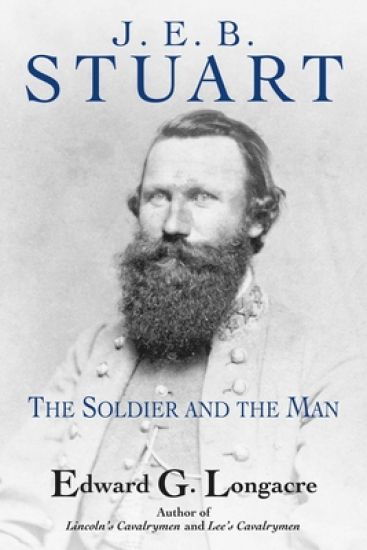
Fifteen years have passed since the publication of the last biography of Jeb Stuart. Several appeared during the last century lauding his contributions to Confederate fortunes in the Eastern Theater. Each follows a familiar tradition established by hero-worshipping subordinates portraying its subject as a model of chivalric conduct with a romantic’s outlook on life and a sense of fair dealing and goodwill, even toward his enemy. J. E. B. Stuart: The Soldier and the Man, by award-winning author Edward Longacre, is the first balanced, detailed, and thoroughly scrutinized study of the life and service of the Civil War’s most famous cavalryman. Long known to scholars and history buffs alike as “The Beau Sabreur of the Confederacy,” James Ewell Brown Stuart of Virginia was possessed of many gifts, personally and professionally, and led the Army of Northern Virginia’s cavalry to the all-but-complete satisfaction of his superiors. Stuart, insisted Robert E. Lee, “never brought me a piece of false information.” Being human, Stuart also under-performed. On occasion, he underestimated his opponents, took unnecessary risks with his habitually understrength command, failed to properly discipline and motivate his troopers, and was prone to errors both strategic and tactical. These flaws were evident during the Gettysburg Campaign, when his wayward route to the battlefield deprived Lee of the ability to safely negotiate his path toward a climactic confrontation with the Union Army of the Potomac. Because of his outsized wartime reputation—one embellished in the century-and-a-half since—most of Stuart’s errors have passed virtually unnoticed or, when addressed, have been excused or explained away in some fashion. Longacre’s study is based on hundreds of published works, archival sources, and newspapers. He probes not only Stuart’s military career but elements of his character and personality that invite investigation. Even the man’s fiercest partisans admitted that he was vain and inordinately sensitive to criticism, with a curious streak of immaturity—at times the hard-edged veteran, at other times a devotee of the pageantry of war, given to affectations such as ostrich-plumed hats, golden spurs, and the headquarters musicians who accompanied him on the march. Ever motivated by appeals to vanity, he curried the patronage of powerful men and responded readily to the attentions of attractive women even though by 1861, he was a long-married man. Personal flaws and limitations aside, Stuart was popular with his officers and men, beloved by members of his staff, and considered by the people of his state and region the beau ideal of Confederate soldiery. The distinction endures today. Longacre’s J. E. B. Stuart is an attempt to determine its validity.

G.A.T.C.A.
Ross K. McGill; Christopher A. Haye; Stuart Lipo
Springer International Publishing AG
2018
nidottu
This book is a practical guide to global anti-tax evasion frameworks. Coverage includes base erosion and profit shifting (BEPS), the Common Reporting Standard (CRS), and the Automatic Exchange of Information (AEoI). It covers the practical operational issues these frameworks present and offers insight into practical compliance options and operational methodologies to reduce costs and risks. The book concludes with insights into how institutions can translate these complex obligations into effective client communications.
![The History of Modern Civilization. A handbook based upon M. G. D.'s "Histoire Sommaire de la Civilisation." With illustrations. [Edited by J. Verschoyle.]](/covers/9781241430436.jpg)
The History of Modern Civilization. A handbook based upon M. G. D.'s "Histoire Sommaire de la Civilisation." With illustrations. [Edited by J. Verschoyle.]
Gustave Ducoudray; John Stuart Verschoyle
British Library, Historical Print Editions
2011
pokkari
Title: The History of Modern Civilization. A handbook based upon M. G. D.'s "Histoire Sommaire de la Civilisation." With illustrations. Edited by J. Verschoyle.]Publisher: British Library, Historical Print EditionsThe British Library is the national library of the United Kingdom. It is one of the world's largest research libraries holding over 150 million items in all known languages and formats: books, journals, newspapers, sound recordings, patents, maps, stamps, prints and much more. Its collections include around 14 million books, along with substantial additional collections of manuscripts and historical items dating back as far as 300 BC.The GENERAL HISTORICAL collection includes books from the British Library digitised by Microsoft. This varied collection includes material that gives readers a 19th century view of the world. Topics include health, education, economics, agriculture, environment, technology, culture, politics, labour and industry, mining, penal policy, and social order. ++++The below data was compiled from various identification fields in the bibliographic record of this title. This data is provided as an additional tool in helping to insure edition identification: ++++ British Library Ducoudray, Gustave; Verschoyle, John Stuart; 1891. xx, 585 p.; 8 . 9009.d.6.
George W. Green et al., Petitioners, V. City of Stuart, Florida. U.S. Supreme Court Transcript of Record with Supporting Pleadings
Carroll Dunscombe; M G Littman
Gale Ecco, U.S. Supreme Court Records
2011
pokkari