Kirjojen hintavertailu. Mukana 12 045 104 kirjaa ja 12 kauppaa.

Kirjahaku

Etsi kirjoja tekijän nimen, kirjan nimen tai ISBN:n perusteella.

1000 tulosta hakusanalla Derek Gerrard

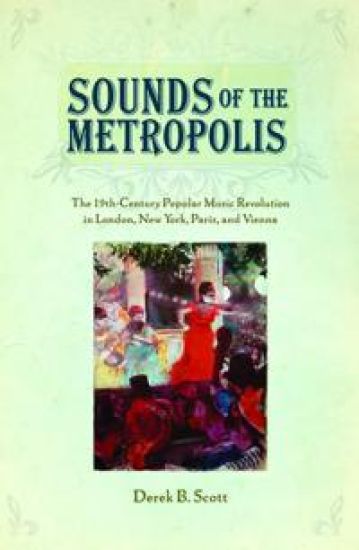
Sounds of the Metropolis

Sounds of the Metropolis

Derek B. Scott

Oxford University Press Inc
2008
sidottu
The phrase "popular music revolution" may instantly bring to mind such twentieth-century musical movements as jazz and rock 'n' roll. In Sounds of the Metropolis, however, Derek Scott argues that the first popular music revolution actually occurred in the nineteenth century, illustrating how a distinct group of popular styles first began to assert their independence and values. London, New York, Paris, and Vienna feature prominently as cities in which the challenge to the classical tradition was strongest, and in which original and influential forms of popular music arose, from Viennese waltz and polka to vaudeville and cabaret. Scott explains the popular music revolution as driven by social changes and the incorporation of music into a system of capitalist enterprise, which ultimately resulted in a polarization between musical entertainment (or "commercial" music) and "serious" art. He focuses on the key genres and styles that precipitated musical change at that time, and that continued to have an impact upon popular music in the next century. By the end of the nineteenth century, popular music could no longer be viewed as watered down or more easily assimilated art music; it had its own characteristic techniques, forms, and devices. As Scott shows, "popular" refers here, for the first time, not only to the music's reception, but also to the presence of these specific features of style. The shift in meaning of "popular" provided critics with tools to condemn music that bore the signs of the popular-which they regarded as fashionable and facile, rather than progressive and serious. A fresh and persuasive consideration of the genesis of popular music on its own terms, Sounds of the Metropolis will appeal to students of music, cultural sociology, and history.
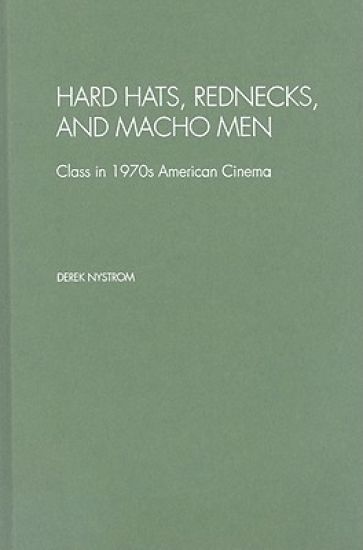
Hard Hats, Rednecks, and Macho Men

Hard Hats, Rednecks, and Macho Men

Derek Nystrom

Oxford University Press Inc
2009
sidottu
Everywhere you look in 1970s American cinema, you find white working-class men. They bring a violent conclusion to Easy Rider, murdering the film's representatives of countercultural alienation and disaffection. They lurk in the Georgia woods of Deliverance, attacking outsiders in a manner that evokes the South's recent history of racial violence and upheaval. They haunt the singles nightclubs of Looking for Mr. Goodbar, threatening the film's newly liberated heroine with patriarchal violence. They strut through the disco clubs of Saturday Night Fever, dancing to music whose roots in post-Stonewall homosexuality invite ambiguity that the men ignore. Hard Hats, Rednecks, and Macho Men argues that the persistent appearance of working-class characters in these and other films of the 1970s reveals the powerful role class played in the key social and political developments of the decade, such as the decline of the New Left and counterculture, the re-emergence of the South as the Sunbelt, and the rise of the women's and gay liberation movements. Examining the "youth cult" film, the neo-Western "southern," and the "new nightlife" film, Nystrom shows how these cinematic renderings of white working-class masculinity actually tell us more about the crises facing the middle class during the 1970s than about working-class experience itself. Hard Hats thus demonstrates how these representations of the working class serve as fantasies about a class Other-fantasies that offer imaginary resolutions to middle-class anxieties provoked by the decade's upheavals. Drawing on examples of iconic films from the era-Saturday Night Fever, Cruising, Five Easy Pieces, and Walking Tall, among others-Nystrom presents an incisive, evocative study of class and American cinema during one of the nation's most tumultuous decades.
Hard Hats, Rednecks, and Macho Men

Hard Hats, Rednecks, and Macho Men

Derek Nystrom

Oxford University Press Inc
2009
nidottu
Everywhere you look in 1970s American cinema, you find white working-class men. They bring a violent conclusion to Easy Rider, murdering the film's representatives of countercultural alienation and disaffection. They lurk in the Georgia woods of Deliverance, attacking outsiders in a manner that evokes the South's recent history of racial violence and upheaval. They haunt the singles nightclubs of Looking for Mr. Goodbar, threatening the film's newly liberated heroine with patriarchal violence. They strut through the disco clubs of Saturday Night Fever, dancing to music whose roots in post-Stonewall homosexuality invite ambiguity that the men ignore. Hard Hats, Rednecks, and Macho Men argues that the persistent appearance of working-class characters in these and other films of the 1970s reveals the powerful role class played in the key social and political developments of the decade, such as the decline of the New Left and counterculture, the re-emergence of the South as the Sunbelt, and the rise of the women's and gay liberation movements. Examining the "youth cult" film, the neo-Western "southern," and the "new nightlife" film, Nystrom shows how these cinematic renderings of white working-class masculinity actually tell us more about the crises facing the middle class during the 1970s than about working-class experience itself. Hard Hats thus demonstrates how these representations of the working class serve as fantasies about a class Other-fantasies that offer imaginary resolutions to middle-class anxieties provoked by the decade's upheavals. Drawing on examples of iconic films from the era-Saturday Night Fever, Cruising, Five Easy Pieces, and Walking Tall, among others-Nystrom presents an incisive, evocative study of class and American cinema during one of the nation's most tumultuous decades.
Parliamentary Elections in Russia

Parliamentary Elections in Russia

Derek S. Hutcheson

Oxford University Press
2018
sidottu
As a nuclear power, UN Security Council member, emerging Arctic hegemon and the largest state in the world, Russia -- and its stability -- is of extreme importance in global politics. In the most comprehensive long-term study to date, Derek Hutcheson argues that Russia's legislature, the Federal Assembly, forms an integral part of the country's political system and machinery of governance. Having previously formed a counterweight to presidential power under Boris Yeltsin, the legislative agenda has become more centralised under Vladimir Putin. Successive changes to the electoral and party systems have resulted in the dominance of a four-party 'cartel', with the pro-presidential United Russia party at its centre. A perception that Russian elections are predictable, controlled and pointless to examine has grown, but Hutcheson reminds us that real voters cast real ballots. This book tells the story of how the electoral system has evolved, how campaign strategies have developed and how voting behaviour has changed. Hutcheson has utilised a combination of official data and new primary material to set 25 years of Russian parliamentary elections into context. Putting forward an in-depth analysis of post-Soviet politics, he looks forward to the next stage in Russia's political evolution just as he looked back.
Deciphering Sun Tzu: How to Read the Art of War

Deciphering Sun Tzu: How to Read the Art of War

Derek M. C. Yuen

Oxford University Press
2022
nidottu
As the People's Republic's seemingly inexorable rise to economic and military power continues, never has the need for a better grasp of Chinese strategic thought by the West been more acute. In Deciphering Sun Tzu, Derek Yuen seeks to reclaim for the reader the hidden contours and lost Chinese and Taoist contexts of Sun Tzu's renowned treatise The Art of War, a literary classic and arguably one of the most influential books ever written. He also explains its historical, philosophical, strategic, and cross-cultural significance. His comprehensive analysis of Sun Tzu, based on a close reading of the Chinese sources, also reconstructs the philosophy, Taoist methodology and worldview that effectively form the cornerstones of Chinese strategic thinking, which are arguably as relevant today as at any moment in history. Yuen's innovative reading and analysis of Sun Tzu within and from a Chinese context is a new way of approaching the strategic master's main concepts, which he compares with those of Clausewitz, Liddell-Hart and other Western strategists. Deciphering Sun Tzu offers illuminating analysis and contextualization of The Art of War in a manner that has long been sought by Western readers and opens new means of getting to grips with Chinese strategic thought.
Lutheran Music and the Thirty Years War

Lutheran Music and the Thirty Years War

Derek L. Stauff

OXFORD UNIVERSITY PRESS INC
2025
sidottu
This book takes a new look at sacred music written in present-day central Germany during the Thirty Years War (1618-48), and in doing so reveals distinct connections between religious works and the historical and political contexts in which they emerged. As author Derek L. Stauff asserts, specific Lutheran biblical motets and sacred concertos engage with the war's events, people, and politics in more detailed and meaningful ways than previously imagined. Composers working in Saxony, like Heinrich Schütz, Johann Hermann Schein, Tobias Michael, and Andreas Hammerschmidt, crafted these connections by deftly selecting biblical texts that specifically resonated with the war, by setting their texts in ways that amplify these resonances, and by performing this music in politically meaningful contexts. As a result, their music could take on a variety of war-related meanings: some pieces represent the Lutheran church and community, stoking fears about Catholic political aggression and religious persecution, warning Lutherans of the grave peril in which their church was foundering, and comforting believers with promises of God's protection. Other works celebrate contemporary political and military alignments, such as the Swedish-Saxon alliance (1631-35) and its victory at the Battle of Breitenfeld (1631), and close scrutiny of a few musical pieces reveals hidden or implicit critique of a controversial decree like the Edict of Restitution (1628) or of the excesses of Swedish troops. Stauff investigates the scriptural texts at the root of this repertoire, drawing on theological and devotional writings to show how early modern Lutherans connected these texts to the war and its political disputes. He also reconstructs the political contexts in which some works were performed or published; while his analyses focus chiefly on Saxony--especially Leipzig--they also remain relevant to other Lutheran regions of the Holy Roman Empire. In a repertoire that might all too easily appear to uniformly preach peace and protest war, or to float timelessly in a liturgical space undisturbed by contemporary affairs, Stauff decisively shows how Lutheran composers actively reflected on and responded to the war, as well as the political and religious struggles underpinning it, through their sacred music.
English Drama, 1660-1700

English Drama, 1660-1700

Derek Hughes

Clarendon Press
1996
sidottu
This magisterial work forms a close critical study of all the surviving plays first written and professionally premiered in England between 1660 and 1700. Hughes's readable volume analyses many texts, often in detail and for the first time, and also places them within the range of contemporary theatrical output, with its diversity of outlook and constant shifts in fashion and subject. The Country-Wife and The Man of Mode are treated not as typical `Restoration Comedies' but as almost unique plays. Hughes also presents innovative work on the politcal, intellectual, and social background of the corpus, with extensive discussion of its treatment of women and the contribution of women dramatists.
Reasons and Persons

Reasons and Persons

Derek Parfit

Oxford University Press
1986
nidottu
This book challenges, with several powerful arguments, some of our deepest beliefs about rationality, morality, and personal identity. The author claims that we have a false view of our own nature; that it is often rational to act against our own best interests; that most of us have moral views that are directly self-defeating; and that, when we consider future generations the conclusions will often be disturbing. He concludes that moral non-religious moral philosophy is a young subject, with a promising but unpredictable future.
The Priesthood of Industry

The Priesthood of Industry

Derek Matthews; Malcolm Anderson; John Richard Edwards

Oxford University Press
1998
sidottu
The leading professional accounting bodies in Britain today boast more than a quarter of a million qualified members and accountants are moving into top management positions in increasing numbers. Accountants have become the foremost professional grouping in British business management. The Priesthood of Industry documents the rise of the accountancy profession, from the handful of accountants listed in the trade directories of the major cities in the late-eighteenth century to the huge commercially-oriented firms of the late-twentieth century. The authors focus on the individual: the professional accountant, and adopt an economic determinist analysis to explain the rise of public practice and the transfer of staff to industry in increasing numbers. They also consider the routes through which this transfer of skills took place, and identify demand and supply side factors to explain the professional accountant's present hegemony in business management.
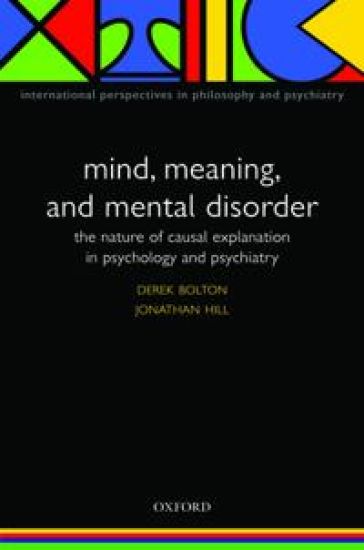
Mind, Meaning and Mental Disorder

Mind, Meaning and Mental Disorder

Derek Bolton; Jonathan Hill

Oxford University Press
2004
nidottu
Philosophical ideas about the mind, brain, and behaviour can seem theoretical and unimportant when placed alongside the urgent questions of mental distress and disorder. However, there is a need to give direction to attempts to answer these questions. On the one hand a substantial research effort is going into the investigation of brain processes and the development of drug treatments for psychiatric disorders, and on the other, a wide range of psychotherapies is becoming available to adults and children with mental health problems. These two strands reflect traditional distinctions between mind and body, and causal as opposed to meaningful explanations of behaviour. In this book, which has been written for psychiatrists, psychologists, philosophers, and others in related fields, the authors propose a radical re-interpretation of these traditional distinctions. Throughout the discussions philosophical theories are brought to bear on the particular questions of the explanation of behaviours, the nature of mental causation, and eventually the origins of major disorders including depression, anxiety disorders, schizophrenia, and personality disorder. First published in 1996, this volume played an important role in bridging the gap between philosophy and psychiatry, and introducing those in psychiatry to philosophical ideas somewhat neglected in their field. Completely updated, the new edition of this acclaimed volume draws on the strengths of the first edition, and will be a central text in the burgeoning field of philosophy of psychiatry.
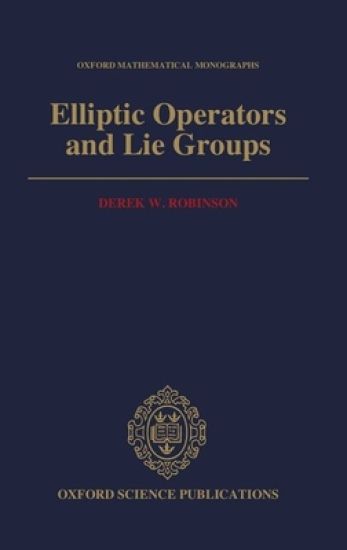
Elliptic Operators and Lie Groups

Elliptic Operators and Lie Groups

Derek W. Robinson

Clarendon Press
1991
sidottu
Elliptic operators arise naturally in several different mathematical settings, notably in the representation theory of Lie groups, the study of evolution equations, and the examination of Riemannian manifolds. This book develops the basic theory of elliptic operators on Lie groups and thereby extends the conventional theory of parabolic evolution equations to a natural non-commutative context. In order to achieve this goal, the author presents a synthesis of ideas from partial differential equations, harmonic analysis, functional analysis, and the theory of Lie groups. He begins by discussing the abstract theory of general operators with complex coefficients before concentrating on the central case of second-order operators with real coefficients. A full discussion of second-order subellilptic operators is also given. Prerequisites are a familiarity with basic semigroup theory, the elementary theory of Lie groups, and a firm grounding in functional analysis as might be gained from the first year of a graduate course.
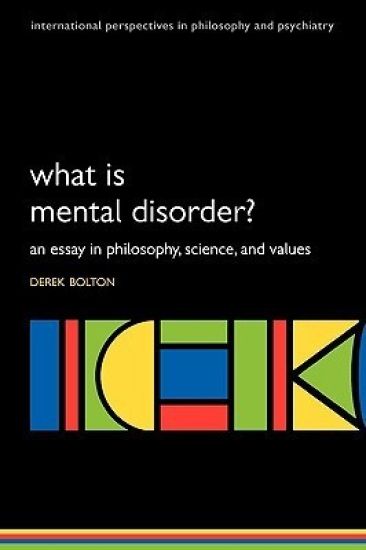
What is Mental Disorder?

What is Mental Disorder?

Derek Bolton

Oxford University Press
2008
nidottu
The effects of mental disorder are apparent and pervasive, in suffering, loss of freedom and life opportunities, negative impacts on education, work satisfaction and productivity, complications in law, institutions of healthcare, and more. With new editions of the 'bibles' of psychiatric diagnosis - the ICD and DSM - under development, it is timely to take a step back and re-evaluate exactly how we diagnose and define mental disorder. This new book by Derek Bolton tackles the problems involved in the definition and boundaries of mental disorder. These problems are evident now in many contexts: in the diagnostic manuals themselves, in epidemiological estimates of prevalence, in distinguishing normal sadness from depressive illness, for example, or childhood temperamental traits from developmental psychopathology, and in mental health legislation and criminal law. In many ways these problems are contemporary expressions of those identified in the heated debates surrounding psychiatry in the 1960s and 1970s: does psychiatry pathologize what is really normal life suffering? Is mental illness really social deviance, not a proper domain of medicine? Is psychiatry really a form of social control? However, these original problems have been transformed by crucial developments over the past few decades, and the book seeks to update the position taking them into account. The last few decades have seen the closing of the asylums and the appearance of care in the community: mental disorder is now in our midst, intensifying the problems of the '60s and '70s. Attempts have been made to define clearly a concept of mental disorder that is truly medical as opposed to social, inevitably relying on the distinction between human nature and culture. In the science, there is increasing evidence that this distinction is unviable, and accumulating evidence that there is no clear line between what is normal in the population and what is abnormal. What is Mental Disorder? reviews these various crucial developments and their profound impact for the concept and its boundaries in a provocative and timely book.
Moving Words

Moving Words

Derek Attridge

Oxford University Press
2015
nidottu
The contemporary reader of English poetry is able to take pleasure in the sounds and movements of the English language in works written over the past eight centuries, and to find poems that convey powerful emotions and vivid images from this entire period. This book investigates the ways in which poets have exploited the resources of the language as a spoken medium--its characteristic rhythms, its phonetic qualities, its deployment of syntax--to write verse that continues to move and delight. The chapters in the first of the two parts examine a number of issues relating to poetic form: the resurgence of interest in formal questions in recent years, the role of syntactic phrasing in the operation of poetry, the function of rhyme, and the relation between sound and sense. The second part is concerned with rhythm and metre, explaining and demonstrating 'beat prosody' as a tool of poetic analysis, and discussing three major traditions in English versification: the free four-beat form used in much popular verse, the controlled power of the iambic pentameter, and the twentieth-century invention of free verse. All these topics are discussed by means of particular case studies, from the metrical form of a thirteenth-century lyric to uses of sound in recent poetry. Among the many poets whose work is considered are Spenser, Milton, Dryden, Keats, Tennyson, Hardy, Yeats, Frost, Ashbery, Hill, Plath, Paterson, and Prynne. Drawing on Derek Attridge's thirty-five years of engagement with the forms of poetry, this volume provides extensive evidence of the importance of close attention to the moving and sounding of language in the poems we enjoy.
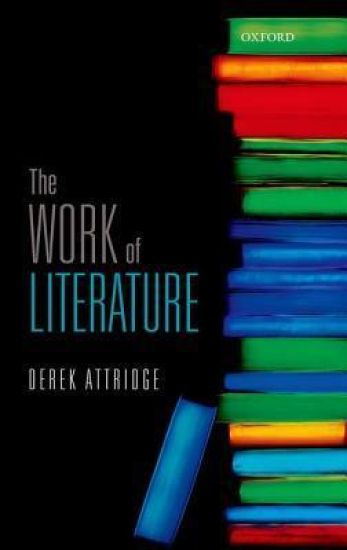
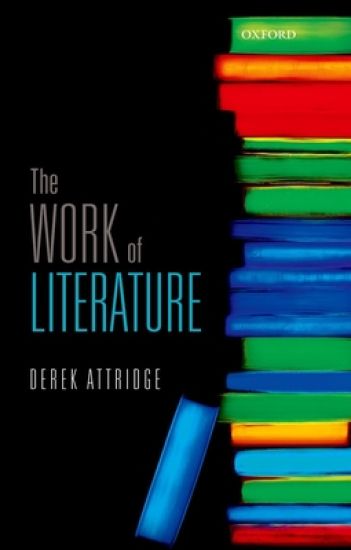
The Work of Literature

The Work of Literature

Derek Attridge

Oxford University Press
2015
sidottu
What is distinctive about the cultural practice called 'literature'? How does it benefit individuals and society? How do literary works retain their importance and their capacity to give pleasure over decades and centuries? What constitutes responsible criticism? These are some of the questions addressed in this book, which develops the arguments put forward in Derek Attridge's influential study The Singularity of Literature (2004). Beginning with an extended cross-examination in the form of an interview addressing a range of topics relating to the work of literature (understood both as the activity of the writer and as the text itself) and the practices of literary reading and literary criticism, it asks what it means to 'do justice to' a work of literature, provides a full account of the concept of singularity, considers the problematic power of criticism, and advances an account of the role of context in the writing and reading of literary works. In other chapters it explores the issue of cultural difference in responses to literature, discusses the working of metaphor, questions the attribution of knowledge to literary works, and addresses the topics of affect and hospitality. The book follows through the consequences of regarding the singular and inventive work of literature as an event that takes place anew each time it is read, providing an opening to an otherness excluded by prevailing cultural norms and habits of thought and feeling. Although the focus of the book is on literature, the arguments are relevant to all the arts, and engage with the thought of major aesthetic theorists in a number of traditions.
Fiction and Narrative

Fiction and Narrative

Derek Matravers

Oxford University Press
2017
nidottu
For the past twenty years there has been a virtual consensus in philosophy that there is a special link between fiction and the imagination. In particular, fiction has been defined in terms of the imagination: what it is for something to be fictional is that there is some requirement that a reader imagine it. Derek Matravers argues that this rests on a mistake; the proffered definitions of 'the imagination' do not link it with fiction but with representations more generally. In place of the flawed consensus, he offers an account of what it is to read, listen to, or watch a narrative whether that narrative is fictional or non-fictional. The view that emerges, which draws extensively on work in psychology, downgrades the divide between fiction and non-fiction and largely dispenses with the imagination. In the process, he casts new light on a succession of issues: on the 'paradox of fiction', on the issue of fictional narrators, on the problem of 'imaginative resistance', and on the nature of our engagement with film.
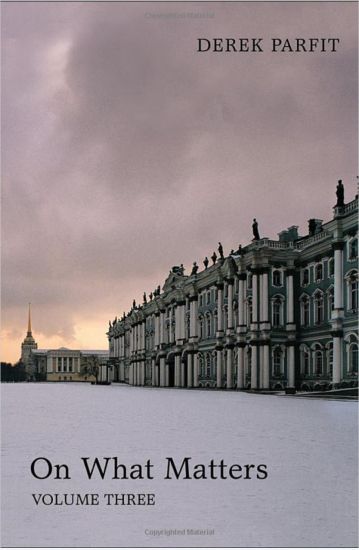
On What Matters

On What Matters

Derek Parfit

Oxford University Press
2017
sidottu
Derek Parfit presents the third volume of On What Matters, his landmark work of moral philosophy. Parfit develops further his influential treatment of reasons, normativity, the meaning of moral discourse, and the status of morality. He engages with his critics, and shows the way to resolution of their differences. This volume is partly about what it is for things to matter, in the sense that we all have reasons to care about these things. Much of the book discusses three of the main kinds of meta-ethical theory: Normative Naturalism, Quasi-Realist Expressivism, and Non-Metaphysical Non-Naturalism, which Derek Parfit now calls Non-Realist Cognitivism. This third theory claims that, if we use the word 'reality' in an ontologically weighty sense, irreducibly normative truths have no mysterious or incredible ontological implications. If instead we use 'reality' in a wide sense, according to which all truths are truths about reality, this theory claims that some non-empirically discoverable truths-such as logical, mathematical, modal, and some normative truths-raise no difficult ontological questions. Parfit discusses these theories partly by commenting on the views of some of the contributors to Peter Singer's collection Does Anything Really Matter? Parfit on Objectivity. Though Peter Railton is a Naturalist, he has widened his view by accepting some further claims, and he has suggested that this wider version of Naturalism could be combined with Non-Realist Cognitivism. Parfit argues that Railton is right, since these theories no longer deeply disagree. Though Allan Gibbard is a Quasi-Realist Expressivist, he has suggested that the best version of his view could be combined with Non-Realist Cognitivism. Parfit argues that Gibbard is right, since Gibbard and he now accept the other's main meta-ethical claim. It is rare for three such different philosophical theories to be able to be widened in ways that resolve their deepest disagreements. This happy convergence supports the view that these meta-ethical theories are true. Parfit also discusses the views of several other philosophers, and some other meta-ethical and normative questions.
Essential Fish Biology

Essential Fish Biology

Derek Burton; Margaret Burton

Oxford University Press
2017
sidottu
Essential Fish Biology provides an introductory overview of the functional biology of fish and how this may be affected by the widely contrasting habitat conditions within the aquatic environment. It describes the recent advances in comparative animal physiology which have greatly influenced our understanding of fish function as well as generating questions that have yet to be resolved. Fish taxa represent the largest number of vertebrates, with over 25,000 extant species. However, much of our knowledge, apart from taxonomy and habitat descriptions, has been based on relatively few of them , usually those which live in fresh water and/or are of commercial interest. Unfortunately there has also been a tendency to base our interpretation of fish physiology on that of mammalian systems, as well as to rely on a few type species of fish. This accessible textbook will redress the balance by using examples of fish from a wide range of species and habitats, emphasizing diversity as well as recognizing shared attributes with other vertebrates.
Essential Fish Biology

Essential Fish Biology

Derek Burton; Margaret Burton

Oxford University Press
2017
nidottu
Essential Fish Biology provides an introductory overview of the functional biology of fish and how this may be affected by the widely contrasting habitat conditions within the aquatic environment. It describes the recent advances in comparative animal physiology which have greatly influenced our understanding of fish function as well as generating questions that have yet to be resolved. Fish taxa represent the largest number of vertebrates, with over 25,000 extant species. However, much of our knowledge, apart from taxonomy and habitat descriptions, has been based on relatively few of them , usually those which live in fresh water and/or are of commercial interest. Unfortunately there has also been a tendency to base our interpretation of fish physiology on that of mammalian systems, as well as to rely on a few type species of fish. This accessible textbook will redress the balance by using examples of fish from a wide range of species and habitats, emphasizing diversity as well as recognizing shared attributes with other vertebrates.
The Work of Literature

The Work of Literature

Derek Attridge

Oxford University Press
2017
nidottu
What is distinctive about the cultural practice called 'literature'? How does it benefit individuals and society? How do literary works retain their importance and their capacity to give pleasure over decades and centuries? What constitutes responsible criticism? These are some of the questions addressed in this book, which develops the arguments put forward in Derek Attridge's influential study The Singularity of Literature (2004). Beginning with an extended cross-examination in the form of an interview addressing a range of topics relating to the work of literature (understood both as the activity of the writer and as the text itself) and the practices of literary reading and literary criticism, it asks what it means to 'do justice to' a work of literature, provides a full account of the concept of singularity, considers the problematic power of criticism, and advances an account of the role of context in the writing and reading of literary works. In other chapters it explores the issue of cultural difference in responses to literature, discusses the working of metaphor, questions the attribution of knowledge to literary works, and addresses the topics of affect and hospitality. The book follows through the consequences of regarding the singular and inventive work of literature as an event that takes place anew each time it is read, providing an opening to an otherness excluded by prevailing cultural norms and habits of thought and feeling. Although the focus of the book is on literature, the arguments are relevant to all the arts, and engage with the thought of major aesthetic theorists in a number of traditions.