Kirjojen hintavertailu. Mukana 12 016 292 kirjaa ja 12 kauppaa.

Kirjahaku

Etsi kirjoja tekijän nimen, kirjan nimen tai ISBN:n perusteella.

1000 tulosta hakusanalla Edward Michell

Edward Said at the Limits

Edward Said at the Limits

Mustapha Marrouchi

State University of New York Press
2004
pokkari
Shows the full breadth and scope of Edward Said's work and of his role as a public intellectual.On Edward Said at the Limits, Mustapha Marrouchi offers a sensitive critique of Edward Said, one of America's foremost commentators on the Palestinian cause. Marrouchi does justice to the extraordinary life of a complex figure who was fundamentally a humanist committed to the eradication of domination and whose angry and eloquent writings are of fierce relevance to the fragmented world in which we live. The Said story has become the model for the struggle to rewrite colonial history.Offering the most up-to-date and comprehensive bibliography of Said's work, this is the only single author book devoted solely to Edward Said and his writing.
Edward Sapir

Edward Sapir

Regna Darnell

University of Nebraska Press
2010
pokkari
This first full-scale biography of Edward Sapir (1884–1939) does justice to the life and ideas of the most distinguished linguist of Boasian anthropology, who contributed substantially to the professionalization of linguistics as an independent discipline. Sapir was the first to apply comparative Indo-European methods to the study of American Indian languages, pursuing fieldwork on more than twenty of them. His theoretical work on the relationship between the individual personality and culture remains a major part of culture theory in anthropology, as does his insistence on the symbolic nature of culture and the importance of culture as understood and articulated by its members. The first professional anthropologist in Canada and teacher of a whole generation of North American linguists and anthropologists at Chicago and Yale, Sapir also wrote poetry and literary criticism. He insisted on the humanistic nature of anthropology and was the most articulate spokesman for the interdisciplinary social science of the late 1920s and 1930s. All the richness and diversity of Sapir’s relatively short life are conveyed by Regna Darnell in an engrossing narrative that combines profound knowledge of her subject with historical reconstruction.
Edward S. Curtis and the North American Indian Project in the Field
Mick Gidley provides an intimate and informative glimpse of photographer Edward S. Curtis (1868–1952) and his associates as they embarked on their epic quest to document through word and picture the traditional cultures of Native Americans in the western United States—cultures that Curtis believed were inevitably doomed. Curtis's project in the early decades of the twentieth century became the largest anthropological enterprise ever undertaken in this country, yielding the monumental work The North American Indian. Its publication was a watershed in the anthropological study of Native Americans, inspiring the first feature-length documentary film, popular magazine articles, books for young readers, lectures, and photography exhibitions. Housing a wealth of ethnographic information yet steeped in nostalgia and predicated on the assumption that Native Americans were a "vanishing race," Curtis's work has been both influential and controversial, and its vision of Native Americans must still be reckoned with today. Gidley draws on reports and reflections by Curtis and the project's assistants, memoirs by Curtis family members, and eyewitness accounts by newspaper reporters in presenting an unprecedented look at anthropological fieldwork as it was commonly practiced during this period. He also examines the views of Curtis and his contemporaries concerning their enterprise and how both Native Americans and the mainstream American public perceived their efforts.
Edward Eberstadt & Sons

Edward Eberstadt & Sons

Michael Vinson; William Reese

University of Oklahoma Press
2017
nidottu
An unlikely bookseller in New York City became the leading dealer in rare Western Americana for most of the twentieth century. After working in western-U.S. and South American gold mines at the turn of the twentieth century, Edward Eberstadt (1883-1958) returned to his home in New York City in 1907. Through luck and happenstance, he purchased an old book for fifty cents that turned out to be a rare sixteenth-century Mexican imprint. From this bit of serendipity, Eberstadt quickly became one of the leading western Americana rare book dealers. In this book Michael Vinson tells the story of how Edward Eberstadt & Sons developed its legendary book collection, which formed the backbone of many of today's top western Americana archives.Although the firm's business records have not survived, Edward and his sons, Charles and Lindley, were all prodigious letter writers, and nearly every collector kept his or her correspondence. Drawing upon these letters and on his own extensive experience in the rare book trade, Vinson gives the reader a vivid sense of how the commerce in rare books and manuscripts unfolded during the era of the Eberstadts, particularly in the relationships between dealers and customers. He explores the backstory that scholars of art history and museology have pursued in recent decades: the assembling of cultural treasures, their organization for use, and the establishment of institutions to support that use. His work describes the important role this key bookselling firm played in the western Americana trade from the early 1900s to Eberstadt & Sons' dissolution in 1975. From Yale University and the American Antiquarian Society to the Newberry Library and the Huntington Library, the firm of Edward Eberstadt & Sons has left its mark in western Americana repositories across the nation. Told here for the first time, the Eberstadt story reveals how one family's business and legacy have shaped the study of the American West.
Edward Douglass White

Edward Douglass White

Robert B. Highsaw

Louisiana State University Press
1999
nidottu
Elite, personable, and persuasive, Edward Douglass White, a ''large and bearish man from Louisiana,'' served on the United States Supreme Court for twenty-seven years. During his tenure, first as an associate justice (1894-1910) and then as the ninth chief justice (1910-1921), White significantly influenced American public law. Robert Highsaw' s extensive judicial biography stresses White's constitutional thought and philosophy. Several chapters discuss his early years in Louisiana, his training in Jesuit schools there and at Georgetown University, and his early legal career in New Orleans. The emphasis, however, remains on White's theories and applications of the judicial and constitutional processes. Edward Douglass White ""looked upon the American constitutional system as a model for a well-ordered society that must be preserved."" White's concept of a federal system in which the national and state governments each operated within a defined sphere of powers underlay many of his opinions. White considered farm issues that developed after the closing of the western frontier, economic issues precipitated by a growing laboring class, and tense political issues of civil liberties that emerged during World War I. He played an important part in developing administrative law and was, perhaps, most responsible for strengthening dual federalism of commerce and taxing powers. His pragmatism, evidenced in the Insular cases where his doctrine of ""incorporated"" and ""unincorporated"" territories, synthesized American constitutional law with the political reality of American imperialism. White was a conservative, but unlike the conservative justices of the 1920s and 1930s whose intransigence produced the judicial revolution of 1937, he saw that injury to the Constitution might result from its consistent use as a barrier to social progress. Significantly, Edward Douglass White demonstrates that ""the judicial revolution of 1937 and the ensuing decades of the Court's history are meaningless unless we know what happened fifty or so years earlier.
Because I Was Flesh: The Autobiography of Edward Dahlberg

Because I Was Flesh: The Autobiography of Edward Dahlberg

Edward Dahlberg

NEW DIRECTIONS PUBLISHING CORPORATION
1967
nidottu
Because I Was Flesh is an authentic record from the inferno of modern city life, and a testament of American experience. Lizzie Dahlberg, separated from a worthless husband, works as a lady barber to keep herself and her son in shabby respectability amid the vice and brutality of Kansas City in the early 1900's. Her constant objective: to acquire a new husband who can give her security and help educate the child. She is attractive to men, but fate never brings her a good one. One suitor makes her put the boy in an orphanage--years of torment that are brilliantly described--and then betrays her. Another does marry her--and disappears with her savings. Lizzie is in despair, but soon begins to laugh at life again and arches her bosom for the next prospect. As he grows through a sensitive, painful adolescence, Edward is both fascinated and appalled by his mother. He adores her but is ashamed of her. He tries to escape, bumming his way to Los Angeles and later going to college in Berkeley, but is always drawn back. Even her death, with which the book ends, cannot release him. Seldom has there been so ruthless, and yes so tender a dissection of the mother-son relationship. And from it Lizzie Dahlberg emerges as one of the unforgettable characters of modern literature.
Edward P. Dozier

Edward P. Dozier

Marilyn Norcini

University of Arizona Press
2007
sidottu
Edward P. Dozier was the first American Indian to establish a career as an academic anthropologist. In doing so, he faced a double paradox, cademic and cultural. The notion of objectivity that governed academic anthropology at the time dictated that researchers be impartial outsiders. Scientific knowledge was considered unbiased, impersonal, and public. In contrast, Dozier's Pueblo Indian culture regarded knowledge as privileged, personal, and gendered. Ceremonial knowledge was protected by secrecy and was never intended to be made public, either within or outside of the community. As an indigenous ethnologist and linguist, Dozier negotiated a careful balance between the conflicting values of a social scientist and a Pueblo Indian. Based on archival research, ethnographic fieldwork at Santa Clara Pueblo, and extensive interviews, this intellectual biography traces Dozier's education from a Bureau of Indian Affairs day school through the University of New Mexico on federal reimbursable loans and graduate school on the GI Bill. Dozier was the first graduate of the new post World War II doctoral program in anthropology at the University of California at Los Angeles in 1952. Beginning with his multicultural and linguistic heritage, the book interprets pivotal moments in his career, including the impact of Pueblo kinship on his indigenous research at Tewa Village (Hano); his rising academic standing and Indian advocacy at Northwestern University; his achievement of full academic status after he conducted non-indigenous fieldwork with the Kalinga in the Philippines; and his leadership in establishing American Indian Studies at the University of Arizona. Norcini interprets Dozier's career within the contexts of the history of American anthropology and Pueblo Indian culture. In the final analysis, Dozier is positioned as a transitional figure who helped transform the historical paradox of an American Indian anthropologist into the contemporary paradigm of indigenous scholarship in the academy.
Edward Abbey

Edward Abbey

James M. Cahalan

University of Arizona Press
2003
nidottu
The best biography ever about Ed. Cahalan's meticulous research and thoughtful interviews have made this book the authoritative source for Abbey scholars and fans alike.? ?Doug Peacock, author, environmentalist activist and explorer, and the inspiration for Hayduke in The Monkey Wrench Gang He was a hero to environmentalists and the patron saint of monkeywrenchers, a man in love with desert solitude. A supposed misogynist, ornery and contentious, he nevertheless counted women among his closest friends and admirers. He attracted a cult following, but he was often uncomfortable with it. He was a writer who wandered far from Home without really starting out there. James Cahalan has written a definitive biography of a contemporary literary icon whose life was a web of contradictions. Edward Abbey: A Life sets the record straight on "Cactus Ed," giving readers a fuller, more human Abbey than most have ever known. It separates fact from fiction, showing that much of the myth surrounding Abbey such as his birth in Home, Pennsylvania, and later residence in Oracle, Arizona was self-created and self-perpetuated. It also shows that Abbey cultivated a persona both in his books and as a public speaker that contradicted his true nature: publicly racy and sardonic, he was privately reserved and somber. Cahalan studied all of Abbey's works and private papers and interviewed many people who knew him including the models for characters in The Brave Cowboy and The Monkey Wrench Gang to create the most complete picture to date of the writer's life. He examines Abbey's childhood roots in the East and his love affair with the West, his personal relationships and tempestuous marriages, and his myriad jobs in continually shifting locations including sixteen national parks and forests. He also explores Abbey's writing process, his broad intellectual interests, and the philosophical roots of his politics. For Abbey fans who assume that his "honest novel," The Fool's Progress, was factual or that his public statements were entirely off the cuff, Cahalan's evenhanded treatment will be an eye-opener. More than a biography, Edward Abbey: A Life is a corrective that shows that he was neither simply a countercultural cowboy hero nor an unprincipled troublemaker, but instead a complex and multifaceted person whose legacy has only begun to be appreciated. The book contains 30 photographs, capturing scenes ranging from Abbey's childhood to his burial site.
Edward Taylor - American Writers 52

Edward Taylor - American Writers 52

Stanford Donald E.

UNIVERSITY OF MINNESOTA PRESS
1965
nidottu
Edward Taylor - American Writers 52 was first published in 1965. Minnesota Archive Editions uses digital technology to make long-unavailable books once again accessible, and are published unaltered from the original University of Minnesota Press editions.
Edward Albee - American Writers 77

Edward Albee - American Writers 77

Cohn Ruby

UNIVERSITY OF MINNESOTA PRESS
1969
nidottu
Edward Albee - American Writers 77 was first published in 1969. Minnesota Archive Editions uses digital technology to make long-unavailable books once again accessible, and are published unaltered from the original University of Minnesota Press editions.
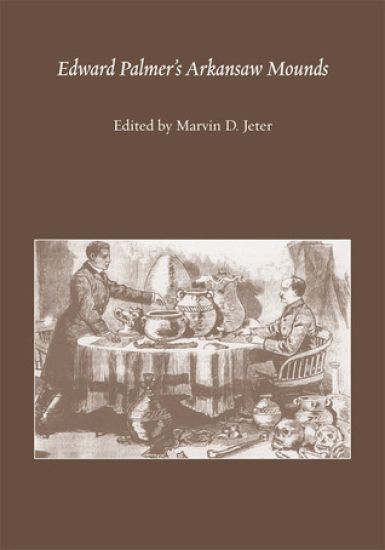
EDWARD PALMER'S ARKANSAW MOUNDS

EDWARD PALMER'S ARKANSAW MOUNDS

The University of Alabama Press
2010
nidottu
Normal0falsefalsefalseMicrosoftInternetExplorer4During the 1880s a massive scientific effort was launched by the Smithsonian Institution to discover who had built the prehistoric burial mounds found throughout the United States. Arkansaw Mounds tells the story of this exploration and of Edward Palmer, one of the nineteenth century's greatest natural historians and archaeologists, who was recruited to lead the research project. Arkansas was unusually rich in prehistoric remains, especially mounds, and became a major focus of the study. Palmer and his team of researchers discovered that the mounds had been built by the ancestors of the historic North American Indians, shattering the then-popular theory that a lost non-Indian race had built them.