In this work, first published in two volumes in 1890 and 1894, Erwin Rohde (1845–1898), the German classical scholar and friend of Nietzsche, describes the ancient Greek cult of souls and establishes the sources of the belief in the immortality of the soul, exploring its relation to life both before and after death. This belief in the survival of the soul already existed in the earliest Greek writings, but when and from where did it originate? In Volume 1 Rohde examines belief in the soul as it appears in Homeric poetry and within local cults, and finds that the idea of an afterlife is already represented in different forms in the works of Hesiod and Aeschylus. He also discusses burial rites and the Eleusinian Mysteries. Psyche, reissued here in the 1898 edition, remains a standard reference work on this topic.
In this work, first published in two volumes in 1890 and 1894, Erwin Rohde (1845–1898), the German classical scholar and friend of Nietzsche, describes the ancient Greek cult of souls and establishes the sources of the belief in the immortality of the soul, exploring its relation to life both before and after death. This belief in the survival of the soul already existed in the earliest Greek writings, but when and from where did it originate? Volume 2 examines the question in the context of the worship of Dionysos, arguing that there were originally many sides to the cult of the wine-god, and that one of these may have been the source of this belief. Psyche, reissued here in the 1898 edition, remains a standard reference work on this topic.
Jan Tinbergen was the first Nobel Prize winner in Economics and one of the most influential economists of the 20th century. This book argues that his crucial contribution is the theory of economic policy and the legitimation of economic expertise in service of the state. It traces his youthful socialist ideals which found political direction in the Plan-socialist movement of the 1930s for which he developed new economic models to combat the Great Depression. After World War II he was able to synthesize that work into a theory of economic policy which not only provided a lasting framework for economic policy around the world, but also secured a permanent place for economic experts close to government. The book then turns to an examination of his attempt to repeat this achievement in the development projects in the Global South and at the international level for the United Nations.
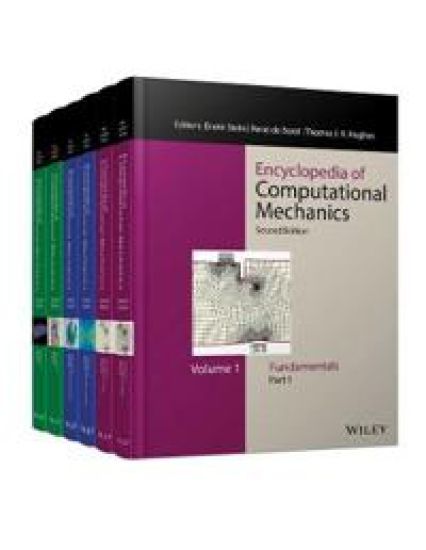
An extensively expanded and revised edition of the leading major reference work in computational engineering The completely updated and extended second edition of Encyclopedia of Computational Mechanics, Second Edition has, once again, been prepared under the guidance of three of the world's foremost experts in the field. It follows the same structure as the first edition, yet has been expanded from three to six full volumes to give readers a more in-depth and complete understanding of the topic. Volumes 1 & 2 (Fundamentals) contain contributions related to mathematics, mechanics, and computer science, and are structured as discretization methods, treating approximations with finite differences, discrete variational forms, boundary integral equations and further problem-oriented techniques, mesh-based and meshfree discretizations and the generation and visualization of geometry; Isogeometric analysis as well as various direct and iterative solvers; time-dependent parabolic problems and FEMs for the Maxwell equation; further, new chapters on uncertainty quantification and related stochastic solution methods are included. Volumes 3 & 4 (Solids and Structures) are organized into five different parts, namely, structural behavior; constitutive theories and their implementation; materials and processing; interaction problems; and identification, stochastics, and optimization. Volumes 5 & 6 (Fluids) build on the fundamentals of the first volumes, and offer four main groups that describe additional basic methodologies used in computational fluid dynamics; cover the various aspects of incompressible viscous flows; focus on compressible fluid dynamics; and address problems involving moving domains and free surfaces, and application areas. The single most comprehensive reference on computational mechanics18 new chapters added representing a more than 20% increase over current editionExtensive revision plan with major updates to the majority of existing articlesCovers solid and fluid mechanics, with extensive treatment of FEA and CFD techniques With contributions from leading experts around the globe, this is an essential and comprehensive reference for any university engineering department or corporation, and contains invaluable, up-to-date content for researchers, students, and practitioners alike.
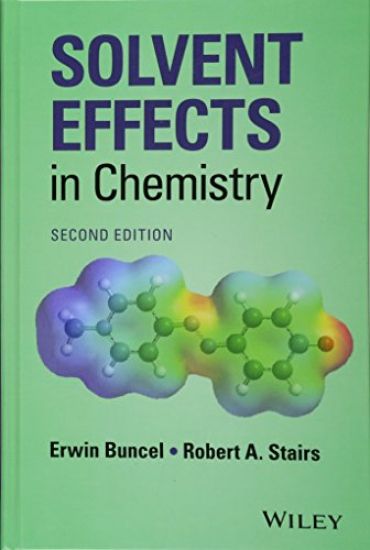
This book introduces the concepts, theory and experimental knowledge concerning solvent effects on the rate and equilibrium of chemical reactions of all kinds. It begins with basic thermodynamics and kinetics, building on this foundation to demonstrate how a more detailed understanding of these effects may be used to aid in determination of reaction mechanisms, and to aid in planning syntheses. Consideration is given to theoretical calculations (quantum chemistry, molecular dynamics, etc.), to statistical methods (chemometrics), and to modern day concerns such as "green" chemistry, where utilization and disposal of chemical waste or by-products in an environmentally safe way is as important as achieving the desired end products by all chemists nowadays. The treatment progresses from elementary to advanced material in straightforward fashion. The more advanced topics are not developed in an overly rigorous way so that upper-level undergraduates, graduates, and newcomers to the field can grasp the concepts easily.
This completely updated edition of A Frequency Dictionary of German contains the 5,000 most commonly used words of German today, occurring in a 20-million-word corpus (compared to a 4.2-million-word corpus in the first edition). The basis of the frequency list is a significantly extended version of the Herder/BYU Corpus of Contemporary German. The Dictionary contains spoken and written German, and represents different genres, text types, registers, styles, and also regional varieties.The Dictionary provides a rich resource for language teaching and curriculum design, while former CD content is now available to access at www.routledge.com/9781138659780 as support material to provide the full text in a tab-delimited format ideally suited for use by corpus and computational linguists.The corpus is designed to represent the current German language as it is used in the real world. Useful as a reference for students and course designers alike, A Frequency Dictionary of German is an important new resource.
This completely updated edition of A Frequency Dictionary of German contains the 5,000 most commonly used words of German today, occurring in a 20-million-word corpus (compared to a 4.2-million-word corpus in the first edition). The basis of the frequency list is a significantly extended version of the Herder/BYU Corpus of Contemporary German. The Dictionary contains spoken and written German, and represents different genres, text types, registers, styles, and also regional varieties.The Dictionary provides a rich resource for language teaching and curriculum design, while former CD content is now available to access at www.routledge.com/9781138659780 as support material to provide the full text in a tab-delimited format ideally suited for use by corpus and computational linguists.The corpus is designed to represent the current German language as it is used in the real world. Useful as a reference for students and course designers alike, A Frequency Dictionary of German is an important new resource.