Kirjojen hintavertailu. Mukana 12 419 077 kirjaa ja 12 kauppaa.

Kirjahaku

Etsi kirjoja tekijän nimen, kirjan nimen tai ISBN:n perusteella.

1000 tulosta hakusanalla Friedrich Neumann

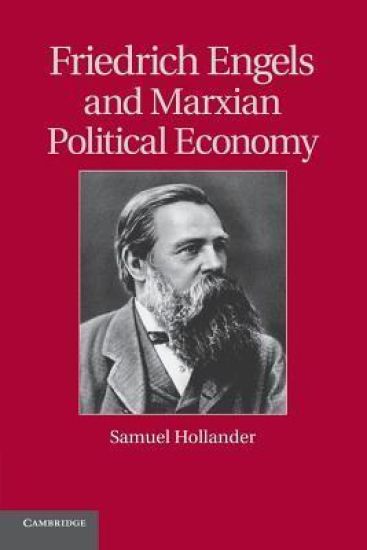
Friedrich Engels and Marxian Political Economy

Friedrich Engels and Marxian Political Economy

Samuel Hollander

Cambridge University Press
2014
pokkari
This book rejects the commonly encountered perception of Friedrich Engels as perpetuator of a 'tragic deception' of Marx, and the equally persistent body of opinion treating him as 'his master's voice'. Engels' claim to recognition is reinforced by an exceptional contribution in the 1840s to the very foundations of the Marxian enterprise, a contribution entailing not only the 'vision' but some of the building blocks in the working out of that vision. Subsequently, he proved himself to be a sophisticated interpreter of the doctrine of historical materialism and an important contributor in his own right. This volume serves as a companion to Samuel Hollander's The Economics of Karl Marx (Cambridge University Press, 2008).
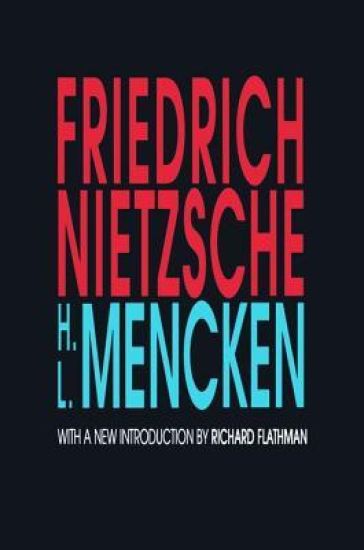
Friedrich Nietzsche

Friedrich Nietzsche

H.L. Mencken

Routledge
2017
sidottu
The decisive influence of Friedrich Nietzsche on H.L. Mencken is readily acknowledged in the vast literature on the great American journalist and social critic. However, Mencken's 1908 study of the philosopher has been relegated to footnote status by Mencken's critics and biographers and has been largely ignored by Nietzsche scholars. There are good reasons for reversing this judgment. Mencken's work was one of the first comprehensive and sympathetic treatments of Nietzsche's thought in the English language. It is a provocative engagement with the German philosopher's complex and elusive ideas, enhanced by a style that reverberates with a verve and dynamism approaching Nietzsche's own.Mencken presents a view of Nietzsche that elucidates the latter's complex and contentious form of the "gospel of individualism" while evincing a keen appreciation of his unrivalled capacity for critical analysis. The historical scope of Nietzsche's thought is fully evident in Mencken's analysis as is its application to modern societies and politics. In tracing the biographical and intellectual impetus for Nietzsche's relentless attacks on conventional moralities and established modes of thought, Mencken discerned both an ideal and a method for grappling with social and cultural issues that remain salient in our own time.
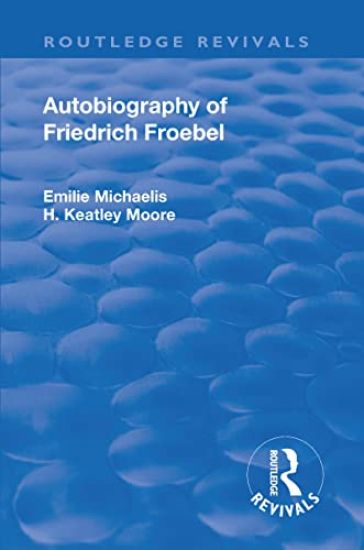
Revival: Autobiography of Friedrich Froebel (1915)
Originally published in 1915, the Autobiography of Fredrich Froebel provides a detailed overview of the life of the eminent German educator Fredrich Froebel, it charts his life and looks at his significant contribution to the field of education, including his Idealist philosophy of early childhood education, and his establishment of the kindergarten, a school for four-and five-year-old children that is found worldwide. The book also looks at the community surrounding Froebel and includes a chapter by Madame Louise Froebel’s providing a reminiscence of her husband’s life.
Revival: Autobiography of Friedrich Froebel (1915)
Originally published in 1915, the Autobiography of Fredrich Froebel provides a detailed overview of the life of the eminent German educator Fredrich Froebel, it charts his life and looks at his significant contribution to the field of education, including his Idealist philosophy of early childhood education, and his establishment of the kindergarten, a school for four-and five-year-old children that is found worldwide. The book also looks at the community surrounding the author and includes a chapter by Madame Louise Froebel’s providing a reminiscence of her husband’s life.
Friedrich Max Müller and the Role of Philology in Victorian Thought
The German comparative philologist Friedrich Max Müller (1823-1900) was one of the most influential scholars in Victorian Britain. Müller travelled to Britain in 1846 in order to prepare a translation of the Rig Veda. This research visit would turn into a lifelong stay after Müller was appointed as Taylor Professor of Modern Languages at Oxford in 1854. Müller’s activities in this position would exert a profound influence on British intellectual life during the second half of the nineteenth-century: his book-length essay on Comparative Mythology (1856) inspired evolutionist thinkers such as Herbert Spencer and Edward Burnett Tylor and made philology into one of the master sciences at mid-century; his debates with Charles Darwin and his followers on the origin of language constituted a significant component of religiously informed reactions to Darwin’s ideas about human descent; his arguments concerning the interdependence of language and thought influenced fields such as psychology, neurology, paediatrics and education until the end of the nineteenth century; his theories concerning an ‘Aryan’ language that purportedly predated Sanskrit and ancient Greek led to controversial debates on the relations between language, religion and race in the Indian subcontinent and beyond; and his monumental 50-volume edition of the Sacred Books of the East helped to lay the foundations for the study of comparative religion. Müller’s interlocutors and readers included people as various as Alexander von Humboldt, Darwin, George Eliot, Matthew Arnold, Friedrich Nietzsche, Ferdinand de Saussure, Ernst Cassirer, Mohandas K. Gandhi and Jarwaharlal Nehru.This volume offers the most comprehensive and interdisciplinary assessment of Müller's career to date. Arising from a conference held at the German Historical Institute in London in 2015, it brings together papers by an international group of experts in German studies, German and British history, linguistics, philosophy, English literary studies, and religious studies in order to examine the many facets of Müller’s scholarship. This book was originally published as a special issue of the Publications of the English Goethe Society.
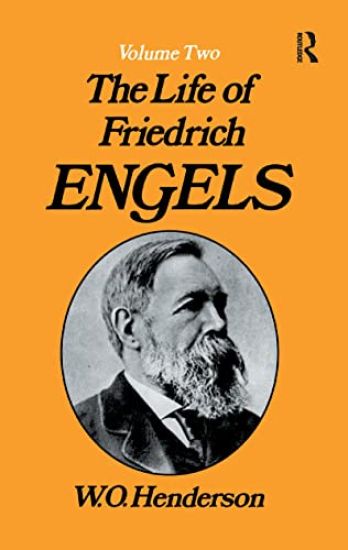
Friedrich Engels

Friedrich Engels

W.O. Henderson

Routledge
2016
nidottu
First Published in 1976. The first volume on this two-part biography traces Engels' carer from his youth in the Wupper valley, through his periods in Bremen and Berlin to the Manchester years and the beginning of his long collaboration with Marx. These early years are described against the background of the prevailing social unrest in Europe, culminating in the 1848 revolutions and portraits are included of many Marx's and Engels' friends and fellow communists.