Kirjojen hintavertailu. Mukana 11 678 731 kirjaa ja 12 kauppaa.

Kirjahaku

Etsi kirjoja tekijän nimen, kirjan nimen tai ISBN:n perusteella.

1000 tulosta hakusanalla Joseph Atkinson

Joseph Conrad

Joseph Conrad

Jeffrey Meyers

Cooper Square Publishers Inc.,U.S.
2001
pokkari
In Joseph Conrad: A Biography, acclaimed writer Jeffrey Meyers presents the definitive account of the life of Joseph Conrad (1857-1924), author of Heart of Darkness, Lord Jim, Nostromo, and many other landmarks in modern literature. Meyers' biography, published for the first time in paperback by Cooper Square Press, is the first biography of the author in many years. Joseph Conrad brings to light new information about Conrad's life and its impact on his fiction: new models emerge for his characters, including Heart of Darkness' Kurtz, and Meyers also examines in great detail Conrad's relationship with the wild and beautiful American journalist Jane Anderson.
Joseph Ellicott and the Holland Land Company

Joseph Ellicott and the Holland Land Company

William Chazanof

Syracuse University Press
1979
pokkari
In 1800, the Holland Land Company assigned surveyor Joseph Ellicott the task of selling at a profit 3.3 million acres of land west of the Genesee River in New York State. By 1821, when Ellicott’s career as Resident-Agent ended, the area’s population had grown from only a few settlers to over 100,000. This study traces the evolution of western New York from the time the Indians relinquished control to the solidification of institutional life.As a land promoter in the wilderness, Joseph Ellicott quickly discovered that business and politics went hand in hand, for the factors that affected land sales were frequently political. Although his contract with the Holland Land Company expressly forbade it, he became deeply involved in the political life of western New York, playing a decisive role in the creation of Genesee County and its further divisions into four counties. Ellicott used his influence to advance the Erie Canal project, particularly from Rochester westward, and persuaded the state legislature to grant a charter for the Bank of Niagara. Although the rest of the state fluctuated in its political preferences, from his base in Batavia he kept western New York loyal to the Republican Party, building up close relations with DeWitt Clinton.During his long career, Ellicott made many enemies. The postwar nationalists resented him as the agent of the Dutch-owned company. Taxpayers fought him because he blocked a road tax on land owned by nonresidents; his employers were irritated when he could not persuade the state to buy Holland Land Company property; his increasing melancholy angered customers; and his break with Clinton during the 1820 gubernatorial campaign set off a chain reaction of political pressures that led to his dismissal as Resident-Agent the next year. Ellicott direct in 1826.Based on extensive research in the Holland Land Company Papers in Amsterdam’s City Archives, Professor Chazanof’s study presents a previously unexplored part of the political history of New York State on regional, national, and international levels. Illustrations and maps are included.
Joseph Conrad at Mid-Century

Joseph Conrad at Mid-Century

Kenneth A. Lohf; Eugene P. Sheehy

University of Minnesota Press
1957
nidottu
Joseph Conrad at Mid-Century was first published in 1957. Minnesota Archive Editions uses digital technology to make long-unavailable books once again accessible, and are published unaltered from the original University of Minnesota Press editions.Published in the centennial year of Joseph Conrad's birth, this is the first comprehensive bibliography of the writings by and about this important author. Though there is a current revival of interest in Conrad's work, criticism and scholarship devoted to this celebrated novelist and short story writer have lagged behind that of other major twentieth-century authors. This compendium of data about the growing body of Conrad literature should stimulate further interest by bringing together a vast amount of reference information that has been widely scattered until now.The bibliography lists works by Conrad, including serializations, significant translations, and film adaptations, and writings about Conrad, including book and periodical material in western languages, appearing from 1895, the year of publication of Almayer's Folly, through 1955. There are a total of 1200 numbered entries containing approximately 3000 items.In the first section, devoted to Conrad's works, the enumeration of English and American editions is followed by the listing of translations. Most of Conrad's essays and many of his novels were serialized before they appeared in book form, and these serializations are listed here also.The second section lists the studies of Conrad's life and works, as published in books, pamphlets, periodical articles, and reviews. Data are included on bibliographies, commemorative issues of periodicals, criticism of individual works and of Conrad's work in general, and parodies and other miscellany.
Joseph Campbell on Myth and Mythology

Joseph Campbell on Myth and Mythology

University Press of America
1993
nidottu
A selection of readings by Joseph Campbell, including the editor's comments on the influence of mythology on personal and societal behaviour and the evolution of the creative mythologies of today. The development of Campbell's thought is traced and an analysis of 'The Hero's Journey' is included.
Joseph Guardian of the Holy Family(bb)

Joseph Guardian of the Holy Family(bb)

Marlyn Monge

Pauline Books Media
2019
sidottu
This beautiful board book Joseph: Guardian of the Holy Family provides a memorable way for toddlers to become familiar with Saint Joseph and his role in the earthly life of Jesus. Features & Benefits - ideal as a birth or baptismal gift - entertaining for children ages 1--5 - durable board book - perfect for reading aloud Illustrated by Mary Rojas
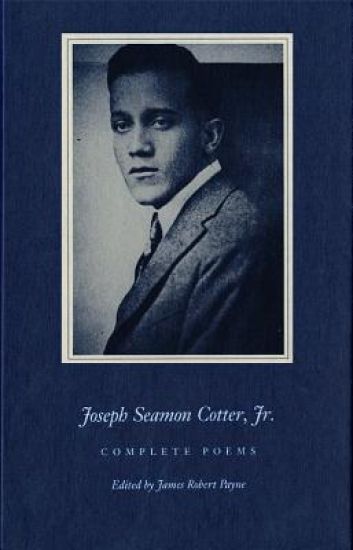
Joseph Seamon Cotter Jr.

Joseph Seamon Cotter Jr.

Joseph Seaman Cotter

University of Georgia Press
1990
sidottu
Joseph Seamon Cotter, Jr.: Complete Poems brings together for the first time all the poems of an accomplished African-American poet of the years just preceding the 1920s renaissance in black American literature.Born in Louisville, Kentucky, in 1895, Joseph Seamon Cotter, Jr., was a precocious child, reared in a strong family tradition of poetry. His father, a local educator, wrote poetry himself, and the family maintained a close friendship with the prominent poet Paul Laurence Dunbar. Encouraged by this environment, Cotter displayed literary leanings from an early age. As his father recalled, Keats was his son's favorite poet among the many writers in their extensive family library: "He never tired of the 'Ode on a Grecian Urn.'" After completing high school, Cotter attended Fisk University in Nashville, Tennessee, for two years until he contracted tuberculosis and was forced to return home. Cotter then wrote almost incessantly—and published one collection of poetry, The Band of Gideon—before his death in 1919 at age twenty-three.Rejecting the popular dialect style of his father and other highly regarded poets of his day, Cotter reflected in his poetry the broad impact of the most devastating event of the time, World War I. Though not limited to war themes, Cotter was unquestionably among the finest poets of the Great War. Displaying empathy for the experience of black soldiers, he perceives that the true enemy of these servicemen is not Germany but racial injustice, as shown in Cotter's "Sonnet to Negro Soldiers": "They shall go down unto Life's Borderland, / Walk unafraid within that Living Hell, / Nor heed the driving rain of shot and shell / That 'round them falls; but with uplifted hand / Be one with mighty hosts, an armed band / Against man's wrong to man-for such full well / They know. And from their trembling lips shall swell / A song of hope the world can understand. / All this to them shall be a glorious sign, / A glimmer of that resurrection morn, / When age-long Faith crowned with a grace benign / Shall rise and from their brows cast down the thorn / Of prejudice. E'en though through blood it be, / There breaks this day their dawn of Liberty."Cotter's poems, from the explorations of prejudice in The Band of Gideon through the later sonnet sequence "Out of the Shadows," place him among the poetic innovators of the second decade of this century.In Joseph Seamon Cotter, Jr.: Complete Poems, James Robert Payne has assembled the entire canon of a diverse poet rarely included in contemporary anthologies because his work has been inaccessible. Payne established reliable text of all of Cotter's poetry, including seven recently discovered poems that are published here for the first time. This collection includes a biographical essay, the poems, a textual commentary, and an apparatus, bringing the productive final years of Joseph Seamon Cotter, Jr., sharply into focus.
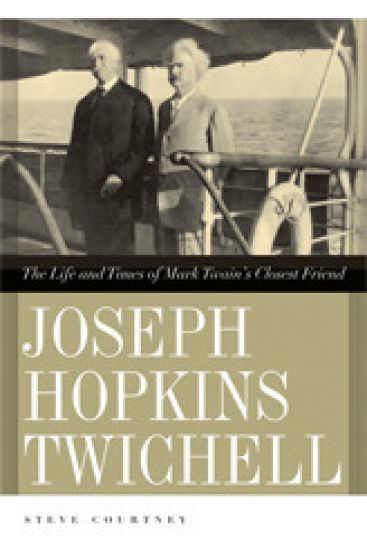
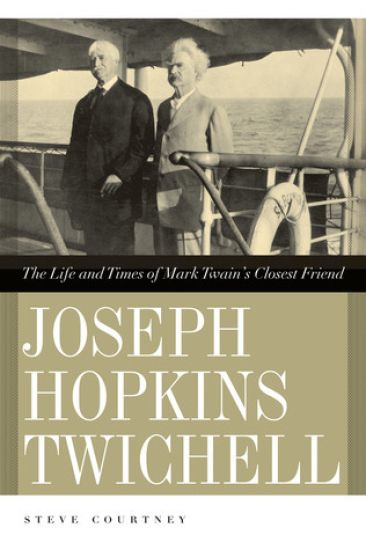
Joseph Hopkins Twichell

Joseph Hopkins Twichell

Steve Courtney

University of Georgia Press
2008
sidottu
Bewilderment often follows when one learns that Mark Twain’s best friend of forty years was a minister. That Joseph Hopkins Twichell (1838-1918) was also a New Englander with Puritan roots only entrenches the “odd couple” image of Twain and Twichell. This biography adds new dimensions to our understanding of the Twichell-Twain relationship; more important, it takes Twichell on his own terms, revealing an elite Everyman—a genial, energetic advocate of social justice in an era of stark contrasts between America’s “haves and have-nots.”After Twichell’s education at Yale and his Civil War service as a Union chaplain, he took on his first (and only) pastorate at Asylum Hill Congregational Church in Hartford, Connecticut, then the nation’s most affluent city. Steve Courtney tells how Twichell shaped his prosperous congregation into a major force for social change in a Gilded Age metropolis, giving aid to the poor and to struggling immigrant laborers as well as supporting overseas missions and cultural exchanges. It was also during his time at Asylum Hill that Twichell would meet Twain, assist at Twain’s wedding, and preside over a number of the family’s weddings and funerals.Courtney shows how Twichell’s personality, abolitionist background, theological training, and war experience shaped his friendship with Twain, as well as his ministerial career; his life with his wife, Harmony, and their nine children; and his involvement in such pursuits as Nook Farm, the lively community whose members included Harriet Beecher Stowe and Charles Dudley Warner. This was a life emblematic of a broad and eventful period of American change. Readers will gain a clear appreciation of why the witty, profane, and skeptical Twain cherished Twichell’s companionship.
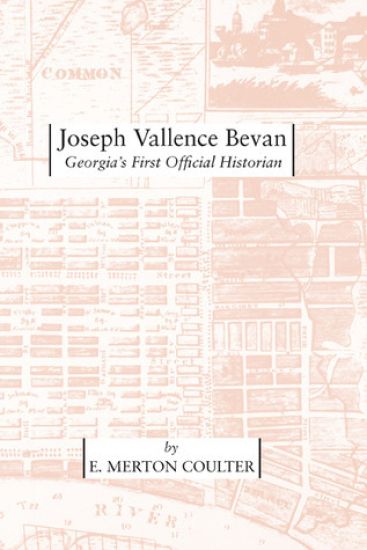
Joseph Vallence Bevan

Joseph Vallence Bevan

E. Merton Coulter

University of Georgia Press
2010
pokkari
Published in 1964, this biography of Joseph Vallence Bevan tells the story of Georgia’s first official historian. Born in Ireland, Bevan moved with his family to Georgia at a young age. He attended the University of Georgia and the College of South Carolina before continuing his education in England. There he met William Godwin, an influential political philosopher, journalist, and novelist, who wrote Letter of Advice To a Young American: On the Course of Studies It Might Be Most Advantageous for Him To Pursue for Bevan.Back in the U.S., Bevan edited the Augusta Chronicle & Georgia Gazette, studied law, served on the Georgia legislature, and became coeditor and owner of the Savannah Georgian. In 1824, by recommendation of Governor George M. Troup, the legislature appointed Bevan as the first official historian of Georgia. His main duties were to arrange the state archives, publish selections from the archives, and to write a history of the state. Bevan was unable to complete a history of Georgia before his death in 1830 at the young age of thirty-two. However, he paved the road for future historians making important acquisitions of transcripts from Great Britain which describe the colonial history of Georgia.
Joseph Hopkins Twichell

Joseph Hopkins Twichell

Steve Courtney

University of Georgia Press
2010
pokkari
Bewilderment often follows when one learns that Mark Twain’s best friend of forty years was a minister. That Joseph Hopkins Twichell (1838-1918) was also a New Englander with Puritan roots only entrenches the “odd couple” image of Twain and Twichell. This biography adds new dimensions to our understanding of the Twichell-Twain relationship; more important, it takes Twichell on his own terms, revealing an elite Everyman—a genial, energetic advocate of social justice in an era of stark contrasts between America’s “haves and have-nots.”After Twichell’s education at Yale and his Civil War service as a Union chaplain, he took on his first (and only) pastorate at Asylum Hill Congregational Church in Hartford, Connecticut, then the nation’s most affluent city. Steve Courtney tells how Twichell shaped his prosperous congregation into a major force for social change in a Gilded Age metropolis, giving aid to the poor and to struggling immigrant laborers as well as supporting overseas missions and cultural exchanges. It was also during his time at Asylum Hill that Twichell would meet Twain, assist at Twain’s wedding, and preside over a number of the family’s weddings and funerals.Courtney shows how Twichell’s personality, abolitionist background, theological training, and war experience shaped his friendship with Twain, as well as his ministerial career; his life with his wife, Harmony, and their nine children; and his involvement in such pursuits as Nook Farm, the lively community whose members included Harriet Beecher Stowe and Charles Dudley Warner. This was a life emblematic of a broad and eventful period of American change. Readers will gain a clear appreciation of why the witty, profane, and skeptical Twain cherished Twichell’s companionship.
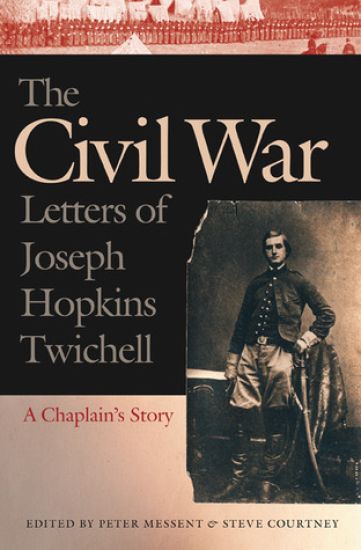
The Civil War Letters of Joseph Hopkins Twichell

The Civil War Letters of Joseph Hopkins Twichell

Joseph Hopkins Twichell

University of Georgia Press
2012
pokkari
In 1861 young Joseph Twichell cut short his seminary studies to become a Union Army chaplain in New York's Excelsior Brigade. A middle-class New England Protestant, Twichell served for three years in a regiment manned mostly by poor Irish American Catholics. This selection of Twichell's letters to his Connecticut family will rank him alongside the Civil War's most literate and insightful firsthand chroniclers of life on the road, in battle, and in camp. As a noncombatant, he at once observed and participated in the momentous events of the Peninsula and Wilderness Campaigns and at the Second Bull Run, as well as at Fredericksburg, Chancellorsville, Gettysburg, and Spotsylvania.Twichell writes about politics and slavery and the theological and cultural divide between him and his men. Most movingly, he tells of tending the helpless, burying the dead, and counseling the despondent. Alongside accounts of a run-in with slave hunters, a massive withdrawal of wounded soldiers from Richmond, and other extraordinary events, Twichell offers close-up views of his commanding officer, the "political general" Daniel Sickles, surely one of the most colorful and controversial leaders on either side.Civil War scholars and enthusiasts will welcome this fresh voice from an underrepresented class of soldier, the army chaplain. Readers who know of Twichell's later life as a prominent minister and reformer or as Mark Twain's closest friend will appreciate these insights into his early, transforming experiences.
Joseph Henry Lumpkin

Joseph Henry Lumpkin

Paul DeForest Hicks

University of Georgia Press
2012
pokkari
This biography of Joseph Henry Lumpkin (1799-1867) details the life and work of the man whose senior judgeship on Georgia's Supreme Court spanned more than twenty years and included service as its first Chief Justice. Paul Hicks portrays Lumpkin as both a civic-minded professional and an evangelical Presbyterian reformer. Exploring Lumpkin's important contributions to the institutional development of the Georgia Supreme Court, Hicks discusses Lumpkin's opinions in cases ranging in concern from family conflicts to slavery. He also shows how Lumpkin cleared a way through the thicket of antiquated laws that threatened to strangle the growth of corporate banking and business in Georgia. Treated in depth as well are the evolution of his views on slavery and secession and his involvement in social and economic reform, including temperance, education, African American colonization, and industrialization.Hicks also covers Lumpkin's undergraduate days at the University of Georgia and Princeton, his experiences as a state legislator and successful lawyer, and his family life. Among the family members portrayed are Lumpkin's older brother, Wilson, a two-term governor of Georgia; and Lumpkin's son-in-law, Thomas R. R. Cobb, cofounder with Lumpkin of the University of Georgia Law School.Joseph Henry Lumpkin played an important role in the public life of Georgia during the formative era of American law and the age of sectionalism. Here is a full and compelling portrait of Lumpkin as an individual of both intellect and passion, on and off the bench.
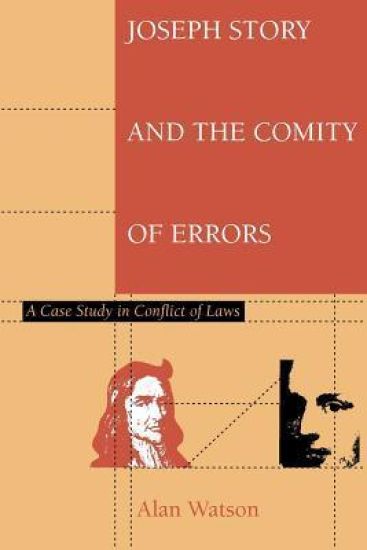
Joseph Story and the Comity of Errors

Joseph Story and the Comity of Errors

Alan Watson

University of Georgia Press
2012
pokkari
Joseph Story and the Comity of Errors examines the decisions of Supreme Court justice and Harvard law professor Joseph Story (1779–1845). According to Alan Watson, Story erred in his interpretation of Dutchman Ulrich Huber’s theory of comity—the respect accorded by one sovereignty to another sovereignty’s laws. Watson suggests that it is because of Story’s misinterpretation that the Dred Scott case went before the United States Supreme Court, whose notorious ruling against Scott fed directly into heated sectional conflict that culminated in the Civil War. Demonstrating the odd twists and turns that legal development sometimes takes, the book is also a fascinating case study that reveals much about the relationship of law to society.
Joseph A. Schumpeter

Joseph A. Schumpeter

John Medearis

Continuum International Publishing Group Ltd.
2009
sidottu
This is the fourth volume in the "Major Conservative and Libertarian Thinkers" series. Joseph Schumpeter (1883-1950) was one of the foremost economic thinkers of the twentieth century. Today Schumpeter is most well-known for his idea of 'creative destruction'. This is the notion that a market economy is simultaneously creative and destructive and therein lies the process of renewal that is central to the endurance and also the unpopularity of capitalism. Schumpeter's work also contains one of the most important conservative critiques of mass democracy. Schumpeter argued that mass democracy had totalitarian tendencies and was likely to degenerate into the tyranny of the popular.
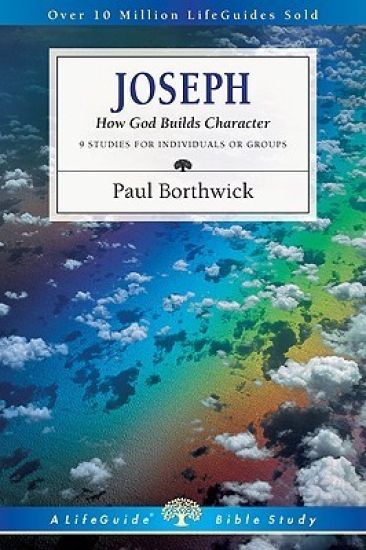
Joseph: How God Builds Character

Joseph: How God Builds Character

Paul Borthwick

IVP Bible Studies
2003
nidottu
Joseph faced hard times--more than once.He was sold into slavery by his brothers. He spent years imprisoned because of a false accusation. And yet Joseph was able to live in forgiveness and hope, and God did great things in his life every step of the way. Paul Borthwick invites you to explore Joseph's story as a way toward discovering how God's dreams might be fulfilled in and through you.These nine session LifeGuide(R) Bible Study features questions for starting group discussions and for meeting God in personal reflection, together with leader's notes and a "Now or Later" section in each study.For over three decades LifeGuide Bible Studies have provided solid biblical content and raised thought-provoking questions--making for a one-of-a-kind Bible study experience for individuals and groups. This series has more than 130 titles on Old and New Testament books, character studies, and topical studies.
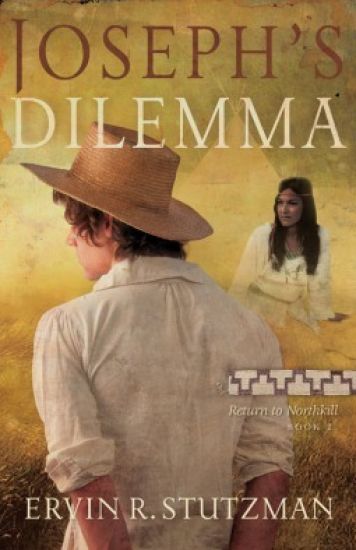
Joseph's Dilemma

Joseph's Dilemma

Ervin R Stutzman

Herald Press (VA)
2015
pokkari
Book 2 of the Return to Northkill trilogy. Unwilling captive or adopted son? Amish teen Joseph Hochstetler is taken into captivity by Native Americans during the French and Indian War. Initially he resists the Indians attempts to help him adapt to their ways their food, games, and relaxed pace of life. In this story of forbidden love, Joseph finds himself pressed between his unfolding romance with a young Indian woman and the tug of his heritage. His eyes newly opened to the wrongs committed by the white settlers, Joseph determines never to go back to his Amish community. But the encroaching British army soon forces the Indians to give up their captives under threat of death. Based on actual events, Joseph s Dilemma traces the wrenching dilemma of a young man caught between his Amish past, his love for a woman, and an unknown future. Continues the story started in "Jacob s Choice.""
Joseph Dirand

Joseph Dirand

Joseph Dirand

Rizzoli International Publications
2017
sidottu
When describing a space that intertwines both minimalism and elegance, the name Joseph Dirand immediately comes to mind. The son of Jacques Dirand, one of the most renowned interior photographers of his time, Joseph Dirand is now one of the most sought-after architects. By incorporating a quintessentially French style into otherwise minimalist interiors, Dirand creates instantly recognisable spaces, known for their strong lines and meticulous precision. This book focuses primarily on Dirand s residential interior design work in Paris and New York, while also featuring some of his acclaimed designs for the interiors of hotels, restaurants, and fashion houses worldwide. Lavishly illustrated with photography that captures the timelessness of his style, which touts impeccable proportions and breathtaking attention to detail, Joseph Dirand: Spaces/Interiors is a feast for the eyes and essential for anyone with an interest in interior design.
Joseph of Exeter: Trojan War I-III

Joseph of Exeter: Trojan War I-III

A. K. Bate

Aris Phillips Ltd
1986
nidottu
Joseph wrote his epic around the year 1180, and revised it at the court of Henry II of England where he had obtained some sort of post through the influence of his uncle, Baldwin, Archbishop of Canterbury. The work is one of a series of texts in Latin and Anglo-Norman, apparently commissioned by the King, helping to trace back the Plantagenet line to the Trojans. It is a pendant to the Anglo-Norman Roman de Troie written by Benoit de Sainte-More in the 1160s. Joseph rejected the Vergilian 'mendacious poetic' account of the war in favour of the 'historical' narrative of Dares Phrygius, an 'eye-witness' of the events. This version not only coincided with the Plantagenets' preference for historical material but also presented Aeneas, the founder of the Romans, as a traitor. In Henry's struggles with the Pope over the Investiture problem any slur on the origins of the Romans could be useful ammunition. Books I-III cover the first Trojan war when Laomedon was besieged, the Judgement of Paris and the Rape of Helen. In style Joseph closely resembles Lucan whom he had read "with an eye that allowed little to escape" (Raby), yet his imitation is far from servile. Sedgwick even goes so far as to say that Joseph "surpasses the bold constructions of Silver Latin". Moreover, Joseph restores to epic the gods that Lucan had banished. The result is an epic that in the 17th century was still considered to have been written in the classical period. Latin text with facing-page English translation, introduction and commentary.