Kirjojen hintavertailu. Mukana 12 534 173 kirjaa ja 12 kauppaa.

Kirjahaku

Etsi kirjoja tekijän nimen, kirjan nimen tai ISBN:n perusteella.

768 tulosta hakusanalla Jury Dimitrin

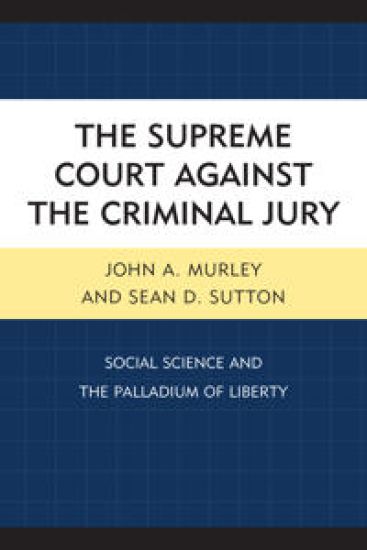
The Supreme Court against the Criminal Jury

The Supreme Court against the Criminal Jury

John A. Murley; Sean D. Sutton

Lexington Books
2014
sidottu
The Supreme Court against the Criminal Jury: Social Science and the Palladium of Liberty is an analysis of the United States Supreme Court decisions in what has come to be called the “jury-size” and “jury-decision rule” cases. In Williams v. Florida (1970) and Ballew v. Georgia (1978), a majority of the Supreme Court looked to history, empirical studies, and functional analysis to support its claim that there was “no discernible difference” between the verdicts of juries of six and juries of twelve. In the process the Court also decided that the number twelve was an historical accident and that the twelve-member jury was not an essential ingredient of trial by jury. Two years later, the Court, following essentially the same line of reasoning used in Williams, decided in the companion cases Apodaca v. Oregon (1972) and Johnson v. Louisiana (1972) that defendants were as well served with juries that reached verdicts by a majority vote of 11-1,10-2 and 9-3 as they were with unanimous jury verdicts. In these cases the Supreme Court rejected the centuries old common law view that the unanimous jury verdict was an essential element of trial by jury. With these four decisions, the criminal jury as it had been known for more than six hundred years under the common law and the Constitution was in principle abandoned. We critique these decisions from the perspective of unreliable jury studies and the impact of these decision on jury nullification.
The Supreme Court against the Criminal Jury

The Supreme Court against the Criminal Jury

John A. Murley; Sean D. Sutton

Lexington Books
2014
nidottu
The Supreme Court against the Criminal Jury: Social Science and the Palladium of Liberty is an analysis of the United States Supreme Court decisions in what has come to be called the “jury-size” and “jury-decision rule” cases. In Williams v. Florida (1970) and Ballew v. Georgia (1978), a majority of the Supreme Court looked to history, empirical studies, and functional analysis to support its claim that there was “no discernible difference” between the verdicts of juries of six and juries of twelve. In the process the Court also decided that the number twelve was an historical accident and that the twelve-member jury was not an essential ingredient of trial by jury. Two years later, the Court, following essentially the same line of reasoning used in Williams, decided in the companion cases Apodaca v. Oregon (1972) and Johnson v. Louisiana (1972) that defendants were as well served with juries that reached verdicts by a majority vote of 11-1,10-2 and 9-3 as they were with unanimous jury verdicts. In these cases the Supreme Court rejected the centuries old common law view that the unanimous jury verdict was an essential element of trial by jury. With these four decisions, the criminal jury as it had been known for more than six hundred years under the common law and the Constitution was in principle abandoned. We critique these decisions from the perspective of unreliable jury studies and the impact of these decision on jury nullification.
Charting a Future for the Civil Jury System
"Juries are the one place where common citizens play an important part in the governmental process. But both the jury system and the American legal system itself have been under attack. Juries have been reduced in size, their selection procedures altered, and the unanimity requirement suspended. Many now question the ability of lay jurors to decide increasingly complex technical and scientific questions arising in civil suits and have advocated sharp limitations on the right to a jury trial. At the same time, the civil justice system itself has been criticized for the high and rising costs of litigation, along with the rising number of lawsuits that have strained the capacity of many courts which have effectively curtailed access to the courts. This report of a conference in June 1992, cosponsored by the Brookings Institution and the litigation section of the American Bar Association, brings together leading academic scholars, attorneys, federal and state judges, and federal and state legislative representatives and their staffs. They examine the civil jury system and offer policy recommendations to help resolve disputes in a more effective and efficient manner."
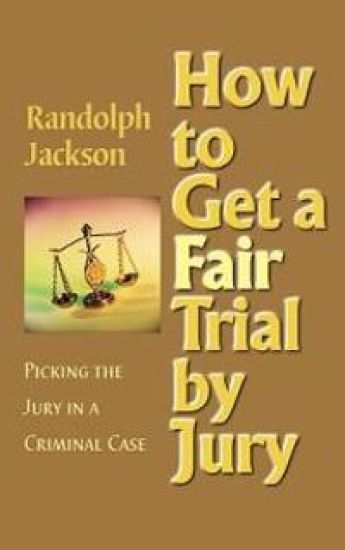
How to Get a Fair Trial by Jury

How to Get a Fair Trial by Jury

Randolph Jackson

We the People Press
2010
nidottu
Justice Randolph Jackson of the New York State Supreme Court discusses the complex process of picking a jury in a criminal case. Justice Jackson takes into account a wide range of circumstances and factors, including, but not limited to, the ever-elusive human factor. This book is essential reading for legal professionals and laypersons alike, but it is especially valuable for those individuals who are facing trial or who have family members who are doing so. The many ways that race or ethnicity can influence jurors is one of the author's special concerns. This is an accessible and readable volume; but it is also a deeply knowledgeable summary of a lifetime's worth of experience with jury trials.