Kirjojen hintavertailu. Mukana 11 717 486 kirjaa ja 12 kauppaa.

Kirjahaku

Etsi kirjoja tekijän nimen, kirjan nimen tai ISBN:n perusteella.

1000 tulosta hakusanalla Vector Hasting

Witt Vector

Witt Vector

VDM Publishing House
2010
nidottu
Observera att förlaget som ger ut denna produkt baserar innehållet i sina produkter på fria källor som Wikipedia. Boken är med stor sannolikhet endast ett utdrag ur dessa informationskällor, alltså inte en vanlig bok i den bemärkelsen.
Super Vector Space

Super Vector Space

VDM Publishing House
2010
nidottu
Observera att förlaget som ger ut denna produkt baserar innehållet i sina produkter på fria källor som Wikipedia. Boken är med stor sannolikhet endast ett utdrag ur dessa informationskällor, alltså inte en vanlig bok i den bemärkelsen.
Projective Vector Field

Projective Vector Field

VDM Publishing House
2010
nidottu
Observera att förlaget som ger ut denna produkt baserar innehållet i sina produkter på fria källor som Wikipedia. Boken är med stor sannolikhet endast ett utdrag ur dessa informationskällor, alltså inte en vanlig bok i den bemärkelsen.
Dimension (vector Space)

Dimension (vector Space)

VDM Publishing House
2010
nidottu
Observera att förlaget som ger ut denna produkt baserar innehållet i sina produkter på fria källor som Wikipedia. Boken är med stor sannolikhet endast ett utdrag ur dessa informationskällor, alltså inte en vanlig bok i den bemärkelsen.
Row Vector

Row Vector

VDM Publishing House
2010
nidottu
Observera att förlaget som ger ut denna produkt baserar innehållet i sina produkter på fria källor som Wikipedia. Boken är med stor sannolikhet endast ett utdrag ur dessa informationskällor, alltså inte en vanlig bok i den bemärkelsen.
Ordered Vector Space

Ordered Vector Space

VDM Publishing House
2010
nidottu
Observera att förlaget som ger ut denna produkt baserar innehållet i sina produkter på fria källor som Wikipedia. Boken är med stor sannolikhet endast ett utdrag ur dessa informationskällor, alltså inte en vanlig bok i den bemärkelsen.
Connection (vector Bundle)

Connection (vector Bundle)

VDM Publishing House
2010
nidottu
Observera att förlaget som ger ut denna produkt baserar innehållet i sina produkter på fria källor som Wikipedia. Boken är med stor sannolikhet endast ett utdrag ur dessa informationskällor, alltså inte en vanlig bok i den bemärkelsen.
Complex Vector Functional Equations

Complex Vector Functional Equations

Valery Covachev; Ice B Risteski

World Scientific Publishing Co Pte Ltd
2001
sidottu
The subject of complex vector functional equations is a new area in the theory of functional equations. This monograph provides a systematic overview of the authors' recently obtained results concerning both linear and nonlinear complex vector functional equations, in all aspects of their utilization. It is intended for mathematicians, physicists and engineers who use functional equations in their investigations.
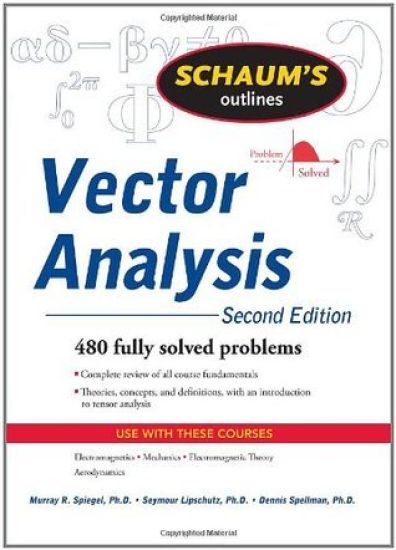
Schaum's Outline of Vector Analysis, 2ed

Schaum's Outline of Vector Analysis, 2ed

Murray Spiegel; Seymour Lipschutz

McGraw-Hill Professional
2009
nidottu
The guide to vector analysis that helps students study faster, learn better, and get top gradesMore than 40 million students have trusted Schaum's to help them study faster, learn better, and get top grades. Now Schaum's is better than ever-with a new look, a new format with hundreds of practice problems, and completely updated information to conform to the latest developments in every field of study.Fully compatible with your classroom text, Schaum's highlights all the important facts you need to know. Use Schaum's to shorten your study time-and get your best test scores!Schaum's Outlines-Problem Solved.
Plant Virus Vector Interactions
Most viruses that infect plants need an intermediary (vector) for their spread between plants. This book describes, for the main vector groups, the current state of knowledge of what happens to viruses in their passage through their vectors and what interactions within the vector determine whether or not they are passed on to new plants. This volume of Advances in Botanical Research brings together current research on virus-vector interactions, with chapters on aphids, fungi, whitefly, beetles, nematodes, thrips, leafhoppers, treehoppers, and planthoppers, and other vectors. Advances in Botanical Research is a multi-volume publication that brings together reviews by recognized experts on subjects of importance to those involved in botanical research. First published in 1963, Advances in Botanical Research has earned a reputation for excellence in the field for more than thirty years. In 1995, Advances in Botanical Research was merged with Advances in Plant Pathology to provide one comprehensive resource for the plant science community, with equal coverage of plant pathology and botany in both thematic and mixed volumes. Now edited by J.A. Callow (University of Birmingham, UK), supported by an international Editorial Board, Advances in Botanical Research publishes in-depth and up-to-date reviews on a wide range of topics which will appeal to post-graduates and researchers in plant sciences including botany, plant biochemistry, plant pathology and plant physiology. Eclectic volumes in the serial are supplemented by thematic volumes on such topics as Plant Protein Kinases, and Plant Trichomes. In 1999, the Institute for Scientific Information released figures showing that Advances in Botanical Research has an Impact Factor of 4.378, placing it 8th in the highly competitive category of Plant Sciences.
Piezoelectric Actuators: Vector Control Method

Piezoelectric Actuators: Vector Control Method

Frederic Giraud; Christophe Giraud-Audine

Butterworth-Heinemann Inc
2019
nidottu
Piezoelectric Actuators: Vector Control Method: Base, Modeling and Mechatronic Design of Ultrasonic Devices guides researchers and engineers through the process of implementing the vector control method (VCM) in their systems. The book presents which measurements can be made, how to visualize a variable as a rotating vector, about the angular position of the rotating reference frame, how to calculate the parameters of the controllers, and how to observe key variables. Additionally, the book focuses on the modeling of PE ultrasonic transducers and investigates the energy conversion process in an ultrasonic transducer.
Population Biology of Vector-Borne Diseases
Population Biology of Vector-Borne Diseases is the first comprehensive survey of this rapidly developing field. The chapter topics provide an up-to-date presentation of classical concepts, reviews of emerging trends, synthesis of existing knowledge, and a prospective agenda for future research. The contributions offer authoritative and international perspectives from leading thinkers in the field. The dynamics of vector-borne diseases are far more intrinsically ecological compared with their directly transmitted equivalents. The environmental dependence of ectotherm vectors means that vector-borne pathogens are acutely sensitive to changing environmental conditions. Although perennially important vector-borne diseases such as malaria and dengue have deeply informed our understanding of vector-borne diseases, recent emerging viruses such as West Nile virus, Chikungunya virus, and Zika virus have generated new scientific questions and practical problems. The study of vector-borne disease has been a particularly rich source of ecological questions, while ecological theory has provided the conceptual tools for thinking about their evolution, transmission, and spatial extent. Population Biology of Vector-Borne Diseases is an advanced textbook suitable for graduate level students taking courses in vector biology, population ecology, evolutionary ecology, disease ecology, medical entomology, viral ecology/evolution, and parasitology, as well as providing a key reference for researchers across these fields.
Population Biology of Vector-Borne Diseases
Population Biology of Vector-Borne Diseases is the first comprehensive survey of this rapidly developing field. The chapter topics provide an up-to-date presentation of classical concepts, reviews of emerging trends, synthesis of existing knowledge, and a prospective agenda for future research. The contributions offer authoritative and international perspectives from leading thinkers in the field. The dynamics of vector-borne diseases are far more intrinsically ecological compared with their directly transmitted equivalents. The environmental dependence of ectotherm vectors means that vector-borne pathogens are acutely sensitive to changing environmental conditions. Although perennially important vector-borne diseases such as malaria and dengue have deeply informed our understanding of vector-borne diseases, recent emerging viruses such as West Nile virus, Chikungunya virus, and Zika virus have generated new scientific questions and practical problems. The study of vector-borne disease has been a particularly rich source of ecological questions, while ecological theory has provided the conceptual tools for thinking about their evolution, transmission, and spatial extent. Population Biology of Vector-Borne Diseases is an advanced textbook suitable for graduate level students taking courses in vector biology, population ecology, evolutionary ecology, disease ecology, medical entomology, viral ecology/evolution, and parasitology, as well as providing a key reference for researchers across these fields.
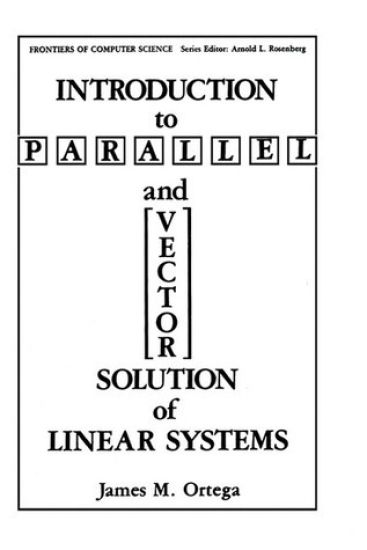
Introduction to Parallel and Vector Solution of Linear Systems

Introduction to Parallel and Vector Solution of Linear Systems

James M. Ortega

Kluwer Academic/Plenum Publishers
1988
sidottu
Although the origins of parallel computing go back to the last century, it was only in the 1970s that parallel and vector computers became available to the scientific community. The first of these machines-the 64 processor llliac IV and the vector computers built by Texas Instruments, Control Data Corporation, and then CRA Y Research Corporation-had a somewhat limited impact. They were few in number and available mostly to workers in a few government laboratories. By now, however, the trickle has become a flood. There are over 200 large-scale vector computers now installed, not only in government laboratories but also in universities and in an increasing diversity of industries. Moreover, the National Science Foundation's Super­ computing Centers have made large vector computers widely available to the academic community. In addition, smaller, very cost-effective vector computers are being manufactured by a number of companies. Parallelism in computers has also progressed rapidly. The largest super­ computers now consist of several vector processors working in parallel. Although the number of processors in such machines is still relatively small (up to 8), it is expected that an increasing number of processors will be added in the near future (to a total of 16 or 32). Moreover, there are a myriad of research projects to build machines with hundreds, thousands, or even more processors. Indeed, several companies are now selling parallel machines, some with as many as hundreds, or even tens of thousands, of processors.