

Kirjahaku
Etsi kirjoja tekijän nimen, kirjan nimen tai ISBN:n perusteella.
1000 tulosta hakusanalla Wilson-Perry Maxine Wilson-Perry

The Autobiography Of The Blind James Wilson: With A Preliminary Essay On His Life, Character And Writings, As Well As On The Present State Of The Blin
James Wilson; John Bird
KESSINGER PUBLISHING, LLC
2008
sidottu

The wonderful world of Jacqueline Wilson is waiting for you to colour it in! Unleash your creativity and lose yourself in this beautiful colouring book bursting with Nick Sharratt's inspirational illustrations of Jacqueline's larger-than-life characters. This is the perfect gift for any Jacqueline Wilson fan.

Angus Wilson was a critic, lecturer and man of letters. Pre-eminently though he was a novelist, indeed, in the words of Paul Bailey 'no other novelist of his generation offered as complete and detailed a portrait of English society.'His first volume of stories, The Wrong Set (1949) - reissued in Faber Finds - launched Wilson as one of the most controversial, colourful and entertaining figures on the post-war literary scene, and he rapidly developed into a major novelist, maturing from enfant terrible to elder statesman in the process. Margaret Drabble's biography traces the influences of his bizarrely extended family, his years as a librarian at the British Museum - interrupted by a grim spell in the code-breaking huts at Bletchley Park - and his unexpected liberation as a writer. It portrays the dizzying progress of a writer and enthusiast whose work was at the forefront of English fiction for the second-half of the twentieth-century: above all it is a portrait of an artist of enormous courage, a man who confronted challenge to the very end. In his later years he became both influence and mentor for a younger generation of writers, including Ian McEwan, Rose Tremain and Margaret Drabble herself. Margaret Drabble knew Angus Wilson from the late 1960s and her biography is enriched with personal knowledge and recollections.'He has been fortunate in his biographer . . . Altogether, with the assistance and consent of Tony Garrett, the dedicatee and second hero of the book, she has given a minute, intimate and candid account . . . of Wilson's hectic life.' Frank Kermode, London Review of Books 'A solid tribute of scholarship and affection' Penelope Fitzgerald, Independent'No one interested in the story of modern fiction can fail to find this life fascinating. Its virtues - a bright, crowded canvas, warmth, a witty, polished style - are those of Wilson's novels . . . Through it all shines so human a picturer of a courageous, doubting, eccentric, driven writer.' Jackie Wullschlager, Financial Times

Winner! 1990 Pulitzer Prize for DramaWinner! 1990 Drama Desk Award Outstanding New PlayNominee! 1990 Tony Award Best PlayNominee! 2013 Outer Critics Circle Award Outstanding Revival of a PlayNominee! 2013 Drama League Award Outstanding Revival of a PlayIt is 1936 and Boy Willie arrives in Pittsburgh from the South in a battered truck loaded with watermelons to sell. He has an opportunity to buy some land down home but he has to come up with the money right quick. He wa

Finalist! 2000 Pulitzer Prize in DramaPeddling stolen refrigerators in the feeble hope of making enough money to open a video store King Hedley a man whose self worth is built on self delusion is scraping in the dirt of an urban backyard trying to plant seeds where nothing will grow. Getting spending killing and dying in a world where getting is hard and killing is commonplace are threads woven into this 1980's installment in the author's renowned cycle of plays about the black ex
Finalist! 1992 Pulitzer Prize in Drama This is the 1960s chapter of the Pulitzer Prize winning playwright's decade by decade saga of ordinary African Americans in this turbulent century. It takes place in Memphis Lee's coffee shop in a Pittsburgh neighborhood that is on the brink of economic development. Focus is on the characters who hang out there: a local sage, an elderly man who imparts the secrets of life as learned from a 322 year old sage, an ex con, a numbers runner, a laconic

Set in 1904 August Wilson's Gem of the Ocean begins on the eve of Aunt Esther's 287th birthday. When Citizen Barlow comes to her Pittsburgh's Hill District home seeking asylum she sets him off on a spiritual journey to find a city in the middle of the Atlantic Ocean. Gem of the Ocean is the ninth work in Wilson's ten-play cycle that has recorded the American Black experience and helped to define generations. The Broadway run starred Tony Award winner Phylicia Rashad as Aunt Esthe

Tootsie & Wilson Meet Pete the Parakeet
The Saturn Creative Team
Saturn Music Entertainment
2018
nidottu
Tootsie & Wilson reach new imagination heights as they try to figure out what their friend Pete has planned for the baby's birthday party. Join the fun Explore the activities in the back of the book. Here you'll find a maze, word search, music, and coloring sheets

Most famous in Europe for his efforts to establish the League of Nations under US leadership at the end of the First World War, Woodrow Wilson stands as one of America’s most influential and visionary presidents. A Democrat who pursued progressive domestic policies during his first term in office, he despised European colonialism and believed that the recipe for world peace was the self-determination of all peoples, particularly those under the yoke of the vast Ottoman and Austro-Hungarian Empires. His efforts to resist heavy reparations on Germany fell on deaf ears, while the refusal of France, Russia and Britain to accept a League of Nations led by America, together with the US Senate’s refusal to ratify the League, led to its ultimate failure. Woodrow Wilson has traditionally been seen by both admirers and critics as an idealist and a heroic martyr to the cause of internationalism. But John Thompson takes a different view, arguing that Wilson was a pragmatist, whose foreign policy was flexible and responsive to pressures and events. His conclusion, that Wilson was in fact an exceptionally skilful politician, who succeeded in maintaining national unity whilst leading America onto the world stage for the first time in its history, offers a challenging interpretation for anyone interested in the man and his era.




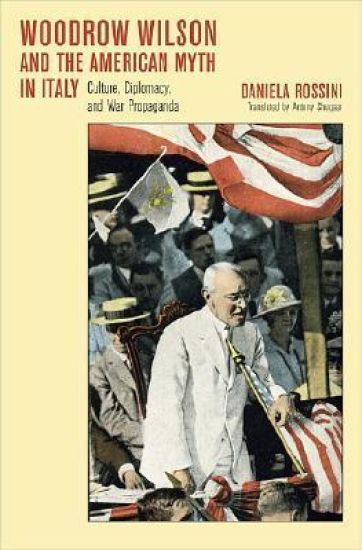
In 1918, Woodrow Wilson’s image as leader of the free world and the image of America as dispenser of democracy spread throughout Italy, filling an ideological void after the rout of Caporetto and diverting attention from a hapless ruling class. Wilson’s popularity depended not only on the modernity of his democratic message, but also on a massive propaganda campaign he conducted across Italy, using as conduits the American Red Cross, the YMCA, and the Committee on Public Information.American popularity, though, did not ensure mutual understanding. The Paris peace negotiations revealed the limits of policies on both sides, illustrated most clearly in Wilson’s disastrous direct appeal to the Italian public. The estranged countries pulled inward, the Americans headed toward isolationism, the Italians toward fascism.Rossini sets the Italian-American political confrontation within the full context of the two countries’ cultural perceptions of each other, different war experiences, and ideas about participatory democracy and peace. A stellar example of the new international history, this timely book highlights the impact of American ideology and sense of mission in the world.

Audubon was not the father of American ornithology. That honorific belongs to Alexander Wilson, whose encyclopedic American Ornithology established a distinctive approach that emphasized the observation of live birds. In the first full-length study to reproduce all of Wilson’s unpublished drawings for the nine-volume Ornithology, Edward Burtt and William Davis illustrate Wilson’s pioneering and, today, underappreciated achievement as the first ornithologist to describe the birds of the North American wilderness.Abandoning early ambitions to become a poet in the mold of his countryman Robert Burns, Wilson emigrated from Scotland to settle near Philadelphia, where the botanist William Bartram encouraged his proclivity for art and natural history. Wilson traveled 12,000 miles on foot, on horseback, in a rowboat, and by stage and ship, establishing a network of observers along the way. He wrote hundreds of accounts of indigenous birds, discovered many new species, and sketched the behavior and ecology of each species he encountered.Drawing on their expertise in both science and art, Burtt and Davis show how Wilson defied eighteenth-century conventions of biological illustration by striving for realistic depiction of birds in their native habitats. He drew them in poses meant to facilitate identification, making his work the model for modern field guides and an inspiration for Audubon, Spencer Fullerton Baird, and other naturalists who followed. On the bicentennial of his death, this beautifully illustrated volume is a fitting tribute to Alexander Wilson and his unique contributions to ornithology, ecology, and the study of animal behavior.

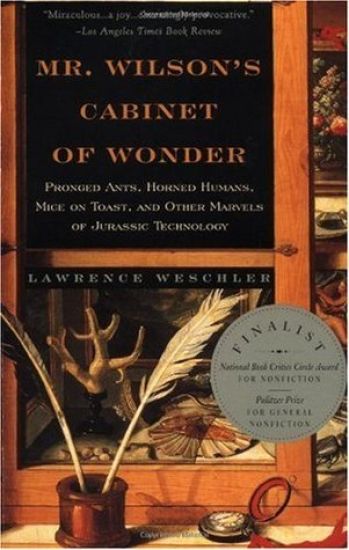
Pronged ants, horned humans, a landscape carved on a fruit pit--some of the displays in David Wilson's Museum of Jurassic Technology are hoaxes. But which ones? As he guides readers through an intellectual hall of mirrors, Lawrence Weschler revisits the 16th-century "wonder cabinets" that were the first museums and compels readers to examine the imaginative origins of both art and science. Illustrations.