Kirjojen hintavertailu. Mukana 11 699 587 kirjaa ja 12 kauppaa.

Kirjahaku

Etsi kirjoja tekijän nimen, kirjan nimen tai ISBN:n perusteella.

680 tulosta hakusanalla "Inversion"

Numerical Methods for Laplace Transform Inversion

Numerical Methods for Laplace Transform Inversion

Alan M. Cohen

Springer-Verlag New York Inc.
2007
sidottu
Operational methods have been used for over a century to solve problems such as ordinary and partial differential equations. When solving such problems, in many cases it is fairly easy to obtain the Laplace transform, while it is very demanding to determine the inverse Laplace transform that is the solution of a given problem. Sometimes, after some difficult contour integration, we may find that a series solution results, but this may be quite difficult to evaluate in order to get an answer at a particular time value. The advent of computers has given an impetus to developing numerical methods for the determination of the inverse Laplace transform. This book gives background material on the theory of Laplace transforms, together with a fairly comprehensive list of methods that are available at the current time. Computer programs are included for those methods that perform consistently well on a wide range of Laplace transforms.
The Heat Kernel and Theta Inversion on SL2(C)

The Heat Kernel and Theta Inversion on SL2(C)

Jay Jorgenson; Serge Lang

Springer-Verlag New York Inc.
2008
sidottu
The worthy purpose of this text is to provide a complete, self-contained development of the trace formula and theta inversion formula for SL(2,Z[i])\SL(2,C). Unlike other treatments of the theory, the approach taken here is to begin with the heat kernel on SL(2,C) associated to the invariant Laplacian, which is derived using spherical inversion. The heat kernel on the quotient space SL(2,Z[i])\SL(2,C) is arrived at through periodization, and further expanded in an eigenfunction expansion. A theta inversion formula is obtained by studying the trace of the heat kernel. Following the author's previous work, the inversion formula then leads to zeta functions through the Gauss transform.
Bienes Raíces: Su Guía de Inversión Immobiliaria en la Florida Para los Compradores Globales: Poseer, Invertir y Disfrutar el Estilo
Un estilo de vida id lico y retornos financieros s lidos - qu m s podr a desear de una inversi n de bienes ra ces? Lisa y Lee Mirman, MBAs de la Universidad de Duke, han creado su pr ctica de bienes ra ces en la Florida con tica y transparencia intransigente. Escrito para el comprador global, esta es una gu a que debe tener cualquier persona que busca invertir en el mercado de propiedades y el estilo de vida en la Florida. Haciendo uso de sus 40 a os de experiencia, Lisa y Lee desmitifican el proceso de la inversi n de bienes ra ces. Aprenda: Procesos detallados paso a paso para comprar, administrar y vender su vivienda de la Florida C mo elegir a los mejores profesionales con quienes trabajar D nde invertir, con la sinopsis del mercado de las reas m s populares de la Florida C mo la compra y venta de bienes ra ces en la Florida es diferente que en otras partes del mundo C mo entender los contratos de las propiedades inmobiliarias, las inspecciones, y el aseguramiento C mo comprar una propiedad en la Florida de una manera agradable, rentable y libre de preocupaciones con una gu a de planeamiento fiscal y legal sensata. Descubra porqu , para muchos de los clientes globales de Lisa y de Lee, la propiedad en la Florida es una de las inversiones inmobiliarias mejores y m s seguras del mundo hoy. El enfoque sistem tico comprensivo, honesto y abierto, de dos agentes inmersos en el mercado, hace que esto sea una ayuda inestimable para invertir en uno de los mercados de propiedades m s atractivos de los EE.UU.. Fergal DeClar - director, Programa de MSc, Escuela Europea de Econom a, Madrid, Espa a ... consejo profesional obligatorio para hacer una inversi n acertada.... me ha ayudado a entender c mo la compra en los EE.UU. es diferente del modelo operativo en Europa. Fran ois Angelelli - presidente, CDES Francia, Par s, Francia Hewlett-Packard Incre blemente til, profundo y eficaz. La Florida ha sido siempre una propuesta maravillosa y con el desempe o actual del mercado, No lo pens dos veces Duncan Revie - CEO, Soccerex, Londres, Reino Unido
Deep Learning-Based Forward Modeling and Inversion Techniques for Computational Physics Problems
This book investigates in detail the emerging deep learning (DL) technique in computational physics, assessing its promising potential to substitute conventional numerical solvers for calculating the fields in real-time. After good training, the proposed architecture can resolve both the forward computing and the inverse retrieve problems.Pursuing a holistic perspective, the book includes the following areas. The first chapter discusses the basic DL frameworks. Then, the steady heat conduction problem is solved by the classical U-net in Chapter 2, involving both the passive and active cases. Afterwards, the sophisticated heat flux on a curved surface is reconstructed by the presented Conv-LSTM, exhibiting high accuracy and efficiency. Additionally, a physics-informed DL structure along with a nonlinear mapping module are employed to obtain the space/temperature/time-related thermal conductivity via the transient temperature in Chapter 4. Finally, in Chapter 5, a series of the latest advanced frameworks and the corresponding physics applications are introduced.As deep learning techniques are experiencing vigorous development in computational physics, more people desire related reading materials. This book is intended for graduate students, professional practitioners, and researchers who are interested in DL for computational physics.
Deep Learning-Based Forward Modeling and Inversion Techniques for Computational Physics Problems
This book investigates in detail the emerging deep learning (DL) technique in computational physics, assessing its promising potential to substitute conventional numerical solvers for calculating the fields in real-time. After good training, the proposed architecture can resolve both the forward computing and the inverse retrieve problems.Pursuing a holistic perspective, the book includes the following areas. The first chapter discusses the basic DL frameworks. Then, the steady heat conduction problem is solved by the classical U-net in Chapter 2, involving both the passive and active cases. Afterwards, the sophisticated heat flux on a curved surface is reconstructed by the presented Conv-LSTM, exhibiting high accuracy and efficiency. Additionally, a physics-informed DL structure along with a nonlinear mapping module are employed to obtain the space/temperature/time-related thermal conductivity via the transient temperature in Chapter 4. Finally, in Chapter 5, a series of the latest advanced frameworks and the corresponding physics applications are introduced.As deep learning techniques are experiencing vigorous development in computational physics, more people desire related reading materials. This book is intended for graduate students, professional practitioners, and researchers who are interested in DL for computational physics.
Global Optimization Methods in Geophysical Inversion

Global Optimization Methods in Geophysical Inversion

Mrinal K. Sen; Paul L. Stoffa

Cambridge University Press
2013
sidottu
Providing an up-to-date overview of the most popular global optimization methods used in interpreting geophysical observations, this new edition includes a detailed description of the theoretical development underlying each method and a thorough explanation of the design, implementation and limitations of algorithms. New and expanded chapters provide details of recently developed methods, such as the neighborhood algorithm, particle swarm optimization, hybrid Monte Carlo and multi-chain MCMC methods. Other chapters include new examples of applications, from uncertainty in climate modeling to whole earth studies. Several different examples of geophysical inversion, including joint inversion of disparate geophysical datasets, are provided to help readers design algorithms for their own applications. This is an authoritative and valuable text for researchers and graduate students in geophysics, inverse theory and exploration geoscience, and an important resource for professionals working in engineering and petroleum exploration.
Global Optimization Methods in Geophysical Inversion

Global Optimization Methods in Geophysical Inversion

Mrinal K. Sen; Paul L. Stoffa

Cambridge University Press
2018
pokkari
Providing an up-to-date overview of the most popular global optimization methods used in interpreting geophysical observations, this new edition includes a detailed description of the theoretical development underlying each method and a thorough explanation of the design, implementation and limitations of algorithms. New and expanded chapters provide details of recently developed methods, such as the neighborhood algorithm, particle swarm optimization, hybrid Monte Carlo and multi-chain MCMC methods. Other chapters include new examples of applications, from uncertainty in climate modeling to whole earth studies. Several different examples of geophysical inversion, including joint inversion of disparate geophysical datasets, are provided to help readers design algorithms for their own applications. This is an authoritative and valuable text for researchers and graduate students in geophysics, inverse theory and exploration geoscience, and an important resource for professionals working in engineering and petroleum exploration.
Studies in the Psychology of Sex Sexual Inversion; Volume 11
This work has been selected by scholars as being culturally important, and is part of the knowledge base of civilization as we know it. This work was reproduced from the original artifact, and remains as true to the original work as possible. Therefore, you will see the original copyright references, library stamps (as most of these works have been housed in our most important libraries around the world), and other notations in the work.This work is in the public domain in the United States of America, and possibly other nations. Within the United States, you may freely copy and distribute this work, as no entity (individual or corporate) has a copyright on the body of the work.As a reproduction of a historical artifact, this work may contain missing or blurred pages, poor pictures, errant marks, etc. Scholars believe, and we concur, that this work is important enough to be preserved, reproduced, and made generally available to the public. We appreciate your support of the preservation process, and thank you for being an important part of keeping this knowledge alive and relevant.
The Heat Kernel and Theta Inversion on SL2(C)

The Heat Kernel and Theta Inversion on SL2(C)

Jay Jorgenson; Serge Lang

Springer-Verlag New York Inc.
2010
nidottu
The worthy purpose of this text is to provide a complete, self-contained development of the trace formula and theta inversion formula for SL(2,Z[i])\SL(2,C). Unlike other treatments of the theory, the approach taken here is to begin with the heat kernel on SL(2,C) associated to the invariant Laplacian, which is derived using spherical inversion. The heat kernel on the quotient space SL(2,Z[i])\SL(2,C) is arrived at through periodization, and further expanded in an eigenfunction expansion. A theta inversion formula is obtained by studying the trace of the heat kernel. Following the author's previous work, the inversion formula then leads to zeta functions through the Gauss transform.
Numerical Methods for Laplace Transform Inversion

Numerical Methods for Laplace Transform Inversion

Alan M. Cohen

Springer-Verlag New York Inc.
2010
nidottu
Operational methods have been used for over a century to solve problems such as ordinary and partial differential equations. When solving such problems, in many cases it is fairly easy to obtain the Laplace transform, while it is very demanding to determine the inverse Laplace transform that is the solution of a given problem. Sometimes, after some difficult contour integration, we may find that a series solution results, but this may be quite difficult to evaluate in order to get an answer at a particular time value. The advent of computers has given an impetus to developing numerical methods for the determination of the inverse Laplace transform. This book gives background material on the theory of Laplace transforms, together with a fairly comprehensive list of methods that are available at the current time. Computer programs are included for those methods that perform consistently well on a wide range of Laplace transforms.
Computational Electromagnetics and Model-Based Inversion

Computational Electromagnetics and Model-Based Inversion

Harold A Sabbagh; R. Kim Murphy; Elias H. Sabbagh; John C. Aldrin; Jeremy S Knopp

Springer-Verlag New York Inc.
2013
sidottu
This volume will define the direction of eddy-current technology in nondestructive evaluation (NDE) in the twenty-first century. It describes the natural marriage of the computer to eddy-current NDE, and its publication was encouraged by favorable responses from workers in the nuclear-power and aerospace industries. It will be used by advanced students and practitioners in the fields of computational electromagnetics, electromagnetic inverse-scattering theory, nondestructive evaluation, materials evaluation and biomedical imaging, among others, and will be based on our experience in applying the subject of computational electromagnetics to these areas, as manifested by our recent research and publications. Finally, it will be a reference to future monographs on advanced NDE that are being contemplated by our colleagues and others. Its importance lies in the fact that it will be the first book to show that advanced computational methods can be used to solve practical, but difficult, problems in eddy-current NDE. In fact, in many cases these methods are the only things available for solving the problems.The book will cover the topic of computational electromagnetics in eddy-current nondestructive evaluation (NDE) by emphasizing three distinct topics: (a) fundamental mathematical principles of volume-integral equations as a subset of computational electromagnetics, (b) mathematical algorithms applied to signal-processing and inverse scattering problems, and (c) applications of these two topics to problems in which real and model data are used. This will make the book more than an academic exercise; we expect it to be valuable to users of eddy-current NDE technology in industries as varied as nuclear power, aerospace, materials characterization and biomedical imaging. We know of no other book on the market that covers this material in the manner in which we will present it, nor are there any books, to our knowledge, that apply this material to actual test situations that are of importance to the industries cited. It will be the first book to actually define the modern technology of eddy-current NDE, by showing how mathematics and the computer will solve problems more effectively than current analog practice.
Computational Electromagnetics and Model-Based Inversion

Computational Electromagnetics and Model-Based Inversion

Harold A Sabbagh; R. Kim Murphy; Elias H. Sabbagh; John C. Aldrin; Jeremy S Knopp

Springer-Verlag New York Inc.
2015
nidottu
This volume will define the direction of eddy-current technology in nondestructive evaluation (NDE) in the twenty-first century. It describes the natural marriage of the computer to eddy-current NDE, and its publication was encouraged by favorable responses from workers in the nuclear-power and aerospace industries. It will be used by advanced students and practitioners in the fields of computational electromagnetics, electromagnetic inverse-scattering theory, nondestructive evaluation, materials evaluation and biomedical imaging, among others, and will be based on our experience in applying the subject of computational electromagnetics to these areas, as manifested by our recent research and publications. Finally, it will be a reference to future monographs on advanced NDE that are being contemplated by our colleagues and others. Its importance lies in the fact that it will be the first book to show that advanced computational methods can be used to solve practical, but difficult, problems in eddy-current NDE. In fact, in many cases these methods are the only things available for solving the problems.The book will cover the topic of computational electromagnetics in eddy-current nondestructive evaluation (NDE) by emphasizing three distinct topics: (a) fundamental mathematical principles of volume-integral equations as a subset of computational electromagnetics, (b) mathematical algorithms applied to signal-processing and inverse scattering problems, and (c) applications of these two topics to problems in which real and model data are used. This will make the book more than an academic exercise; we expect it to be valuable to users of eddy-current NDE technology in industries as varied as nuclear power, aerospace, materials characterization and biomedical imaging. We know of no other book on the market that covers this material in the manner in which we will present it, nor are there any books, to our knowledge, that apply this material to actual test situations that are of importance to the industries cited. It will be the first book to actually define the modern technology of eddy-current NDE, by showing how mathematics and the computer will solve problems more effectively than current analog practice.
El paseo aleatorio hacia la jubilacion: La inversion y el riesgo en los Fondos de Pensiones
A principios del siglo XX la duraci n media de la vida de una persona en la fase de jubilaci n o retiro era muy exigua, en cambio a principios del siglo XXI la situaci n ha cambiado radicalmente, es probable que muchas personas puedan vivir en la fase de jubilaci n por mas tiempo del que hayan permanecido en actividad laboral. Por otra parte las pensiones publicas de jubilaci n, por distintos motivos, ser n cada vez mas menguantes. Por lo tanto el mantenimiento de un determinado nivel o calidad de vida durante la fase de jubilaci n depender tanto de la responsabilidad como de la informaci n y acierto de cada individuo en las decisiones que deber adoptar en aras a su previsi n. En lo esencial un esquema de previsi n individual es sencillo. La complejidad aparece cuando se plantean las cuestiones concretas a las que se enfrenta cualquier participe de un esquema de previsi n. Constituyendo el riesgo financiero susceptible de ser asumido un aspecto esencial. La inversi n con bajo riesgo implica un rendimiento financiero muy escaso, pero la inversi n con un determinado riesgo, en el sentido de dispersi n de los posibles resultados, solo puede ser asumida por el inversor que tenga capacidad econ mica y disposici n personal para ello. El libro "El paseo aleatorio hacia la jubilaci n" pretende introducir al lector en la mec nica del proceso de acumulaci n que tiene la finalidad de hacer posible la generaci n de un flujo de rentas en la fase de retiro, describir las distintas clases de riesgos financieros y extrafinancieros a los que se expone, y poner de relieve como se puede determinar la combinaci n de activos, renta fija y renta variable, que mejor puede ajustarse a las necesidades individuales de cada persona o unidad familiar.
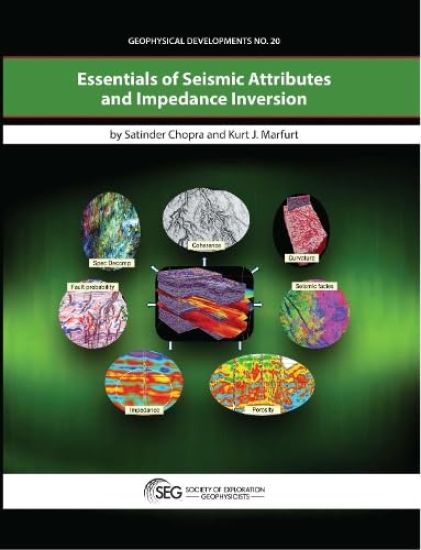
Essentials of Seismic Attributes and Impedance Inversion

Essentials of Seismic Attributes and Impedance Inversion

Satinder Chopra; Kurt J. Marfurt

Society of Exploration Geophysicists
2024
sidottu
Seismic attributes are best illustrated through examples. Essentials of Seismic Attributes and Impedance Inversion is a comprehensive resource, extensively referenced and richly illustrated with more than 1,000 figures. These examples not only clarify theory, best practices, workflows, and case studies but also highlight common pitfalls in interpretation.