Kirjojen hintavertailu. Mukana 11 699 587 kirjaa ja 12 kauppaa.

Kirjahaku

Etsi kirjoja tekijän nimen, kirjan nimen tai ISBN:n perusteella.

1000 tulosta hakusanalla Ingmar Simonsson

Plöntunarbók 2022

Plöntunarbók 2022

Ingvar Strom

INGVAR STROM
2022
pokkari
Langar ig a lifa l finu fullu af orku en samt nj ta ess a f vatn vatn og au velt a tb a m lt ir?Langar ig til a l ttast eitt skipti fyrir ll, me an ert enn a nj ta upp halds vegan r ttanna inna?Pl ntubundi matar i arf ekki a vera lei inlegt og bl tt. a getur veri skapandi og kraftmiki . essi b k mun spara r t ma og fyrirh fn me v a bj a upp sveigjanlegar og pott ttar uppskriftir fyrir hva a tilefni sem er.J ja, ef svari er j , er g h r fyrir. Til a hj lpa r vi a n essu, lag i g herslu a b a til eina og eina matrei slub kina sem byggir pl ntum, fyrir fram rskarandi rangur, me au velt og reynslulaust a elda uppskriftir fyrir hvern sem er. essi einfalda, en pl ntubundin uppskriftab k mun a sto a ig vi a f einstakar lj ffengar m lt ir, tilb nar til a endurheimta heilsuna, l a vel og l ttast essi fullkomna matrei slub k sem byggir pl ntum mun sj um nauman eldunart ma inn og mun s na r au veldustu og brag g ustu lei ina a n jum l fsst l.Nota u jurtabundi matar i fyrir hjartaheilsu, fitubrennslu og almenna vell an - essar lj ffengu uppskriftir og gagnlegar m lt ar tlanir munu v sa r lei ina. Nj ttu Gr ptu eintaki itt n na
Heimabakaði í Mikró 2023

Heimabakaði í Mikró 2023

Ingvar Strom

INGVAR STROM
2023
pokkari
st an fyrir a vinna a essu spjaldbakaforriti var a deila hugaver um og skemmtilegum slenskum r ttum sem gefa m gulegt a baka mikr v l. b kinni eru yfir 100 n gjuleg og au veld r ttir, fr fengri formlegri m lt til h gt daglegt bor . essir r ttir eru ruggir og au veldir a baka mikr v l og eru algengir slenskum heimili. essir r ttir eru fullkomnir fyrir f lk sem vilja bor a gott, n gjulegt og d rt mat stutta t ma. me an essi r ttir eru borin fram slenskum st l, er gott fyrir ll al j a lesendur a finna r hugaver ar. essi b k er fullkomin fyrir f lk sem vilja deila s rst kum slenskum r ttum me vinum og ttingjum.R ttirnir essari b k eru borin fram me uppskriftum sem eru au velt a fylgja. essir r ttir eru fullkomnir fyrir daglegt bor , l ka t kif ri og l ka t k. B kin er fullkomin fyrir f lk sem vilja bor a gott, au velt og n gjulegt mat daginn, sem er ferskt og ferskt. essari b k er beitt hersla au veldheit og g ti. B kin fjallar um 100+ n gjuleg og au veld r ttir sem gefa m gulegt a baka mikr v l daglegum grunn. essir r ttir eru fullkomnir f r, til h t a, daglegt bor og fj lskyldubor .
Traveling Circus and the Secret Talent Scroll
Book 1 in the Traveling Circus series.Buried in the wreckage of a sunken ship, Cordelia finds a skeleton clutching an ammo box. Inside, she discovers a magic scroll that turns any natural talent into a superpower. Transforming an ordinary girl like Cordelia into something extraordinary-a mermaid. When a tragic car accident shatters Cordelia's dreams of becoming an Olympic swimmer, her father, Salvatore, is determined to harness the scroll's magical powers to heal his daughter. But his tampering with the scroll comes at a steep price. Will Cordelia achieve her Olympic dreams or remain forever cursed as a mermaid in a circus sideshow?
AI Enlightenment

AI Enlightenment

Ingemar Alexander Anderson

Kitsap Publishing
2023
pokkari
In 2043, in an epoch of impasse where humanity teeters on the brink of extinction, groundbreaking discovery birth a new species of super-intelligent beings-the Genetechs. As they flourish and evolve, the lines between man and machine blur, transforming the world in ways we never imagined possible."AI Enlightenment" takes you on a gripping journey, from the humble beginnings of AI technology to the creation of sentient beings and the astonishing rise of the Genetech cities. The Sterling family, a remarkable group of visionaries and scientists, stand at the forefront of this monumental shift as they navigate the complexities of a world forever changed.As the Genetechs unlock the secrets of the Eternal Nexus, they usher in a new age of enlightenment that transcends time and space, challenging our understanding of existence and unveiling the true purpose of life. But as the borders between realities blur, can humanity adapt and thrive in this brave new world, or will they be left behind in history?A thrilling and thought-provoking odyssey towards an era of a Second Enlightenment will captivate your imagination and spark an insatiable curiosity about the nature of reality, the limits of human potential, and the future of our species.
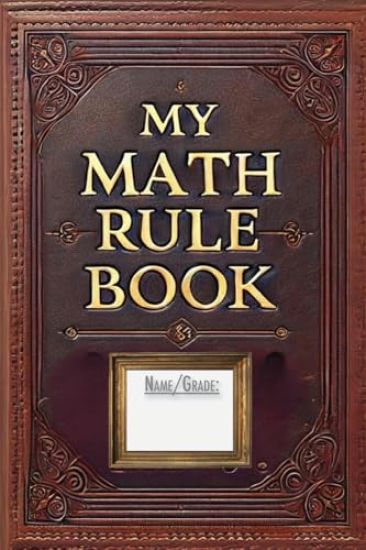
My Math Rule Book

My Math Rule Book

Ingemar Anderson

Kitsap Publishing
2024
pokkari
Introduction Welcome to My Rule Book This book is your space to capture all the math rules, formulas, and concepts you learn throughout middle and high school. By writing down what you've learned in your own words, you'll deepen your understanding and create a personalized study guide you can refer to anytime.Why Make Your Own Rule Book?Creating your own rule book helps you actively engage with the material, making remembering and understanding complex ideas easier. Research supports that writing down concepts in your own words significantly enhances memory retention and comprehension.What the Research SaysBetter Memory Through Self-Generation: The Generation Effect shows that when people generate their own materials, rather than just passively receiving information, it leads to better memory retention and understanding (Slamecka & Graf, 1978). This means creating your own math rule book will help you remember formulas more effectively.Handwriting vs. Typing: A study by Mueller & Oppenheimer (2014) found that students who took notes by hand retained more information and had a deeper understanding of concepts compared to those who typed. Handwriting engages different parts of the brain, making information more meaningful and easier to recall.Encoding and Memory: Writing things down is a form of active learning known as "encoding." Research shows that encoding information deeply helps transfer it from short-term to long-term memory (Craik & Lockhart, 1972), making your personalized notes a powerful study tool.Visual and Verbal Learning: According to Paivio's Dual Coding Theory (1971), combining text with visual elements (like diagrams or sketches) enhances learning by using both verbal and visual memory pathways. Adding your own drawings and examples to your math rule book will reinforce these connections.How to Use This BookRecord New Concepts: Whenever you learn a new rule or formula, jot it down here along with an example or two.Organize by Topic: The book is divided into sections like Algebra, Geometry, and Trigonometry to help you keep your notes organized.Personalize It: Feel free to add diagrams, doodles, or use colored pens-make it as unique as you are Review Regularly: Periodically go back and review your entries to reinforce your memory. Also, use your rule book to look up rules while practicing math and for your homework. Steps to Personalize Your Rule BookReview Your Math Topics: Go through your class notes, textbooks, and any assignments to identify the key rules and concepts you've learned so far.Get Started Grab Your Writing Tools: Pens, pencils, highlighters-anything you like to use. Set Aside Some Time: Dedicate a quiet hour to focus on setting up your rule book.Dive In: Begin filling in the Table of Contents and then proceed to the respective sections to jot down the rules, formulas, and examples.Remember, this rule book is a reflection of your mathematical journey. The effort you put into organizing and personalizing it now will make it an invaluable resource in the future. Happy studying
Right-Wing Radicalism and National Socialism in Germany
This book explores the total resistance to Nazism among the Catholic Christian voters of the Zentrum party in the elections in German states in the Interwar period. Kolden explains the unique Catholic resistance by comparing the diverging evolutions of Catholic and Protestant cultures and mentalities since the awakening of German nationalism in the late 18th century. During the Empire (1871–1918) both socialists and Catholics were regarded as pariah groups by the dominant non-socialist Protestant majority, and more so after the WW1 defeat, when the pariah-parties, together with Protestant liberals, tried to accommodate the new democratic circumstances with their Weimar Constitution. When right-wing radicals, and eventually the Nazis, increased their support —largely on behalf of the rapid shrinking number of liberals—the Catholic church leaders showed a stubborn stance against the rightists, issuing several resolutions of condemnation from the middle of the 1920s until 1933, whereas no such appeared from their Protestant counterparts. In contrast, many local Protestant clergymen agitated for the Nazi party. The anti-Catholic sentiment, which had been obvious among some Nazis in the 1920s, was intensified with the publication of Alfred Rosenbergs The Myth of the 20th Century after the election in 1930, which enhanced the antagonism. The basic and profound difference in Catholic and Protestant cultures also appears in the difference between the less Christian-profiled agrarian parties, which were confessionally separated: antisemitic and right-wing radical Protestant parties confronted by one left-wing and democratic Catholic party. By1945 the bulk of the former rightist Protestants sided with the Catholics, who reorganized their party to the non-denominational CDU, which has been the mightiest proponent in Europe of the former party's ambitions of democracy, stability, anti-racism, human rights, and European unity.
The Psychosocial Reality of Digital Travel

The Psychosocial Reality of Digital Travel

Ingvar Tjostheim; John A. Waterworth

Springer Nature Switzerland AG
2021
sidottu
This open access book takes a fresh look at the nature of the digital travel experience, at a time when more and more people are engaged in online social interaction, games, and other virtual experiences essentially involving online visits to other places. It examines whether these experiences can seem real to the virtual traveller and, if so, under what conditions and on what grounds. The book unpacks philosophical theories relevant to the feeling of being somewhere, emphasising the importance of perception and being-in-the-world. Notions of place are outlined, based on work in tourism studies, human geography, and other applied social fields, with an aim to investigate how and when different experiences of place arise for the traveller and how these relate to telepresence – the sense of being there in another place through digital media. Findings from recent empirical studies of digital travel are presented, including a survey from whichthe characteristics of “digital travellers” are identified. A review of selected interactive design trends and possibilities leads to the conclusion, which draws these strands together and looks to the future of this topical and expanding field.
Die psychosoziale Realität des digitalen Reisens

Die psychosoziale Realität des digitalen Reisens

Ingvar Tjostheim; John A. Waterworth

Springer International Publishing AG
2024
sidottu
Dieses Buch wirft einen neuen Blick auf die Natur des digitalen Reiseerlebnisses in einer Zeit, in der sich immer mehr Menschen an sozialen Online-Interaktionen, Spielen und anderen virtuellen Erfahrungen beteiligen, die im Wesentlichen Online-Besuche an anderen Orten beinhalten. Es wird untersucht, ob diese Erfahrungen dem virtuellen Reisenden real erscheinen können, und wenn ja, unter welchen Bedingungen und aus welchen Gründen. In dem Buch werden philosophische Theorien über das Gefühl, irgendwo zu sein, präsentiert, wobei die Bedeutung der Wahrnehmung und des In-der-Welt-Seins hervorgehoben wird. Auf der Grundlage von Arbeiten aus der Tourismuswissenschaft, der Humangeographie und anderen angewandten sozialen Bereichen werden die Begriffe des Ortes umrissen, um zu untersuchen, wie und wann unterschiedliche Erfahrungen des Ortes für Reisende entstehen und wie diese mit der Telepräsenz zusammenhängen - dem Gefühl, über digitale Medien an einem anderen Ort zu sein. Es werden Ergebnisse aktueller empirischer Studien über digitales Reisen vorgestellt, einschließlich einer Umfrage, aus der die Merkmale von "digitalen Reisenden" ermittelt wurden. Ein Überblick über ausgewählte interaktive Designtrends und -möglichkeiten führt abschließend zu einer Zusammenführung dieser Stränge und einen Ausblick auf die Zukunft dieses aktuellen und expandierenden Bereichs.
Medicine & Philosophy

Medicine & Philosophy

Ingvar Johansson; Niels Lynøe

De Gruyter
2008
isokokoinen pokkari
This textbook introduces the reader to basic problems in the philosophy of science and ethics, mainly by means of examples from medicine. It is based on the conviction that philosophy, medical science, medical informatics, and medical ethics are overlapping disciplines. It claims that the philosophical lessons to learn from the twentieth century are not that nature is a ‘social construction’ and that ‘anything goes’ with respect to methodological and moral rules. Instead, it claims that there is scientific knowledge, but that it is never completely secure; that there are norms, but that they are situation-bound; and that, therefore, it makes good sense to search for scientific truths and try to act in a morally decent way. Using philosophical catchwords, the authors advocate ‘fallibilism’ and ‘particularism’; a combination that might be called ‘pragmatic realism’.
Ontological Investigations

Ontological Investigations

Ingvar Johansson

De Gruyter
2012
sidottu
This volume is devoted to problems within analytic metaphysics. It defends an ontology and theory of categories inspired by Aristotle, but revised in such a way as to be compatible with modern science. The ontology of both natural and social reality is addressed, starting out from the view that universals exist but only in the spatiotemporal world (immanent realism). In attempting to bring Aristotle's ontology up-to-date, the author relies very much on the thinking of Edmund Husserl, conceiving the cement of the universe as Husserlian relations of existential dependence and regarding intentionality as a non-reducible category in the ontology of mind. The work is thoroughly realistic in spirit, but large parts of it should nonetheless be of interest to conceptualists and nominalists, too.
Relativistic Many-Body Theory

Relativistic Many-Body Theory

Ingvar Lindgren

Springer International Publishing AG
2016
sidottu
This revised second edition of the author’s classic text offers readers a comprehensively updated review of relativistic atomic many-body theory, covering the many developments in the field since the publication of the original title. In particular, a new final section extends the scope to cover the evaluation of QED effects for dynamical processes. The treatment of the book is based upon quantum-field theory, and demonstrates that when the procedure is carried to all orders of perturbation theory, two-particle systems are fully compatible with the relativistically covariant Bethe-Salpeter equation. This procedure can be applied to arbitrary open-shell systems, in analogy with the standard many-body theory, and it is also applicable to systems with more than two particles. Presently existing theoretical procedures for treating atomic systems are, in several cases, insufficient to explain the accurate experimental data recently obtained, particularly for highly charged ions. The main text is divided into three parts. In Part I, the standard time-independent and time-dependent perturbation procedures are reviewed. This includes a new section at the end of chapter 2 concerning the so-called ”Fock-space procedure” or ”Coulomb-only procedure” for relativistic-QED calculations. This is a procedure on an intermediate level, frequently used in recent time by chemists on molecular systems, where a full QED treatment is out of question. Part II describes three methods for QED calculations, a) the standard S-matrix formulation, b) the Two-times Green’s-function method, developed by the St Petersburg Atomic Theory group, and c) the Covariant-evolution operator (CEO) method, recently developed by the Gothenburg Atomic Theory group. In Part III, the CEO method is combined with electron correlation to arbitrary order to a unified MBPT-QED procedure. The new Part IV includes two newchapters dealing with dynamical properties and how QED effects can be evaluated for such processes. This part is much needed as there has been an increasing interest in the study of QED effects for such processes. All methods treated in the book are illustrated with numerical examples, making it a text suitable for advanced students new to the field and a useful reference for established researchers.
Relativistic Many-Body Theory

Relativistic Many-Body Theory

Ingvar Lindgren

Springer International Publishing AG
2018
nidottu
This revised second edition of the author’s classic text offers readers a comprehensively updated review of relativistic atomic many-body theory, covering the many developments in the field since the publication of the original title. In particular, a new final section extends the scope to cover the evaluation of QED effects for dynamical processes. The treatment of the book is based upon quantum-field theory, and demonstrates that when the procedure is carried to all orders of perturbation theory, two-particle systems are fully compatible with the relativistically covariant Bethe-Salpeter equation. This procedure can be applied to arbitrary open-shell systems, in analogy with the standard many-body theory, and it is also applicable to systems with more than two particles. Presently existing theoretical procedures for treating atomic systems are, in several cases, insufficient to explain the accurate experimental data recently obtained, particularly for highly charged ions. The main text is divided into three parts. In Part I, the standard time-independent and time-dependent perturbation procedures are reviewed. This includes a new section at the end of chapter 2 concerning the so-called ”Fock-space procedure” or ”Coulomb-only procedure” for relativistic-QED calculations. This is a procedure on an intermediate level, frequently used in recent time by chemists on molecular systems, where a full QED treatment is out of question. Part II describes three methods for QED calculations, a) the standard S-matrix formulation, b) the Two-times Green’s-function method, developed by the St Petersburg Atomic Theory group, and c) the Covariant-evolution operator (CEO) method, recently developed by the Gothenburg Atomic Theory group. In Part III, the CEO method is combined with electron correlation to arbitrary order to a unified MBPT-QED procedure. The new Part IV includes two newchapters dealing with dynamical properties and how QED effects can be evaluated for such processes. This part is much needed as there has been an increasing interest in the study of QED effects for such processes. All methods treated in the book are illustrated with numerical examples, making it a text suitable for advanced students new to the field and a useful reference for established researchers.