Kirjojen hintavertailu. Mukana 11 627 220 kirjaa ja 12 kauppaa.

Kirjahaku

Etsi kirjoja tekijän nimen, kirjan nimen tai ISBN:n perusteella.

1000 tulosta hakusanalla Patricia Springborg

Parents of Poor Children in England 1580-1800

Parents of Poor Children in England 1580-1800

Patricia Crawford

Oxford University Press
2010
sidottu
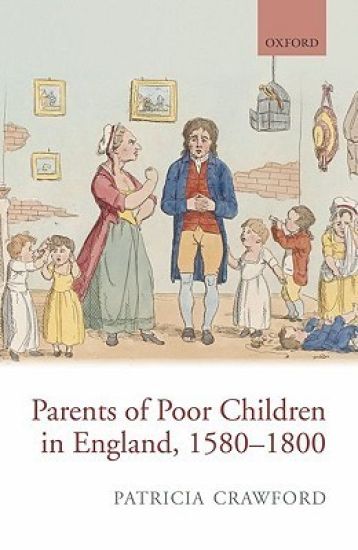
Parents of Poor Children is the first sustained study of the mothers and fathers of poor children in the England of the early modern and early industrial period. Although we know a good deal about the family life of monarchs in this period, much less is known about what life was like for poor single mothers, or for ordinary people who were trying to bring up their children. What were poor mothers and fathers trying to achieve, and what support did they have from their society, especially from the welfare system? Patricia Crawford attempts to answer these important questions, in order to illuminate the experience of parenting at this time from the perspective of the poor, a group who have naturally left little in the way of literary testimony. In doing this, she draws upon a wide range of archival material, including quarter session records, petitions for assistance, applications for places in the London Foundling Hospital, and evidence from criminal trials in London's Old Bailey. England in this period had a developing system of welfare, unique in Europe, by which parish rates were collected and administered to those deemed worthy of relief. The 'civic fathers' who administered this welfare drew upon a code of fatherhood framed in the Elizabethan period, by which a patriarch took responsibility for maintaining and exercising authority over wives and children. But, as Patricia Crawford shows, this code of family conduct was the product of a material world completely alien to that which the poor inhabited. Parents of the poor were different from those of middling and elite status. Poverty, not property, dictated their relationships with their children. Poor families were frequently broken by death. Fathers were frequently absent, and mothers had to rear their children with whatever forms of relief they could find.
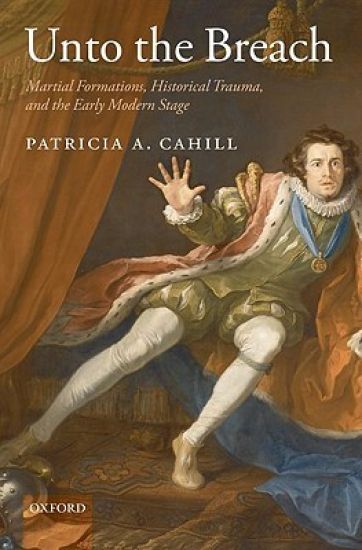
Unto the Breach

Unto the Breach

Patricia A. Cahill

Oxford University Press
2008
sidottu
The Elizabethan theatrical repertory was enthralled with the era's martial discourses and beset by its blinding visions. In her richly historicized account of the theater's engagement with 'modern' warfare, Patricia Cahill juxtaposes the new military technologies and new modes of martial abstraction with the performance of war-suffused dramas by Shakespeare, Marlowe, and their contemporaries. Equally important, she shows that even as early-modern playwrights engaged cutting-edge military practices, they routinely trafficked in phenomena resistant to the new rationalities, conjuring up a domain of eerie sounds, uncanny figures, and haunted temporalities. By going beyond the usual protocols of historicist criticism and emphasizing the complex dynamics of theatrical modes of address, this wide-ranging study investigates the representation of early-modern war trauma and recovers for us a compelling sense of the intimate relationship between affect and intellect on the Renaissance stage. Intervening in ongoing conversations about the drama's role in shaping the cultural imaginary, Unto the Breach shows that, in an era of escalating militarization, England's first commercial theaters offered their audiences something of incalculable value - namely, a space for the performance and 'working through' of what might otherwise remain psychically unbearable in war's violence.
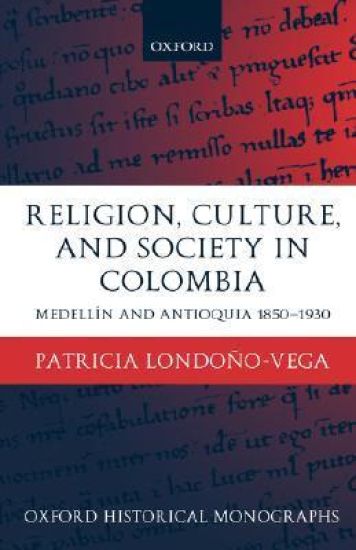
Religion, Society, and Culture in Colombia

Religion, Society, and Culture in Colombia

Patricia Londoño-Vega

Clarendon Press
2002
sidottu
This is the first detailed scholarly study of culture and sociability in Colombia during the period c. 1850 and 1930. Patricia Londoño-Vega gives a vivid picture of some of the factors that reduced social distances in the province of Antioquia during this period of relative harmony and prosperity. She examines hundreds of the groups and voluntary associations which flourished at this time and which brought a growing number of Antioqueños of different social backgrounds together around religious practices and societies, the exercising of charity, a concern for education, and the pursuit of cultural progress. The book describes the crucial role played by religion and the Catholic Church, which underwent considerable growth after the turbulent period of mid-nineteenth century liberal reforms until the end of the conservative era in 1930, and traces the progress of parishes, devotional associations, religious communities, private and public religiosity, and numeros pilanthropic societies, all of which brought about the bonds between the classes. The author examines achievements in education and the emergence of a thriving gamut of literary groups, public libraries, social clubs, and other assciations created to promote public instuction, pedagogy, manners, temperance, 'cultivated' music, and moral improvement. These cultural associations strove towards the longed-for civilisation, as percieved in its prevalent Western connotations. The social intermingling brought about by all these forms of sociability did not of course abolish class distinctions, but did generate a complex and closely integrated society, with an optimistic and constructive view of itself. The description of social and cultural dynamism, set against the background of growing religiiosity, challenges the seldom-discussed assumption that religion slowed down social and cultural modernisation. Primary evidence, drawn from extensive researh in proceedings and reports by groups, associations, periodical publications, statistics, diaries and memoirs, travellers' accounts, books of etiquette, genre literature and other contemporary publications, as well as visual images, particulary photographs, document important topics which have in the past attracted little attention from scholars.
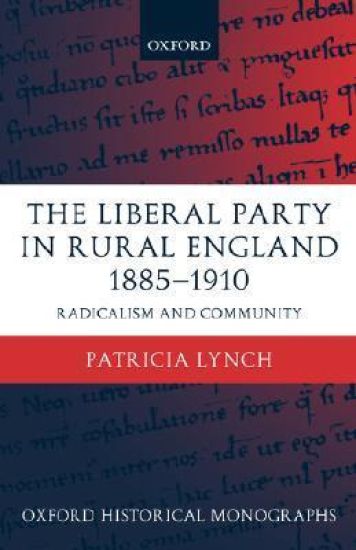
The Liberal Party in Rural England 1885-1910

The Liberal Party in Rural England 1885-1910

Patricia Lynch

Oxford University Press
2003
sidottu
This book explores the relationship between the British Liberal party and the rural working-class voters enfranchised by the Third Reform Act of 1884. In contrast to many works that present urban voters as the primary agents of political change in nineteenth- and twentieth-century England, this study argues that an examination of the dynamics of popular rural politics is essential to a thorough understanding of political developments in the early years of mass enfranchisement. Prior to 1914, capturing a substantial portion of the rural vote was essential to any political party seeking to establish a strong Parliamentary majority; and the Liberal party, coming from a traditionally strong urban base, had to work particularly hard to meet the expectations of the new rural electorate. The book shows that popular political culture in the English countryside was dominated by two important, and sometimes conflicting, traditions: on the one hand, a history of radical social protest, emphasizing attacks on the privileges of landowning elites, and on the other, a widespread concern for the harmony of the local community, coupled with a suspicion of unnecessary divisiveness. The attempt to appeal simultaneously to both of these facets of rural political culture helps to explain not only why the Liberals continued to launch rhetorical attacks on the landed aristocracy and to promote schemes of land reform long after one might have expected them to have switched to a more 'modern' emphasis on class politics, but also why the 'New Liberal' emphasis on the politics of community carried such broad electoral appeal at the beginning of the twentieth century. The book suggests, finally, that in focusing primarily on urban democratization, historians of this period may have exaggerated the role of class allegiances in shaping popular political opinion and underestimated the continuities between 'Old' and 'New' Liberalism.
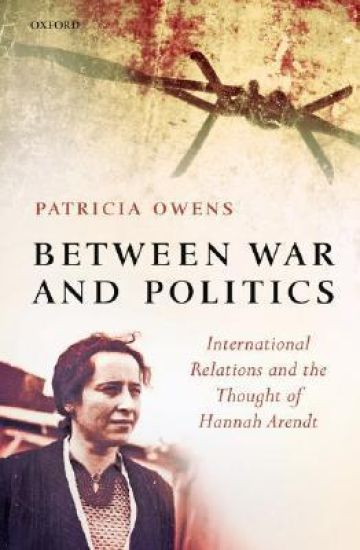
Between War and Politics

Between War and Politics

Patricia Owens

Oxford University Press
2007
sidottu
This is the first book length study of war in the thought of one of the twentieth-century's most important and original political thinkers. Hannah Arendt's writing was fundamentally rooted in her understanding of war and its political significance. But this element of her work has surprisingly been neglected in international and political theory. This book fills an important gap by assessing the full range of Arendt's historical and conceptual writing on war and introduces to international theory the distinct language she used to talk about war and the political world. It builds on her re-thinking of old concepts such as power, violence, greatness, world, imperialism, evil, hypocrisy and humanity and introduces some that are new to international thought like plurality, action, agonism, natality and political immortality. The issues that Arendt dealt with throughout her life and work continue to shape the political world and her approach to political thinking remains a source of inspiration for those in search of guidance not in what to think but how to think about politics and war. Re-reading Arendt's writing, forged through firsthand experience of occupation and struggles for liberation, political founding and resistance in time of war, reveals a more serious engagement with war than her earlier readers have recognised. Arendt's political theory makes more sense when it is understood in the context of her thinking about war and we can think about the history and theory of warfare, and international politics, in new ways by thinking with Arendt. This book is a project of the Oxford Leverhulme Programme on the Changing Character of War.
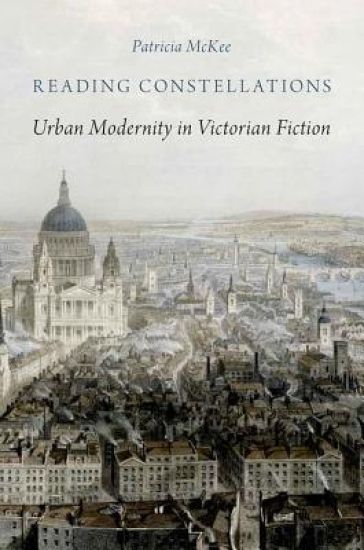
Reading Constellations

Reading Constellations

Patricia McKee

Oxford University Press Inc
2014
sidottu
Reading Constellations uses Walter Benjamin's philosophy of history to examine four canonical Victorian novels by Dickens, Hardy, and James. Throughout its chapters, the monograph deploys the dialectical notion of the "constellation" to read moments in novels in which past and present interpenetrate and the ways these writers open out the representation of the city to new modes of articulation and-through narrative perception- the reader's perception of the phenomena of the city, its place as the exemplar of modernity, and the ways in which it determines subjectivity.
Kant's Thinker

Kant's Thinker

Patricia Kitcher

Oxford University Press Inc
2014
nidottu
Kant's discussion of the relations between cognition and self-consciousness lie at the heart of the Critique of Pure Reason, in the celebrated transcendental deduction. Although this section of Kant's masterpiece is widely believed to contain important insights into cognition and self-consciousness, it has long been viewed as unusually obscure. Many philosophers have tried to avoid the transcendental psychology that Kant employed. By contrast, Patricia Kitcher follows Kant's careful delineation of the necessary conditions for knowledge and his intricate argument that knowledge requires self-consciousness. She argues that far from being an exercise in armchair psychology, the thesis that thinkers must be aware of the connections among their mental states offers an astute analysis of the requirements of rational thought. The book opens by situating Kant's theories in the then contemporary debates about "apperception," personal identity and the relations between object cognition and self-consciousness. After laying out Kant's argument that the distinctive kind of knowledge that humans have requires a unified self- consciousness, Kitcher considers the implications of his theory for current problems in the philosophy of mind. If Kant is right that rational cognition requires acts of thought that are at least implicitly conscious, then theories of consciousness face a second "hard problem" beyond the familiar difficulties with the qualities of sensations. How is conscious reasoning to be understood? Kitcher shows that current accounts of the self-ascription of belief have great trouble in explaining the case where subjects know their reasons for the belief. She presents a "new" Kantian approach to handling this problem. In this way, the book reveals Kant as a thinker of great relevance to contemporary philosophy, one whose allegedly obscure achievements provide solutions to problems that are still with us.
The Modern Castrato

The Modern Castrato

Patricia Howard

Oxford University Press Inc
2014
sidottu
The Modern Castrato: Gaetano Guadagni and the Coming of a New Operatic Age chronicles the career of the most significant castrato of the second half of the eighteenth-century. Through a coincidence of time and place, Gaetano Guadagni was on the forefront of the heroic opera reform, and many forward-thinking composers of the age created roles for him. Author Patricia Howard reveals that Guadagni may have been the only singer of the time fully able to understand the demands and opportunities of this reform, as well to possess the intelligence and self-knowledge to realize that it suited his skills, limitations and temperament perfectly—making him the first castrato to embrace the concepts of modern singing. The first full-length biography of this outstanding singer, The Modern Castrato illuminates the everyday lives of eighteenth-century singers while spotlighting the historic high points of the century. Most famous for his creation of the role of Orpheus in Gluck's Orfeo ed Euridice, his career ranged widely and brought him into contact with many progressives theorists and composers such as Traetta, Jommelli, and Bertoni. Howard's focus on the development of Guadagni's career pauses on essential, related topics along the way, such as the castrato in society, the eighteenth-century revolution in acting, and the remarkable evidence for Guadagni's marionette theater. Howard also assesses Guadagni's surviving compositions, which give new insight into the quality and character of his voice as well as his technical and expressive abilities. The Modern Castrato is an engaging narrative that will prove essential reading for opera lovers and scholars of eighteenth-century music.
Surviving Triple-Negative Breast Cancer

Surviving Triple-Negative Breast Cancer

Patricia Prijatel; Carol Scott-Connor

Oxford University Press Inc
2014
nidottu
After her diagnosis of hormone-negative breast cancer, health journalist Patricia Prijatel did what any reporter would do: start investigating the disease, how it occurs, how it's treated, and how to keep it from recurring. While she learned that important research on triple-negative breast cancer (TNBC) was emerging, she found a noticeable lack of resources on the disease, which differs from hormone-positive breast cancer in important ways, including prognosis and treatment options. Triple-negative breast cancer disproportionately affects younger women and African-American women--and some forms of it can be more dangerous than other types of breast cancer. But there are many reasons to be hopeful, as Prijatel shows in this book. Surviving Triple-Negative Breast Cancer delivers research-based information on the biology of TNBC; the role of genetics, family history, and race; how to navigate treatment options; understanding a pathology report; and a plethora of strategies to reduce the risk of recurrence, including diet and lifestyle changes. In clear, approachable language, Prijatel provides a fact-filled guide based on a vast array of scientific studies. Woven throughout the book are stories of women who have faced TNBC. These are mothers, wives, daughters, and sisters who went through a variety of medical treatments and then got on with life--one competes in triathlons, two had babies after being treated with chemo, one got remarried in her 50s, and one just celebrated the 30th birthday of the son she was nursing when she was diagnosed. Writing with honesty and humor, Prijatel delivers an inspiring message--that TNBC is a disease to take seriously, with proper and occasionally aggressive treatment, but it is not automatically a killer. Most women diagnosed with the disease survive and go on to live full lives. Surviving Triple-Negative Breast Cancer is a roadmap for women who want to be empowered through their treatment and recovery.
Between War and Politics

Between War and Politics

Patricia Owens

Oxford University Press
2009
nidottu
This is the first book length study of war in the thought of one of the twentieth-century's most important and original political thinkers. Hannah Arendt's writing was fundamentally rooted in her understanding of war and its political significance. But this element of her work has surprisingly been neglected in international and political theory. This book fills an important gap by assessing the full range of Arendt's historical and conceptual writing on war and introduces to international theory the distinct language she used to talk about war and the political world. It builds on her re-thinking of old concepts such as power, violence, greatness, world, imperialism, evil, hypocrisy and humanity and introduces some that are new to international thought like plurality, action, agonism, natality and political immortality. The issues that Arendt dealt with throughout her life and work continue to shape the political world and her approach to political thinking remains a source of inspiration for those in search of guidance not in what to think but how to think about politics and war. Re-reading Arendt's writing, forged through firsthand experience of occupation and struggles for liberation, political founding and resistance in time of war, reveals a more serious engagement with war than her earlier readers have recognised. Arendt's political theory makes more sense when it is understood in the context of her thinking about war and we can think about the history and theory of warfare, and international politics, in new ways by thinking with Arendt.
Securing the World Economy

Securing the World Economy

Patricia Clavin

Oxford University Press
2013
sidottu
Securing the World Economy explains how efforts to support global capitalism became a core objective of the League of Nations. Based on new research drawn together from archives on three continents, it explores how the world's first ever inter-governmental organization sought to understand and shape the powerful forces that influenced the global economy, and the prospects for peace. It traces how the League was drawn into economics and finance by the exigencies of the slump and hyperinflation after the First World War, when it provided essential financial support to Austria, Hungary, Greece, Bulgaria, and Estonia and, thereby, established the founding principles of financial intervention, international oversight, and the twentieth-century notion of international 'development'. But it is the impact of the Great Depression after 1929 that lies at the heart of this history. Patricia Clavin traces how the League of Nations sought to combat economic nationalism and promote economic and monetary co-operation in a variety of, sometimes contradictory, ways. Many of the economists, bureaucrats, and policy-advisors who worked for it played a seminal role in the history of international relations and social science, and their efforts did not end with the outbreak of the Second World War. In 1940 the League established an economic mission in the United States, where it contributed to the creation of organizations for the post-war world - the United Nations Organization, the IMF, the World Bank, the UN Food and Agriculture Organization - as well as to plans for European reconstruction and co-operation. It is a history that resonates deeply with challenges that face the Twenty-First Century world.
Science

Science

Patricia Fara

Oxford University Press
2010
nidottu
Science: A Four Thousand Year History rewrites science's past. Instead of focussing on difficult experiments and abstract theories, Patricia Fara shows how science has always belonged to the practical world of war, politics, and business. Rather than glorifying scientists as idealized heroes, she tells true stories about real people - men (and some women) who needed to earn their living, who made mistakes, and who trampled down their rivals in their quest for success. Fara sweeps through the centuries, from ancient Babylon right up to the latest hi-tech experiments in genetics and particle physics, illuminating the financial interests, imperial ambitions, and publishing enterprises that have made science the powerful global phenomenon that it is today. She also ranges internationally, illustrating the importance of scientific projects based around the world, from China to the Islamic empire, as well as the more familiar tale of science in Europe, from Copernicus to Charles Darwin and beyond. Above all, this four thousand year history challenges scientific supremacy, arguing controversially that science is successful not because it is always right - but because people have said that it is right.
The Institutional Logics Perspective

The Institutional Logics Perspective

Patricia H. Thornton; William Ocasio; Michael Lounsbury

Oxford University Press
2012
sidottu
How do institutions influence and shape cognition and action in individuals and organizations, and how are they in turn shaped by them? Various social science disciplines have offered a range of theories and perspectives to provide answers to this question. Within organization studies in recent years, several scholars have developed the institutional logics perspective. An institutional logic is the set of material practices and symbolic systems including assumptions, values, and beliefs by which individuals and organizations provide meaning to their daily activity, organize time and space, and reproduce their lives and experiences. This approach affords significant insights, methodologies, and research tools, to analyze the multiple combinations of factors that may determine cognition, behaviour, and rationalities. In tracing the development of the institutional logics perspective from earlier institutional theory, the book analyzes seminal research, illustrating how and why influential works on institutional theory motivated a distinct new approach to scholarship on institutional logics. The book shows how the institutional logics perspective transforms institutional theory. It presents novel theory, further elaborates the institutional logics perspective, and forges new linkages to key literatures on practice, identity, and social and cognitive psychology. It develops the microfoundations of institutional logics and institutional entrepreneurship, proposing a set of mechanisms that go beyond meta-theory, integrating this work with macro theory on institutional logics into a cross-levels model of cultural heterogeneity. By incorporating current psychological understanding of human behaviour and linking it to sociological perspectives, it aims to provide an encompassing framework for institutional analysis, and to be an essential and accessible reference for scholars and advanced students of organizational behaviour, organization and management theory, business strategy, and cultural sociology.
The Institutional Logics Perspective

The Institutional Logics Perspective

Patricia H. Thornton; William Ocasio; Michael Lounsbury

Oxford University Press
2012
nidottu
How do institutions influence and shape cognition and action in individuals and organizations, and how are they in turn shaped by them? Various social science disciplines have offered a range of theories and perspectives to provide answers to this question. Within organization studies in recent years, several scholars have developed the institutional logics perspective. An institutional logic is the set of material practices and symbolic systems including assumptions, values, and beliefs by which individuals and organizations provide meaning to their daily activity, organize time and space, and reproduce their lives and experiences. This approach affords significant insights, methodologies, and research tools, to analyze the multiple combinations of factors that may determine cognition, behaviour, and rationalities. In tracing the development of the institutional logics perspective from earlier institutional theory, the book analyzes seminal research, illustrating how and why influential works on institutional theory motivated a distinct new approach to scholarship on institutional logics. The book shows how the institutional logics perspective transforms institutional theory. It presents novel theory, further elaborates the institutional logics perspective, and forges new linkages to key literatures on practice, identity, and social and cognitive psychology. It develops the microfoundations of institutional logics and institutional entrepreneurship, proposing a set of mechanisms that go beyond meta-theory, integrating this work with macro theory on institutional logics into a cross-levels model of cultural heterogeneity. By incorporating current psychological understanding of human behaviour and linking it to sociological perspectives, it aims to provide an encompassing framework for institutional analysis, and to be an essential and accessible reference for scholars and advanced students of organizational behaviour, organization and management theory, business strategy, and cultural sociology.
Medieval Amalfi and its Diaspora, 800-1250

Medieval Amalfi and its Diaspora, 800-1250

Patricia Skinner

Oxford University Press
2013
sidottu
'Rich in gold and cloths'? This is the first full-length study of the history of medieval maritime republic of Amalfi that addresses both the internal political, social, and economic history of Amalfi - as an independent city-state, under Norman rule and as part of the Kingdom of Sicily - and the history of its diaspora, those Amalfitans who left temporarily or permanently and whose activities contributed to the image of their home city as a thriving centre specialising in the luxury end of the market. In reuniting these two disparate strands of its history, Patricia Skinner argues that, instead of being seen in opposition to each other, the very different evidence presented by the internal documentary archives and the narrative accounts of external observers can and should be utilised to reconstruct the ties which bound the emigrants to their home city. By taking a prosopographical approach, she reveals the presence of Amalfitans in many parts of the Italian peninsula and further afield in the Mediterranean. At the same time, she critically re-examines some of the externally-generated views of Amalfitan wealth, suggesting that these may have as much - or more - to do with literary and patronage networks as with the actual situation on the ground.
Hyper-Organization

Hyper-Organization

Patricia Bromley; John W. Meyer

Oxford University Press
2015
sidottu
Hyper-Organization offers an institutional explanation for the expansion of formal organization in the contemporary era-in numbers, internal complexity, social domains, and national contexts. Much expansion is hard to justify in terms of technical production or political power, it lies in areas such as protecting the environment, promoting marginalized groups, or behaving with transparency. The authors argue that expansion is supported by widespread cultural rationalization characterized by scientism, rights and empowerment discourses, and an explosion of education. These cultural changes are transmitted through legal, accounting, and professionalization principles, driving the creation of new organizations and the elaboration of existing ones. The resulting organizations are constructed to be proper social actors, as much as functionally effective entities. They are painted as autonomous and integrated but depend heavily on external definitions to sustain this depiction. So expansion creates organizations that are, whatever their actual effectiveness, structurally arational. This book advances theories of social organization in three main ways. First, by giving an account of the expansive rise of 'organization' rooted in rapid worldwide cultural rationalization. Second, explaining the construction of contemporary organizations as purposive actors, rather than passive bureaucracies or loose associations. Third, showing how the expanded actorhood of the contemporary organization, and the associated interpenetration with the environment, dialectically generate structures far removed from instrumental rationality.
Hyper-Organization

Hyper-Organization

Patricia Bromley; John W. Meyer

Oxford University Press
2015
nidottu
Hyper-Organization offers an institutional explanation for the expansion of formal organization in the contemporary era-in numbers, internal complexity, social domains, and national contexts. Much expansion is hard to justify in terms of technical production or political power, it lies in areas such as protecting the environment, promoting marginalized groups, or behaving with transparency. The authors argue that expansion is supported by widespread cultural rationalization characterized by scientism, rights and empowerment discourses, and an explosion of education. These cultural changes are transmitted through legal, accounting, and professionalization principles, driving the creation of new organizations and the elaboration of existing ones. The resulting organizations are constructed to be proper social actors, as much as functionally effective entities. They are painted as autonomous and integrated but depend heavily on external definitions to sustain this depiction. So expansion creates organizations that are, whatever their actual effectiveness, structurally arational. This book advances theories of social organization in three main ways. First, by giving an account of the expansive rise of 'organization' rooted in rapid worldwide cultural rationalization. Second, explaining the construction of contemporary organizations as purposive actors, rather than passive bureaucracies or loose associations. Third, showing how the expanded actorhood of the contemporary organization, and the associated interpenetration with the environment, dialectically generate structures far removed from instrumental rationality.
Evidence-Based Practice in Educating Deaf and Hard-of-Hearing Students

Evidence-Based Practice in Educating Deaf and Hard-of-Hearing Students

Patricia Elizabeth Spencer; Marc Marschark

Oxford University Press Inc
2010
nidottu
Debates about methods of supporting language development and academic skills of deaf or hard-of-hearing children have waxed and waned for more than 100 years: Will using sign language interfere with learning to use spoken language or does it offer optimal access to communication for deaf children? Does placement in classrooms with mostly hearing children enhance or impede academic and social-emotional development? Will cochlear implants or other assistive listening devices provide deaf children with sufficient input for age-appropriate reading abilities? Are traditional methods of classroom teaching effective for deaf and hard-of-hearing students? Although there is a wealth of evidence with regard to each of these issues, too often, decisions on how to best support deaf and hard-of-hearing children in developing language and academic skills are made based on incorrect or incomplete information. No matter how well-intentioned, decisions grounded in opinions, beliefs, or value judgments are insufficient to guide practice. Instead, we need to take advantage of relevant, emerging research concerning best practices and outcomes in educating deaf and hard-of-hearing learners. In this critical evaluation of what we know and what we do not know about educating deaf and hard-of-hearing students, the authors examine a wide range of educational settings and research methods that have guided deaf education in recent years--or should. The book provides a focus for future educational and research efforts, and aims to promote optimal support for deaf and hard-of-hearing learners of all ages. Co-authored by two of the most respected leaders in the field, this book summarizes and evaluates research findings across multiple disciplines pertaining to the raising and educating of deaf children, providing a comprehensive but concise record of the successes, failures, and unanswered questions in deaf education. A readily accessible and invaluable source for teachers, university students, and other professionals, Evidence-Based Practice in Educating Deaf and Hard-of-Hearing Students encourages readers to reconsider assumptions and delve more deeply into what we really know about deaf and hard-of-hearing children, their patterns of development, and their lifelong learning.
Adolescence and Beyond

Adolescence and Beyond

Patricia K. Kerig; Marc S. Schulz; Stuart T. Hauser

Oxford University Press Inc
2012
sidottu
While the period of transition from adolescence to adulthood has become a recent focus for developmental psychologists and child mental health practitioners, the full role of the family during this period is only beginning to be explored. Many compelling questions, of interest to anyone involved in adolescence research, remain unanswered. To what extent do family experiences influence the way one navigates through emerging adulthood? How do we begin to understand the interplay between adolescents' contexts and their development and well-being? Adolescence and Beyond: Family Processes and Development offers an accessible synthesis of research, theories, and perspectives on the family processes that contribute to development. Chapters from expert researchers cover a wide variety of topics surrounding the link between family processes and individual development, including adolescent romantic relationships, emotion regulation, resilience in contexts of risk, and socio-cultural and ethnic influences on development. Drawing on diverse research and methodological approaches that include direct family observations, interviews, and narrative analyses, this volume presents cutting-edge conceptual and empirical work on the key developmental tasks and challenges in the transition between adolescence and adulthood. Researchers, practitioners, and students in social, developmental, and clinical psychology--as well as those in social work, psychiatry, and pediatrics--will find this book an invaluable summary of important research on the link between family process and individual development.
Kant's Thinker

Kant's Thinker

Patricia Kitcher

Oxford University Press Inc
2011
sidottu
Kant's discussion of the relations between cognition and self-consciousness lie at the heart of the Critique of Pure Reason, in the celebrated transcendental deduction. Although this section of Kant's masterpiece is widely believed to contain important insights into cognition and self-consciousness, it has long been viewed as unusually obscure. Many philosophers have tried to avoid the transcendental psychology that Kant employed. By contrast, Patricia Kitcher follows Kant's careful delineation of the necessary conditions for knowledge and his intricate argument that knowledge requires self-consciousness. She argues that far from being an exercise in armchair psychology, the thesis that thinkers must be aware of the connections among their mental states offers an astute analysis of the requirements of rational thought. The book opens by situating Kant's theories in the then contemporary debates about 'apperception,' personal identity and the relations between object cognition and self-consciousness. After laying out Kant's argument that the distinctive kind of knowledge that humans have requires a unified self- consciousness, Kitcher considers the implications of his theory for current problems in the philosophy of mind. If Kant is right that rational cognition requires acts of thought that are at least implicitly conscious, then theories of consciousness face a second 'hard problem' beyond the familiar difficulties with the qualities of sensations. How is conscious reasoning to be understood? Kitcher shows that current accounts of the self-ascription of belief have great trouble in explaining the case where subjects know their reasons for the belief. She presents a 'new' Kantian approach to handling this problem. In this way, the book reveals Kant as a thinker of great relevance to contemporary philosophy, one whose allegedly obscure achievements provide solutions to problems that are still with us.