Kirjojen hintavertailu. Mukana 12 049 368 kirjaa ja 12 kauppaa.

Kirjahaku

Etsi kirjoja tekijän nimen, kirjan nimen tai ISBN:n perusteella.

1000 tulosta hakusanalla Philo

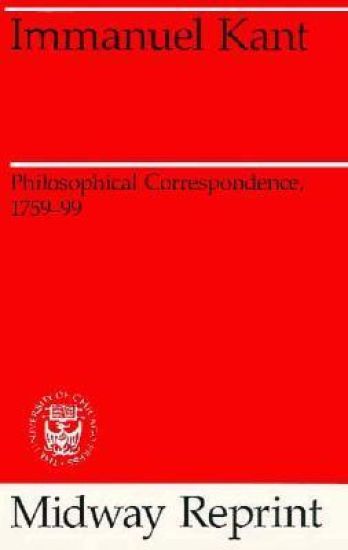
Philosophical Correspondence, 1759-1799

Philosophical Correspondence, 1759-1799

Immanuel Kant

University of Chicago Press
1986
nidottu
Drawn from the Prussian Academy edition of Kant's collected works, these letters make it possible to trace the development of Kant's thought from his earliest worries about the topics discussed in the Critique of Pure Reason to his attempts in later life to meet the objections of his critics and erstwhile disciples. "Perhaps the major value of these writings is their demonstration of Kant's own attitude towards his philosophical works."—Paul Arthur Schilpp, Saturday Review
Philosophy Between the Lines

Philosophy Between the Lines

Arthur M. Melzer

University of Chicago Press
2017
nidottu
Philosophical esotericism the practice of communicating one's unorthodox thoughts "between the lines" was a common practice until the end of the eighteenth century. The famous Encyclopedie of Diderot, for instance, not only discusses this practice in over twenty different articles, but admits to employing it itself. The history of Western thought contains hundreds of such statements by major philosophers testifying to the use of esoteric writing in their own work or others'. Despite this long and well-documented history, however, esotericism is often dismissed today as a rare occurrence. But by ignoring esotericism, we risk cutting ourselves off from a full understanding of Western philosophical thought. Arthur M. Melzer serves as our deeply knowledgeable guide in this capacious and engaging history of philosophical esotericism. Walking readers through both an ancient (Plato) and a modern (Machiavelli) esoteric work, he explains what esotericism is and is not. It relies not on secret codes, but simply on a more intensive use of familiar rhetorical techniques like metaphor, irony, and insinuation. Melzer explores the various motives that led thinkers in different times and places to engage in this strange practice, while also exploring the motives that lead more recent thinkers not only to dislike and avoid this practice but to deny its very existence. In the book's final section, "A Beginner's Guide to Esoteric Reading," Melzer turns to how we might once again cultivate the long-forgotten art of reading esoteric works. Philosophy Between the Lines is the first comprehensive, book-length study of the history and theoretical basis of philosophical esotericism, and it provides a crucial guide to how many major writings philosophical, but also theological, political, and literary were composed prior to the nineteenth century.
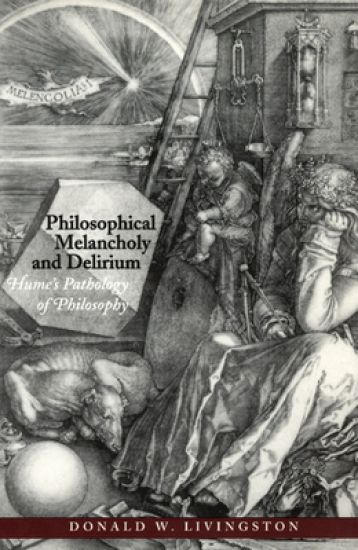
Philosophical Melancholy and Delirium

Philosophical Melancholy and Delirium

Donald W. Livingston

University of Chicago Press
1998
sidottu
This is a study of the Scottish philosopher David Hume, which seeks to revise understanding of Hume's thought by investigating the distinction he made between "true" and "false" philosophy. The text traces this distinction through all Hume's writings, providing a systematic pathology of the corrupt philosophical consciousness in history, politics, philosophy and literature that characterized Hume's time. For Hume, false philosophy leads either to melancholy over the groundlessness of common opinion, or delirium over transcending it, while true philosophy leads to wisdom. By demonstrating how a philosophical method can be used to expose the political motivations behind intellectual positions, historical events and their subsequent interpretations, the author of this study seeks to revitalize Hume's thought and reveal its relevance for contemporary discussions of politics, nationalism and ideology.
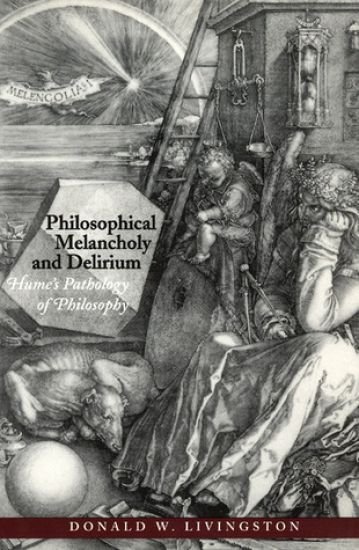
Philosophical Melancholy and Delirium

Philosophical Melancholy and Delirium

Donald W. Livingston

University of Chicago Press
1998
nidottu
This is a study of the Scottish philosopher David Hume, which seeks to revise understanding of Hume's thought by investigating the distinction he made between "true" and "false" philosophy. The text traces this distinction through all Hume's writings, providing a systematic pathology of the corrupt philosophical consciousness in history, politics, philosophy and literature that characterized Hume's time. For Hume, false philosophy leads either to melancholy over the groundlessness of common opinion, or delirium over transcending it, while true philosophy leads to wisdom. By demonstrating how a philosophical method can be used to expose the political motivations behind intellectual positions, historical events and their subsequent interpretations, the author of this study seeks to revitalize Hume's thought and reveal its relevance for contemporary discussions of politics, nationalism and ideology.
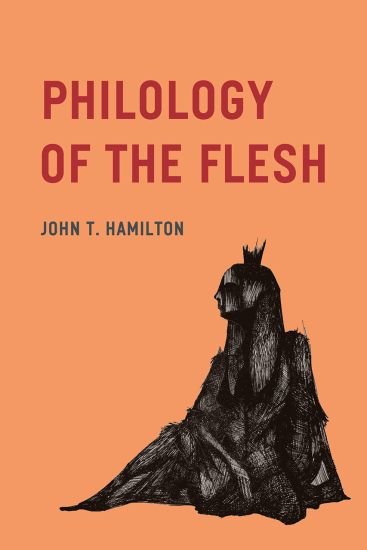
Philology of the Flesh

Philology of the Flesh

John T Hamilton

University of Chicago Press
2018
sidottu
As the Christian doctrine of Incarnation asserts, “the Word became Flesh.” Yet, while this metaphor is grounded in Christian tradition, its varied functions far exceed any purely theological import. It speaks to the nature of God just as much as to the nature of language. In Philology of the Flesh, John T. Hamilton explores writing and reading practices that engage this notion in a range of poetic enterprises and theoretical reflections. By pressing the notion of philology as “love” (philia) for the “word” (logos), Hamilton’s readings investigate the breadth, depth, and limits of verbal styles that are irreducible to mere information. While a philologist of the body might understand words as corporeal vessels of core meaning, the philologist of the flesh, by focusing on the carnal qualities of language, resists taking words as mere containers. By examining a series of intellectual episodes—from the fifteenth-century Humanism of Lorenzo Valla to the poetry of Emily Dickinson, from Immanuel Kant and Johann Georg Hamann to Friedrich Nietzsche, Franz Kafka, and Paul Celan—Philology of the Flesh considers the far-reaching ramifications of the incarnational metaphor, insisting on the inseparability of form and content, an insistence that allows us to rethink our relation to the concrete languages in which we think and live.
Philosophers Speak for Themselves: Berkeley, Hume, and Kant
The philosophic search for truth has been evident in all ages and among all peoples. The developments of each generation require new philosophies and the recasting of old ones. The eighteenth century was no exception, and the scientific advances of the times brought about many innovations in philosophic thought. At a time when scientists were reducing certain phenomena of the natural world to expressions of a few simple mathematical laws, men such as Berkeley, Hume, and Kant were trying to discover how far and on what basis human reason could be applied with similar success in other fields. The selections in this book, preceded by short biographical sketches, document this philosophic search. "The selections are liberal and well chosen, indeed only an examination of the table of contents will give an adequate idea of the value of this volume. . . . How better can one become a modern thinker than by reading and studying at first hand the writings that have made modern thought possible?"—Roger W. Holmes, The Philosophical Review
Philosophy by Other Means

Philosophy by Other Means

Robert B. Pippin

University of Chicago Press
2021
sidottu
Throughout his career, Robert B. Pippin has examined the relationship between philosophy and the arts. With his writings on film, literature, and visual modernism, he has shown that there are aesthetic objects that cannot be properly understood unless we acknowledge and reflect on the philosophical concerns that are integral to their meaning. His latest book, Philosophy by Other Means, extends this trajectory, offering a collection of essays that present profound considerations of philosophical issues in aesthetics alongside close readings of novels by Henry James, Marcel Proust, and J. M. Coetzee. The arts hold a range of values and ambitions, offering beauty, playfulness, and craftsmanship while deepening our mythologies and enriching the human experience. Some works take on philosophical ambitions, contributing to philosophy in ways that transcend the discipline’s traditional analytic and discursive forms. Pippin’s claim is twofold: criticism properly understood often requires a form of philosophical reflection, and philosophy is impoverished if it is not informed by critical attention to aesthetic objects. In the first part of the book, he examines how philosophers like Kant, Hegel, and Adorno have considered the relationship between art and philosophy. The second part of the book offers an exploration of how individual artworks might be considered forms of philosophical reflection. Pippin demonstrates the importance of practicing philosophical criticism and shows how the arts can provide key insights that are out of reach for philosophy, at least as traditionally understood.
Philosophy by Other Means

Philosophy by Other Means

Robert B. Pippin

University of Chicago Press
2021
nidottu
Throughout his career, Robert B. Pippin has examined the relationship between philosophy and the arts. With his writings on film, literature, and visual modernism, he has shown that there are aesthetic objects that cannot be properly understood unless we acknowledge and reflect on the philosophical concerns that are integral to their meaning. His latest book, Philosophy by Other Means, extends this trajectory, offering a collection of essays that present profound considerations of philosophical issues in aesthetics alongside close readings of novels by Henry James, Marcel Proust, and J. M. Coetzee. The arts hold a range of values and ambitions, offering beauty, playfulness, and craftsmanship while deepening our mythologies and enriching the human experience. Some works take on philosophical ambitions, contributing to philosophy in ways that transcend the discipline’s traditional analytic and discursive forms. Pippin’s claim is twofold: criticism properly understood often requires a form of philosophical reflection, and philosophy is impoverished if it is not informed by critical attention to aesthetic objects. In the first part of the book, he examines how philosophers like Kant, Hegel, and Adorno have considered the relationship between art and philosophy. The second part of the book offers an exploration of how individual artworks might be considered forms of philosophical reflection. Pippin demonstrates the importance of practicing philosophical criticism and shows how the arts can provide key insights that are out of reach for philosophy, at least as traditionally understood.
Philosophy, Writing, and the Character of Thought

Philosophy, Writing, and the Character of Thought

John T Lysaker

University of Chicago Press
2021
pokkari
Philosophy’s relation to the act of writing is John T. Lysaker’s main concern in Philosophy, Writing, and the Character of Thought. Whether in Plato, Montaigne, Nietzsche, Wittgenstein, or Derrida, philosophy has come in many forms, and those forms—the concrete shape philosophizing takes in writing—matter. Much more than mere adornment, the style in which a given philosopher writes is often of crucial importance to the point he or she is making, part and parcel of the philosophy itself. ?Considering each of the ways in which writing influences philosophy, Lysaker explores genres like the aphorism, dialogue, and essay, as well as logical-rhetorical operations like the example, irony, and quotation. At the same time, he shows us the effects of these rhetorical devices through his own literary experimentation. In dialogue with such authors as Benjamin, Cavell, Emerson, and Lukács, he aims to revitalize philosophical writing, arguing that philosophy cannot fulfill its intellectual and cultural promise if it keeps to professional articles and academic prose. Instead, philosophy must embrace writing as an essential, creative activity, and deliberately reform how it approaches its subject matter, readership, and the evolving social practices of reading and reflection.
Philosophical Remarks

Philosophical Remarks

Ludwig Wittgenstein

University of Chicago Press
1980
nidottu
When in May 1930, the Council of Trinity College, Cambridge, had to decide whether to renew Wittgenstein's research grant, it turned to Bertrand Russell for an assessment of the work Wittgenstein had been doing over the past year. His verdict: The theories contained in this new work . . . are novel, very original and indubitably important. Whether they are true, I do not know. As a logician who likes simplicity, I should like to think that they are not, but from what I have read of them I am quite sure that he ought to have an opportunity to work them out, since, when completed, they may easily prove to constitute a whole new philosophy. [Philosophical Remarks] contains the seeds of Wittgenstein's later philosophy of mind and of mathematics. Principally, he here discusses the role of indispensable in language, criticizing Russell's The Analysis of Mind. He modifies the Tractatus's picture theory of meaning by stressing that the connection between the proposition and reality is not found in the picture itself. He analyzes generality in and out of mathematics, and the notions of proof and experiment. He formulates a pain/private-language argument and discusses both behaviorism and the verifiability principle. The work is difficult but important, and it belongs in every philosophy collection.--Robert Hoffman, PhilosophyAny serious student of Wittgenstein's work will want to study his Philosophical Remarks as a transitional book between his two great masterpieces. The Remarks is thus indispensible for anyone who seeks a complete understanding of Wittgenstein's philosophy.--Leonard Linsky, American Philosophical Association
Philosophy of Saint Thomas Aquinas

Philosophy of Saint Thomas Aquinas

Stephen L. Brock

James Clarke Co Ltd
2016
nidottu
If Saint Thomas Aquinas was a great theologian, it is in no small part because he was a great philosopher. And he was a great philosopher because he was a great metaphysician. In the twentieth century, metaphysics was not much in vogue, among either theologians or even philosophers; but now it is making a comeback, and once the contours of Thomas's metaphysical vision are glimpsed, it looks like anything but a museum piece. It only needs some dusting off. Many are studying Thomas now for the answers that he might be able to give to current questions, but he is perhaps even more interesting for the questions that he can raise regarding current answers: about the physical world, about human life and knowledge, and (needless to say) about God. This book is aimed at helping those who are not experts in medieval thought to begin to enter into Thomas's philosophical point of view. Along the way, it brings out some aspects of his thought that are not often emphasised in the current literature, and it offers a reading of his teaching on the divine nature that goes rather against the drift of some prominent recent interpretations.
Philosophy and Happiness

Philosophy and Happiness

Palgrave Macmillan
2009
sidottu
A useful resource for anybody interested in contemporary thinking on happiness, Philosophy and Happiness encompasses a variety of philosophical traditions and draws from empirical work in psychology and economics to answer some of the oldest, and most pressing, questions about what contributes to individual well-being and life satisfaction.
Philosophy of Action

Philosophy of Action

Lilian O'Brien

Palgrave Macmillan
2014
sidottu
Accessible and wide-ranging, this introduction to contemporary Philosophy of Action guides the reader through the major views and arguments. The topics addressed include the nature of intentional action and its explanation, the nature of reasons, the role of desire and intention in action, the nature of autonomy and the possibility of group agents.
Philosophy of Action

Philosophy of Action

Lilian O'Brien

Palgrave Macmillan
2014
nidottu
Accessible and wide-ranging, this introduction to contemporary Philosophy of Action guides the reader through the major views and arguments. The topics addressed include the nature of intentional action and its explanation, the nature of reasons, the role of desire and intention in action, the nature of autonomy and the possibility of group agents.
Philosophy of Religion

Philosophy of Religion

Chad Meister

Palgrave Macmillan
2014
sidottu
Philosophy of Religion provides an engaging analysis of the current state of play in philosophy of religion, focusing on several central issues in the field. It is inclusive in its approach and designed for students, but it will also be useful to scholars and others seeking such an evaluation and interpretation of this field.
Philosophy of Religion

Philosophy of Religion

Chad Meister

Palgrave Macmillan
2014
nidottu
Philosophy of Religion provides an engaging analysis of the current state of play in philosophy of religion, focusing on several central issues in the field. It is inclusive in its approach and designed for students, but it will also be useful to scholars and others seeking such an evaluation and interpretation of this field.
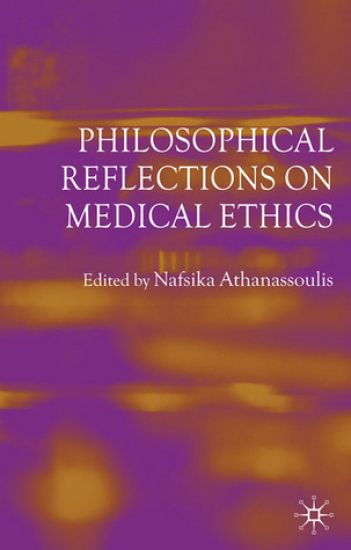
Philosophical Reflections on Medical Ethics
This book provides a collection of original essays on cutting-edge topics in medical ethics research. Leading philosophers give in-depth accounts of issues as diverse as embryo pre-selection, the role of autonomy in organ transplant markets, conscientious objection in the health care professions and neonatal euthanasia. Provocative and original, the contributions to this volume will be of interest to academic, students and health care professionals alike.