Kirjojen hintavertailu. Mukana 12 511 810 kirjaa ja 12 kauppaa.

Kirjahaku

Etsi kirjoja tekijän nimen, kirjan nimen tai ISBN:n perusteella.

1000 tulosta hakusanalla Ritesh Modi

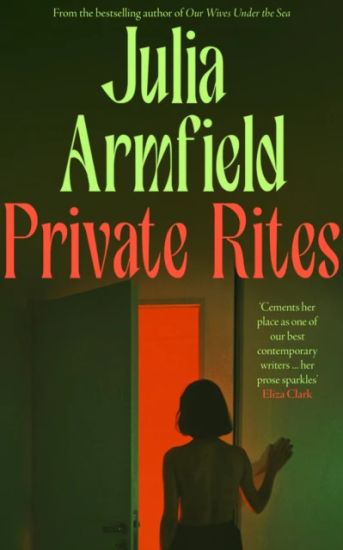
Private Rites

Private Rites

Julia Armfield

HARPERCOLLINS PUBLISHERS
2024
sidottu
'Brilliantly audacious' GUARDIAN 'Stunning' DAZED 'Her prose sparkles' ELIZA CLARK ‘Hauntingly good’ iNEWS ’A must read’ GLAMOUR 'Brilliant, original’ KALIANE BRADLEY 'One of my favourite novels' JEFF VANDERMEER 'Elegant, evocative' CLAIRE FULLER 'Extraordinary, unsettling' JACQUELINE WILSON From the bestselling author of Our Wives Under the Sea, a haunting, heart wrenching novel of three sisters navigating queer love and faith at the end of the world. There’s no way to bury a body in earth which is flooded It’s been raining for a long time now, for so long that the lands have reshaped themselves. Old places have been lost. Arcane rituals and religions have crept back into practice. Sisters Isla, Irene and Agnes have not spoken in some time when their estranged father dies. A famous architect revered for making the new world navigable, he had long cut himself off from public life. They find themselves uncertain of how to grieve his passing when everything around them seems to be ending anyway. As the sisters come together to clear the grand glass house that is the pinnacle of his legacy, they begin to sense that the magnetic influence of their father lives on through it. Something sinister seems to be unfolding, something related to their mother’s long-ago disappearance and the strangers who have always been unusually interested in their lives. Soon, it becomes clear that the sisters have been chosen for a very particular purpose, one with shattering implications for their family and their imperilled world. A Book of the Year in the Guardian and Dazed ‘Armfield writes so gracefully’ THE TIMES ‘Evocative yet grounded’ OBSERVER ‘A chilling vision of a future capital that I’ve found impossible to shake’ INEWS ‘Ballard-ian in apocalyptic scope … Deeply, passionately, messily human’ PAUL TREMBLAY ‘A signature cocktail of deadpan wit and staggering beauty’ ALICE SLATER ‘Every page guillotines you with its wisdom’ TOM BENN Longlisted for the 2024 Climate Fiction Prize
Private Rites

Private Rites

Julia Armfield

Fourth Estate
2024
nidottu
'Brilliantly audacious' GUARDIAN'Stunning'DAZED'Her prose sparkles' ELIZA CLARK'Hauntingly good' iNEWS'A must read' GLAMOUR'One of my favourite novels' JEFF VANDERMEER
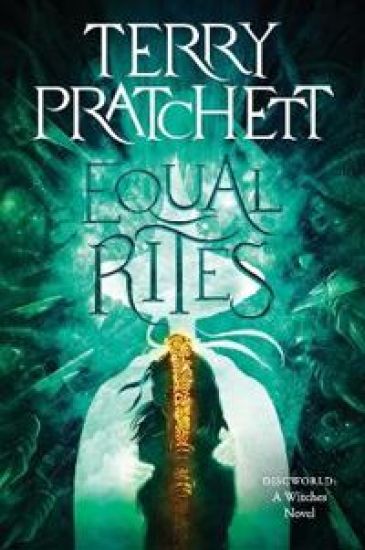
EQUAL RITES

EQUAL RITES

HARPERCOLLINS PUBLISHERS INC
2024
nidottu
"Unadulterated fun. . . witty, frequently hilarious."--San Francisco ChronicleChaos and hilarity ensue when a young woman becomes the first female wizard, upending the Discworld in this bitingly funny tale from internationally bestselling author Sir Terry Pratchett.A little knowledge is a dangerous thing, but it's not half so bad as a lot of ignorance.Everyone knows there's no such thing as a female wizard. So when a dying wizard accidentally passes on his staff of power to an eighth daughter of an eighth son, the exclusively masculine world of wizarding is thrown into a tailspin.Eskarina isn't afraid of male critics and she isn't going to relinquish this unexpected gift. With a little hocus pocus from Granny Weatherwax, the Discworld's most infamous witch (an old crone who has plenty of experience ignoring the status quo), Esk infiltrates the magical Unseen University and befriends another apprentice, a wizard named Simon.But power is unpredictable, and these bright young students soon find themselves in a whole new dimension of trouble. . . .The Discworld novels can be read in any order but Equal Rites is the first book in the Witches collection. The Witches collection, in order, includes: Equal RitesWyrd SistersWitches AbroadLords and LadiesMaskeradeCarpe Jugulum
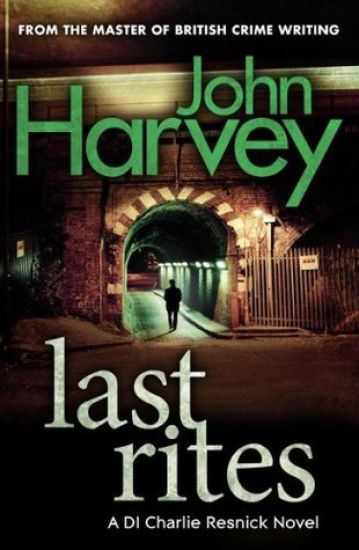
Last Rites

Last Rites

John Harvey

Cornerstone
2013
pokkari
Lorraine Preston's brother, Michael, was sent down for life for the murder of their father - and now he's being allowed out for their mother's funeral. With his previously stable relationship with Hannah Campbell wavering, Resnick is forced back on his self-belief, his understanding of people.
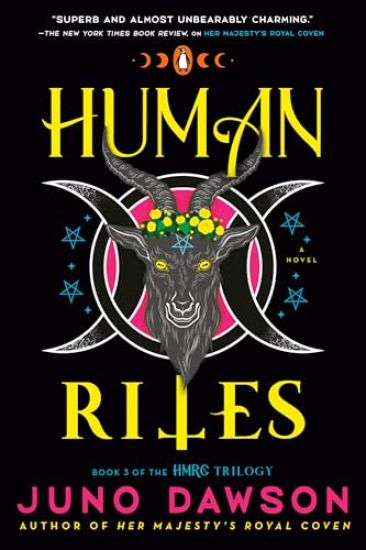
Human Rites

Human Rites

Juno Dawson

Penguin Publishing Group
2025
nidottu
With Her Majesty's Royal Coven in shambles and the fate of the world hanging in the balance, the sisterhood of friends and witches must find a new way of putting together the pieces if (wo)mankind is to stand a chance, in this final chapter to Juno's "irresistible" series (Lana Harper) Niamh, Ciara, Leonie, Elle and Theo. Five very different witches with one thing in common: they were unwittingly chosen by the dangerously charming Lucifer, the demon king of desire, to fulfil a dark prophecy: Satanis will rise and the daughters of Gaia will fall. The coven is reunited--but broken. Niamh is back from the dead...but she hasn't come back alone. Elle mourns a son she never had. Ciara languishes in a prison for witches, and Leonie reels from a very unexpected surprise. Meanwhile, Lucifer offers fledgling witch Theo a deal: if she helps him, her coven--her family--will be spared. But the magic he asks for will take her out of London--out of time, entirely. The final confrontation between good and evil in the spectacular conclusion to the saga of Her Majesty's Royal Coven.
Performing Rites

Performing Rites

Simon Frith

Oxford University Press
1998
nidottu
Who's better? Billie Holiday or P.J. Harvey? Blur or Oasis? Dylan or Keats? And how many friendships have ridden on the answer? Such questions aren't merely the stuff of fanzines and idle talk; they inform our most passionate arguments, distil our most deeply held values, make meaning of our ever-changing culture. In Performing Rites, one of the most influential writers on popular music asks what we talk about when we talk about music. What's good, what's bad? What's high, what's low? Why do such distinctions matter? Instead of dismissing emotional response and personal taste as inaccessible to the academic critic, Simon Frith takes these forms of engagement as his subject and discloses their place at the very centre of the aesthetics that structure our culture and colour our lives. Taking up hundreds of songs and writers, Frith insists on acts of evaluation of popular music as music. Ranging through and beyond the twentieth century, Performing Rites puts the Pet Shop Boys and Puccini, rhythm and lyric, voice and technology, into a dialogue about the undeniable impact of poplar aesthetics on our lives. How we nod our heads or tap our feet, grin or grimace or flip the dial; how we determine what's sublime and what's for real — these are part of the way we construct our social identities, and an essential response to the performance of all music. Frith argues that listening itself is a performance, both social gesture and bodily response. From how they are made to how they are received, popular songs appear here as not only meriting aesthetic judgements but also demanding them, and shaping our understanding of what all music means.
Negotiating Rites

Negotiating Rites

Ute Husken; Frank Neubert

Oxford University Press Inc
2011
nidottu
In common understanding, but also in scholarly discourse, ritual has been long viewed as an undisputed and indisputable part of (especially religious) tradition, performed over and over in the same ways: stable in form, meaningless, preconcieved, and with the aim of creating harmony and enabling a tradition's survival. The authors represented in this collection argue, however, that these assumptions can be seriously challenged. Not only are rituals frequently disputed, they also constitute a field in which vital and sometimes even violent negotiations take place. Negotiations - here understood as processes of interaction during which differing positions are debated and/or acted out - are ubiquitous in ritual contexts, either in relation to the ritual itself, or in relation to the realm beyond any given ritual performance. The authors contend that a central feature of ritual is its embeddedness in negotiation processes and that life beyond the ritual frame often is negotiated in the field of rituals. This point of view opens up fruitful new perspectives on ritual procedures, on the interactions that constitute these procedures, and on the contexts in which they are embedded. By explicitly addressing and theorizing the relevance of negotiation in the world of ritual, the essays in this volume seek to persuade scholars and students alike to think differently and to find new starting points for more nuanced discussions.
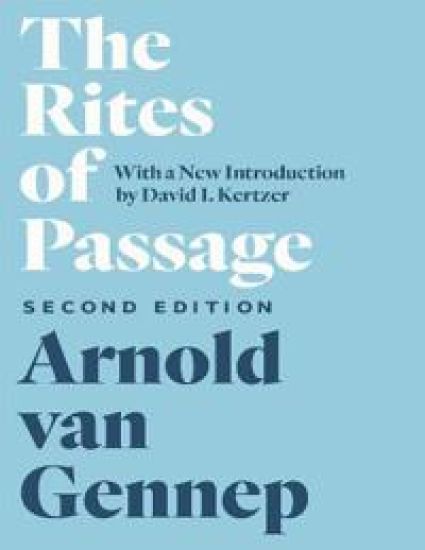
The Rites of Passage, Second Edition

The Rites of Passage, Second Edition

Arnold Van Gennep

University of Chicago Press
2019
sidottu
Folklorist Arnold van Gennep's masterwork, The Rites of Passage, has been a staple of anthropological education for more than a century. First published in French in 1909, and translated into English by the University of Chicago Press in 1960, this landmark book explores how the life of an individual in any society can be understood as a succession of stages: birth, puberty, marriage, parenthood, advancement to elderhood, and, finally, death. Van Gennep's command of the ethnographic record enabled him to discern crosscultural patterns in rituals of separation, transition, and incorporation. With compelling precision, he elaborated the terms that would both define twentieth-century ritual theory and become a part of our everyday lexicon. This new edition of his work demonstrates how we can still make use of its enduring critical tools to understand our own social, religious, and political worlds. Featuring an introduction by Pulitzer Prize-winning anthropologist and historian David I. Kertzer, this edition reminds readers just how startlingly insightful The Rites of Passage remains a century after its initial publication.
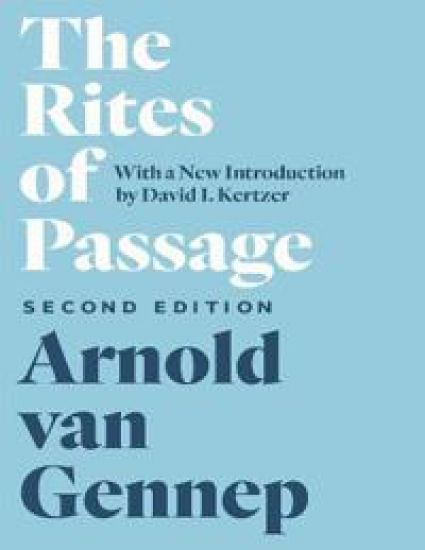
The Rites of Passage, Second Edition

The Rites of Passage, Second Edition

Arnold Van Gennep

University of Chicago Press
2019
pokkari
Folklorist Arnold van Gennep's masterwork, The Rites of Passage, has been a staple of anthropological education for more than a century. First published in French in 1909, and translated into English by the University of Chicago Press in 1960, this landmark book explores how the life of an individual in any society can be understood as a succession of stages: birth, puberty, marriage, parenthood, advancement to elderhood, and, finally, death. Van Gennep's command of the ethnographic record enabled him to discern crosscultural patterns in rituals of separation, transition, and incorporation. With compelling precision, he elaborated the terms that would both define twentieth-century ritual theory and become a part of our everyday lexicon. This new edition of his work demonstrates how we can still make use of its enduring critical tools to understand our own social, religious, and political worlds. Featuring an introduction by Pulitzer Prize-winning anthropologist and historian David I. Kertzer, this edition reminds readers just how startlingly insightful The Rites of Passage remains a century after its initial publication.
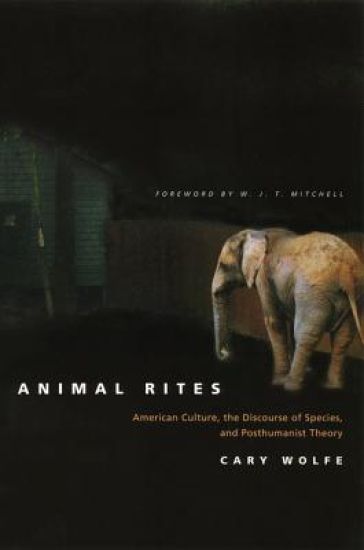
Animal Rites

Animal Rites

Cary Wolfe; W. J. T. Mitchell

University of Chicago Press
2003
sidottu
Now that supposedly distinguishing marks of humanity, from reasoning to tool use, have been found in other species, how can we justify discriminating against nonhuman animals solely on the basis of their species? And how must cultural studies and critical practices change to do justice to "others" who are not human? In "Animal Rites", Cary Wolfe examines contemporary notions of humanism, ethics and animals by reconstructing a little known but crucial underground tradition of theorizing the animal from Wittgenstein, Cavell and Lyotard to Levinas, Derrida, Zizek, Maturana and Varela. Through detailed readings of how discourses of race, sexuality, colonialism and animality interact in 20th-century American culture - Hemingway's fiction, the film "The Silence of the Lambs", Michael Crichton's novel "Congo" - Wolfe explores what it would mean, in theory and critical practice, to take seriously "the question of the animal". A pathbreaking contribution to discussions of posthumanism, "Animal Rites" should interest readers in a wide range of fields, from science and literature to philsosophy and ethics, from animal rights and ecology to literary theory and criticism.
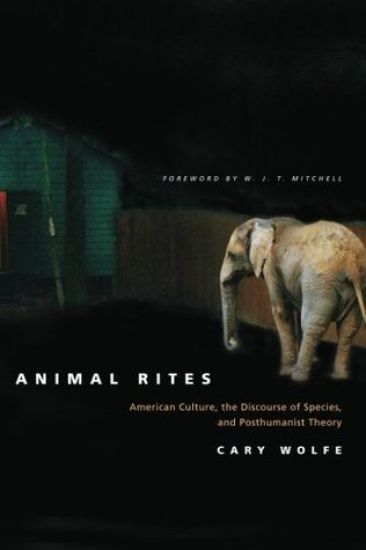
Animal Rites

Animal Rites

Cary Wolfe; W. J. T. Mitchell

University of Chicago Press
2003
nidottu
Now that supposedly distinguishing marks of humanity, from reasoning to tool use, have been found in other species, how can we justify discriminating against nonhuman animals solely on the basis of their species? And how must cultural studies and critical practices change to do justice to "others" who are not human? In "Animal Rites", Cary Wolfe examines contemporary notions of humanism, ethics and animals by reconstructing a little known but crucial underground tradition of theorizing the animal from Wittgenstein, Cavell and Lyotard to Levinas, Derrida, Zizek, Maturana and Varela. Through detailed readings of how discourses of race, sexuality, colonialism and animality interact in 20th-century American culture - Hemingway's fiction, the film "The Silence of the Lambs", Michael Crichton's novel "Congo" - Wolfe explores what it would mean, in theory and critical practice, to take seriously "the question of the animal". A pathbreaking contribution to discussions of posthumanism, "Animal Rites" should interest readers in a wide range of fields, from science and literature to philsosophy and ethics, from animal rights and ecology to literary theory and criticism.
Equal Rites

Equal Rites

Clyde Forsberg Jr.

Columbia University Press
2004
sidottu
Both the Prophet Joseph Smith and his Book of Mormon have been characterized as ardently, indeed evangelically, anti-Masonic. Yet in this sweeping social, cultural, and religious history of nineteenth-century Mormonism and its milieu, Clyde Forsberg argues that masonry, like evangelical Christianity, was an essential component of Smith's vision. Smith's ability to imaginatively conjoin the two into a powerful and evocative defense of Christian, or Primitive, Freemasonry was, Forsberg shows, more than anything else responsible for the meteoric rise of Mormonism in the nineteenth century. This was to have significant repercussions for the development of Mormonism, particularly in the articulation of specifically Mormon gender roles. Mormonism's unique contribution to the Masonic tradition was its inclusion of women as active and equal participants in Masonic rituals. Early Mormon dreams of empire in the Book of Mormon were motivated by a strong desire to end social and racial discord, lest the country fall into the grips of civil war. Forsberg demonstrates that by seeking to bring women into previously male-exclusive ceremonies, Mormonism offered an alternative to the male-dominated sphere of the Master Mason. By taking a median and mediating position between Masonry and Evangelicism, Mormonism positioned itself as a religion of the people, going on to become a world religion. But the original intent of the Book of Mormon gave way as Mormonism moved west, and the temple and polygamy (indeed, the quest for empire) became more prevalent. The murder of Smith by Masonic vigilantes and the move to Utah coincided with a new imperialism-and a new polygamy. Forsberg argues that Masonic artifacts from Smith's life reveal important clues to the precise nature of his early Masonic thought that include no less than a vision of redemption and racial concord.
Human Rites

Human Rites

Hannah Ward; Jennifer Wild

Mowbray
1995
nidottu
This ecumenical collection of prayers, liturgies and rituals seeks to illustrate the impressive creativity fo liturgy from the ground up - from congregations, groups and individuals struggling to come to terms with change and all the celebration and loss which that involves. A wealth of human experiences is explored and expressed through experimental rituals: expressions of god, namings, affirming relationships, separating, dying, grieving, healing, retirement, abortion, miscarriage, and much more. It is hoped that this anthology will imspire and enable others to construct their own liturgies, rituals, blessings and prayers. Hannah Ward and Jennifer Wild are former members of Anglican religious orders. They are co-founders of Womanpsace, a spritituality programme. Their book Guard the Chaos: Finding Meaning in Change was published in 1995.
Forbidden Rites

Forbidden Rites

Kieckhefer Richard

Pennsylvania State University Press
1998
sidottu
Preserved in the Bavarian State Library in Munich is a manuscript that few scholars have noticed and that no one in modern times has treated with the seriousness it deserves. Forbidden Rites consists of an edition of this medieval Latin text with a full commentary, including detailed analysis of the text and its contents, discussion of the historical context, translation of representative sections of the text, and comparison with other necromantic texts of the late Middle Ages. The result is the most vivid and readable introduction to medieval magic now available. Like many medieval texts for the use of magicians, this handbook is a miscellany rather than a systematic treatise. It is exceptional, however, in the scope and variety of its contents—prayers and conjurations, rituals of sympathetic magic, procedures involving astral magic, a catalogue of spirits, lengthy ceremonies for consecrating a book of magic, and other materials. With more detail on particular experiments than the famous thirteenth-century Picatrix and more variety than the Thesaurus Necromantiae ascribed to Roger Bacon, the manual is one of the most interesting and important manuscripts of medieval magic that has yet come to light.
Forbidden Rites

Forbidden Rites

Richard Kieckhefer

Pennsylvania State University Press
1998
pokkari
Preserved in the Bavarian State Library in Munich is a manuscript that few scholars have noticed and that no one in modern times has treated with the seriousness it deserves. Forbidden Rites consists of an edition of this medieval Latin text with a full commentary, including detailed analysis of the text and its contents, discussion of the historical context, translation of representative sections of the text, and comparison with other necromantic texts of the late Middle Ages. The result is the most vivid and readable introduction to medieval magic now available. Like many medieval texts for the use of magicians, this handbook is a miscellany rather than a systematic treatise. It is exceptional, however, in the scope and variety of its contents—prayers and conjurations, rituals of sympathetic magic, procedures involving astral magic, a catalogue of spirits, lengthy ceremonies for consecrating a book of magic, and other materials. With more detail on particular experiments than the famous thirteenth-century Picatrix and more variety than the Thesaurus Necromantiae ascribed to Roger Bacon, the manual is one of the most interesting and important manuscripts of medieval magic that has yet come to light.
Voting Rites

Voting Rites

Ron Hirschbein

Praeger Publishers Inc
1999
sidottu
Does it really matter if a voter decides to vote-or, as a significant number of Americans do each election, not vote? Ron Hirschbein explores this issue and shows why enfranchisement cannot be understood unless it is placed in context and history. Clearly, the meaning of a vote depends upon the situation: a vote cast among the 400 of Athens or in the College of Cardinals has one significance; this is considerably different from pulling a lever every four years in a mass society of spectacles and commodities. Hirschbein also examines how voting was transformed from an expression of the political will of the Athenian polity into a sacred natural right-only to be turned to a ritual of mass society. First, Hirschbein looks at the right to vote as the centerpiece of American civic religion. He contrasts civic myths about enfranchisement with anthropological realities. Specifically he argues that, given the intractable mathematics of mass society, the chances that a single vote will determine the outcome of an election approach the infinitesimal. However, he suggests that voting plays a neglected ritual function by constructing, legitimizing, and celebrating political reality for players and spectators alike. Hirschbein then explicates the origins and evanescent meanings of enfranchisement by examining the theory and practice of voting among the citizenry of ancient Athens, medieval ecclesiastical bureaucrats, Enlightenment natural law thinkers, and the founders of the Virtuous Republic. He concludes with speculation about possible futures. A controversial and important analysis, this will be of interest to the general public as well as scholars, researchers, and policy makers involved with election issues and theories of democracy.
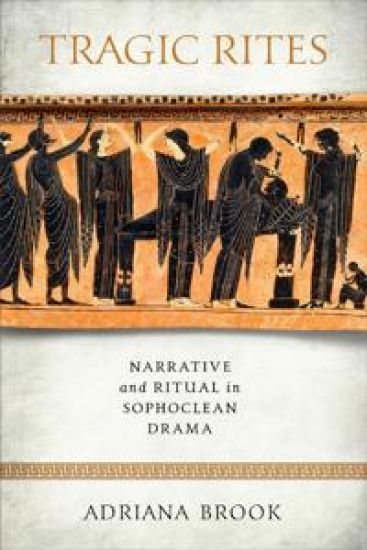
Tragic Rites

Tragic Rites

Adriana E. Brook

University of Wisconsin Press
2018
sidottu
Presenting an innovative new reading of Sophocles' plays, Tragic Rites analyzes the poetic and narrative function of ritual in the seven extant plays of Sophocles. Adriana Brook closely examines four of them?Ajax, Electra, Philoctetes, and Oedipus at Colonus?in the context of her wide-ranging consideration of the entire Sophoclean corpus. Exploring the playwright's dramatic technique, she shows how he used elements of ritual to guide the perceptions and expectations of his fifth-century audience about plot and character. Employing both modern ritual theory and Aristotle's Poetics, Brook exposes the deep structural analogies between ritual and narrative, the parallels between mistakes in ritual and deviations from the expected in the plot, and the relationship between ritual content and dramatic closure.
Last Rites

Last Rites

John Lukacs

Yale University Press
2009
sidottu
A master historian offers an eloquent and personal auto-history of his life and his ideas Twenty years ago, John Lukacs paused to set down the history of his own thoughts and beliefs in Confessions of an Original Sinner, an adroit blend of autobiography and personal philosophy. Now, in Last Rites, he continues and expands his reflections, this time integrating his conception of history and human knowledge with private memories of his wives and loves, and enhancing the book with footnotes from his idiosyncratic diaries. The resulting volume is fascinating and delightful—an auto-history by a passionate, authentic, brilliant, and witty man.Lukacs begins with a concise rendering of a historical understanding of our world (essential reading for any historian), then follows with trenchant observations on his life in the United States, commentary on his native Hungary and the new meanings it took for him after 1989, and deeply personal portraits of his three wives, about whom he has not written before. He includes also a chapter on his formative memories of May and June 1940 and of Winston Churchill, a subject in some of Lukacs’s later studies. Last Rites is a richly layered summation combined with a set of extraordinary observations—an original book only John Lukacs could have written.Praise for Confessions of an Original Sinner: “[Lukacs] is an often witty and always fascinating—even entertaining—writer.”—Washington Post
Equal Rites, Unequal Outcomes

Equal Rites, Unequal Outcomes

Kluwer Academic/Plenum Publishers
2002
nidottu
Thirteen years ago, in June 1988, the Radcliffe Classof1953 celebrated its 35th Reunion. Amidst the festivities, we who participated repeatedly asked ourselves the same two questions: Is Harvard as sexist as it was when we were undergraduates? If not, what is the status ofwomen at Harvard today? To find the answers we formed an ad hoc committee and charged the members to report back to the class in five years. The committee interviewed selected senior and junior Harvard faculty, Harvard and Radcliffe administrators, students, and alumni/ae. We identified and studied Harvard and Radcliffe reports on their institu­ tions and on their student organizations. We contributed to and participated in a 1990 Radcliffe Focus Group, "ASurveyofAlumnae and Undergraduate Perceptions. " We found that the University was not as sexist in 1988 as it had been in 1953. Yet the status ofwomen, though improved, remained quite unequal to thatofmen. (Radcliffe College was organizationally separate from Harvard University until 1977, when a "non-merger merger" was implemented. However, Radcliffe had no fac­ ulty of its own and employed Harvard faculty to teach its students, in strictly separate classes until World War II. The merger effort was com­ pleted in 1999 with the complete integration ofthe two institutions and the formation ofthe Radcliffe Institute for Advanced Study, a "tub on its own bottom" like other Harvard graduate and professional schools. ) In 1993 the Class of'53 voted unanimously to form the Commit­ tee for the EqualityofWomen at Harvard (CEWH).