Kirjojen hintavertailu. Mukana 12 534 168 kirjaa ja 12 kauppaa.

Kirjahaku

Etsi kirjoja tekijän nimen, kirjan nimen tai ISBN:n perusteella.

1000 tulosta hakusanalla Roger Ascham

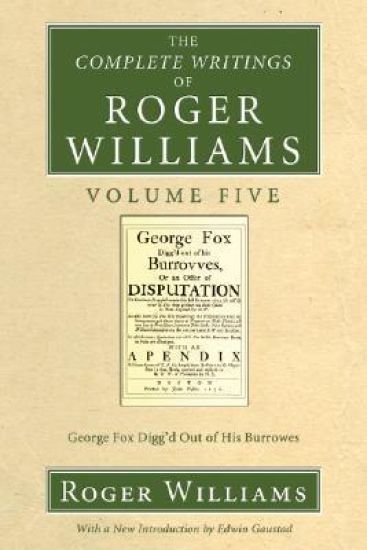
The Complete Writings of Roger Williams, Volume 5

The Complete Writings of Roger Williams, Volume 5

Roger Williams; Edwin Gaustad

Wipf Stock Publishers
2007
pokkari
Ten years after the U. S. Civil War, a group of men in Rhode Island made a conserted effort to rescue the widely scattered writings of Roger Williams. Few sets were printed though, and under the guidance of Perry Miller, The Complete Writings of Roger Williams were brought back in 1963, but still in short numbers. The present collection now makes these volumes available to readers in their original orthography. The theme of religious liberty is dominant in these volumes, running through Williams's correspondence with John Cotton and on through his famous pair of works on The Bloudy Tenent of Persecution. All of the extant shorter writings and letters of Roger Williams are included in this set, along with two significant works resulting from his engagement with Native Americans: his seminal Key into the Language of America and Christenings Make Not Christians. ""Roger Williams was one of those rare individuals who took the accepted ideas of his time and followed them to conclusions that challenged his contemporaries and still challenge us. To have his complete writings once again available is a great service to all who would understand American religion and political institutions at the deepest level."" Edmund S. Morgan Sterling Professor of History Emeritus Yale University ""It has been America's great good fortune that Roger Williams's career stood at the beginning of its history. Just as some experience in the youth of a person is ever afterward a determinant of his personality, so the American character has inevitably been molded by the fact that in the first years of colonization there arose this prophet of religious liberty. Later generations could not forget him or deny him. The image of him in conflict with the founders of New England could not be obliterated; all later righteous men would be tormented by it until they learned to accept his basic thesis, that freedom is a condition of the spirit."" Perry Miller (1963) Roger Williams (1603-1683) grew up in Puritan circles in London, sailed to Massachusetts in 1630, and, having been banished for his controversial views on the separation of church and state, founded Rhode Island on the basis of his new principles of religious liberty.
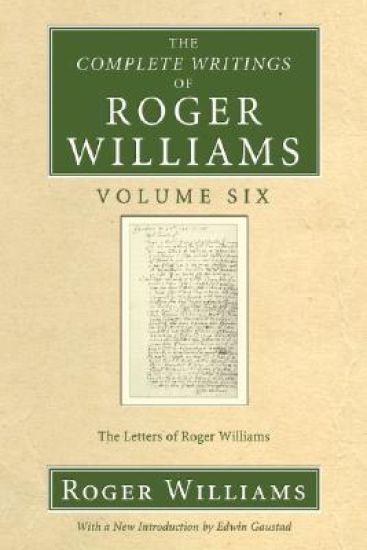
The Complete Writings of Roger Williams, Volume 6

The Complete Writings of Roger Williams, Volume 6

Roger Williams; Edwin Gaustad

Wipf Stock Publishers
2007
pokkari
Ten years after the U. S. Civil War, a group of men in Rhode Island made a conserted effort to rescue the widely scattered writings of Roger Williams. Few sets were printed though, and under the guidance of Perry Miller, The Complete Writings of Roger Williams were brought back in 1963, but still in short numbers. The present collection now makes these volumes available to readers in their original orthography. The theme of religious liberty is dominant in these volumes, running through Williams's correspondence with John Cotton and on through his famous pair of works on The Bloudy Tenent of Persecution. All of the extant shorter writings and letters of Roger Williams are included in this set, along with two significant works resulting from his engagement with Native Americans: his seminal Key into the Language of America and Christenings Make Not Christians. ""Roger Williams was one of those rare individuals who took the accepted ideas of his time and followed them to conclusions that challenged his contemporaries and still challenge us. To have his complete writings once again available is a great service to all who would understand American religion and political institutions at the deepest level."" Edmund S. Morgan Sterling Professor of History Emeritus Yale University ""It has been America's great good fortune that Roger Williams's career stood at the beginning of its history. Just as some experience in the youth of a person is ever afterward a determinant of his personality, so the American character has inevitably been molded by the fact that in the first years of colonization there arose this prophet of religious liberty. Later generations could not forget him or deny him. The image of him in conflict with the founders of New England could not be obliterated; all later righteous men would be tormented by it until they learned to accept his basic thesis, that freedom is a condition of the spirit."" Perry Miller (1963) Roger Williams (1603-1683) grew up in Puritan circles in London, sailed to Massachusetts in 1630, and, having been banished for his controversial views on the separation of church and state, founded Rhode Island on the basis of his new principles of religious liberty.
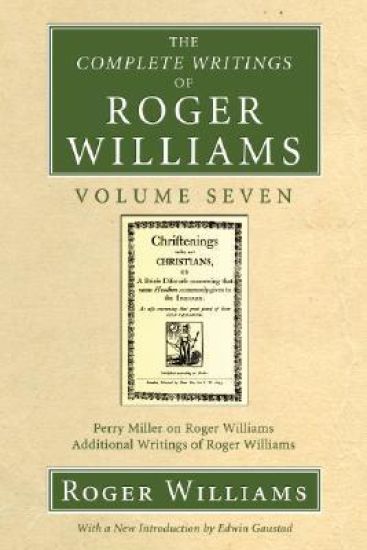
The Complete Writings of Roger Williams, Volume 7

The Complete Writings of Roger Williams, Volume 7

Roger Williams; Edwin Gaustad

Wipf Stock Publishers
2007
pokkari
Ten years after the U. S. Civil War, a group of men in Rhode Island made a conserted effort to rescue the widely scattered writings of Roger Williams. Few sets were printed though, and under the guidance of Perry Miller, The Complete Writings of Roger Williams were brought back in 1963, but still in short numbers. The present collection now makes these volumes available to readers in their original orthography. The theme of religious liberty is dominant in these volumes, running through Williams's correspondence with John Cotton and on through his famous pair of works on The Bloudy Tenent of Persecution. All of the extant shorter writings and letters of Roger Williams are included in this set, along with two significant works resulting from his engagement with Native Americans: his seminal Key into the Language of America and Christenings Make Not Christians. ""Roger Williams was one of those rare individuals who took the accepted ideas of his time and followed them to conclusions that challenged his contemporaries and still challenge us. To have his complete writings once again available is a great service to all who would understand American religion and political institutions at the deepest level."" Edmund S. Morgan Sterling Professor of History Emeritus Yale University ""It has been America's great good fortune that Roger Williams's career stood at the beginning of its history. Just as some experience in the youth of a person is ever afterward a determinant of his personality, so the American character has inevitably been molded by the fact that in the first years of colonization there arose this prophet of religious liberty. Later generations could not forget him or deny him. The image of him in conflict with the founders of New England could not be obliterated; all later righteous men would be tormented by it until they learned to accept his basic thesis, that freedom is a condition of the spirit."" Perry Miller (1963) Roger Williams (1603-1683) grew up in Puritan circles in London, sailed to Massachusetts in 1630, and, having been banished for his controversial views on the separation of church and state, founded Rhode Island on the basis of his new principles of religious liberty.
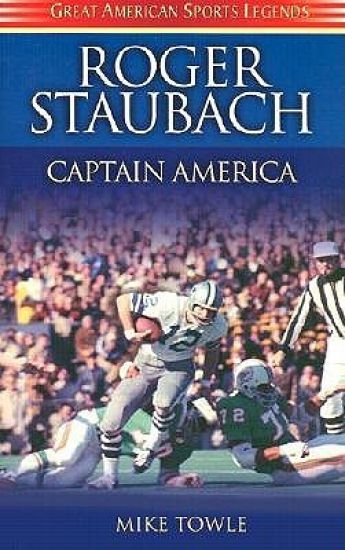
Roger Staubach

Roger Staubach

Mike Towle

Cumberland House Publishing,US
2002
pokkari
If at one time the Dallas Cowboys were America's Team, Roger Staubach was America's Quarterback. Roger the Dodger was a real-life embodiment of apple pie, world championships, and role models. Staubach was a Heisman Trophy winner at Annapolis who served four years as a naval officer before going on to a stellar eleven-year career with the Dallas Cowboys that included four NFC championships and two Super Bowl titles. Considered the master of the two-minute offense and late-game comeback, Staubach eventually earned a spot in the Cowboys' illustrious Ring of Honor and, ultimately in 1985, the Pro Football Hall of Fame.If ever there was a perfect meshing of franchise, coach, and on-field leader, it was the silver-white-and-blue Cowboys of the seventies with Tom Landry strolling the sidelines in his trademark fedora and the unflappable Staubach barking signals. He led the NFL in passing five times, and when he retired at age thirty-seven he departed the game in possession of the highest quarterback rating of all time. After his retirement from football, he pretty much left the game behind, forsaking a shot at coaching or television commentary to focus his energies on the corporate world as chairman and CEO of the Staubach Company, a diversified commercial real estate company.Roger Staubach: Captain America is an oral history of Staubach's life, times, and career. It is told in the words of dozens of former teammates and opponents, friends, business associates, civic leaders, acquaintances, and others who have known him over the years. Staubach turned sixty in 2002, and this book offers a touching and telling testimonial to a true American hero and role model.
Roger Zelazny's Shadows of Amber

Roger Zelazny's Shadows of Amber

Betancourt John Gregory

ibooks
2016
sidottu
Oberon, newly-crowned King of Amber, finds himself in the middle of deadly political machinations, as his father tries to turn him into a puppet ruler. Meanwhile, rumors abound of a Shadow Amber in the sea, where a distorted version of Oberon sits on an onyx throne. To make matters worse, Oberon's sister is trying to marry him off to a grasping would-be queen, at least two siblings are out for his blood, and the entire Shadow-universe is starting to unravel. What's a new king to do? Seek help from an unlikely new ally!
Roger Waters and Pink Floyd

Roger Waters and Pink Floyd

Phil Rose

Fairleigh Dickinson University Press
2015
sidottu
Beyond its elucidation and critique of traditional ‘notation-centric’ musicology, this book's primary emphasis is on the negotiation and construction of meaning within the extended musical multimedia works of the classic British group Pink Floyd. Encompassing the concept albums that the group released from 1973 to 1983, during Roger Waters’ final period with the band, chapters are devoted to Dark Side of the Moon (1973), Wish You Were Here (1975), Animals (1977), The Wall (1979) and The Final Cut (1983), along with Waters’ third solo album Amused to Death (1993). This book's analysis of album covers, lyrics, music and film makes use of techniques of literary and film criticism, while employing the combined lenses of musical hermeneutics and discourse analysis, so as to illustrate how sonic and musical information contribute to listeners’ interpretations of the discerning messages of these monumental musical artifacts. Ultimately, it demonstrates how their words, sounds, and images work together in order to communicate one fundamental concern, which—to paraphrase the music journalist Karl Dallas—is to affirm human values against everything in life that should conspire against them.
Roger Waters and Pink Floyd

Roger Waters and Pink Floyd

Phil Rose

Fairleigh Dickinson University Press
2016
nidottu
Beyond its elucidation and critique of traditional ‘notation-centric’ musicology, this book's primary emphasis is on the negotiation and construction of meaning within the extended musical multimedia works of the classic British group Pink Floyd. Encompassing the concept albums that the group released from 1973 to 1983, during Roger Waters’ final period with the band, chapters are devoted to Dark Side of the Moon (1973), Wish You Were Here (1975), Animals (1977), The Wall (1979) and The Final Cut (1983), along with Waters’ third solo album Amused to Death (1993). This book's analysis of album covers, lyrics, music and film makes use of techniques of literary and film criticism, while employing the combined lenses of musical hermeneutics and discourse analysis, so as to illustrate how sonic and musical information contribute to listeners’ interpretations of the discerning messages of these monumental musical artifacts. Ultimately, it demonstrates how their words, sounds, and images work together in order to communicate one fundamental concern, which—to paraphrase the music journalist Karl Dallas—is to affirm human values against everything in life that should conspire against them.
The Roger Scarlett Mysteries, Vol. 1: The Beacon Hill Murders / The Back Bay Murders
The Beacon Hill Murders: Boston's Beacon Hill, a distinguished neighborhood of old mansions and old money, has been invaded, much to its mortification, by the Suttons, a family of well-heeled parvenus. The latest daring play of the head of the clan, rags-to-riches stock exchange gambler Frederick Sutton, is to break into Boston society--but this ambitious move proves his most daunting stake yet. On the night Frederick Sutton hosts for dinner at his grand estate his prim and disapproving attorney, Mr. Underwood, and that widow of impeccable taste and irresistible charm, Mrs. Anceney, the final course for the night turns out to be death When a murderer's bullet puts an end to Frederick Sutton's lofty social ambitions, there is only one person, seemingly, who could possibly have done the foul deed. But surely this person cannot be guilty of such an egregious social faux pas as murder Then a second slaying takes place at the Sutton mansion, this one even more mystifying than the first, in a room guarded by Boston's finest. Fortunately keen-minded Inspector Kane, as chronicled by the admiring Mr. Underwood, has the acumen necessary to solve the baffling Beacon Hill murders.The Back Bay Murders: Arthur Prendergast insisted both to Inspector Norton Kane of the Boston police and to Kane's loyal chronicler, the prim lawyer Mr. Underwood, that he was being menaced by some mysterious and malevolent unknown, but no one believed the terrified ravings of the neurotic young man. The very next day, however, Mr. Prendergast was found murdered, his jugular vein cruelly severed This was only the beginning of the reign of terror that cuts a swath of death at Mrs. Quincy's brownstone boarding house in the formerly sedate neighborhood of Boston's Back Bay. It seems scarcely believable that one of the seemingly innocuous residents at Mrs. Quincey's refined home could be guilty of the monstrous murders, but as Inspector Kane lectures Mr. Underwood, "You ought to know that under the surface of normal existence there are hidden currents which sometimes burst through. You shrink from them with horror, but I'm trained to expect their manifestations." Fortunately the keen-minded Inspector Kane is able to damn the fearsome currents bursting over this particular Back Bay brownstone when he brilliantly solves the baffling Back Bay murders.
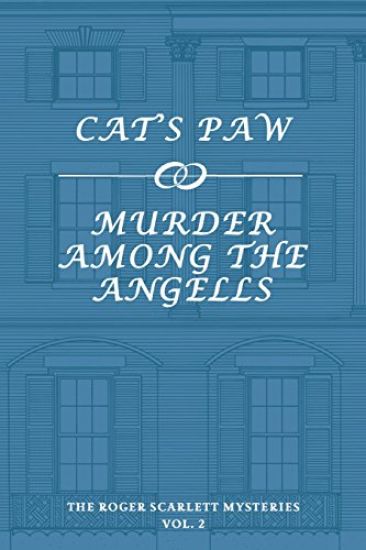
The Roger Scarlett Mysteries, Vol. 2: Cat's Paw / Murder Among the Angells
Cat's Paw: From his great Gothic mansion in Boston's Fenway, wealthy and elderly Martin Greenough rules as a mercurial despot over a curious menagerie of dependents that includes his determinedly respectable companion, Mrs. Warden, some rather odd servants, various nieces and nephews and their spouses and a male cat named Lucy. On the occasion of childless Cousin Mart's birthday, the vultures--or, in deference to the niceties, let us say the relatives--gather to demonstrate their devotion to the old man--though they are, in fact, much more interested in the old man's money. When it is learned that Cousin Mart is changing his will, however, the family's feathers are ruffled and the squawking begins After Cousin Mart's long burning candle is violently snuffed out during an evening of Fourth of July fireworks festivities, it falls to keen-minded Inspector Kane--accompanied, as usual, by his faithful chronicler, the prim attorney Mr. Underwood--to collar an individual who proves to have been a most clever killer indeed, even by the elevated standard of the ingenious Roger Scarlett.Murder Among the Angells: The austere and forbidding abode of the Angells, located on Boston's Beacon Street, is a great L-shaped mansion curiously divided into two identical halves, which are respectively occupied by two aged brothers and their families and connected only by an elevator. The two Angell brothers, Carolus and Darius, have for decades been locked in a grim contest of survival in their divided mansion, on account of their eccentric health faddist father's queer will, which devises his entire estate to whichever brother outlives the other, as a way of encouraging the pair to live healthfully. Before the novel is over, however, both of the brothers will have died violently--one of them while traveling alone in the mansion elevator Thus is keen-minded Inspector Kane of the Boston police--who for the last recorded occasion is accompanied on a criminal investigation by his admiring friend Mr. Underwood, who happens to be Darius Angell's attorney--presented with what proves to be the strangest and most perplexing problem in homicide that the pair has encountered.