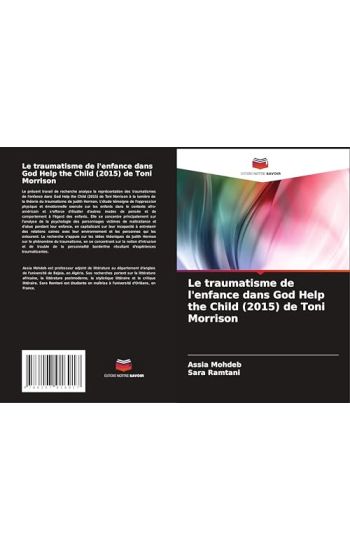
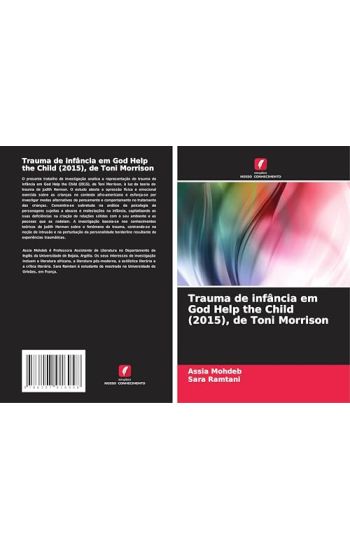
Le pr sent travail de recherche analyse la repr sentation des traumatismes de l'enfance dans God Help the Child (2015) de Toni Morrison la lumi re de la th orie du traumatisme de Judith Herman. L' tude t moigne de l'oppression physique et motionnelle exerc e sur les enfants dans le contexte afro-am ricain et s'efforce d' tudier d'autres modes de pens e et de comportement l' gard des enfants. Elle se concentre principalement sur l'analyse de la psychologie des personnages victimes de maltraitance et d'abus pendant leur enfance, en capitalisant sur leur incapacit entretenir des relations saines avec leur environnement et les personnes qui les entourent. La recherche s'appuie sur les id es th oriques de Judith Herman sur le ph nom ne du traumatisme, en se concentrant sur la notion d'intrusion et de trouble de la personnalit borderline r sultant d'exp riences traumatisantes.
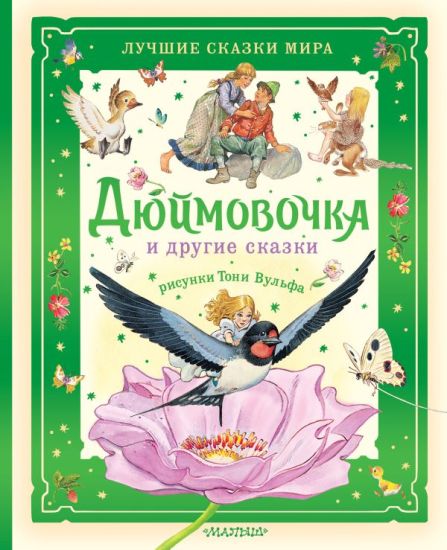
V knigu "Djujmovochka i drugie skazki" voshli skazki raznykh narodov. Eto i znamenitye skazki Kh. K. Andersena "Djujmovochka", "Gadkij utjonok", "Snezhnaja koroleva", i skazki narodov Evropy: "Ivan-tsarevich", "Doch-semiletka", "Vasilisa dobraja", "Snegovichka". V kazhdoj skazke est ljubov i mudrost, dobro i zlo. I dobro nepremenno pobezhdaet zlo. Illjustratsii k skazkam vypolneny Toni Vulfom, Libiko Marajja i drugimi znamenitymi italjanskimi khudozhnikami.Dlja detej do 3-kh let.
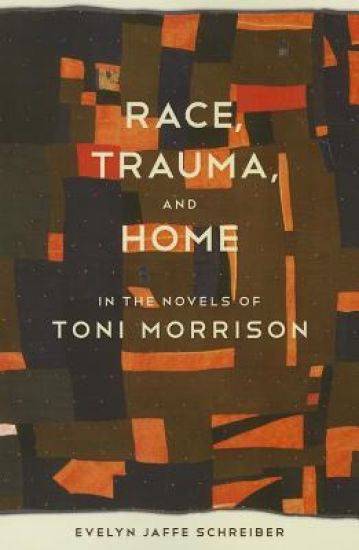
In this first interdisciplinary study of all nine of Nobel Laureate Toni Morrison's novels, Evelyn Jaffe Schreiber investigates how the communal and personal trauma of slavery embedded in the bodies and minds of its victims lives on through successive generations of African Americans. Approaching trauma from several cutting-edge theoretical perspectives - psychoanalytic, neurobiological, and cultural and social theories - Schreiber analyses the lasting effects of slavery as depicted in Morrison's work and considers the almost insurmountable task of recovering from trauma to gain subjectivity. With an innovative application of neuroscience to literary criticism, Schreiber explains how trauma, whether initiated by physical abuse, dehumanization, discrimination, exclusion, or abandonment, becomes embedded in both psychic and bodily circuits. Slavery and its legacy of cultural rejection create trauma on individual, familial, and community levels, and parents unwittingly transmit their trauma to their children through repetition of their bodily stored experiences. Concepts of ""home"" - whether a physical place, community, or relationship - are reconstructed through memory to provide a positive self and serve as a healing space for Morrison's characters. Remembering and retelling trauma within a supportive community enables trauma victims to move forward and attain a meaningful subjectivity and selfhood.Through careful analysis of each novel, Schreiber traces the success or failure of Morrison's characters to build or rebuild a cohesive self, starting with slavery and the initial postslavery generation, and continuing through the twentieth century, with a special focus on the effects of inherited trauma on children. When characters attempt to escape trauma through physical relocation, or to project their pain onto others through aggressive behavior or scapegoating, the development of selfhood falters. Only when trauma is confronted through verbalization and challenged with reparative images of home, can memories of a positive self overcome the pain of past experiences and cultural rejection.While the cultural trauma of slavery can never truly disappear, Schreiber argues that memories that reconstruct a positive self, whether created by people, relationships, a physical place, or a concept, help Morrison's characters to establish subjectivity. A groundbreaking interdisciplinary work, Schreiber's book unites psychoanalytic, neurobiological, and social theories into a full and richly textured analysis of trauma and the possibility of healing in Morrison's novels.
Reading, Learning, Teaching Toni Morrison draws on contemporary scholarship and Morrison’s own commentary to explicate all of her novels published to date, including her 2008 novel A Mercy. Morrison, the 1993 Nobel Prize winner, is an unabashedly confrontational author. Her profound and complex novels address problems such as slavery, violence, poverty, and sexual abuse. Morrison’s work encompasses a project of total cultural renewal: she re-imagines and reaffirms the experience of African Americans from the earliest days of slavery up to the present, avoiding stereotypes or oversimplification. She employs African and Western literary traditions and conventions as a basis for both structure and critique, re-writing some of the «master narratives» of American culture and history. This book analyzes Morrison’s novels in the context of African American history and literature, and provides supplemental material to guide teachers and students to understand and appreciate Morrison’s novels.
Comparative Postcolonialism in the Works of V.S. Naipaul and Toni Morrison: Fragmented Identities begins with an overview of its theoretical framework, highlighting the intersectional relationship between postcolonial literature and comparative literature. Tracing selected novels by Naipaul and Morrison, the book takes, as a starting point, Fanon’s three-phase journey of the decolonizing process. In the first phase of mimicry, Naipaul’s and Morrison’s earlier novels represent the assimilation of indigenous people into dominant hegemonic cultures. The second phase is envisioned as the re-narration or re-interpretation of the past and old legends of indigenous culture. Morrison succeeds in asserting that her ancestors’ past is the only way to celebrate a cultural identity, but Naipaul tends to criticize and neglect his past and his original, indigenous culture. The third phase marks the emergence of a revolutionary literature, in which Naipaul and Morrison guide their people to hybridity as a new way of becoming and resisting the hegemonic dichotomies in dominant societies.
Comparative Postcolonialism in the Works of V.S. Naipaul and Toni Morrison: Fragmented Identities begins with an overview of its theoretical framework, highlighting the intersectional relationship between postcolonial literature and comparative literature. Tracing selected novels by Naipaul and Morrison, the book takes, as a starting point, Fanon’s three-phase journey of the decolonizing process. In the first phase of mimicry, Naipaul’s and Morrison’s earlier novels represent the assimilation of indigenous people into dominant hegemonic cultures. The second phase is envisioned as the re-narration or re-interpretation of the past and old legends of indigenous culture. Morrison succeeds in asserting that her ancestors’ past is the only way to celebrate a cultural identity, but Naipaul tends to criticize and neglect his past and his original, indigenous culture. The third phase marks the emergence of a revolutionary literature, in which Naipaul and Morrison guide their people to hybridity as a new way of becoming and resisting the hegemonic dichotomies in dominant societies.
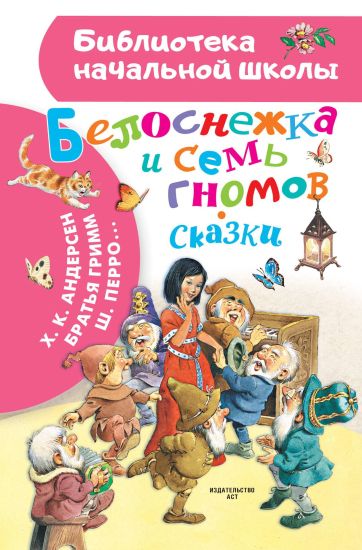
"Belosnezhka i sem gnomov. Skazki" - sbornik zavorazhivajuschikh istorij o chudesakh, velikanakh, volshebnikakh i o tom, chto dobro vsegda pobezhdaet zlo. Skazki napisali Kh.K. Andersen, Sharl Perro, Bratja Grimm i Vilgelm Gauf, a illjustratsii narisoval znamenityj italjanskij khudozhnik Toni Vulf. Dlja mladshego shkolnogo vozrasta.
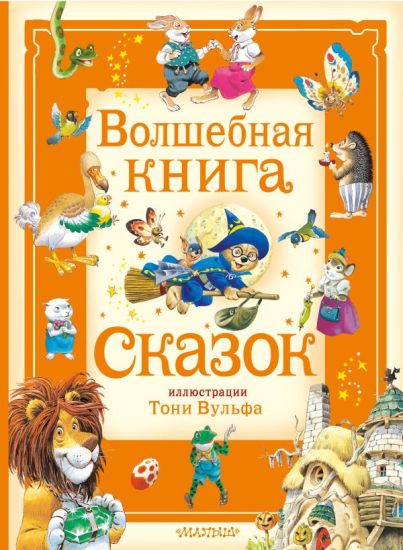
V "Volshebnuju knigu skazok" voshli dobrye istorii o chudesnom lese i ego obitateljakh. Ocharovatelnye zverjata khodjat drug v drugu v gosti, veselo otmechajut prazdniki i vsegda gotovy prijti na pomosch sosedu. Skazochnye istorii ob izobretatele Ryzhike i ego podruge Snezhinke, udivitelnykh ptitsakh Dodo, zamke uzhasnogo Troglodita i pochti Velikom Volshebnike Toptyzhke pereskazal s italjanskogo M. Mikhajlov. Velikolepnye illjustratsii, kotorye tak interesno rassmatrivat i detjam, i vzroslym, narisoval neprevzojdjonnyj Toni Vulf (psevdonim Antonio Lupatelli) - master detskoj knizhnoj illjustratsii iz Italii.
O presente trabalho de investiga o analisa a representa o do trauma de inf ncia em God Help the Child (2015), de Toni Morrison, luz da teoria do trauma de Judith Herman. O estudo atesta a opress o f sica e emocional exercida sobre as crian as no contexto afro-americano e esfor a-se por investigar modos alternativos de pensamento e comportamento no tratamento das crian as. Concentra-se sobretudo na an lise da psicologia de personagens sujeitas a abusos e molesta es na inf ncia, capitalizando as suas defici ncias na cria o de rela es s lidas com o seu ambiente e as pessoas que as rodeiam. A investiga o baseia-se nos conhecimentos te ricos de Judith Herman sobre o fen meno do trauma, centrando-se na no o de intrus o e na perturba o da personalidade borderline resultante de experi ncias traum ticas.
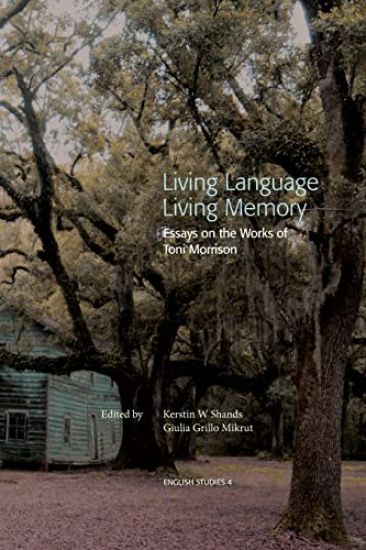
In 1993 Toni Morrison was awarded the Nobel Prize for Literature. The Nobel committee described her work as “characterized by visionary force and poetic import [that] gives life to an essential aspect of American reality.”Twenty years later, a group of scholars met in Stockholm to commemorate and celebrate Morrison’s award, and just as importantly, to critically engage the wealth of scholarship that has sprung up around Morrison’s work—both the six novels recognized by the Nobel committee and those works of fiction and criticism published in the two decades afterwards.The essays in this collection implicitly and explicitly take up Morrison’s clarion call to vivify language. They engage her words by elaborating on their meaning, offering readings of her literary texts that highlight their intertextuality, their proliferating conversations with other texts and contexts, and even other languages. In some, Morrison’s words give life to authors no longer with us, in others we are encouraged to resituate her writing in unfamiliar contexts in order to highlight the multiplicity of meanings generated by her work. The essays offer rich testimony to the life-giving properties of Morrison’s language and seek to contribute to the ongoing afterlife of her work by adding to the scholarly conversations animated by her extraordinary literary career.
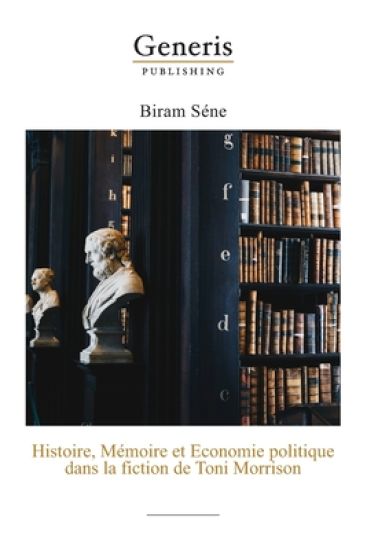
Cette tude s'int resse l'histoire, la m moire et l' conomie politique dans l'oeuvre de Toni Morrison. Sans tre historienne, Morrison essaie de r crire l'histoire de la communaut africaine am ricaine afin de l'ins rer d'abord dans l'agenda historique de l'Am rique avant de l'exposer la civilisation de l'universel. Contrairement la th se de Karl Marx stipulant que le moteur de l'histoire c'est la lutte des classes, cette tude montre que l'on peut faire l'histoire tout en se passant de l' rection des classes sociales. C'est d'ailleurs en cela, que r side la force du message de Morrison qui, travers ses crits, lutte contre le racisme et lance un appel aux valeurs universelles telles que l'amour, la dignit humaine, l'esprit de solidarit qui peuvent tre consid r s comme les seuls gages pour une paix sociale durable. Cette tude pr sente aussi un int r t particulier certaines techniques narratives qui rapprochent l'oeuvre de Morrison de l'africanisme. On y note par exemple une forte pr sence du discours oral qui renvoie la culture africaine comme la chanson et le nom qui rappellent souvent des moments ou des v nements historiques. Enfin, travers cette tude, le lecteur peut comprendre que Morrison prend l' criture comme un moyen pour faire de la politique. Dans le but de lutter contre l' rection des classes sociales caus es par la recherche de profits (par exemple la relation entre les ma tres et les esclaves ou entre les bourgeois et les prol taires), elle valorise ou revalorise la culture noire et appelle le monde au dialogue et la tol rance pour une coh sion sociale durable.