Kirjojen hintavertailu. Mukana 11 699 587 kirjaa ja 12 kauppaa.

Kirjahaku

Etsi kirjoja tekijän nimen, kirjan nimen tai ISBN:n perusteella.

1000 tulosta hakusanalla Vector Hasting

Natural Products in Vector-Borne Disease Management
Natural Products in Vector-Borne Disease Management explores the potential application of natural products in vector control and disease management. The chapters discuss the global impact of specific vector-borne diseases, gaps in management, and natural products in specific stages of development - discovery, optimization, validation, and preclinical/clinical development. Toxic effects and mechanisms of action are also discussed. This book also explores how therapeutic plant derivatives can be used to combat the vectors of infection and how natural products can be used to manage and treat vector-borne diseases like malaria, leishmaniasis, dengue, and trypanosomiasis. With the inclusion of case studies on field and clinical applications and the contributions from experts in the field, Natural Products in Vector-Borne Disease Management is an essential resource to researchers, academics, and clinicians in parasitology, virology, microbiology, biotechnology, pharmacology, and pharmacognosy working in the field of vector-borne diseases.
Introductory Theory of Topological Vector SPates
This text offers an overview of the basic theories and techniques of functional analysis and its applications. It contains topics such as the fixed point theory starting from Ky Fan's KKM covering and quasi-Schwartz operators. It also includes over 200 exercises to reinforce important concepts.;The author explores three fundamental results on Banach spaces, together with Grothendieck's structure theorem for compact sets in Banach spaces (including new proofs for some standard theorems) and Helley's selection theorem. Vector topologies and vector bornologies are examined in parallel, and their internal and external relationships are studied. This volume also presents recent developments on compact and weakly compact operators and operator ideals; and discusses some applications to the important class of Schwartz spaces.;This text is designed for a two-term course on functional analysis for upper-level undergraduate and graduate students in mathematics, mathematical physics, economics and engineering. It may also be used as a self-study guide by researchers in these disciplines.
V-Invex Functions and Vector Optimization

V-Invex Functions and Vector Optimization

Shashi K. Mishra; Shouyang Wang; Kin Keung Lai

Springer-Verlag New York Inc.
2007
sidottu
This volume summarizes and synthesizes an aspect of research work that has been done in the area of Generalized Convexity over the past few decades. Specifically, the book focuses on V-invex functions in vector optimization that have grown out of the work of Jeyakumar and Mond in the 1990's. The authors integrate related research into the book and demonstrate the wide context from which the area has grown and continues to grow.
Finite-Dimensional Vector Spaces

Finite-Dimensional Vector Spaces

P. R. Halmos

Springer-Verlag New York Inc.
1974
sidottu
“The theory is systematically developed by the axiomatic method that has, since von Neumann, dominated the general approach to linear functional analysis and that achieves here a high degree of lucidity and clarity. The presentation is never awkward or dry, as it sometimes is in other “modern” textbooks; it is as unconventional as one has come to expect from the author. The book contains about 350 well placed and instructive problems, which cover a considerable part of the subject. All in all this is an excellent work, of equally high value for both student and teacher.” Zentralblatt für Mathematik
Algebraic Surfaces and Holomorphic Vector Bundles

Algebraic Surfaces and Holomorphic Vector Bundles

Robert Friedman

Springer-Verlag New York Inc.
1998
sidottu
This book is based on courses given at Columbia University on vector bun­ dles (1988) and on the theory of algebraic surfaces (1992), as well as lectures in the Park City lIAS Mathematics Institute on 4-manifolds and Donald­ son invariants. The goal of these lectures was to acquaint researchers in 4-manifold topology with the classification of algebraic surfaces and with methods for describing moduli spaces of holomorphic bundles on algebraic surfaces with a view toward computing Donaldson invariants. Since that time, the focus of 4-manifold topology has shifted dramatically, at first be­ cause topological methods have largely superseded algebro-geometric meth­ ods in computing Donaldson invariants, and more importantly because of and Witten, which have greatly sim­ the new invariants defined by Seiberg plified the theory and led to proofs of the basic conjectures concerning the 4-manifold topology of algebraic surfaces. However, the study of algebraic surfaces and the moduli spaces ofbundles on them remains a fundamen­ tal problem in algebraic geometry, and I hope that this book will make this subject more accessible. Moreover, the recent applications of Seiberg­ Witten theory to symplectic 4-manifolds suggest that there is room for yet another treatment of the classification of algebraic surfaces. In particular, despite the number of excellent books concerning algebraic surfaces, I hope that the half of this book devoted to them will serve as an introduction to the subject.
An Introduction to Vector Analysis

An Introduction to Vector Analysis

B. Hague

Chapman and Hall
1970
nidottu
The principal changes that I have made in preparing this revised edition of the book are the following. (i) Carefuily selected worked and unworked examples have been added to six of the chapters. These examples have been taken from class and degree examination papers set in this University and I am grateful to the University Court for permission to use them. (ii) Some additional matter on the geometrieaI application of veetors has been incorporated in Chapter 1. (iii) Chapters 4 and 5 have been combined into one chapter, some material has been rearranged and some further material added. (iv) The chapter on int~gral theorems, now Chapter 5, has been expanded to include an altemative proof of Gauss's theorem, a treatmeot of Green's theorem and a more extended discussioo of the classification of vector fields. (v) The only major change made in what are now Chapters 6 and 7 is the deletioo of the discussion of the DOW obsolete pot funetioo. (vi) A small part of Chapter 8 on Maxwell's equations has been rewritten to give a fuller account of the use of scalar and veetor potentials in eleetromagnetic theory, and the units emploYed have been changed to the m.k.s. system.
The Geometry of Vector Fields (Routledge Revivals)
This volume, first published in 2000, presents a classical approach to the foundations and development of the geometry of vector fields, describing vector fields in three-dimensional Euclidean space, triply-orthogonal systems and applications in mechanics. Topics covered include Pfaffian forms, systems in n-dimensional space, and foliations and their Godbillion-Vey invariant. There is much interest in the study of geometrical objects in n-dimensional Euclidean space and this volume provides a useful and comprehensive presentation.
The Geometry of Vector Fields (Routledge Revivals)
This volume, first published in 2000, presents a classical approach to the foundations and development of the geometry of vector fields, describing vector fields in three-dimensional Euclidean space, triply-orthogonal systems and applications in mechanics. Topics covered include Pfaffian forms, systems in n-dimensional space, and foliations and their Godbillion-Vey invariant. There is much interest in the study of geometrical objects in n-dimensional Euclidean space and this volume provides a useful and comprehensive presentation.
Analysis in Vector Spaces

Analysis in Vector Spaces

Mustafa A. Akcoglu; Paul F. A. Bartha; Dzung Minh Ha

John Wiley Sons Inc
2009
sidottu
A rigorous introduction to calculus in vector spaces The concepts and theorems of advanced calculus combined with related computational methods are essential to understanding nearly all areas of quantitative science. Analysis in Vector Spaces presents the central results of this classic subject through rigorous arguments, discussions, and examples. The book aims to cultivate not only knowledge of the major theoretical results, but also the geometric intuition needed for both mathematical problem-solving and modeling in the formal sciences. The authors begin with an outline of key concepts, terminology, and notation and also provide a basic introduction to set theory, the properties of real numbers, and a review of linear algebra. An elegant approach to eigenvector problems and the spectral theorem sets the stage for later results on volume and integration. Subsequent chapters present the major results of differential and integral calculus of several variables as well as the theory of manifolds. Additional topical coverage includes: Sets and functionsReal numbersVector functionsNormed vector spacesFirst- and higher-order derivativesDiffeomorphisms and manifoldsMultiple integralsIntegration on manifoldsStokes' theoremBasic point set topology Numerous examples and exercises are provided in each chapter to reinforce new concepts and to illustrate how results can be applied to additional problems. Furthermore, proofs and examples are presented in a clear style that emphasizes the underlying intuitive ideas. Counterexamples are provided throughout the book to warn against possible mistakes, and extensive appendices outline the construction of real numbers, include a fundamental result about dimension, and present general results about determinants. Assuming only a fundamental understanding of linear algebra and single variable calculus, Analysis in Vector Spaces is an excellent book for a second course in analysis for mathematics, physics, computer science, and engineering majors at the undergraduate and graduate levels. It also serves as a valuable reference for further study in any discipline that requires a firm understanding of mathematical techniques and concepts.
Knowledge Discovery with Support Vector Machines

Knowledge Discovery with Support Vector Machines

Lutz H. Hamel

John Wiley Sons Inc
2009
sidottu
An easy-to-follow introduction to support vector machines This book provides an in-depth, easy-to-follow introduction to support vector machines drawing only from minimal, carefully motivated technical and mathematical background material. It begins with a cohesive discussion of machine learning and goes on to cover: Knowledge discovery environments Describing data mathematically Linear decision surfaces and functions Perceptron learning Maximum margin classifiers Support vector machines Elements of statistical learning theory Multi-class classification Regression with support vector machines Novelty detection Complemented with hands-on exercises, algorithm descriptions, and data sets, Knowledge Discovery with Support Vector Machines is an invaluable textbook for advanced undergraduate and graduate courses. It is also an excellent tutorial on support vector machines for professionals who are pursuing research in machine learning and related areas.
Analysis in Vector Spaces Set

Analysis in Vector Spaces Set

Mustafa A. Akcoglu; Paul F. A. Bartha; Dzung Minh Ha

John Wiley Sons Inc
2009
sidottu
This set includes: Analysis in Vector Spaces ISBN 978-0-470-14824-2 and Analysis in Vector Spaces, Student Solutions Manual ISBN 978-0-470-14825-9. rigorous introduction to calculus in vector spaces The concepts and theorems of advanced calculus combined with related computational methods are essential to understanding nearly all areas of quantitative science. Analysis in Vector Spaces presents the central results of this classic subject through rigorous arguments, discussions, and examples. The book aims to cultivate not only knowledge of the major theoretical results, but also the geometric intuition needed for both mathematical problem-solving and modeling in the formal sciences. The authors begin with an outline of key concepts, terminology, and notation and also provide a basic introduction to set theory, the properties of real numbers, and a review of linear algebra. An elegant approach to eigenvector problems and the spectral theorem sets the stage for later results on volume and integration. Subsequent chapters present the major results of differential and integral calculus of several variables as well as the theory of manifolds. Additional topical coverage includes: Sets and functionsReal numbersVector functionsNormed vector spacesFirst- and higher-order derivativesDiffeomorphisms and manifoldsMultiple integralsIntegration on manifoldsStokes' theoremBasic point set topology Numerous examples and exercises are provided in each chapter to reinforce new concepts and to illustrate how results can be applied to additional problems. Furthermore, proofs and examples are presented in a clear style that emphasizes the underlying intuitive ideas. Counterexamples are provided throughout the book to warn against possible mistakes, and extensive appendices outline the construction of real numbers, include a fundamental result about dimension, and present general results about determinants. Assuming only a fundamental understanding of linear algebra and single variable calculus, Analysis in Vector Spaces is an excellent book for a second course in analysis for mathematics, physics, computer science, and engineering majors at the undergraduate and graduate levels. It also serves as a valuable reference for further study in any discipline that requires a firm understanding of mathematical techniques and concepts.
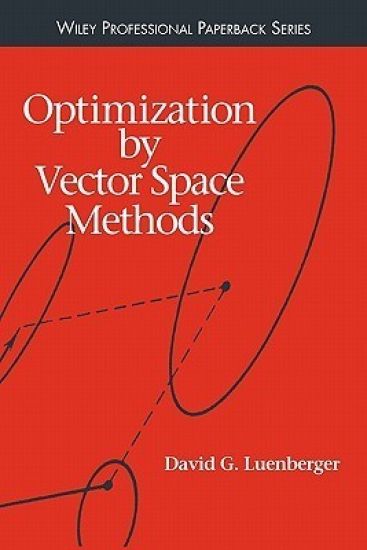
Optimization by Vector Space Methods

Optimization by Vector Space Methods

David G. Luenberger

John Wiley Sons Inc
1998
nidottu
Engineers must make decisions regarding the distribution of expensive resources in a manner that will be economically beneficial. This problem can be realistically formulated and logically analyzed with optimization theory. This book shows engineers how to use optimization theory to solve complex problems. Unifies the large field of optimization with a few geometric principles. Covers functional analysis with a minimum of mathematics. Contains problems that relate to the applications in the book.
Tensor and Vector Analysis

Tensor and Vector Analysis

Springer Springer

Dover Publications Inc.
2012
nidottu
Concise and user-friendly, this college-level text assumes only a knowledge of basic calculus in its elementary and gradual development of tensor theory. The introductory approach bridges the gap between mere manipulation and a genuine understanding of an important aspect of both pure and applied mathematics.Beginning with a consideration of coordinate transformations and mappings, the treatment examines loci in three-space, transformation of coordinates in space and differentiation, tensor algebra and analysis, and vector analysis and algebra. Additional topics include differentiation of vectors and tensors, scalar and vector fields, and integration of vectors. The concluding chapter employs tensor theory to develop the differential equations of geodesics on a surface in several different ways to illustrate further differential geometry.
A History of Vector Analysis

A History of Vector Analysis

Michael J. Crowe

Dover Publications Inc.
2003
nidottu
Prize-winning study traces the rise of the vector concept from the discovery of complex numbers through the systems of hypercomplex numbers to the final acceptance around 1910 of the modern system of vector analysis.
Finite-Dimensional Vector Spaces

Finite-Dimensional Vector Spaces

Paul R. Halmos

Dover Publications Inc.
2017
nidottu
A fine example of a great mathematician's intellect and mathematical style, this classic on linear algebra is widely cited in the literature. The treatment is an ideal supplement to many traditional linear algebra texts and is accessible to undergraduates with some background in algebra. "Extremely well-written and logical, with short and elegant proofs." - MAA Reviews.
Pest and Vector Control

Pest and Vector Control

H. F. Van Emden; M. W. Service

Cambridge University Press
2004
pokkari
As ravagers of crops and carriers of diseases affecting plants, humans and animals, insects present a challenge to a growing human population. In Pest and Vector Control, Professors van Emden and Service describe the available options for meeting this challenge, discussing their relative advantages, disadvantages and future potential. Methods such as chemical and biological control, host tolerance and resistance are discussed integrating (often for the first time) information and experience from the agricultural and medical/veterinary fields. Chemical control is seen as a major component of insect control, both now and in the future, but this is balanced with an extensive account of associated problems, especially the development of pesticide-tolerant populations.
Introduction to Vector Analysis

Introduction to Vector Analysis

Tallack J.C.

Cambridge University Press
2009
pokkari
The first eight chapters of this book were originally published in 1966 as the successful Introduction to Elementary Vector Analysis. In 1970, the text was considerably expanded to include six new chapters covering additional techniques (the vector product and the triple products) and applications in pure and applied mathematics. It is that version which is reproduced here. The book provides a valuable introduction to vectors for teachers and students of mathematics, science and engineering in sixth forms, technical colleges, colleges of education and universities.
Helices and Vector Bundles

Helices and Vector Bundles

Cambridge University Press
1990
pokkari
This volume is devoted to the use of helices as a method for studying exceptional vector bundles, an important and natural concept in algebraic geometry. The work arises out of a series of seminars organised in Moscow by A. N. Rudakov. The first article sets up the general machinery, and later ones explore its use in various contexts. As to be expected, the approach is concrete; the theory is considered for quadrics, ruled surfaces, K3 surfaces and P3(C).