Kirjojen hintavertailu. Mukana 12 083 983 kirjaa ja 12 kauppaa.

Kirjahaku

Etsi kirjoja tekijän nimen, kirjan nimen tai ISBN:n perusteella.

1000 tulosta hakusanalla Arvind Kumar

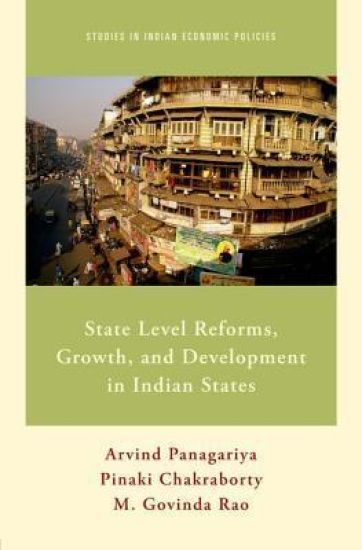
State Level Reforms, Growth, and Development in Indian States

State Level Reforms, Growth, and Development in Indian States

Arvind Panagariya; Pinaki Chakraborty; M. Govinda Rao

Oxford University Press Inc
2014
sidottu
Most discussions of India's substantive economic growth since the 1990s tend to focus on national level statistics or on particular sectors such as the financial and call service sectors or on the pharmaceutical industry. But with a population of 1.2 billion, India demands to be treated like a collection of individual "countries, " rather than a unified nation. Ten of its states have populations equaling or exceeding that of the United Kingdom. If the state of Uttar Pradesh were a country, it would be the fourth largest, behind China, India, and the United States. These facts pointedly tell us that if we are to understand the ongoing experiment in economic reforms and poverty alleviation, we must study India at the level of the state. In this spirit, State Level Reforms and Growth and Development in Indian States provides the first-ever comprehensive analysis of growth at the highly diverse state level. The authors argue that when the national government loosened its stronghold on industry and services, state governments were able to shape the fortunes of their citizens through state-level policy reforms. Because of this, every Indian state experienced accelerated growth, unlike China during the first two decades of its development when the eastern half flourished as the western half lagged. Every Indian state has grown faster in the last decade than any other decade in the post-independence era. In fact, some of the poorest states, notably Bihar and Orissa, have been growing the fastest. Professors Panagariya and Chakraborty and Dr. Rao refute the common assumptions that growth has not occurred or that poverty has not been reduced in all Indian states. The recent reforms have also led to improved access in every state to basic amenities such as permanent houses, electricity, water, and sanitation. These accomplishments notwithstanding, regional inequality on a per capita basis has grown as well. Reforms in state-controlled sectors such as agriculture, industry, healthcare, and education have not advanced as far as some analysts previously predicted. The authors outline the reforms in these areas and draw on the experience of states that have successfully carried out some of them. The authors pay special attention to reforms in the areas of education and health while recognizing that the Indian constitution vests in the states much of this legislative and other authority and while considering the real absolute rise in income, literacy, and health status across all the states.
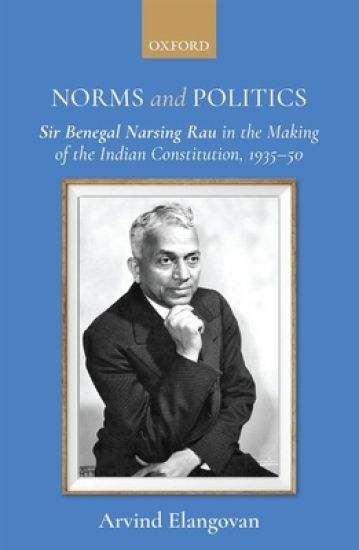
Norms and Politics

Norms and Politics

Arvind Elangovan

OUP India
2019
sidottu
At the twilight of the British rule in India, a little known civil servant, Sir Benegal Narsing Rau (1887-1953) was sought after by the ruling elites - both British and Indian, for his immense knowledge of the nature and working of the constitutions of the world as well as his reputation for being just and impartial between competing political interests. Yet, Rau's ideas and his voice have largely been forgotten today. By examining Rau's constitutional ideas and following its trajectory in late colonial Indian politics, this book shows how the process of the making of the Indian constitution was actually never separated from the politics of conflict that dominated this period. This book demonstrates that it is only by foregrounding this political history that we can simultaneously remember Rau's critical contributions as well as understand why he was forgotten in the first place.
Religion and the Specter of the West

Religion and the Specter of the West

Arvind-Pal S. Mandair

Columbia University Press
2009
sidottu
Arguing that intellectual movements, such as deconstruction, postsecular theory, and political theology, have different implications for cultures and societies that live with the debilitating effects of past imperialisms, Arvind Mandair unsettles the politics of knowledge construction in which the category of "religion" continues to be central. Through a case study of Sikhism, he launches an extended critique of religion as a cultural universal. At the same time, he presents a portrait of how certain aspects of Sikh tradition were reinvented as "religion" during the late nineteenth and early twentieth centuries. India's imperial elite subtly recast Sikh tradition as a sui generis religion, which robbed its teachings of their political force. In turn, Sikhs began to define themselves as a "nation" and a "world religion" that was separate from, but parallel to, the rise of the Indian state and global Hinduism. Rather than investigate these processes in isolation from Europe, Mandair shifts the focus closer to the political history of ideas, thereby recovering part of Europe's repressed colonial memory. Mandair rethinks the intersection of religion and the secular in discourses such as history of religions, postcolonial theory, and recent continental philosophy. Though seemingly unconnected, these discourses are shown to be linked to a philosophy of "generalized translation" that emerged as a key conceptual matrix in the colonial encounter between India and the West. In this riveting study, Mandair demonstrates how this philosophy of translation continues to influence the repetitions of religion and identity politics in the lives of South Asians, and the way the academy, state, and media have analyzed such phenomena.
Religion and the Specter of the West

Religion and the Specter of the West

Arvind-Pal S. Mandair

Columbia University Press
2016
pokkari
Arguing that intellectual movements, such as deconstruction, postsecular theory, and political theology, have different implications for cultures and societies that live with the debilitating effects of past imperialisms, Arvind Mandair unsettles the politics of knowledge construction in which the category of "religion" continues to be central. Through a case study of Sikhism, he launches an extended critique of religion as a cultural universal. At the same time, he presents a portrait of how certain aspects of Sikh tradition were reinvented as "religion" during the late nineteenth and early twentieth centuries. India's imperial elite subtly recast Sikh tradition as a sui generis religion, which robbed its teachings of their political force. In turn, Sikhs began to define themselves as a "nation" and a "world religion" that was separate from, but parallel to, the rise of the Indian state and global Hinduism. Rather than investigate these processes in isolation from Europe, Mandair shifts the focus closer to the political history of ideas, thereby recovering part of Europe's repressed colonial memory. Mandair rethinks the intersection of religion and the secular in discourses such as history of religions, postcolonial theory, and recent continental philosophy. Though seemingly unconnected, these discourses are shown to be linked to a philosophy of "generalized translation" that emerged as a key conceptual matrix in the colonial encounter between India and the West. In this riveting study, Mandair demonstrates how this philosophy of translation continues to influence the repetitions of religion and identity politics in the lives of South Asians, and the way the academy, state, and media have analyzed such phenomena.
The Philosophy of Religion and Advaita Vedanta

The Philosophy of Religion and Advaita Vedanta

Arvind Sharma

Pennsylvania State University Press
1995
pokkari
Philosophy of religion, as we know it today, emerged in the West and has been shaped by Western philosophical and theological trends, while the philosophical tradition of India flowed along its own course until the late nineteenth century, when active, if tentative, contact was established between the West and the East. This book provides a definite focus to this interaction by investigating issues raised in Western philosophy of religion from the perspective of Advaita Vedanta, the influential school of Indian thought. In promoting the emergence of a cross-cultural philosophy of religion, Arvind Sharma focuses on John H. Hick and his well-known work The Philosophy of Religion as representative of modern Western philosophy of religion, and on Sankara, along with his modern successors such as M. Hiriyanna and S. Radhakrishnan, as representative of Advaita Vedanta.
Part of the Problem, Part of the Solution

Part of the Problem, Part of the Solution

Arvind Sharma

Praeger Publishers Inc
2008
sidottu
Part of the Problem, Part of the Solution unleashes religion's true potential to do good by bridging the modern divide between religion and an ever pervasive secular society, a notion often loathed by individuals on both sides of the religious aisle. As noted scholars such as Huston Smith, Karen Armstrong, Rosemary Radford Reuther, Harvey Cox, and Seyyed Hossein Nasr explain throughout the conversations related in this text, people of varied and conflicting faiths can come together to engage in civil, useful dialogue, and members of quite varied religious traditions can work together for the benefit of all humankind and can help defuse the world's current epidemic of violence. By showing how religion is an instrument in human affairs that can be tuned for both good and evil, this book lays the groundwork for an important cooperative effort to blossom. Furthermore, today's trend of associating all religion with suspicion has spiraled into a dangerous situation-that in discarding all religion because some of it causes harm, one risks throwing away the baby with the bathwater. Books such as When Religion Becomes Evil by Charles Kimball, The God Delusion by Richard Dawkins, The End of Faith by Sam Harris, Breaking the Spell: Religion as a Natural Phenomenon by Daniel Dennett, and God is Not Great: How Religion Poisons Everything by Christopher Hitchens have created quite a sensation, leaving the impression that religion, at its root, brings more heartache than handshakes. This development has dismayed many scholars, students, and practitioners of religion, of all faiths, who believe that only half the story-the negative half-is being told. Although demonstrating that certain religious beliefs have surely contributed to the violence that has occurred in this century, this book also explores how other religious teachings can help solve the epidemic of violence.
Hindu Narratives on Human Rights

Hindu Narratives on Human Rights

Arvind Sharma

Praeger Publishers Inc
2009
sidottu
This pioneering work examines the existing understanding of Hinduism in relation to human rights discourse. Written by a leading Hindu scholar, Hindu Narratives on Human Rights is organized around specific rights, such as the right to own property, the rights of children, women's rights, and animal rights. Within these categories and in light of the questions they raise, the book provides a guided tour of Hindu narratives on ethics, ranging from the famous religious epics, the Mahabharata and the Ramayana, to various forms of secular literature drawn from almost a thousand years of Indic civilization. The realization that Hindu ethical discourse is narrative rather than propositional is a relatively recent one. Hence, the prevailing tendency in the West has been to overlook it in the context of the discussion of human rights. This book was written to correct that oversight. It shows that the presence of the universal in the particular in Hindu stories is a key to understanding Hindu thinking about human rights—and it indicates ways in which Hindu ethical discourse can interact creatively with modern human rights discourse.
Clinical Microbiology for the General Dentist, An Issue of Dental Clinics of North America

Clinical Microbiology for the General Dentist, An Issue of Dental Clinics of North America

Arvind Babu Rajendra Santosh; Orrett E. Ogle

Elsevier - Health Sciences Division
2017
sidottu
This issue of Dental Clinics of North America focuses on Clinical Microbiology for the General Dentist, and is edited by Drs. Orrett Ogle and Arvind Babu Rajendra Santosh. Articles will include: Clinical microbiology for the dentist; Normal oral flora and the oral ecosystem; Bacterial, viral and fungal infections of the oral cavity; Odontogenic infections: clinical and microbiological evaluation, diagnosis, treatment and prevention; Osteomyelitis: clinical and microbiological evaluation, diagnosis, treatment and prevention; Periodontal infections; Epidemiology of oral microbial infections; Bacterial infections in oral cavity; Fungal infections in oral cavity; Viral infections in oral cavity; Immunization recommendations for the oral health professionals; Opportunistic infections in oral cavity; Microbial carcinogenesis: HPV, HIV, KSV, and EBV; Recent recommendations of HIV treatment; and more!
God, Truth and Reality

God, Truth and Reality

Arvind Sharma

Palgrave Macmillan
1992
sidottu
All arts and sciences, in their own way, ultimately try to come to grips with reality. What sets philosophy, theology and religion apart is that they grapple with ultimate reality. Over the decades spanned by John Hick's life, in the course of this grappling (reminiscent of Jacob's nocturnal encounter with the angel) philosophy became analytic, theology dialogical and religion comparative along one line of development. In these essays, written in honour of Professor Hick, leading world scholars in these fields share their most recent insights. They are, so to speak, postcards from the cutting edge.
When Will You Break?

When Will You Break?

Arvind Ahuja; Kusum Ahuja

Lulu.com
2018
pokkari
This is a fictional story of Karimi's trials and tribulations, love and loss. Join Karimi in his journey across beautiful mountains and magnificent seas of the African Continent as he escapes from oppression, ethnic cleansing, corrupt power-hungry politicians and sultry sirens who are comfortable using their bodies to achieve their goals. Surviving with a never-say-die spirit, and from unexpected people, when all seemed lost.
The Structured Credit Handbook

The Structured Credit Handbook

Arvind Rajan; Glen McDermott; Ratul Roy

John Wiley Sons Inc
2007
sidottu
The Structured Credit Handbook is a comprehensive introduction to all types of credit-linked financial instruments. This book provides state-of-the-art primers on single tranche collateralized debt obligations (CDOs), collateralized loan obligations (CLOs), credit derivatives (such as credit default swaps and swaptions), and iBoxx indexes. Filled with in-depth insight and expert advice, The Structured Credit Handbook covers all aspects of the synthetic arbitrage CDO market, including new instruments such as CDO2. Readers will also gain a firm understanding of the investment rationale, risks, and rewards associated with CDO investments through this valuable resource. The exploding use of credit derivatives and collateralized debt obligations (CDOs) has transformed the world of credit, creating an $18 trillion market almost overnight and resulting in innumerable investment and career opportunities globally. The Structured Credit Handbook provides the reader with a comprehensive and clear roadmap to today's new credit landscape. The full spectrum of structured credit products, from single-name CDS to CDOs, is explained in a simple, clear fashion that is free from the financial jargon and mathematical complexity which characterize many other derivative texts. The handbook begins with an in-depth explanation of the building blocks of the structured credit markets, single-name default swaps and indexes, and it culminates with complex products such as credit options, synthetic tranches, CDOs based on bank loans and asset-backed securities, and CDO-squareds. Written by experienced practitioners who have participated in this market since its infancy, each of the thirteen chapters introduces and analyzes a new product and explains its practical applications. A rich set of real-life case studies illustrate the application of each product in a concrete market setting. The book may be used in a semester-long course on structured credit as part of a business or finance curriculum. Whether you are a market professional, a university student or faculty member, or simply a financially savvy layperson, look no further for an up-to-date and thorough introduction to this rapidly growing and exciting field. Dr. Arvind Rajan, Managing Director, Citigroup Global Markets, is engaged in proprietary trading of Structured Credit products, and until recently, was global head of Structured Credit Research and Strategy at Citigroup. Glen McDermott (New York, NY) is Director of Fixed Income Sales and the former head of CDO Research at Citigroup Global Markets Inc. Ratul Roy is head of CDO Strategy for Citigroup Global Markets and has spent the prior nine years in structuring or analyzing CDOs and other structured credit products.
Parametric Sensitivity in Chemical Systems

Parametric Sensitivity in Chemical Systems

Arvind Varma; Massimo Morbidelli; Hua Wu

Cambridge University Press
2005
pokkari
The behavior of a chemical system is affected by many physicochemical parameters. The sensitivity of the system's behavior to changes in parameters is known as parametric sensitivity. When a system operates in a parametrically sensitive region, its performance becomes unreliable and changes sharply with small variations in parameters. Thus, it would be of great value to predict sensitivity behavior in chemical systems. This book is the first to provide a thorough treatment of the concept of parametric sensitivity and the mathematical tool it generated, sensitivity analysis. The emphasis is on applications to real situations. The book begins with definitions of various sensitivity indices and describes the numerical techniques used for their evaluation. Extensively illustrated chapters discuss sensitivity analysis in a variety of chemical reactors - batch, tubular, continuous-flow, fixed-bed - and in combustion systems, air pollution, and metabolic processes. Chemical engineers, chemists, graduate students, and researchers will welcome this valuable resource.
Politics after Television

Politics after Television

Arvind Rajagopal

Cambridge University Press
2001
sidottu
In January 1987, the Indian state-run television began broadcasting a Hindu epic in serial form, The Ramayana, to nationwide audiences, violating a decades-old taboo on religious partisanship. What resulted was the largest political campaign in post-independence times, around the symbol of Lord Ram, led by Hindu nationalists. The complexion of Indian politics was irrevocably changed thereafter. In this book, Arvind Rajagopal analyses this extraordinary series of events. While audiences may have thought they were harking back to an epic golden age, Hindu nationalist leaders were embracing the prospects of neoliberalism and globalisation. Television was the device that hinged these movements together, symbolising the new possibilities of politics, at once more inclusive and authoritarian. Simultaneously, this study examines how the larger historical context was woven into and changed the character of Hindu nationalism.
Bitcoin and Cryptocurrency Technologies

Bitcoin and Cryptocurrency Technologies

Arvind Narayanan; Joseph Bonneau; Edward Felten; Andrew Miller; Steven Goldfeder

PRINCETON UNIVERSITY PRESS
2016
sidottu
Bitcoin and Cryptocurrency Technologies provides a comprehensive introduction to the revolutionary yet often misunderstood new technologies of digital currency. Whether you are a student, software developer, tech entrepreneur, or researcher in computer science, this authoritative and self-contained book tells you everything you need to know about the new global money for the Internet age. How do Bitcoin and its block chain actually work? How secure are your bitcoins? How anonymous are their users? Can cryptocurrencies be regulated? These are some of the many questions this book answers. It begins by tracing the history and development of Bitcoin and cryptocurrencies, and then gives the conceptual and practical foundations you need to engineer secure software that interacts with the Bitcoin network as well as to integrate ideas from Bitcoin into your own projects. Topics include decentralization, mining, the politics of Bitcoin, altcoins and the cryptocurrency ecosystem, the future of Bitcoin, and more. * An essential introduction to the new technologies of digital currency* Covers the history and mechanics of Bitcoin and the block chain, security, decentralization, anonymity, politics and regulation, altcoins, and much more* Features an accompanying website that includes instructional videos for each chapter, homework problems, programming assignments, and lecture slides* Also suitable for use with the authors' Coursera online course* Electronic solutions manual (available only to professors)
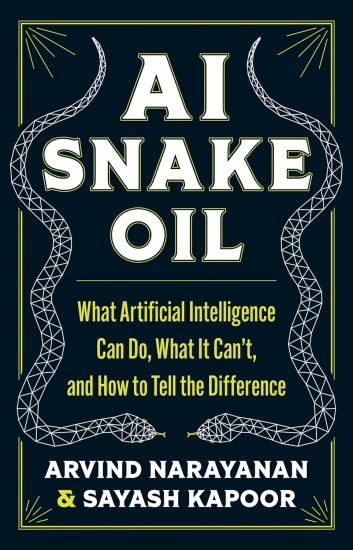
AI Snake Oil

AI Snake Oil

Arvind Narayanan; Sayash Kapoor

PRINCETON UNIVERSITY PRESS
2024
sidottu
From two of TIME’s 100 Most Influential People in AI, what you need to know about AI—and how to defend yourself against bogus AI claims and productsConfused about AI and worried about what it means for your future and the future of the world? You’re not alone. AI is everywhere—and few things are surrounded by so much hype, misinformation, and misunderstanding. In AI Snake Oil, computer scientists Arvind Narayanan and Sayash Kapoor cut through the confusion to give you an essential understanding of how AI works and why it often doesn’t, where it might be useful or harmful, and when you should suspect that companies are using AI hype to sell AI snake oil—products that don’t work, and probably never will.While acknowledging the potential of some AI, such as ChatGPT, AI Snake Oil uncovers rampant misleading claims about the capabilities of AI and describes the serious harms AI is already causing in how it’s being built, marketed, and used in areas such as education, medicine, hiring, banking, insurance, and criminal justice. The book explains the crucial differences between types of AI, why organizations are falling for AI snake oil, why AI can’t fix social media, why AI isn’t an existential risk, and why we should be far more worried about what people will do with AI than about anything AI will do on its own. The book also warns of the dangers of a world where AI continues to be controlled by largely unaccountable big tech companies.By revealing AI’s limits and real risks, AI Snake Oil will help you make better decisions about whether and how to use AI at work and home.
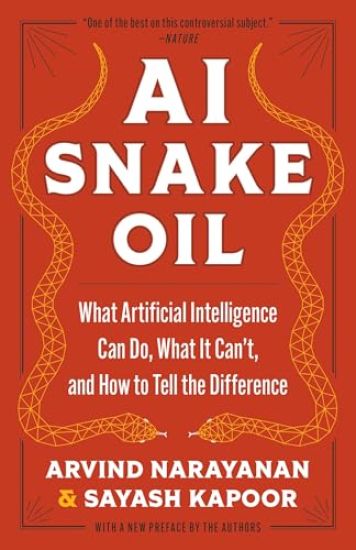
AI Snake Oil

AI Snake Oil

Arvind Narayanan; Sayash Kapoor

PRINCETON UNIVERSITY PRESS
2025
pokkari
From two of TIME’s 100 Most Influential People in AI, what you need to know about AI—and how to defend yourself against bogus AI claims and productsConfused about AI and worried about what it means for your future and the future of the world? You’re not alone. AI is everywhere—and few things are surrounded by so much hype, misinformation, and misunderstanding. In AI Snake Oil, computer scientists Arvind Narayanan and Sayash Kapoor cut through the confusion to give you an essential understanding of how AI works and why it often doesn’t, where it might be useful or harmful, and when you should suspect that companies are using AI hype to sell AI snake oil—products that don’t work, and probably never will.While acknowledging the potential of some AI, such as ChatGPT, AI Snake Oil uncovers rampant misleading claims about the capabilities of AI and describes the serious harms AI is already causing in how it’s being built, marketed, and used in areas such as education, medicine, hiring, banking, insurance, and criminal justice. The book explains the crucial differences between types of AI, why organizations are falling for AI snake oil, why AI can’t fix social media, why AI isn’t an existential risk, and why we should be far more worried about what people will do with AI than about anything AI will do on its own. The book also warns of the dangers of a world where AI continues to be controlled by largely unaccountable big tech companies.By revealing AI’s limits and real risks, AI Snake Oil will help you make better decisions about whether and how to use AI at work and home.
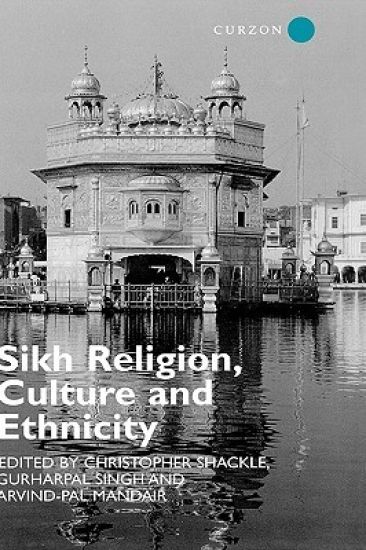
Sikh Religion, Culture and Ethnicity

Sikh Religion, Culture and Ethnicity

Arvind-Pal S. Mandair; Christopher Shackle; Gurharpal Singh

RoutledgeCurzon
2000
sidottu
This book brings together new approaches to the study of Sikh religion, culture and ethnicity being pursued in the diaspora by Sikh academics in western universities in Britain and North America. An important aspect of the volume is the diversity of topics that are engaged - including film and gender theory, theology, hermeneutics, deconstruction, semiotics and race theory - and brought to bear on the individual contributors' specialism within Sikh studies, thereby helping to explode previously static dichotomies such as insider vs. outsider or history vs. tradition. The volume should have strong appeal both to an academic market including students of politics, religious studies and South Asian studies, and to a more general English-speaking Sikh readership.
Agrarian Movements in India

Agrarian Movements in India

Arvind N. Das

Routledge
1982
sidottu
First published in 1982. In this volume we present a collection of original papers, edited by Arvind N. Das, on agrarian movements in the populous Indian state of Bihar. These movements are traced from the early twentieth century through to the Naxalite activity of the recent past; their content and the forces which gave rise to them are examined; and the response of the state — both the colonial state and the post-colonial state — is identified. Believed to be a significant contribution to the literature on agrarian movements, which should be of considerable value to both specialists on India and to those with a more general interest in the agrarian question.