Kirjojen hintavertailu. Mukana 12 083 983 kirjaa ja 12 kauppaa.

Kirjahaku

Etsi kirjoja tekijän nimen, kirjan nimen tai ISBN:n perusteella.

1000 tulosta hakusanalla Benjamin Franklin Perry

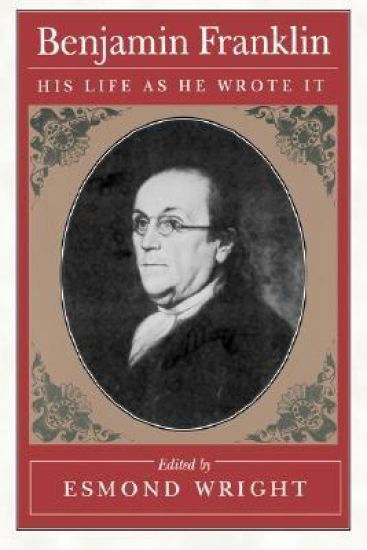
Benjamin Franklin: His Life as He Wrote It
Ever the chronicler and teacher, Franklin wrote an autobiography, ostensibly for his illegitimate son William. Apart from hurried additions when he was in his eighties, his story halts at 1757. Tracing his footsteps centuries later, Franklin's most celebrated biographer completes the last twenty-five years of the autobiography by drawing on Franklin's most personal and insightful letters and writings--even making additions within the interrupted Autobiography to give us the expository memoir that Franklin intended. Indeed, as he wrote it.
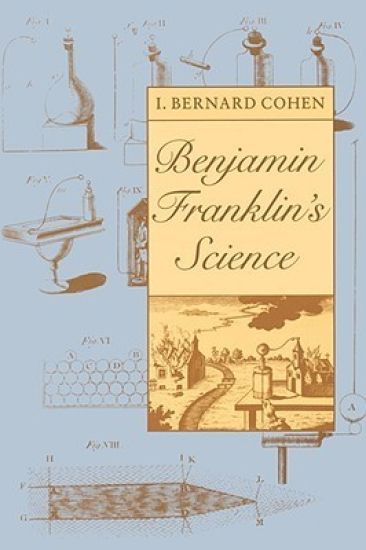
Benjamin Franklin's Science

Benjamin Franklin's Science

I. Bernard Cohen

Harvard University Press
1996
nidottu
Benjamin Franklin is well known to most of us, yet his fundamental and wide-ranging contributions to science are still not adequately understood. Until now he has usually been incorrectly regarded as a practical inventor and tinkerer rather than a scientific thinker. He was elected to membership in the elite Royal Society because his experiments and original theory of electricity had made a science of that new subject. His popular fame came from his two lightning experiments—the sentry-box experiment and the later and more famous experiment of the kite—which confirmed his theoretical speculations about the identity of electricity and provided a basis for the practical invention of the lightning rod. Franklin advanced the eighteenth-century understanding of all phenomena of electricity and provided a model for experimental science in general.I. Bernard Cohen, an eminent historian of science and the principal elucidator of Franklin’s scientific work, examines his activities in fields ranging from heat to astronomy. He provides masterful accounts of the theoretical background of Franklin’s science (especially his study of Newton), the experiments he performed, and their influence throughout Europe as well as the United States. Cohen emphasizes that Franklin’s political and diplomatic career cannot be understood apart from his scientific activities, which established his reputation and brought him into contact with leaders of British and European society. A supplement by Samuel J. Edgerton considers Franklin’s attempts to improve the design of heating stoves, another practical application that arose from theoretical interests.This volume will be valuable to all readers wanting to learn more about Franklin and to gain a deeper appreciation of the development of science in America.
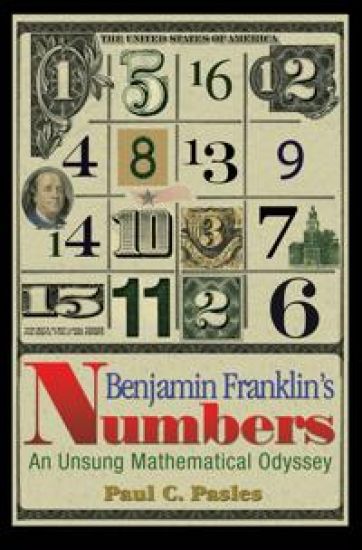
Benjamin Franklin's Numbers

Benjamin Franklin's Numbers

Paul C. Pasles

Princeton University Press
2007
sidottu
Few American lives have been as celebrated--or as closely scrutinized--as that of Benjamin Franklin. Yet until now Franklin's biographers have downplayed his interest in mathematics, at best portraying it as the idle musings of a brilliant and ever-restless mind. In Benjamin Franklin's Numbers, Paul Pasles reveals a side of the iconic statesman, scientist, and writer that few Americans know--his mathematical side. In fact, Franklin indulged in many areas of mathematics, including number theory, geometry, statistics, and economics. In this generously illustrated book, Pasles gives us the first mathematical biography of Benjamin Franklin. He draws upon previously unknown sources to illustrate Franklin's genius for numbers as never before. Magic squares and circles were a lifelong fascination of Franklin's. Here, for the first time, Pasles gathers every one of these marvelous creations together in one place. He explains the mathematics behind them and Franklin's hugely popular Poor Richard's Almanac, which featured such things as population estimates and a host of mathematical digressions. Pasles even includes optional math problems that challenge readers to match wits with the bespectacled Founding Father himself. Written for a general audience, this book assumes no technical skills beyond basic arithmetic. Benjamin Franklin's Numbers is a delightful blend of biography, history, and popular mathematics. If you think you already know Franklin's story, this entertaining and richly detailed book will make you think again.
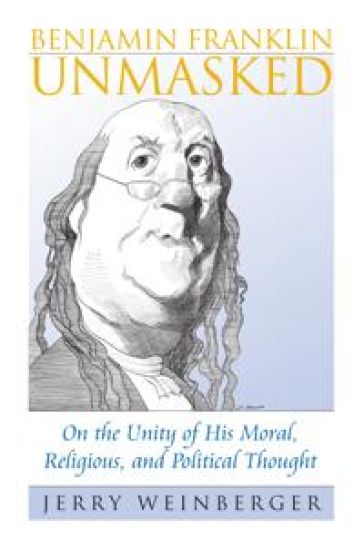
Benjamin Franklin Unmasked

Benjamin Franklin Unmasked

Jerry Weinberger

University Press of Kansas
2005
sidottu
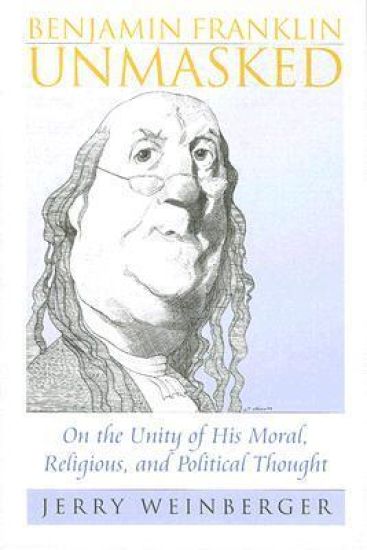
Moral paragon, public servant, founding father; scoundrel, opportunist, womanizing phony: There are many Benjamin Franklins. Now, as we celebrate the tercentenary of Franklin's birth, Jerry Weinberger reveals the Franklin behind the many masks and shows that the real Franklin was far more remarkable than anyone has yet discovered. Taking the Autobiography as the key to Franklin's thought, Weinberger argues that previous assessments have not yet probed to the bottom of Ben's famous irony and elusiveness. While others take the self-portrait as an elder statesman's relaxed and playful retrospection, Weinberger unveils it as the window to Franklin's deepest reflections on God, virtue, justice, equality, natural rights, love, the good life, the modern technological project, and the place and limits of reason in politics and human experience. Along the way, Weinberger explores Franklin's ribald humor, usually ignored or toned down by historians and critics, and shows it to be charming - and philosophic. Following Franklin's rhetorical twists and turns, Weinberger discovers a serious thinker who was profoundly critical of religion, moral virtue, and political ideals and whose grasp of human folly constrained his hopes for enlightenment and political reform. This close and amusing reading of Franklin portrays a scrupulous dialectical philosopher, humane and wise, but more provocative and disturbing than even the most hardboiled interpreters have taken Franklin to be - a freethinking critic of Enlightenment freethinking, who played his moral and theological cards very close to the vest. Written for general readers who want to delve more deeply into the mind of a great man and great American, ""Benjamin Franklin Unmasked"" shows us a massively powerful intellect lurking behind the leather-apron countenance. This lively, witty, and revelatory book is indispensable for those who want to meet the real Franklin.
Benjamin Franklin Unmasked

Benjamin Franklin Unmasked

Jerry Weinberger

University Press of Kansas
2005
nidottu
Reveals the Benjamin Franklin behind the many masks and shows that the real Franklin was far more remarkable than anyone has yet discovered. The author shows us a powerful intellect lurking behind the leather-apron countenance. This lively, witty, and revelatory book is written for readers who want to delve into the mind of this great man.
The Autobiography of Benjamin Franklin

The Autobiography of Benjamin Franklin

Benjamin Franklin; Lewis (INT) Leary

Simon Schuster
2003
pokkari
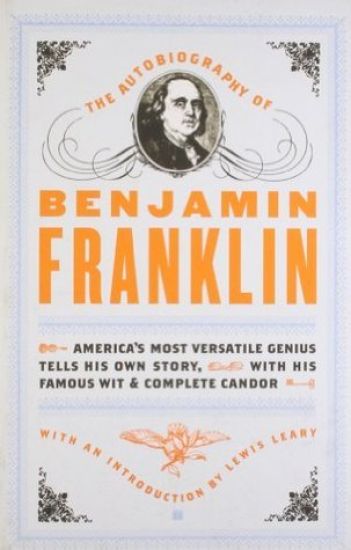
Written initially to guide his son, Benjamin Franklin's autobiography is a lively, spellbinding account of his unique and eventful life, now a classic of world literature that is sure to inspire and delight readers everywhere. Few men could compare to Benjamin Franklin. Virtually self-taught, he excelled as an athlete, a man of letters, a printer, a scientist, a wit, an inventor, an editor, and a writer, and he was probably the most successful diplomat in American history. David Hume hailed him as the first great philosopher and great man of letters in the New World.
Benjamin Franklin and the Birth of America

Benjamin Franklin and the Birth of America

Stacy Schiff

Bloomsbury Publishing PLC
2006
nidottu
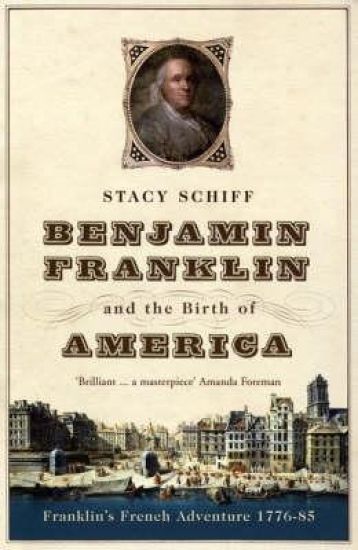
Six months after America declared her independence, Congress dispatched Benjamin Franklin to France to solicit aid and arms for the upcoming fight. He was seventy years old, possessed of the most rudimentary French and had no diplomatic training. But this most remarkable of envoys was also among the most famous men in the world. During his eight years in Paris he charmed the French, outwitted the British spies and stirred a passion for a republic in those who lived under an absolute monarchy. Stacy Schiff tells a tale of international intrigue and from it emerges an intimate portrait of a brilliant man, as well as a sense of the fragility and improvisation of his country's bid for independence.
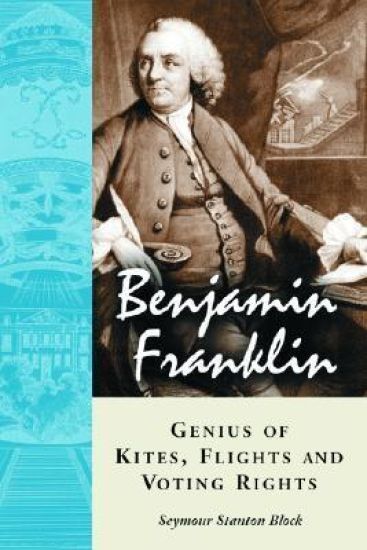
Benjamin Franklin, Genius of Kites, Flights and Voting Rights
This unconventional biography of Benjamin Franklin, the great American Renaissance man, explores examples of Franklin's diverse genius and accomplishments in different fields. Among the topics explored are Franklin's views on women's issues, such as disapproving of impractical hoopskirts, supporting their education, and suggesting insurance for widows and spinsters. It describes his love of a good hoax, contributions to ballooning while an ambassador in France, experiments with the famous kite, and advances in heating houses. His work with money is also covered, including methods of printing money to confuse counterfeiters, a revolutionary way of making a print of a real leaf, and his updated portrait on the present $100 bill. Franklin's role as head of a commission to examine (and debunk) mesmerism is addressed. No stranger to controversy, Franklin headed the first successful attempt to unify the colonies to create a country. This work shows that Franklin is more responsible than any other for the founding of the United States--and also that he was a leading cause of the French Revolution, providing the French with an example of a successful rebellion, lessons on how to shift power from the king, and ideas about erecting a constitutional government (in addition, he weakened the French royal treasury by extracting loans and gifts to support America).
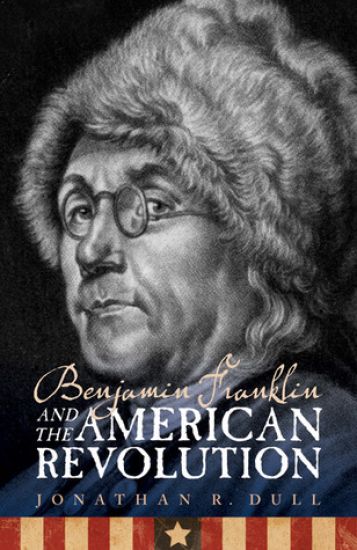
Benjamin Franklin and the American Revolution
The inventor, the ladies' man, the affable diplomat, and the purveyor of pithy homespun wisdom: we all know the charming, resourceful Benjamin Franklin. What is less appreciated is the importance of Franklin's part in the American Revolution: except for Washington he was its most irreplaceable leader. Although aged and in ill health, Franklin served the cause with unsurpassed zeal and dedication. Jonathan R. Dull, whose decades of work on The Papers of Benjamin Franklin have given him rare insight into his subject, explains Franklin's role in the Revolution, what prepared him for that role, and what motivated him. The Franklin presented here, a man immersed in the violence, danger, and suffering of the Revolution, is a tougher person than the Franklin of legend. Dull's portrait captures Franklin's confidence and self-righteousness about himself and the American cause. It shows his fanatical zeal, his hatred of King George III and George's American supporters (particularly Franklin's own son), and his disdain for hardship and danger. It also shows a side of Franklin that he tried to hide: his vanity, pride, and ambition. Though not as lovable and avuncular as the person of legend, this Franklin is more interesting, more complex, and in many ways more impressive.
Benjamin Franklin's Letters to the Press, 1758-1775

Benjamin Franklin's Letters to the Press, 1758-1775

The University of North Carolina Press
2012
nidottu
This collection of Franklin's political writings contains more than double the number previously recognized as his. Much of this writing was performed during the intensive press campaigns for repeal by parliament of obnoxious measures, such as the Stamp Act and Townshend Acts. His letters reveal the adjustment he was making in his private ideas of British empire and American rights.Originally published in 1950.A UNC Press Enduring Edition -- UNC Press Enduring Editions use the latest in digital technology to make available again books from our distinguished backlist that were previously out of print. These editions are published unaltered from the original, and are presented in affordable paperback formats, bringing readers both historical and cultural value.
Benjamin Franklin and Polly Baker

Benjamin Franklin and Polly Baker

Hall Max

The University of North Carolina Press
2012
nidottu
Hall has made the first detailed investigation of Polly Baker. It leads through the exciting world of eighteenth-century journalism, literature, and statecraft. Ben Franklin occupies a position in the story second only to Polly Baker herself. Evident throughout is the tendency of people, even in an age of enlightenment, to believe what they see--provided they see it in print.Originally published in 1960.A UNC Press Enduring Edition -- UNC Press Enduring Editions use the latest in digital technology to make available again books from our distinguished backlist that were previously out of print. These editions are published unaltered from the original, and are presented in affordable paperback formats, bringing readers both historical and cultural value.
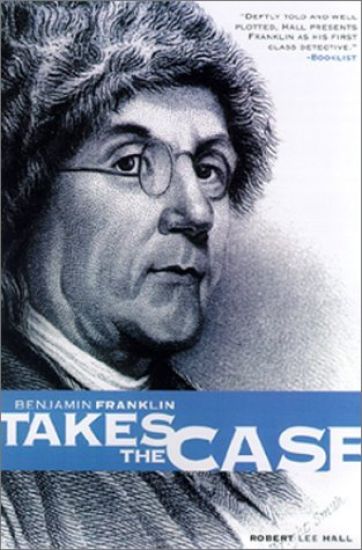
Benjamin Franklin Takes the Case

Benjamin Franklin Takes the Case

Robert Lee Hall

UNIVERSITY OF PENNSYLVANIA PRESS
2001
nidottu
More than ten years ago, Robert Lee Hall made a startling discovery. Within a secret compartment of an old armoire once owned by his great aunt, he found a yellowing manuscript describing a series of mysterious criminal cases. What made these stories so unusual was that they were solved by the renowned scientist and statesman, Benjamin Franklin, while he was a resident of London to plead the case of the American colonies before the British crown. Written by Hall's ancestor, Nick Handy, who happened to be Franklin's assistant throughout these adventures, Hall transcribed the tales and presented them in the order of their occurrence. In Benjamin Franklin Takes the Case, the first mystery in Hall's series, the great Doctor Franklin meets the young orphan Nick Handy in the print shop of an old friend. When his friend is suddenly murdered, it is up to Franklin and Nick to prove who was responsible for the grisly deed. Turning detective, Franklin pursues the strange case along the dark byways of London and into its grand houses, uncovering a theft ring, a profitable trade in slaves and prostitutes, and strong reasons to believe that Nick is in grave danger. Employing his keen sense of scientific observation and his inventor's creative mind, the doctor is able to solve a case that the constables had thought would be impossible to break.
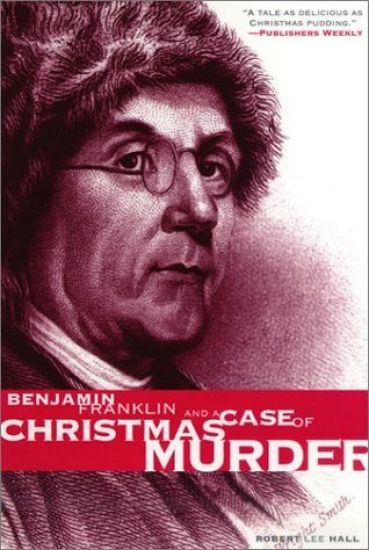
Benjamin Franklin and a Case of Christmas Murder

Benjamin Franklin and a Case of Christmas Murder

Robert Lee Hall

UNIVERSITY OF PENNSYLVANIA PRESS
2001
nidottu
In the second case recorded by Benjamin Franklin's young charge and assistant Nick Handy, the great Doctor Franklin is confronted with a shocking event. While attending a mummers' play at the home of a popular merchant Roddy Fairbrass on Christmas Eve 1757, their host suddenly collapses and dies. Although the bereaved family denies it, Franklin is convinced that he has witnessed a murder. Franklin had been to the Fairbrass home one time before to investigate the report of a ghost and now believes that there must be some sinister connection between the two events. Determined to uncover the truth, the intrepid inventor and statesman, accompanied by Nick, unravels a tangled plot of intrigue and scandal while matching wits with some of London's most notorious criminal minds.
Benjamin Franklin Bache and the Philadelphia "Aurora"

Benjamin Franklin Bache and the Philadelphia "Aurora"

James Tagg

University of Pennsylvania Press
1991
sidottu
This is the first modern biography of Benjamin Franklin Bache, the grandson of Benjamin Franklin. Between the turbulent years of 1793 and 1798, Bache was the young nation's leading political journalist and a sharp critic of the Federalists and their policies. As editor of the most important radical newspaper of the 1790s, he lived at the center of most of the political storms of that decade. He defended the Democratic Societies as the earliest vehicles of public opinion; he strenuously opposed the ratification of the Jay Treaty, the central political event of the decade; he led and orchestrated the attack on George Washington in an attempt to curb growing executive authority; and his defense of French policies contributed to the sedition crisis of 1798. A primary target of the Federalist-sponsored Sedition Act, he was indicted for federal common law seditious libel before that act took effect. In 1798, at the height of the political hysteria, Bache died of yellow fever at the age of twenty-nine. Like Thomas Paine, to whom Bache was personally and ideologically connected, Bache was not a product of Whig Oppositionist or classical republican ideology. Yet neither was he an inheritor of a more thoroughly modem liberal ideal. Committed to rational self -interest, he promoted a civic vision and only partially embraced the newer world of nascent capitalism. James Tagg establishes the ideological and psychological framework of Bache's later radicalism by carefully examining Bache's childhood at Passy with his grandfather, his education in Geneva, and his adolescence in Philadelphia. Benjamin Franklin Bache and the Philadelphia Aurora will interest scholars and students of American history.
Benjamin Franklin - American Writers 19

Benjamin Franklin - American Writers 19

Hornberger Theodore

UNIVERSITY OF MINNESOTA PRESS
1962
nidottu
Benjamin Franklin - American Writers 19 was first published in 1962. Minnesota Archive Editions uses digital technology to make long-unavailable books once again accessible, and are published unaltered from the original University of Minnesota Press editions.