

Kirjahaku
Etsi kirjoja tekijän nimen, kirjan nimen tai ISBN:n perusteella.
1000 tulosta hakusanalla Blake Butler

Twenty-Seven Drawings by William Blake
William Blake; Carl J Smalley
Anson Street Press
2025
pokkari
The history and philosophy of scientific ideas and the role poiesis and imagination play in our understanding of science and progress are widely explored in this book. By examining the views of William Blake and other poets in the context of twentieth-century philosophers Hannah Arendt, Jacob Bronowski, Martin Heidegger, Bruno Latour and Karl Popper, amongst others, the book takes an eclectic approach drawing on examples from biology, history, literature, philosophy and economics, arguing for the reestablishment of imagination as a central attribute of science that may help to resolve some of our most pressing ecological problems as seen in the context of science and technology studies and what is loosely developing into the discipline of environmental humanities.Today, influential scientists looking at consciousness dismiss imagination regarding it at best as a mere epiphenomenon, a ghost in the machine, or at worst non-existent and to be denied. In this book, Keith G. Davies, who sees C. P. Snow’s debate on the separation of the arts and sciences as alive and well, traces the schism back to Plato but more importantly to the seventeenth century and David Hume’s removal of imagination in the conjunction between our observation of causes and their effects. Through extensive research and use of poetry, this book offers an alternate understanding of science with imagination and its continued significance in today’s world.This book is an excellent reference book for postgraduate students, professional researchers, William Blake scholars and the pejoratively labelled interested laymen with concerns in ecology and environmental humanities through offering a new perspective on the history of science and the role of imagination within this field.
The history and philosophy of scientific ideas and the role poiesis and imagination play in our understanding of science and progress are widely explored in this book. By examining the views of William Blake and other poets in the context of twentieth-century philosophers Hannah Arendt, Jacob Bronowski, Martin Heidegger, Bruno Latour and Karl Popper, amongst others, the book takes an eclectic approach drawing on examples from biology, history, literature, philosophy and economics, arguing for the reestablishment of imagination as a central attribute of science that may help to resolve some of our most pressing ecological problems as seen in the context of science and technology studies and what is loosely developing into the discipline of environmental humanities.Today, influential scientists looking at consciousness dismiss imagination regarding it at best as a mere epiphenomenon, a ghost in the machine, or at worst non-existent and to be denied. In this book, Keith G. Davies, who sees C. P. Snow’s debate on the separation of the arts and sciences as alive and well, traces the schism back to Plato but more importantly to the seventeenth century and David Hume’s removal of imagination in the conjunction between our observation of causes and their effects. Through extensive research and use of poetry, this book offers an alternate understanding of science with imagination and its continued significance in today’s world.This book is an excellent reference book for postgraduate students, professional researchers, William Blake scholars and the pejoratively labelled interested laymen with concerns in ecology and environmental humanities through offering a new perspective on the history of science and the role of imagination within this field.
Despite the fact that William Blake summarises the plot of Visions of the Daughters of Albion (1793) in just eight lines in the prefatory ‘Argument,’ there are several contentious moments in the poem which continue to cause debate. Critics read Oothoon’s call to Theotormon’s eagles and her offer to catch girls of silver and gold as either evidence of her rape-damaged psyche or confirmation of her selfless love which transcends her socio-sexual state. How do we reconcile the attack of Theotormon’s eagles and the wanton play of the girls with Oothoon’s articulate and highly sophisticated expressions of spiritual truth and free love?In William Blake’s Divine Love: Visions of Oothoon, Joshua Schouten de Jel explores the hermeneutical possibilities of Oothoon’s self-annihilation and the epistemological potential of her visual copulation by establishing an artistic and hagiographical heritage which informs the pictorial representation and poetic pronunciation of Oothoon’s enlightened entelechy. Working with Michelangelo’s The Punishment of Tityus (1532) and Gian Lorenzo Bernini’s Ecstasy of Saint Teresa (1647–51), Oothoon’s ecstatic figuration reflects two iconographic traditions which, framed by the linguistic tropes of divine love expressed within a female-centred mystagogy, reveal the soteriological significance of Oothoon’s willing self-sacrifice.
Despite the fact that William Blake summarises the plot of Visions of the Daughters of Albion (1793) in just eight lines in the prefatory ‘Argument,’ there are several contentious moments in the poem which continue to cause debate. Critics read Oothoon’s call to Theotormon’s eagles and her offer to catch girls of silver and gold as either evidence of her rape-damaged psyche or confirmation of her selfless love which transcends her socio-sexual state. How do we reconcile the attack of Theotormon’s eagles and the wanton play of the girls with Oothoon’s articulate and highly sophisticated expressions of spiritual truth and free love?In William Blake’s Divine Love: Visions of Oothoon, Joshua Schouten de Jel explores the hermeneutical possibilities of Oothoon’s self-annihilation and the epistemological potential of her visual copulation by establishing an artistic and hagiographical heritage which informs the pictorial representation and poetic pronunciation of Oothoon’s enlightened entelechy. Working with Michelangelo’s The Punishment of Tityus (1532) and Gian Lorenzo Bernini’s Ecstasy of Saint Teresa (1647–51), Oothoon’s ecstatic figuration reflects two iconographic traditions which, framed by the linguistic tropes of divine love expressed within a female-centred mystagogy, reveal the soteriological significance of Oothoon’s willing self-sacrifice.
Challenging the idea that a writer’s work reflects his experiences in time and place, Andrew M. Cooper locates the action of William Blake’s major illuminated books in the ahistorical present, an impersonal spirit realm beyond the three-dimensional self. Blake, Cooper shows, was a formalist who exploited eighteenth-century scientific and philosophical research on vision, sense, and mind for spiritual purposes. Through irony, dialogism, two-way syntax, and synesthesia, Blake extended and refined the prophetic method Milton forged in Paradise Lost to bring the performativity of traditional oral song and storytelling into print. Cooper argues that historicist attempts to place Blake’s vision in perspective, as opposed to seeing it for oneself, involve a deeply self-contradictory denial of his performativity as a poet-artist. Rather, Blake’s expansion of linear reading into a space of creative, self-conscious collaboration laid the basis for his lifelong critique of dualism in religion and science, and anticipated the non-Euclidean geometrics of twentieth-century Modernism.

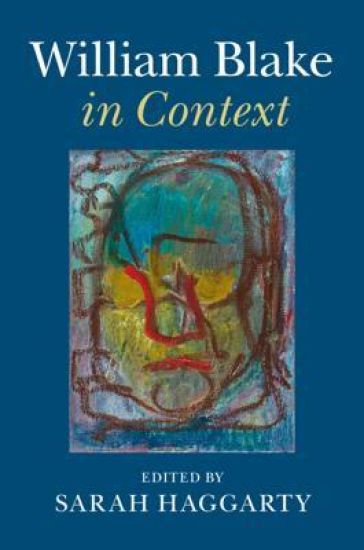
William Blake in Context
Cambridge University Press
2019
sidottu
William Blake, poet and artist, is a figure often understood to have 'created his own system'. Combining close readings and detailed analysis of a range of Blake's work, from lyrical songs to later myth, from writing to visual art, this collection of thirty-eight lively and authoritative essays examines what Blake had in common with his contemporaries, the writers who influenced him, and those he influenced in turn. Chapters from an international team of leading scholars also attend to his wider contexts: material, formal, cultural, and historical, to enrich our understanding of, and engagement with, Blake's work. Accessibly written, incisive, and informed by original research, William Blake in Context enables readers to appreciate Blake anew, from both within and outside of his own idiom.
Originally published in 1949, this book presents a study of William Blake's works and philosophy, focusing particularly on his position in relation to the broader currents of 'English thought'. Illustrative figures and notes are incorporated throughout. This book will be of value to anyone with an interest in Blake's position within the English artistic and literary tradition.
