Kirjahaku
Etsi kirjoja tekijän nimen, kirjan nimen tai ISBN:n perusteella.
1000 tulosta hakusanalla Brian Carson
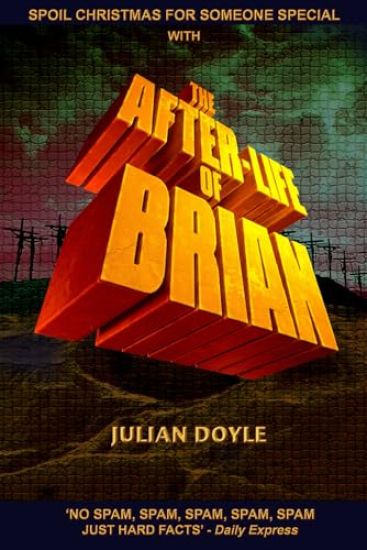
On the 8th November 1979, Monty Python's movie 'Life of Brian' was released to hymn-singing protestors, but went on to break box office records. Exactly 45 years later Julian Doyle the film's editor, threatens to re-ignite the furore. While the Python's treated Jesus with respect, the protestors missed the real reason the Pythons, should have been visited by the Spanish Inquisition and burnt at the stake. Although the Python's were just out to make a comedy, and succeeded as it was voted Britain's top comedy of all time But because they are all well educated individuals they took events in the movie to their logical conclusions. And those conclusions are explosive Even images, like putting skeleton's on crosses, undermines the Jesus story, where they make a cross, Jesus carries it to Golgotha, they dig a hole and nail him up, and after just a few hours, he drops dead, and is taken down. What an incredible waste of time and money to kill a criminal. The idea that every Sabbath, the Romans army took down Jewish criminals is absurd. No, put the criminal on show, to rot in agony till he is a skeleton, that makes total sense. Worse still is the stoning scene. In the Bible Jesus is found guilty by the Jewish Council (the Sanhedrin) and sentenced to death. They then stone him and his body is hung on a tree as demanded by Deuteronomy 21:22. Whoops That is the story in two Jewish documents.(Talmud) No the Gospels say, they don't stone him? But take him to a reluctant Pilate who says: "Take him and judge him by your own law, " (John 18:29) Pilate is quite right, he is no judge of Jewish blasphemy laws. But look at the excuse the Chief Priests make: But we have no right to execute anyone," (John 18:30) What? If there was such a rule how come Pilate does not know about it? And if the Sanhedrin, did stone a blasphemer, what punishment would Pilate inflict? A good spanking ? But forget it, because straight after Jesus death, the Sanhedrin stone Stephen 'The elders dragged Stephen out of the city, and began stoning him (Acts 7) Did anyone complain that the stoning in the movie was wrong? No of course not, because it is so obvious that stoning was not banned by the Romans. So there is something strange about the crucifixion of Jesus, that we discovered when we tried to crucify the Pythons. The movie has Brian in Jerusalem, and so is Jesus, curing lepers there. This is confirmed in John's Gospel that places Jesus in Jerusalem most of the time. BUT we are told Jesus functioned in Galilee and finds his first disciples, Peter and his brother Andrew by the sea of Galilee and they are fishermen who leave their employ on a whim. But this is totally contradicted by John 1:40, which says these same brothers, Peter and Andrew are followers of the Baptist who meet Jesus in Judea where they live. In 'Acts 10:39, Peter is actually reported as saying: 'Now I, and those with me, can witness to everything he did throughout the countryside of Judea and in Jerusalem itself.' Biblical expert, Professor Eisenman confirms: 'A great deal of trouble is taken by these writers to get Jesus to Galilee.' And the answer to all this becomes obvious once you study Brian's Life in the movie. Every scene in the film reveals some tantalizing information to investigate, and it all began when Julian Doyle watched the Python's being crucified in Tunisia, and realized something was seriously wrong with the process. And so began the research that has resulted in this book, that only a very naughty boy, would have dared to write. BEWARE of reviews by people who are not 'verified purchasers' or claim the book was a present. There is a definite attempt to stop the information coming out.

This book analyzes the postmodern foundation of Brian D. McLaren's Kingdom of God theology.

Il 6 maggio 1967 Brian Wilson dichiara che l'album dei Beach Boys Smile, su cui sta lavorando da mesi, stato accantonato. Tre settimane dopo, il 1 giugno, esce Sgt Pepper's dei Beatles che raccoglier tutti i primati, la fama, il posto nella storia che sarebbe potuto essere di Smile. La figura di Brian Wilson e Smile, il capolavoro perduto dei Beach Boys messa a confronto un gruppo di giovani autori, ha generato questa antologia di venti racconti, sorprendenti, intriganti, quanto pu essere un viaggio nel tempo e nelle idee di quaranta anni indietro. Ma si parla anche di realt alternative, di perversioni, di semplici storie d'amore, o della morte di Murry Wilson, padre di Brian, Carl e Dennis. Molti affermano che se Smile fosse uscito nel 1967, opere come Sgt Pepper's o anche lo stesso Dark side of the moon dei Pink Floyd non avrebbero avuto lo stesso impatto e significato. Le emozioni racchiuse in questa antologia, scaturite da un ascolto dell'album ricostruito 45 anni dopo, aiutano a capire perch .

Il 6 maggio 1967 Brian Wilson dichiara che l'album dei Beach Boys Smile, su cui sta lavorando da mesi, stato accantonato. Il disco non uscir . Tre settimane dopo, il 1 giugno, esce Sgt Pepper's dei Beatles che raccoglier tutti i primati, la fama, il posto nella storia che sarebbe potuto essere di Smile. Molti affermano che se Smile fosse uscito nel 1967, opere come Sgt Pepper's o anche lo stesso Dark side of the moon dei Pink Floyd non avrebbero avuto lo stesso impatto e significato. La figura di Brian Wilson e Smile, il capolavoro perduto dei Beach Boys messa a confronto un gruppo di giovani autori, ha generato questa antologia di racconti, sorprendenti, intriganti, quanto pu essere un viaggio nel tempo e nelle idee di quaranta anni indietro, da parte di una generazione nata quando Kurt Cobain moriva.
Letters to Brian is a collection of letters written to the author's imaginary friend.
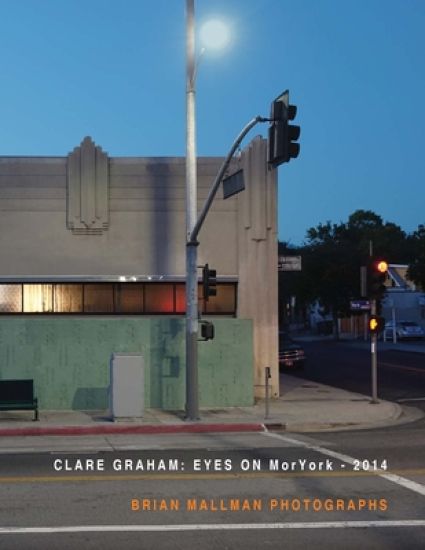
Since 1986, MorYork has been the studio and gallery of Clare Graham and Bob Breen. It continues to evolve. "Eyes on MorYork" is an attempt to have multiple photographers record what the space looks like in 2014, prior to a show at the Craft and Folk Art Museum. The show will be comprised of pieces that normally cohabitate the dense environment of MorYork. Constantly evolving and continually morphing, MorYork is ephemeral, the building continues to live its destiny. These portraits seek to capture moments in its life. These photos were taken by Brian Mallman during 2014, and is Volume 11 in a series of 12 different photographers.
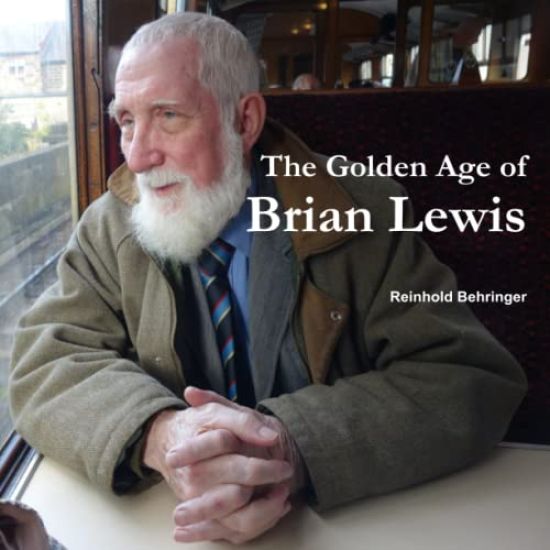
This book is published to honour the artist, poet and publisher Brian Lewis at the occasion of his 80th birthday, which he celebrated on 12 December 2016. It is built from photographs which were taken during the numerous events which Brian had organised in the years 2008 until 2016. These photographs document the wide variety of engagement of Brian in artistic and social endeavours, always including the community and encouraging participation from others and mentoring their contributions in the most positive ways imaginable.

This is a critical study of Friel's entire oeuvre, relating Friel's work to the problems of subjectivity, representation, history and the body, with a view to offering some placement of Friel in relation to both postmodernism and traditional humanism. Central to this study is Friel's concept of 'translation', whereby he offers us the tension of shaping the new through a 'translation' or reformulation of the old.
A Study Guide for Brian Friel's "Dancing at Lughnasa"
Cengage Learning Gale
Gale, Study Guides
2017
pokkari
Step into the life story of a serial killer. He lived through multiple traumatic experiences since he was a young child. He unleashed his rage on the world in a downward spiral leading up to a series of gruesome murders. Detective Jackson records his tale in exchange for a signed confession. Brian refuses to let him stop with the life of another victim on the line. What else could Brian Leroy Lewis have planned?

Brian Friel is Ireland's foremost living playwright, whose work spans fifty years and has won numerous awards, including three Tonys and a Lifetime Achievement Arts Award. Author of twenty-five plays, and whose work is studied at GCSE and A level (UK), and the Leaving Certificate (Ire), besides at undergraduate level, he is regarded as a classic in contemporary drama studies. Christopher Murray's Critical Companion is the definitive guide to Friel's work, offering both a detailed study of individual plays and an exploration of Friel's dual commitment to tradition and modernity across his oeuvre. Beginning with Friel's 1964 work Philadelphia, Here I Come!, Christopher Murray follows a broadly chronological route through the principal plays, including Aristocrats, Faith Healer, Translations, Dancing at Lughnasa, Molly Sweeney and The Home Place. Along the way it considers themes of exile, politics, fathers and sons, belief and ritual, history, memory, gender inequality, and loss, all set against the dialectic of tradition and modernity. It is supplemented by essays from Shaun Richards, David Krause and Csilla Bertha providing varying critical perspectives on the playwright's work.

Brian Friel is Ireland's foremost living playwright, whose work spans fifty years and has won numerous awards, including three Tonys and a Lifetime Achievement Arts Award. Author of twenty-five plays, and whose work is studied at GCSE and A level (UK), and the Leaving Certificate (Ire), besides at undergraduate level, he is regarded as a classic in contemporary drama studies. Christopher Murray offers the definitive guide to Friel's work; both a detailed study of individual plays and an exploration of Friel's dual commitment to tradition and modernity across his oeuvre.Beginning with Friel's 1964 work Philadelphia, Here I Come! it follows a broadly chronological route through the principle plays, including Aristocrats, Faith Healer, Translations, Dancing at Lughnasa, Molly Sweeney and The Home Place. Along the way it considers themes of exile, politics, fathers and sons, belief and ritual, history, memory, gender inequality, and loss, all set against the dialectic of tradition and modernity.