Kirjojen hintavertailu. Mukana 12 016 292 kirjaa ja 12 kauppaa.

Kirjahaku

Etsi kirjoja tekijän nimen, kirjan nimen tai ISBN:n perusteella.

1000 tulosta hakusanalla Clive Riddle

The Riches of Rhyme

The Riches of Rhyme

Clive Scott

Clarendon Press
1988
sidottu
This book is about the ways in which rhyme in French verse produces shapes or interferes with meaning - a topic which, despite its centrality, has hitherto received little critical attention. Part 1 examines those features which are peculiar to French rhyme - the different degrees of rhyme, rhyme gender, the frequency of rhymes on suffixes and endings - and explores the contributions they make to a poem's structure and semantic productivity. Its concern is twofold: to test the adequacy of the current methods of classifying rhymes and to demonstrate how comprehensive interpretations of a poem can be constructed from its rhyme-data. But wider issues are also confronted, including the relationships between rhyme and textuality, between rhyme and truth, between rhyme and rhythm. Part 2 analyses specific plays, poems and collections of poems: Racine's Mithridate, Moliere's Les Femmes Savantes, Voltaire's Poeme sur le Désastre de Lisbonne, Verlaine's Fêtes galantes and Aragon's Les Yeux d'Elsa.
Reading the Rhythm

Reading the Rhythm

Clive Scott

Clarendon Press
1993
sidottu
We are still a long way from knowing how to read the rhythms of free verse, a poetry which has been largely neglected by metrical theory. Clive Scott's readable and scholarly study indicates the strategies of reading needed if justice is to be done to free verse's rhythmic versatility. The core of Reading the Rhythm is an analysis of key French twentieth-century poets and poems, including Perse's Éloges, Cendrars's Prose du Transsibérien, Dix-neuf poèmes élastiques, and Documentaires; Apollinaire's Calligrammes; Supervielle's Gravitations; and Reverdy's Sources de vent. Contemporary trends in the visual arts - Cubism, Futurism, Orphism, photography - are called upon as perceptual models to illuminate free verse and a further perspective is added by the theme of travel and movement. This is an accomplished examination of the rhythms of free verse, and of its implications for our reading of regular verse. It is also a significant study of modernist poetics.
The Poetics of French Verse

The Poetics of French Verse

Clive Scott

Clarendon Press
1998
sidottu
This book explores the expressive resources peculiar to French verse, first through formal discussion of its poetics and then through detailed readings of texts from the seventeenth century to the present. At the same time, it offers a reassessment of the nature of the reading process itself, and makes a case for rescuing a sense of the complex modalities of language from the pressure to interpret. Reading is, above all, the experience of language, and of the self through language, and we should seek ways of preserving these kinds of experience, even though the conventions of critical discourse militate against them. Part Two presents a sequence of thirteen readings (including texts by La Fontaine, Chénier, Vigny, Baudelaire, Mallarmé, Apollinaire, Éluard, Césaire). These readings are grouped according to a set of underlying preoccupations --- formal, acoustic, rhythmic, narratological, etc. --- and each group is prefaced by an introductory discussion of the particular aspect highlighted.
Gendarmes and the State in Nineteenth-Century Europe

Gendarmes and the State in Nineteenth-Century Europe

Clive Emsley

Oxford University Press
1999
sidottu
The history of police and policing have been the subject of much interest and research in recent years, but this book provides the first serious academic exploration of the origins and development of the role of soldier-policemen: the gendarmeries of nineteenth-century Europe. The author presents a detailed account of the French Gendarmeries from the old regime up to the First World War, and looks at the reasons for how and why this model came to be exported across continental Europe in the wake of the Revolutionary and Napoleonic armies. In particular their role is examined within the differing national contexts of Italy, Germany and the Habsburg Empire. The gendarmeries, it is argued, played a significant role in establishing the state, particularly in rural areas. As the physical manifestation of the state, gendarmes carried the state's law and a promise of protection, whilst at the same time ensuring in turn that the state received its annual levies of conscripts and taxes This account fully explores how the organisation and style of nineteenth-century soldier-policing in France developed in such a way that it brought the idea of the state and the state's law to much of twentieth-century continental Europe.
The Improbable Primate

The Improbable Primate

Clive Finlayson

Oxford University Press
2016
nidottu
Taking an ecological approach to our evolution, Clive Finlayson considers the origins of modern humans within the context of a drying climate and changing landscapes. Finlayson argues that environmental change, particularly availability of water, played a critical role in shaping the direction of human evolution, contributing to our spread and success. He argues that our ancestors carved a niche for themselves by leaving the forest and forcing their way into a long-established community of carnivores in a tropical savannah as climate changes opened up the landscape. They took their chance at high noon, when most other predators were asleep. Adapting to this new lifestyle by shedding their hair and developing an active sweating system to keep cool, being close to fresh water was vital. As the climate dried, our ancestors, already bipedal, became taller and slimmer, more adept at travelling farther in search of water. The challenges of seeking water in a drying landscape moulded the minds and bodies of early humans, and directed their migrations and eventual settlements. In this fresh and provocative view of a seven-million-year evolutionary journey, Finlayson demonstrates the radical implications for the interpretation of fossils and technologies and shows that understanding humans within an ecological context provides insights into the emergence and spread of Homo sapiens sapiens worldwide.
Development Policy as Public Finance

Development Policy as Public Finance

Clive Bell

Oxford University Press
2003
sidottu
This work is written out of a conviction that development economics needs to draw more heavily and systematically on recent advances in knowledge made in public economics - especially where the formulation and analysis of development policy are concerned. The central questions - how to raise and spend revenues well, in the sense of promoting development - are surely normative; but whether something is done "well" must also be judged in relation to what is actually feasible. With unrestricted lump-sum transfers ruled out in practice, the design of policy is inherently concerned with considerations of the second-best. This awkward fact besets the analysis of interventions in all areas of economic activity, from international trade to small-scale finance. Debates over whether and how to promote particular sectors or activities at the expense of others, when viewed from this perspective, draw attention away from the humdrum, but decidedly more important goal of raising revenue efficiently and with due regard for equity.
Development Policy as Public Finance

Development Policy as Public Finance

Clive Bell

Oxford University Press
2003
nidottu
This book is written out of a conviction that development economics needs to draw more heavily and systematically on recent advances in knowledge made in public economics, especially where the formulation and analysis of development policy are concerned. The central questions - how to raise and spend revenues well, in the sense of promoting development - are surely normative; but whether something is done 'well' must also be judged in relation to what is actually feasible. With unrestricted lump-sum transfers ruled out in practice, the design of policy is inherently concerned with considerations of the second-best. This awkward fact besets the analysis of interventions in all areas of economic activity, from international trade to small-scale finance. Debates over whether and how to promote particular sectors or activities at the expense of others, when viewed from this perspective, draw attention away from the humdrum, but decidedly more important goal of raising revenue efficiently and with due regard for equity. This stricture applies to international trade, industry, and agriculture, as well as to the familiar choice among different forms of taxes, seigniorage, and debt. At the same time, all proposals to spend public funds, introduce or change regulations, and reform policy should be subjected to a rigorous and uniform system of appraisal, especially when there is a substantial premium on public funds. The methods of social cost-benefit analysis, based on shadow prices, provide just the apparatus that is needed for this purpose. This apparatus and its many applications are developed at length, in the hope of promoting its use as a matter of course. Development Policy as Public Finance will be of interest to graduate students, academics, and advanced undergraduates in economics, development studies, and political science; government agencies and NGOs.
The Financing of John Wesley's Methodism c.1740-1800

The Financing of John Wesley's Methodism c.1740-1800

Clive Murray Norris

Oxford University Press
2017
sidottu
The dominant activities of the eighteenth century Wesleyan Methodist Connexion, in terms of expenditure, were the support of itinerant preaching, and the construction and maintenance of preaching houses. These were supported by a range of both regular and occasional flows of funds, primarily from members' contributions, gifts from supporters, various forms of debt finance, and profits from the Book Room. Three other areas of action also had significant financial implications for the movement: education, welfare, and missions. The Financing of John Wesley's Methodism c.1740-1800 describes what these activities cost, and how the money required was raised and managed. Though much of the discussion is informed by financial and other quantitative data, Clive Norris examines a myriad of human struggles, and the conflict experienced by many early Wesleyan Methodists between their desire to spread the Gospel and the limitations of their personal and collective resources. He describes the struggle between what Methodists saw as the promptings of Holy Spirit and their daily confrontation with reality, not least the financial constraints which they faced.
The Smart Neanderthal

The Smart Neanderthal

Clive Finlayson

Oxford University Press
2019
sidottu
Since the late 1980s the dominant theory of human origins has been that a 'cognitive revolution' (C.50,000 years ago) led to the advent of our species, Homo sapiens. As a result of this revolution our species spread and eventually replaced all existing archaic Homo species, ultimately leading to the superiority of modern humans. Or so we thought. As Clive Finlayson explains, the latest advances in genetics prove that there was significant interbreeding between Modern Humans and the Neanderthals. All non-Africans today carry some Neanderthal genes. We have also discovered aspects of Neanderthal behaviour that indicate that they were not cognitively inferior to modern humans, as we once thought, and in fact had their own rituals and art. Finlayson, who is at the forefront of this research, recounts the discoveries of his team, providing evidence that Neanderthals caught birds of prey, and used their feathers for symbolic purposes. There is also evidence that Neanderthals practised other forms of art, as the recently discovered engravings in Gorham's Cave Gibraltar indicate. Linking all the recent evidence, The Smart Neanderthal casts a new light on the Neanderthals and the 'Cognitive Revolution'. Finlayson argues that there was no revolution and, instead, modern behaviour arose gradually and independently among different populations of Modern Humans and Neanderthals. Some practices were even adopted by Modern Humans from the Neanderthals. Finlayson overturns classic narratives of human origins, and raises important questions about who we really are.
The Smart Neanderthal

The Smart Neanderthal

Clive Finlayson

Oxford University Press
2021
nidottu
Since the late 1980s the dominant theory of human origins has been that a 'cognitive revolution' (C.50,000 years ago) led to the advent of our species, Homo sapiens. As a result of this revolution our species spread and eventually replaced all existing archaic Homo species, ultimately leading to the superiority of modern humans. Or so we thought. As Clive Finlayson explains, the latest advances in genetics prove that there was significant interbreeding between Modern Humans and the Neanderthals. All non-Africans today carry some Neanderthal genes. We have also discovered aspects of Neanderthal behaviour that indicate that they were not cognitively inferior to modern humans, as we once thought, and in fact had their own rituals and art. Finlayson, who is at the forefront of this research, recounts the discoveries of his team, providing evidence that Neanderthals caught birds of prey, and used their feathers for symbolic purposes. There is also evidence that Neanderthals practised other forms of art, as the recently discovered engravings in Gorham's Cave Gibraltar indicate. Linking all the recent evidence, The Smart Neanderthal casts a new light on the Neanderthals and the "Cognitive Revolution". Finlayson argues that there was no revolution and, instead, modern behaviour arose gradually and independently among different populations of Modern Humans and Neanderthals. Some practices were even adopted by Modern Humans from the Neanderthals. Finlayson overturns classic narratives of human origins, and raises important questions about who we really are.
Secularization in the Long 1960s

Secularization in the Long 1960s

Clive D. Field

Oxford University Press
2017
sidottu
Secularization in the Long 1960s: Numerating Religion in Britain provides a major empirical contribution to the literature of secularization. It moves beyond the now largely sterile and theoretical debates about the validity of the secularization thesis or paradigm. Combining historical and social scientific perspectives, Clive D. Field uses a wide range of quantitative sources to probe the extent and pace of religious change in Britain during the long 1960s. In most cases, data is presented for the years 1955-80, with particular attention to the methodological and other challenges posed by each source type. Following an introductory chapter, which reviews the historiography, introduces the sources, and defines the chronological and other parameters, Field provides evidence for all major facets of religious belonging, behaving, and believing, as well as for institutional church measures. The work engages with, and largely refutes, Callum G. Brown's influential assertion that Britain experienced 'revolutionary' secularization in the 1960s, which was highly gendered in nature, and with 1963 the major tipping-point. Instead, a more nuanced picture emerges with some religious indicators in crisis, others continuing on an existing downward trajectory, and yet others remaining stable. Building on previous research by the author and other scholars, and rejecting recent proponents of counter-secularization, the long 1960s are ultimately located within the context of a longstanding gradualist, and still ongoing, process of secularization in Britain.
A Cultural Theology of Salvation

A Cultural Theology of Salvation

Clive Marsh

Oxford University Press
2018
sidottu
There aren't many serious works of systematic theology which engage with Breaking Bad, The Big Bang Theory, Crazy Heart, theories of capital and positive psychology, as well as the Isenheim Altarpiece and Handel's Messiah. This lively, contemporary study of salvation does precisely that. Christian doctrine cannot simply repeat what has gone before, even as it recognises the value and richness of the traditions Christianity carries with it. Clive Marsh acknowledges this in exploring how doctrine interweaves with life experience and cultural consumption. A Cultural Theology of Salvation considers how salvation is to be understood and articulated now, when the theme of 'redemption' appears outside of Christianity in the arts and popular culture. Marsh also assesses whether contemporary interest in 'happiness' has anything to do with salvation. The first part of the book sets the enquiry in the context of how theology operates as a discipline, and the cultural climate in which theology has to be done. The second part offers a number of case-studies (in art, music, TV, film, positive psychology, and economic life) exploring how the concerns of a doctrine of salvation are addressed directly and indirectly in Western culture. The third part distils the results of the case-studies in formulating a contemporary exposition of salvation, and concludes by showing what this means in practice.
A Short History of Police and Policing

A Short History of Police and Policing

Clive Emsley

Oxford University Press
2021
sidottu
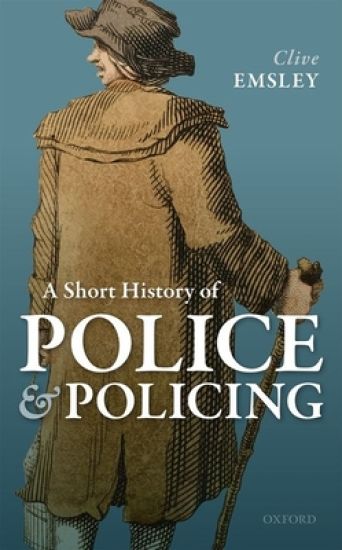
The police are constantly under scrutiny. They are criticized for failings, praised for successes, and hailed as heroes for their sacrifices. Starting from the premise that every society has norms and ways of dealing with transgressors, A Short History of Police and Policing traces the evolution of the multiple forms of 'policing' that existed in the past. It examines the historical development of the various bodies, individuals, and officials who carried these out in different societies, in Europe and European colonies, but also with reference to countries such as ancient Egypt, China, and the USA. By demonstrating that policing was never the exclusive dominion of the police, and that the institution of the police, as we know it today, is a relatively recent creation, Professor Emsley explores the idea and reality of policing, and shows how an institution we now call 'the police' came to be virtually universal in our modern world.
Periodizing Secularization

Periodizing Secularization

Clive D. Field

Oxford University Press
2019
sidottu
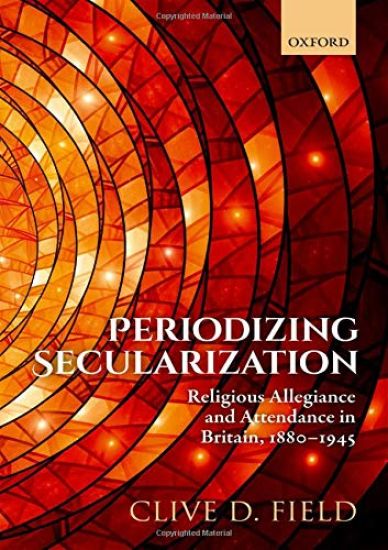
Moving beyond the (now somewhat tired) debates about secularization as paradigm, theory, or master narrative, Periodizing Secularization focuses upon the empirical evidence for secularization, viewed in its descriptive sense as the waning social influence of religion, in Britain. Particular emphasis is attached to the two key performance indicators of religious allegiance and churchgoing, each subsuming several sub-indicators, between 1880 and 1945, including the first substantive account of secularization during the fin de siècle. A wide range of primary sources is deployed, many of them relatively or entirely unknown, and with due regard to their methodological and interpretative challenges. On the back of them, a cross-cutting statistical measure of 'active church adherence' is devised, which clearly shows how secularization has been a reality and a gradual, not revolutionary, process. The most likely causes of secularization were an incremental demise of a Sabbatarian culture (coupled with the associated emergence of new leisure opportunities and transport links) and of religious socialization (in the church, at home, and in the school). The analysis is also extended backwards, to include a summary of developments during the eighteenth and early nineteenth centuries; and laterally, to incorporate a preliminary evaluation of a six-dimensional model of 'diffusive religion', demonstrating that these alternative performance indicators have hitherto failed to prove that secularization has not occurred. The book is designed as a prequel to the author's previous volumes on the chronology of British secularization - Britain's Last Religious Revival? (2015) and Secularization in the Long 1960s (2017). Together, they offer a holistic picture of religious transformation in Britain during the key secularizing century of 1880-1980.
BLACKST GUIDE ANTI-TERRORISM LEGISLATION

BLACKST GUIDE ANTI-TERRORISM LEGISLATION

Clive Walker; Alan Greene

Oxford University Press
2026
nidottu
This new edition of the Blackstone's Guide to the Anti-Terrorism Legislation provides expert explanations and assessments of the UK anti-terrorism legislation. It offers comprehensive and critical guidance on interpretation, impact in practice, and justifiability. The core instruments under scrutiny include: the Terrorism Act 2000, Anti-Terrorism, Crime and Security Act 2001, Terrorism Act 2006, Sanctions and Anti-Money Laundering Act 2018, Counter-Terrorism and Border Security Act 2019, Northern Ireland Troubles (Legacy and Reconciliation) Act 2023, and Terrorism (Protection of Premises) Act 2025. Key extracts from these instruments are included in the appendices. The book opens with chapters examining terrorism strategies and definitions, curtailment of expression, including on the internet, and bans on organisations. Focus shifts to counter-terrorist policing and investigatory powers, terrorist offences, economic sanctions and other personal restrictions. The closing chapters consider protective security with reference to dangerous activities, vulnerable locations, and property and events open to the public, special variants in Northern Ireland such as non-jury trials, and consideration of review and accountability mechanisms. Analysis is provided in the context of the reports from review bodies, including the Independent Reviewers of Terrorism Legislation and UK Parliament, as well as academic commentaries. This analysis highlights important case-law, especially relating to the jurisprudence of human rights, and explores the impacts, relying upon statistical data, dialogues with professionals, and analysis of official claims. The Blackstone's Guide Series delivers concise and accessible books covering the latest legislative changes and amendments. They offer expert commentary by leading names on the effects, extent and scope of the legislation, plus a full copy of the Act itself. They provide a cost-effective solution to key information needs and are the perfect companion for any practitioner needing to get up to speed with the latest changes.
The Beginnings of the Ottoman Empire

The Beginnings of the Ottoman Empire

Clive Foss

Oxford University Press
2022
sidottu
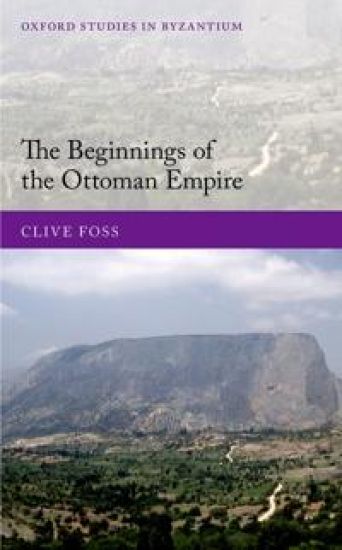
The Ottoman Empire ruled the near East, dominated the Mediterranean, and terrorized Europe for centuries. However, its origins are obscure. The Beginnings of the Ottoman Empire illuminates the founding of the Empire, drawing on Turkish, Greek, Arabic, and Latin sources as well as coins, buildings, and topographic evidence. Clive Foss takes the reader through the rugged homeland of Osman, the founder of the Ottomans, placing his achievement in the context of his more powerful neighbours, most notably the once mighty Byzantine Empire, then in the terminal stages of its decline. Foss then charts the progress of Osman's son Orhan, until the fateful moment in 1354 when his forces crossed into Europe and began their spectacular conquests.
Making Deep History

Making Deep History

Clive Gamble

Oxford University Press
2021
sidottu
One afternoon in late April 1859 two geologically minded businessmen, John Evans and Joseph Prestwich, found and photographed the proof for great human antiquity. Their evidence -- small, hand-held stone tools found in the gravel quarries of the Somme among the bones of ancient animals -- shattered the timescale of Genesis and kicked open the door for a time revolution in human history. In the space of a calendar year, and at a furious pace, the relationship between humans and time was forever changed. This interpretation of deep human history was shaped by the optimistic decade of the 1850s, the Victorian Heyday in the age of equipoise. Proving great human antiquity depended on matching the principles of geology with the personal values of scientific zeal and perseverance; qualities which time-revolutionaries such as Evans and Prestwich had in abundance. Their revolution was driven by a small group of weekend scientists rather than some great purpose, and it proved effective because of its bonds of friendship stiffened by scientific curiosity and business acumen. Clive Gamble explores the personalities of these time revolutionaries and their scientific co-collaborators and adjudicators -- Darwin, Falconer, Lyell, Huxley, and the French antiquary Boucher de Perthes -- as well as their sisters, wives, and nieces Grace McCall, Civil Prestwich, and Fanny Evans. As with all scientific discoveries getting there was often circuitous and messy; the revolutionaries changed their minds and disagreed with those who should have been allies. Gamble's chronological narrative reveals each step from discovery to presentation, reception, consolidation, and widespread acceptance, and considers the impact of their work on the scientific advances of the next 160 years and on our fascination with the shaping power of time.
Crime, Police, and Penal Policy

Crime, Police, and Penal Policy

Clive Emsley

Oxford University Press
2007
sidottu
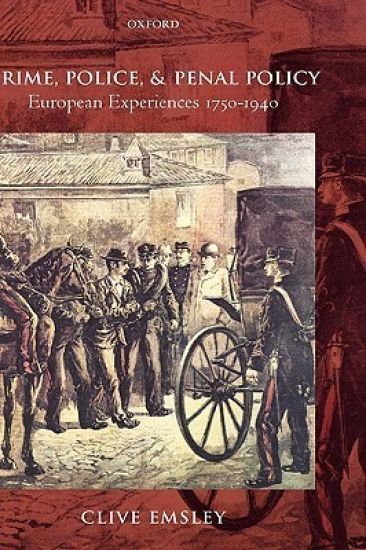
How did ideas about crime and criminals change in Europe from around 1750 to 1940? How did European states respond to these changes with the development of police and penal institutions? Clive Emsley attempts to address these questions using recent research on the history of crime and criminal justice in Europe. Exploring the subject chronologically, he addresses the forms of offending, the changing interpretations and understandings of that offending at both elite and popular levels, and how the emerging nation states of the period responded to criminal activity by the development of police forces and the refinement of forms of punishment. The book focuses on the comparative nature in which different states studied each other and their institutions, and the ways in which different reformers exchanged ideas and investigated policing and penal experiments in other countries. It also explores the theoretical issues underpinning recent research, emphasising that the changes in ideas on crime and criminals were neither linear nor circular, and demonstrating clearly that many ideas hailed as new by contemporary politicians and in current debate on crime and its 'solutions', have a very long and illustrious history.
Intelligence

Intelligence

Clive Harfield; Karen Harfield

Oxford University Press
2008
nidottu
This title provides a clear introduction and practical guide to the use of intelligence in policing, offering detailed explanations of relevant legislation and establishing the theoretical and operational context and rationale within which intelligence can be used. The relationship between criminal procedural law and intelligence-gathering is outlined and different generic sources of intelligence (overt and covert) are introduced. The book offers advice on planning an intelligence operation, analysing and evaluating information, using intelligence-based evidence in court, identifying risk and protecting sensitive sources. It also summarises the role of key agencies involved in intelligence gathering, outlines the National Intelligence Model and draws together key findings from the Butler and Bichard enquiries. The book forms part of the Blackstone's Practical Policing Series. The series, aimed at junior to middle ranking officers, consists of practical guides containing clear and detailed explanations of the relevant legislation and practice, accompanied by case studies, illustrative diagrams and useful checklists. A truly practical guide to all aspects of policing intelligence, from planning and gathering to analysis
Journeymen-Printers, Heresy, and the Inquisition in Sixteenth-Century Spain
Although the history of the book is a booming area of research, the journeymen who printed books in the sixteenth century have remained shadowy figures because they were not thought to have left any significant traces in the archives. Clive Griffin, however, uses Inquisitional documents from Spain and Portugal to reveal a clandestine network of Protestant-minded immigrant journeymen who were arrested by the Holy Office in Spain and Portugal in the 1560s and 1570s at a time of international crisis. A startlingly clear portrait of these humble men (and occasionally women) emerges allowing the reconstruction of what Namier deemed one of history's greatest challenges: 'the biographies of ordinary men'. We learn of their geographical and social origins, educational and professional training, travels, careers, standard of living, violent behaviour, and even their attitudes, beliefs, and ambitions. In the course of this study, many other subjects are addressed, among them: popular culture and religion; the history of skilled labour, the history of the book, and of reading and writing; the Inquisition; foreign and itinerant workers and the xenophobia they encountered; and the 'double lives' of lower-class Protestants living within a uniquely vigilant Catholic society.