Kirjojen hintavertailu. Mukana 12 351 342 kirjaa ja 12 kauppaa.

Kirjahaku

Etsi kirjoja tekijän nimen, kirjan nimen tai ISBN:n perusteella.

1000 tulosta hakusanalla David L. Goetsch

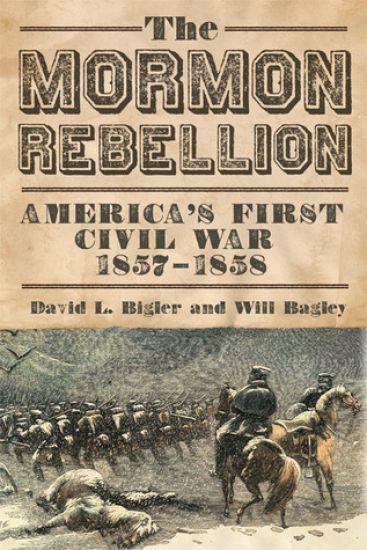
The Mormon Rebellion

The Mormon Rebellion

David L. Bigler; Will Bagley

University of Oklahoma Press
2012
nidottu
In 1857 President James Buchanan ordered U.S. troops to Utah to replace Brigham Young as governor and restore order in what the federal government viewed as a territory in rebellion. In this compelling narrative, award-winning authors David L. Bigler and Will Bagley use long-suppressed sources to show that - contrary to common perception - the Mormon rebellion was not the result of Buchanan's ""blunder,"" nor was it a David-and-Goliath tale in which an abused religious minority heroically defied the imperial ambitions of an unjust and tyrannical government. They argue that Mormon leaders had their own far-reaching ambitions and fully intended to establish an independent nation - the Kingdom of God - in the West.Long overshadowed by the Civil War, the tragic story of this conflict involved a tense and protracted clash pitting Brigham Young's Nauvoo Legion against Colonel Albert Sidney Johnston and the U.S. Army's Utah Expedition. In the end, the conflict between the two armies saw no pitched battles, but in the authors' view, Buchanan's decision to order troops to Utah, his so-called blunder, eventually proved decisive and beneficial for both Mormons and the American republic.A rich exploration of events and forces that presaged the Civil War, The Mormon Rebellion broadens our understanding of both antebellum America and Utah's frontier theocracy and offers a challenging reinterpretation of a controversial chapter in Mormon annals.

Buon Giorno, Arezzo

Buon Giorno, Arezzo

David L. Boren; Giuseppe Fanfani; Cindy Simon Rosenthal

University of Oklahoma Press
2016
nidottu
In the heart of Tuscany stands the city of Arezzo, beckoning those who would know more of the real Italy. A spectacular medieval town of 100,000 residents, Arezzo invites travelers to see its sights and sample its considerable charms. It reserves a special warmth for those who wish to stay a while and truly experience life under the Tuscan sun. In a similar fashion, Buon Giorno, Arezzo invites visitors to make themselves at home. The authors and photographers featured here are kindred spirits - Americans, Europeans, students, and scholars - all touched by Arezzo's magic and eager to share their experience with newcomers.Buon Giorno, Arezzo sketches the city's unique history, from ancient Italy to the present day, with beautifully illustrated forays into its rich tradition of architecture and art - including the masterwork of Renaissance painter Piero della Francesca. Contributors offer insight into Arezzo's language, introducing visitors to speech patterns and accents harking back to the Etruscans, as well as distinct dialects that put the region - the birthplace of Francesco Petrarca (Petrarch), a godfather of the Italian language - at the very ""center of the Italian language universe."" Italians are known internationally for their contributions to music, fashion, film, and wine - and Arezzo's significant influence in each of these areas comes to light and life as the authors explore the city's vibrant modern culture and economy. A congenial companion and knowledgeable guide, steeped in history and replete with photographs of Arezzo's visual delights, Buon Giorno, Arezzo is an essential resource for any traveler hoping to immerse themselves in the daily rhythms and cultural depths of this incomparable Italian city.
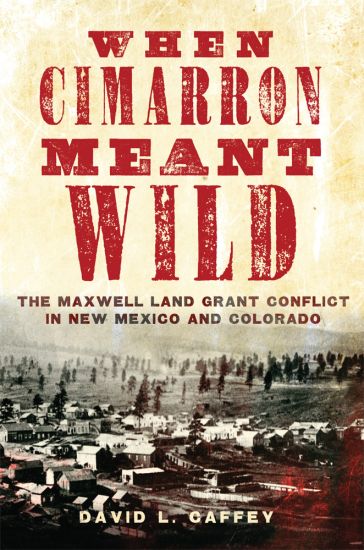
When Cimarron Meant Wild

When Cimarron Meant Wild

David L. Caffey

UNIVERSITY OF OKLAHOMA PRESS
2023
sidottu
The Spanish word cimarron, meaning “wild” or “untamed,” refers to a region in the southern Rocky Mountains where control of timber, gold, coal, and grazing lands long bred violent struggle. After the U.S. occupation following the 1846–1848 war with Mexico, this tract of nearly two million acres came to be known as the Maxwell Land Grant. WhenCimarron Meant Wild presents a new history of the collision that occurred over the region’s resources between 1870 and 1900. Author David L. Caffey describes the epic late-nineteenth-century range war in an account deeply informed by his historical perspective on social, political, and cultural issues that beset the American West to this day. Cimarron country churned with the tensions of the Old West—land disputes, lawlessness, violence, and class war among miners, a foreign corporation, local elites, Texas cattlemen, and the haughty “Santa Fe Ring” of lawyerly speculators. And present, still, were the indigenous Jicarilla Apache and Mouache Ute people, dispossessed of their homeland by successive Spanish, Mexican, and American regimes. A Mexican grant of uncertain size and bounds, awarded to Carlos Beaubien and Guadalupe Miranda in 1841 and later acquired by Lucien Maxwell, marked the beginning of a fight for control of the land and set off overlapping conflicts known as the Colfax County War, the Maxwell Land Grant War, and the Stonewall War. Caffey draws on new research to paint a complex picture of these events, and of those that followed the sale of the claim to investors in 1870. These clashes played out over the following thirty years, involving the new English owners, miners and prospectors, livestock grazers and farmers, and Native Americans. Just how wild was the Cimarron country in the late 1800s? And what were the consequences for the region and for those caught up in the conflict? The answers, pursued through this remarkable work, enhance our understanding of cultural and economic struggle in the American West.
When Cimarron Meant Wild

When Cimarron Meant Wild

David L. Caffey

UNIVERSITY OF OKLAHOMA PRESS
2024
nidottu
The Spanish word cimarron, meaning “wild” or “untamed,” refers to a region in the southern Rocky Mountains where control of timber, gold, coal, and grazing lands long bred violent struggle. After the U.S. occupation following the 1846–1848 war with Mexico, this tract of nearly two million acres came to be known as the Maxwell Land Grant. WhenCimarron Meant Wild presents a new history of the collision that occurred over the region’s resources between 1870 and 1900. Author David L. Caffey describes the epic late-nineteenth-century range war in an account deeply informed by his historical perspective on social, political, and cultural issues that beset the American West to this day. Cimarron country churned with the tensions of the Old West—land disputes, lawlessness, violence, and class war among miners, a foreign corporation, local elites, Texas cattlemen, and the haughty “Santa Fe Ring” of lawyerly speculators. And present, still, were the indigenous Jicarilla Apache and Mouache Ute people, dispossessed of their homeland by successive Spanish, Mexican, and American regimes. A Mexican grant of uncertain size and bounds, awarded to Carlos Beaubien and Guadalupe Miranda in 1841 and later acquired by Lucien Maxwell, marked the beginning of a fight for control of the land and set off overlapping conflicts known as the Colfax County War, the Maxwell Land Grant War, and the Stonewall War. Caffey draws on new research to paint a complex picture of these events, and of those that followed the sale of the claim to investors in 1870. These clashes played out over the following thirty years, involving the new English owners, miners and prospectors, livestock grazers and farmers, and Native Americans. Just how wild was the Cimarron country in the late 1800s? And what were the consequences for the region and for those caught up in the conflict? The answers, pursued through this remarkable work, enhance our understanding of cultural and economic struggle in the American West.
Friendship with Jesus

Friendship with Jesus

David L. Miller

Augsburg Fortress
1999
pokkari
Build a powerful friendship with Jesus through the ancient art of contemplative prayer. Perfect for individual or group use, this guide and workbook helps readers to actually experience events recorded in the Gospel of Mark, so that biblical times, places, and people come to life vividly. As the events unfold before the reader's eyes, God's revelation becomes a present event, and Jesus becomes a companion and friend. In his brief introduction, David Miller explains how the ancient art of contemplative prayer helped strengthen and deepen his relationship with God. After explaining the principles and practice of praying the Scriptures, Miller demonstrates how readers can use the technique for themselves. Then he walks readers, chapter by chapter, through an exciting prayer-reading of Mark's Gospel, pausing on special write-in pages for readers to record their experiences. In a final section, Miller offers journal entries from his own prayer journey through the Gospel, inviting readers to compare with him and with one another the exciting
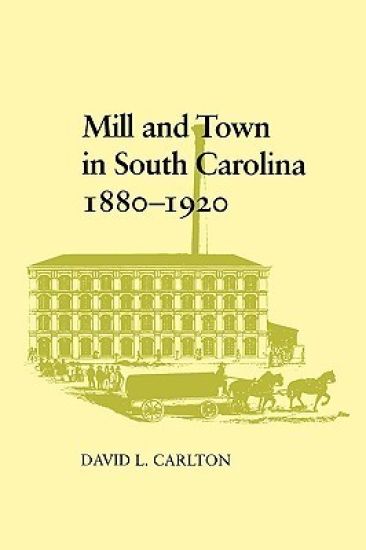
Mill and Town in South Carolina, 1880-1920

Mill and Town in South Carolina, 1880-1920

David L. Carlton

Louisiana State University Press
1982
nidottu
Probing the social repercussions of the industrial development of South Carolina in the decades following Reconstruction, David L. Carlton's Mill and Town in South Carolina, 1880-1920, tells of the conflict that erupted between the rising middle class of the South's small towns and the rural white who came to labor in the towns' burgeoning textile mills.The townsmen who built the mills initially expected no social friction to result from industrialization, since the work force was to consist entirely of white ""Anglo-Saxons"" like themselves. However, as thousands of rural whites moved into the mill villages at the turn of the century, their backwoods independence proved increasingly incompatible with the orderly, hierarchical outlook of the town people. As a result, the town people soon abandoned their belief in white equality and instead began to view the mill people as backward folk needing to be brought under the control of their betters.In keeping with the spirit of the Progressive era, the principal approach of the town people to the task of ""uplifting"" the mill people was through education. Through the creation of child labor and compulsory education laws they hoped to free the mill child from the hold of his parents and cement his allegiance to the new, more progressive world being forged under town leadership. This assault met with resentment and some opposition from the mill population, but the workers could put up little effective resistance until they were organised by the ""demagogue"" Cole Blease, whom they then helped to be elected governor in 1910. Blease's ascendancy, however, was brief. A progressive electoral victory in 1914 resulted in a new surge of reform, and by 1920 the use of the state government to ""uplift"" the poorer whites was an established practice.Tracing the social impact of southern industrialization from its beginnings to the ruse of the demagogue politicians of the early twentieth century, this study by David L. Carlton isolates the role of the textile mills in bringing increased rigidity and tension to the loose social structure of the preindustrial South.
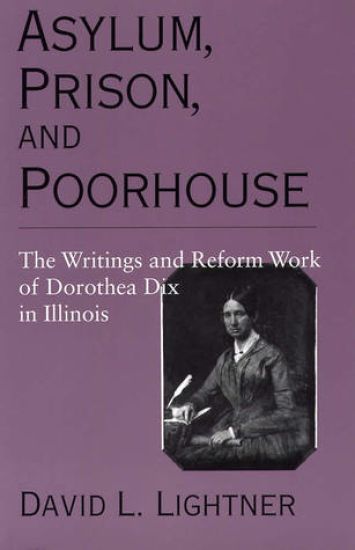
Asylum, Prison, and Poorhouse

Asylum, Prison, and Poorhouse

David L. Lightner

Southern Illinois University Press
1999
nidottu
This illustrated collection of annotated newspaper articles and memorials by Dorothea Dix provides a forum for the great mid-nineteenth-century humanitarian and reformer to speak for herself. Dorothea Lynde Dix (1802­–87) was perhaps the most famous and admired woman in America for much of the nineteenth century. Beginning in the early 1840s, she launched a personal crusade to persuade the various states to provide humane care and effective treatment for the mentally ill by funding specialized hospitals for that purpose. The appalling conditions endured by most mentally ill inmates in prisons, jails, and poorhouses led her to take an active interest also in prison reform and in efforts to ameliorate poverty. In 1846–­47 Dix brought her crusade to Illinois. She presented two lengthy memorials to the legislature, the first describing conditions at the state penitentiary at Alton and the second discussing the sufferings of the insane and urging the establishment of a state hospital for their care. She also wrote a series of newspaper articles detailing conditions in the jails and poorhouses of many Illinois communities. These long-forgotten documents, which appear in unabridged form in this book, contain a wealth of information on the living conditions of some of the most unfortunate inhabitants of Illinois. In his preface, David L. Lightner describes some of the vivid images that emerge from Dorothea Dix's descriptions of social conditions in Illinois a century and a half ago: ""A helpless maniac confined throughout the bitter cold of winter to a dark and filthy pit. Prison inmates chained in hallways and cellars because no more men can be squeezed into the dank and airless cells. Aged paupers auctioned off by county officers to whoever will maintain them at the lowest cost."" Lightner provides an introduction to every document, placing each memorial and newspaper article in its proper social and historical context. He also furnishes detailed notes, making these documents readily accessible to readers a century and a half later. In his final chapter, Lightner assesses both the immediate and the continuing impact of Dix's work.
Mutuality in the Rhetoric and Composition Classroom

Mutuality in the Rhetoric and Composition Classroom

David L. Wallace; Helen Rothschild Ewald

Southern Illinois University Press
2000
nidottu
This study points out the centrality of rhetoric in the academy, asserting the intimate connection between language and knowledge making. The authors also stress the need for a change in the roles of teachers and students in today's classroom. Their goal is mutuality, a sharing of authority.
Stage, Page, Scandals, and Vandals

Stage, Page, Scandals, and Vandals

David L. Rinear

Southern Illinois University Press
2004
sidottu
This biography of William E. Burton explores Burton's diary, letters, reviews, and various reminiscences to reveal the personal and professional lives of the nineteenth-century actor/manager and his role in American literary history.
Federalism

Federalism

David L. Shapiro

Northwestern University Press
1995
nidottu
An exploration of the virtues and defects of federalism as it has developed from a variety of perspectives that include historical, constitutional, economic, social and political considerations. Using the dialectical form adopted by advocates trying a case before a court, the author examines the strongest arguments on the two prinicpal sides of the issue but also probes the potential value of the dialectical process itself.
Quality Middle School Leadership

Quality Middle School Leadership

David L. Weller

Rowman Littlefield Education
2002
nidottu
What are the skills necessary for effective middle school leadership? What are the components of quality middle schools? The answers to these questions lie within this book. The author explores the important facets of a middle school principal's leadership role. It is organized around eleven central skill areas, such as: leadership effectiveness, interdisciplinary teaming, designing curriculum content, and meeting the needs of at-risk students. The result of years of research and evaluation, this essential guide is one that new and experienced middle school principals can implement in their schools in order to provide a better education and a safer learning environment for their students.
Souls in Dispute

Souls in Dispute

David L. Graizbord

University of Pennsylvania Press
2004
sidottu
Throughout the Middle Ages, the Iberian Peninsula was home to a rich cultural mix of Christians, Jews, and Muslims. At the end of the fifteenth century, however, the last Islamic stronghold fell, and Jews were forced either to convert to Christianity or to face expulsion. Thousands left for other parts of Europe and Asia, eventually establishing Sephardic communities in Amsterdam, Venice, Istanbul, southwestern France, and elsewhere. More than a hundred years after the expulsion, some Judeoconversos-descendants of Spanish and Portuguese Jews who had converted to Christianity-were forced to flee the Iberian Peninsula once again to avoid ethnic and religious persecution. Many of them joined the Sephardic Diaspora and embraced rabbinic Judaism. Later some of these same people or their descendants returned to Iberian lands temporarily or permanently and, in a twist that Jewish authorities considered scandalous, reverted to Catholicism. Among them were some who betrayed their fellow conversos to the Holy Office. In Souls in Dispute, David L. Graizbord unravels this intriguing history of the renegade conversos and constructs a detailed and psychologically acute portrait of their motivations. Through a probing analysis of relevant inquisitorial documents and a wide-ranging investigation into the history of the Sephardic Diaspora and Habsburg Spain, Graizbord shows that, far from being simply reckless and vindictive, the renegades used their double acts of border crossing to negotiate a dangerous and unsteady economic environment: so long as their religious and social ambiguity remained undetected, they were rewarded with the means for material survival. In addition, Graizbord sheds new light on the conflict-ridden transformation of makeshift Jewish colonies of Iberian expatriates-especially in the borderlands of southwestern France-showing that the renegades failed to accommodate fully to a climate of conformity that transformed these Sephardic groups into disciplined communities of Jews. Ultimately, Souls in Dispute explains how and why Judeoconversos built and rebuilt their religious and social identities, and what it meant to them to be both Jewish and Christian given the constraints they faced in their time and place in history.
Unwilling to Quit

Unwilling to Quit

David L Prentice

THE UNIVERSITY PRESS OF KENTUCKY
2023
sidottu
Although US involvement in the Vietnam conflict began long before 1965, Lyndon Johnson's substantial large commitment of combat troops that year marked the official beginning of America's longest twentieth-century war. By 1969, after years of intense fighting and thousands of casualties, an increasing number of Americans wanted the United States out of Vietnam. Richard Nixon looked for a way to pull out while preserving the dignity of the United States at home and abroad, and at the same time, to support the anticommunist Republic of Vietnam. Ultimately, he settled on the strategy of Vietnamization—the gradual replacement of US soldiers with South Vietnamese forces. Drawing on newly declassified documents and international archives, Unwilling to Quit dissects the domestic and foreign contexts of America's withdrawal from the Vietnam War. David L. Prentice demonstrates how congressional and presidential politics were a critical factor in Nixon's decision to abandon his hawkish sensibilities in favor of de-escalation. Prentice reframes Nixon's choices, emphasizes Secretary of Defense Melvin Laird's outsized yet subtle role in the decision-making process, and considers how South Vietnam's Nguyen Van Thieu and North Vietnam's Le Duan decisively shaped the American exit. Prentice brings Vietnamese voices into the discussion and underscores the unprecedented influence of American civilians on US foreign policy during the Vietnamization era.
Our Town

Our Town

David L. Kirp; John P. Dwyer; Larry A. Rosenthal

Rutgers University Press
1997
nidottu
An account of the legal battle to open up New Jersey's suburbs to the poor, looking at the views of lawyers on both sides of the controversy. It is a case study of judicial activism and its consequences and an analysis of suburban attitudes regarding race, class and property.
The South, the Nation and the World

The South, the Nation and the World

David L. Carlton; Peter A. Coclanis

University of Virginia Press
2003
nidottu
Like the rest of British North America, the American South was ""born capitalist."" The slave plantation, then, was essentially a form of business enterprise like any other - indeed, one quite modern and sophisticated for its time. There were initially very few significant differences in business culture between the northern and southern parts of what became the United States Yet the plantation placed its peculiar stamp on the South, and vice versa, and its path of development diverged increasingly from that of the growing manufacturing belt of the North. In their essays collected in The South, the Nation, and the World, David Carlton and Peter Coclanis effectively argue that the chronic economic difficulties of the American South cannot simply be explained away as resulting from a distinctive ""premodern"" business climate, because there was actually very little variation between one region's business climate and another's during the Antebellum period. Instead, it was the collapse of the slave regime in the 1860s that left the South in dire need of economic restructuring, and by Reconstruction the emergent American economy had foreclosed options formerly available to southern enterprise. Forced to play catch-up, southerners have had at best mixed success in the continuing struggle to create an economic life affording stable growth and broad opportunity to all the region's people - and Carlton and Coclanis offer a fascinating illumination of the twists and turns in that economic history.