Kirjojen hintavertailu. Mukana 12 464 648 kirjaa ja 12 kauppaa.

Kirjahaku

Etsi kirjoja tekijän nimen, kirjan nimen tai ISBN:n perusteella.

1000 tulosta hakusanalla Gerhard Hauser

Nonmonotonic Reasoning

Nonmonotonic Reasoning

Gerhard Brewka

Cambridge University Press
2012
pokkari
In this 1991 book the author gives a broad overview of different areas of research in nonmonotonic reasoning, and presents some results and ideas based on his research. The guiding principles are: clarification of the different research activities in the area, which have sometimes been undertaken independently of each other, and appreciation of the fact that these research activities often represent different means to the same ends, namely sound theoretical foundations and efficient computation. The book begins with a discussion of the various types of nonmonotonic reasoning, their applications and their logics. Theorem proving techniques for these logics are also described. There then follow chapters dealing with formulations of nonmonotonic inheritance, and nonmonotonic reasoning based on nonmonotonic rules. The final chapter discusses the achievements in the field in the light of the famous Yale shooting example. The book will be welcomed by researchers in theoretical computer science and artificial intelligence.
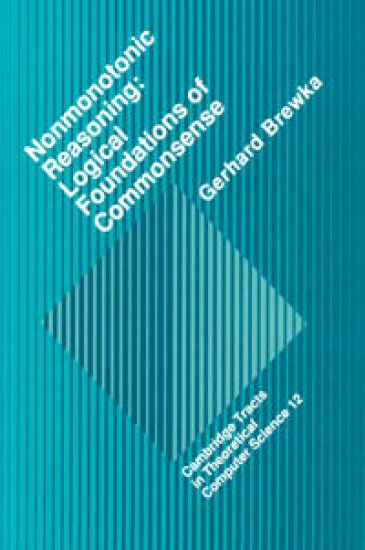
Nonmonotonic Reasoning

Nonmonotonic Reasoning

Gerhard Brewka

Cambridge University Press
1991
sidottu
In this 1991 book the author gives a broad overview of different areas of research in nonmonotonic reasoning, and presents some results and ideas based on his research. The guiding principles are: clarification of the different research activities in the area, which have sometimes been undertaken independently of each other, and appreciation of the fact that these research activities often represent different means to the same ends, namely sound theoretical foundations and efficient computation. The book begins with a discussion of the various types of nonmonotonic reasoning, their applications and their logics. Theorem proving techniques for these logics are also described. There then follow chapters dealing with formulations of nonmonotonic inheritance, and nonmonotonic reasoning based on nonmonotonic rules. The final chapter discusses the achievements in the field in the light of the famous Yale shooting example. The book will be welcomed by researchers in theoretical computer science and artificial intelligence.

Tennyson and the Text

Tennyson and the Text

Gerhard Joseph

Cambridge University Press
1992
sidottu
This 1992 study of Tennyson evolves its themes from the weaving figure of The Lady of Shalott, which becomes a kind of parable for the author and his texts. Taking its derivation from the Latin texere, 'to weave', Professor Joseph's focus on poetic texture and a sense of textuality leads to a consciousness of his own critical and interpretative weaving, while revealing a pattern in the fabric of Tennyson's work. This procedure brings together a theory of perception, developed in the first part of this study, with an analysis of the gendering of Tennyson's characters in the second part, and engages with the methodologies of deconstruction, psychoanalysis, and gender theory. The weaving metaphor also opens up a key theoretical issue regarding Tennyson's poetics: is the textual shuttle managed by the controlling hand of a historically definable author, or is the poetic weaver 'cursed' like the Lady of Shalott to suffer a mystifying doom at the 'unseen hand' of an all-pervasive textuality that occludes authorial intention?
Learning

Learning

Gerhard Steiner

Cambridge University Press
1999
sidottu
This book is a systematic introduction to learning psychology. It describes, analyzes and explains learning by means of 19 scenarios from everyday situations. The reader may therefore connect theoretical considerations with experiences he or she can easily follow. Several scenarios stem from family situations, others from school and business, and still others refer to very individual learning processes: modification of one's own behavior, acquisition of motor skills, or elaborating one's knowledge structures or problems solving abilities. Having worked through the 19 scenarios the reader will be acquainted with the important learning theories: behavioristic, cognitive, social-cognitive as well as the Gestaltists'.
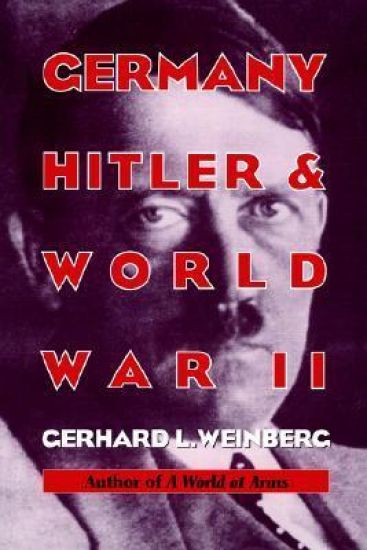
Germany, Hitler, and World War II

Germany, Hitler, and World War II

Gerhard L. Weinberg

Cambridge University Press
1995
sidottu
Reflecting on the greatest war in human history, one cannot help but think about the terrible conflict as a whole, its leaders, its peoples, and the puzzles still open about its conduct. Leaders on both sides realised that at stake from the very beginning was a complete restructuring of the world order. More than a conflict of imperial aggression, World War II was about who would live and command the globe’s resources and which peoples would disappear entirely because they were believed to be inferior or undesirable by the victor. This collection of special studies in twentieth-century German and world history illuminates the nature of the Nazi system and its impact on Germany and the world. Bringing together essays now widely scattered and several never previously published in English, this volume examines the Holocaust, the connections between the European and Pacific theatres of war, as well as the effects, leaders, and research problems of World War II. By examining the effects of World War II, its leaders, its problems, and the Holocaust, this volume provides an illuminating study of the nature of the Nazi system and its impact on Germany and the world.
Learning

Learning

Gerhard Steiner

Cambridge University Press
1999
pokkari
This book is a systematic introduction to learning psychology. It describes, analyzes and explains learning by means of 19 scenarios from everyday situations. The reader may therefore connect theoretical considerations with experiences he or she can easily follow. Several scenarios stem from family situations, others from school and business, and still others refer to very individual learning processes: modification of one's own behavior, acquisition of motor skills, or elaborating one's knowledge structures or problems solving abilities. Having worked through the 19 scenarios the reader will be acquainted with the important learning theories: behavioristic, cognitive, social-cognitive as well as the Gestaltists'.
Memories of Beethoven

Memories of Beethoven

Gerhard von Breuning

Cambridge University Press
1995
pokkari
These are the personal memories of an elderly man who, as a child, was closely acquainted with Beethoven. Gerhard von Breuning, the son of one of Beethoven’s oldest friends, was a favourite of the ageing composer, who delighted in the boy’s frequent visits. His absorbing first-hand account gives us a unique glimpse of Beethoven’s daily life, his personality, friendships and family. It is particularly compelling in providing a clear-eyed witness of Beethoven’s final illness, in graphic reports on the atmosphere of the sick room and the composer’s death throes. This lively translation makes von Breuning’s fascinating document available in English for the first time.
Germany, Hitler, and World War II

Germany, Hitler, and World War II

Gerhard L. Weinberg

Cambridge University Press
1996
pokkari
Reflecting on the greatest war in human history, one cannot help but think about the terrible conflict as a whole, its leaders, its peoples, and the puzzles still open about its conduct. Leaders on both sides realised that at stake from the very beginning was a complete restructuring of the world order. More than a conflict of imperial aggression, World War II was about who would live and command the globe’s resources and which peoples would disappear entirely because they were believed to be inferior or undesirable by the victor. This collection of special studies in twentieth-century German and world history illuminates the nature of the Nazi system and its impact on Germany and the world. Bringing together essays now widely scattered and several never previously published in English, this volume examines the Holocaust, the connections between the European and Pacific theatres of war, as well as the effects, leaders, and research problems of World War II. By examining the effects of World War II, its leaders, its problems, and the Holocaust, this volume provides an illuminating study of the nature of the Nazi system and its impact on Germany and the world.
Equilibrium States in Ergodic Theory

Equilibrium States in Ergodic Theory

Gerhard Keller

Cambridge University Press
1998
pokkari
This book provides a detailed introduction to the ergodic theory of equilibrium states giving equal weight to two of its most important applications, namely to equilibrium statistical mechanics on lattices and to (time discrete) dynamical systems. It starts with a chapter on equilibrium states on finite probability spaces which introduces the main examples for the theory on an elementary level. After two chapters on abstract ergodic theory and entropy, equilibrium states and variational principles on compact metric spaces are introduced emphasizing their convex geometric interpretation. Stationary Gibbs measures, large deviations, the Ising model with external field, Markov measures, Sinai-Bowen-Ruelle measures for interval maps and dimension maximal measures for iterated function systems are the topics to which the general theory is applied in the last part of the book. The text is self contained except for some measure theoretic prerequisites which are listed (with references to the literature) in an appendix.
A World at Arms

A World at Arms

Gerhard L. Weinberg

Cambridge University Press
2005
pokkari
Widely hailed as a masterpiece, this is the first history of World War II to provide a truly global account of the war that encompassed six continents. Starting with the changes that restructured Europe and her colonies following the First World War, Gerhard Weinberg sheds new light on every aspect of World War II. Actions of the Axis, the Allies, and the Neutrals are covered in every theater of the war. More importantly, the global nature of the war is examined, with new insights into how events in one corner of the world helped affect events in other distant parts. In a new edition, with a new preface, A World at Arms remains a classic of global history.
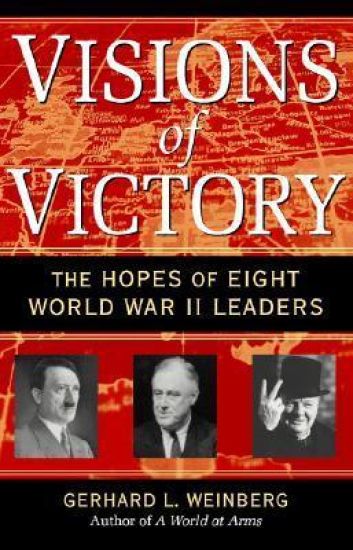
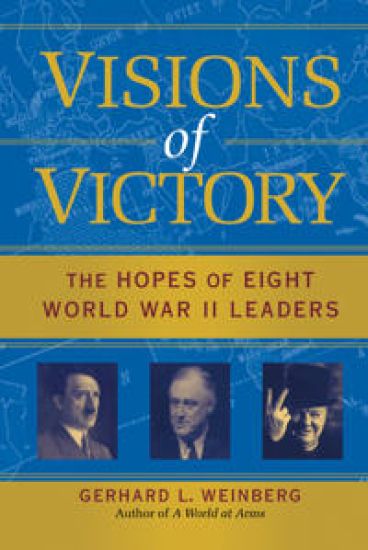
Visions of Victory

Visions of Victory

Gerhard L. Weinberg

Cambridge University Press
2007
pokkari
Visions of Victory, first published in 2005, explores the views of eight leaders of the major powers of World War II - Hitler, Mussolini, Tojo, Chiang Kai-shek, Stalin, Churchill, de Gaulle, and Roosevelt. He compares their visions of the future in the event of victory. While the leaders primarily focused on fighting and winning the war, their decisions were often shaped by their aspirations for the future. What emerges is a startling picture of postwar worlds. After exterminating the Jews, Hitler intended for all Slavs to die so Germans could inhabit Eastern Europe. Mussolini and Hitler wanted extensive colonies in Africa. Churchill hoped for the re-emergence of British and French empires. De Gaulle wanted to annex the northwest corner of Italy. Stalin wanted to control Eastern Europe. Roosevelt's vision included establishing the United Nations. Weinberg's comparison of the individual portraits of the war-time leaders is a highly original and compelling study of history that might have been.
Theory of Finite Simple Groups II

Theory of Finite Simple Groups II

Gerhard Michler

Cambridge University Press
2010
sidottu
This is a coherent explanation for the existence of the 26 known sporadic simple groups originally arising from many unrelated contexts. The given proofs build on the close relations between general group theory, ordinary character theory, modular representation theory and algorithmic algebra described in the first volume. The author presents a new algorithm by which 25 sporadic simple groups can be constructed (the smallest Mathieu group M11 can be omitted for theoretical reasons), and demonstrates that it is not restricted to sporadic simple groups. He also describes the constructions of various groups and proves their uniqueness whenever possible. The computational existence proofs are documented in the accompanying DVD. The author also states several open problems related to the theorem asserting that there are exactly 26 groups, and R. Brauer's warning that there may be infinitely many. Some of these problems require new experiments with the author's algorithm.
Visions of Victory

Visions of Victory

Gerhard L. Weinberg

Cambridge University Press
2005
sidottu
Visions of Victory, first published in 2005, explores the views of eight leaders of the major powers of World War II - Hitler, Mussolini, Tojo, Chiang Kai-shek, Stalin, Churchill, de Gaulle, and Roosevelt. He compares their visions of the future in the event of victory. While the leaders primarily focused on fighting and winning the war, their decisions were often shaped by their aspirations for the future. What emerges is a startling picture of postwar worlds. After exterminating the Jews, Hitler intended for all Slavs to die so Germans could inhabit Eastern Europe. Mussolini and Hitler wanted extensive colonies in Africa. Churchill hoped for the re-emergence of British and French empires. De Gaulle wanted to annex the northwest corner of Italy. Stalin wanted to control Eastern Europe. Roosevelt's vision included establishing the United Nations. Weinberg's comparison of the individual portraits of the war-time leaders is a highly original and compelling study of history that might have been.
The Psychology of Marketing

The Psychology of Marketing

Gerhard Raab; G. Jason Goddard; Alexander Unger

Gower Publishing Ltd
2010
sidottu
This comprehensive guide to both the theory and application of psychology to marketing comes from the author team that produced the acclaimed Customer Relationship Management. It will be of immeasurable help to marketing executives and higher level students of marketing needing an advanced understanding of the applied science of psychology and how it bears on consumers; on influencing; and on the effective marketing of organizations themselves, as well as of products and services. Drawing on consumer, management, industrial, organizational, and market psychology, The Psychology of Marketing's in-depth treatment of theory embraces: ¢ Cognition theories. ¢ Personality, perception and memory. ¢ Motivation and emotion. ¢ Power, control, and exchange. Complemented by case studies from across the globe, The Psychology of Marketing provides a trans-national perspective on how the theory revealed here is applied in practice. Marketers and those aspiring to be marketers will find this book an invaluable help in their role as 'lay psychologists'.
First Communion for the Lutheran Church, Bilingual

First Communion for the Lutheran Church, Bilingual

Gerhard F Kempff; Hector E Hoppe

Concordia Publishing House
1995
pokkari
Este peque o libro est desarrollado para instruir ni os que desean tomar la Santa Cena. Incluye: el Manual para la primera comuni n, Orden para la primera comuni n, y el Catecismo Menor de Lutero. This bilingual resource is for the instruction children who wish to participate in the Lord's Supper. It includes: Manual for First Communion, Order for First Communion and Luther's Small Catechism. By Gerhard F. Kempff and H ctor Hoppe.
Raap

Raap

Gerhard Uys

Gerhard Uys Media
2015
pokkari
Lukas Gideon Uys en Motswedi Gabriel Dawid Mokoena is alleen op die plaas na die wegraping. Bo Carnavon trek 'n rookwolk al vir weke. Hulle gaan een of ander tyd moet dorptoe om te kyk of daar mense is om te red. Raap speel af tydens die zombie-apokalips. Die dooies loop op die aarde, die bloed gaan spat, die honde gaan byt, skote gaan klap.