Kirjojen hintavertailu. Mukana 11 244 527 kirjaa ja 12 kauppaa.

Kirjahaku

Etsi kirjoja tekijän nimen, kirjan nimen tai ISBN:n perusteella.

1000 tulosta hakusanalla Keith Harding

The Flying Inn (1914). By Gilbert Keith Chesterton: Novel

The Flying Inn (1914). By Gilbert Keith Chesterton: Novel

G. K. Chesterton

Createspace Independent Publishing Platform
2017
nidottu
The Flying Inn is the final novel by G. K. Chesterton, first published in 1914. It is set in a future England where the Temperance movement has allowed a bizarre form of "Progressive" Islam to dominate the political and social life of the country. Because of this, alcohol sales to the poor are effectively prohibited, while the rich can get alcoholic drinks "under a medical certificate". The plot centres on the adventures of Humphrey Pump and Captain Patrick Dalroy, who roam the country in their cart with a barrel of rum in an attempt to evade Prohibition, exploiting loopholes in the law to temporarily prevent the police taking action against them. Eventually the heroes and their followers foil an attempted coup by an Islamic military force. The novel includes the poem, The Rolling English Road. The poem was first published under the title A Song of Temperance Reform in the New Witness in 1913.. Gilbert Keith Chesterton, KC*SG (29 May 1874 - 14 June 1936), better known as G. K. Chesterton, was an English writer, poet, philosopher, dramatist, journalist, orator, lay theologian, biographer, and literary and art critic. Chesterton is often referred to as the "prince of paradox". Time magazine has observed of his writing style: "Whenever possible Chesterton made his points with popular sayings, proverbs, allegories-first carefully turning them inside out." Chesterton is well known for his fictional priest-detective Father Brown, and for his reasoned apologetics. Even some of those who disagree with him have recognised the wide appeal of such works as Orthodoxy and The Everlasting Man.Chesterton, as a political thinker, cast aspersions on both Progressivism and Conservatism, saying, "The whole modern world has divided itself into Conservatives and Progressives. The business of Progressives is to go on making mistakes. The business of the Conservatives is to prevent the mistakes from being corrected."Chesterton routinely referred to himself as an "orthodox" Christian, and came to identify this position more and more with Catholicism, eventually converting to Catholicism from High Church Anglicanism. George Bernard Shaw, Chesterton's "friendly enemy" according to Time, said of him, "He was a man of colossal genius."Biographers have identified him as a successor to such Victorian authors as Matthew Arnold, Thomas Carlyle, Cardinal John Henry Newman, and John Ruskin. Chesterton was born in Campden Hill in Kensington, London, the son of Marie Louise, n e Grosjean, and Edward Chesterton.He was baptised at the age of one month into the Church of England, though his family themselves were irregularly practising Unitarians.According to his autobiography, as a young man Chesterton became fascinated with the occult and, along with his brother Cecil, experimented with Ouija boards. Chesterton was educated at St Paul's School, then attended the Slade School of Art to become an illustrator. The Slade is a department of University College London, where Chesterton also took classes in literature, but did not complete a degree in either subject......
The Napoleon of Notting Hill (1904). By: Gilbert Keith Chesterton: political satire

The Napoleon of Notting Hill (1904). By: Gilbert Keith Chesterton: political satire

G. K. Chesterton

Createspace Independent Publishing Platform
2017
nidottu
The Napoleon of Notting Hill is a novel written by G. K. Chesterton in 1904, set in a nearly unchanged London in 1984. Although the novel is set in the future, it is, in effect, set in an alternative reality of Chesterton's own period, with no advances in technology or changes in the class system or attitudes. It postulates an impersonal government, not described in any detail, but apparently content to operate through a figurehead king, randomly chosen.The dreary succession of randomly selected Kings of England is broken up when Auberon Quin, who cares for nothing but a good joke, is chosen. To amuse himself, he institutes elaborate costumes for the provosts of the districts of London. All are bored by the King's antics except for one earnest young man who takes the cry for regional pride seriously - Adam Wayne, the eponymous Napoleon of Notting Hill. While the novel is humorous (one instance has the King sitting on top of an omnibus and speaking to it as to a horse: "Forward, my beauty, my Arab," he said, patting the omnibus encouragingly, "fleetest of all thy bounding tribe"), it is also an adventure story. Chesterton is not afraid to let blood be drawn in his battles, fought with sword and halberd in the London streets between neighbouring boroughs; Wayne thinks up some ingenious strategies, and Chesterton does not shrink from the death in combat of some of his characters. Finally, the novel is philosophical, contemplating the value and meaning of man's actions and the virtue of respect for one's enemies. Gilbert Keith Chesterton, KC*SG (29 May 1874 - 14 June 1936), better known as G. K. Chesterton, was an English writer, poet, philosopher, dramatist, journalist, orator, lay theologian, biographer, and literary and art critic. Chesterton is often referred to as the "prince of paradox". Time magazine has observed of his writing style: "Whenever possible Chesterton made his points with popular sayings, proverbs, allegories-first carefully turning them inside out." Chesterton is well known for his fictional priest-detective Father Brown, and for his reasoned apologetics. Even some of those who disagree with him have recognised the wide appeal of such works as Orthodoxy and The Everlasting Man.Chesterton, as a political thinker, cast aspersions on both Progressivism and Conservatism, saying, "The whole modern world has divided itself into Conservatives and Progressives. The business of Progressives is to go on making mistakes. The business of the Conservatives is to prevent the mistakes from being corrected."Chesterton routinely referred to himself as an "orthodox" Christian, and came to identify this position more and more with Catholicism, eventually converting to Catholicism from High Church Anglicanism. George Bernard Shaw, Chesterton's "friendly enemy" according to Time, said of him, "He was a man of colossal genius."Biographers have identified him as a successor to such Victorian authors as Matthew Arnold, Thomas Carlyle, Cardinal John Henry Newman, and John Ruskin. Chesterton was born in Campden Hill in Kensington, London, the son of Marie Louise, n e Grosjean, and Edward Chesterton.He was baptised at the age of one month into the Church of England, though his family themselves were irregularly practising Unitarians.According to his autobiography, as a young man Chesterton became fascinated with the occult and, along with his brother Cecil, experimented with Ouija boards.
The Ballad of the White Horse, By: Gilbert Keith Chesterton: Epic poems

The Ballad of the White Horse, By: Gilbert Keith Chesterton: Epic poems

G. K. Chesterton

Createspace Independent Publishing Platform
2017
nidottu
Gilbert Keith Chesterton, KC*SG (29 May 1874 - 14 June 1936), better known as G. K. Chesterton, was an English writer, poet, philosopher, dramatist, journalist, orator, lay theologian, biographer, and literary and art critic. Chesterton is often referred to as the "prince of paradox". Time magazine has observed of his writing style: "Whenever possible Chesterton made his points with popular sayings, proverbs, allegories-first carefully turning them inside out." Chesterton is well known for his fictional priest-detective Father Brown, and for his reasoned apologetics. Even some of those who disagree with him have recognised the wide appeal of such works as Orthodoxy and The Everlasting Man.Chesterton, as a political thinker, cast aspersions on both Progressivism and Conservatism, saying, "The whole modern world has divided itself into Conservatives and Progressives. The business of Progressives is to go on making mistakes. The business of the Conservatives is to prevent the mistakes from being corrected."Chesterton routinely referred to himself as an "orthodox" Christian, and came to identify this position more and more with Catholicism, eventually converting to Catholicism from High Church Anglicanism. George Bernard Shaw, Chesterton's "friendly enemy" according to Time, said of him, "He was a man of colossal genius."Biographers have identified him as a successor to such Victorian authors as Matthew Arnold, Thomas Carlyle, Cardinal John Henry Newman, and John Ruskin. Chesterton was born in Campden Hill in Kensington, London, the son of Marie Louise, n e Grosjean, and Edward Chesterton. He was baptised at the age of one month into the Church of England, though his family themselves were irregularly practising Unitarians.According to his autobiography, as a young man Chesterton became fascinated with the occult and, along with his brother Cecil, experimented with Ouija boards. Chesterton was educated at St Paul's School, then attended the Slade School of Art to become an illustrator. The Slade is a department of University College London, where Chesterton also took classes in literature, but did not complete a degree in either subject.
Irish Impressions (1919). By: Gilbert Keith Chesterton: Novel (Original Classics)

Irish Impressions (1919). By: Gilbert Keith Chesterton: Novel (Original Classics)

G. K. Chesterton

Createspace Independent Publishing Platform
2017
nidottu
Written at the defining moment when Ireland was heading toward complete national independence, Chesterton's study of the Irish question demonstrates that if both the English and the Irish had modified their attitudes slightly, subsequent Anglo-Irish relations could have been radically improved. Unlike most historians, he tackles the question from an ideological, philosophical, and religious standpoint. As a Roman Catholic and a lover of English nationalism, Chesterton shared many sentiments with the Irish. Written objectively and frankly, this is an important work for any student of English/Irish history as well as an excellent study of the effects of ideology and religion on society. Gilbert Keith Chesterton, KC*SG (29 May 1874 - 14 June 1936), better known as G. K. Chesterton, was an English writer, poet, philosopher, dramatist, journalist, orator, lay theologian, biographer, and literary and art critic. Chesterton is often referred to as the "prince of paradox". Time magazine has observed of his writing style: "Whenever possible Chesterton made his points with popular sayings, proverbs, allegories-first carefully turning them inside out." Chesterton is well known for his fictional priest-detective Father Brown, and for his reasoned apologetics. Even some of those who disagree with him have recognised the wide appeal of such works as Orthodoxy and The Everlasting Man.Chesterton, as a political thinker, cast aspersions on both Progressivism and Conservatism, saying, "The whole modern world has divided itself into Conservatives and Progressives. The business of Progressives is to go on making mistakes. The business of the Conservatives is to prevent the mistakes from being corrected."Chesterton routinely referred to himself as an "orthodox" Christian, and came to identify this position more and more with Catholicism, eventually converting to Catholicism from High Church Anglicanism. George Bernard Shaw, Chesterton's "friendly enemy" according to Time, said of him, "He was a man of colossal genius."Biographers have identified him as a successor to such Victorian authors as Matthew Arnold, Thomas Carlyle, Cardinal John Henry Newman, and John Ruskin.
A Miscellany of Men (1912). By: Gilbert Keith Chesterton: (Original Classics)

A Miscellany of Men (1912). By: Gilbert Keith Chesterton: (Original Classics)

G. K. Chesterton

Createspace Independent Publishing Platform
2017
nidottu
Gilbert Keith Chesterton, KC*SG (29 May 1874 - 14 June 1936), better known as G. K. Chesterton, was an English writer, poet, philosopher, dramatist, journalist, orator, lay theologian, biographer, and literary and art critic. Chesterton is often referred to as the "prince of paradox". Time magazine has observed of his writing style: "Whenever possible Chesterton made his points with popular sayings, proverbs, allegories-first carefully turning them inside out." Chesterton is well known for his fictional priest-detective Father Brown, and for his reasoned apologetics. Even some of those who disagree with him have recognised the wide appeal of such works as Orthodoxy and The Everlasting Man.Chesterton, as a political thinker, cast aspersions on both Progressivism and Conservatism, saying, "The whole modern world has divided itself into Conservatives and Progressives. The business of Progressives is to go on making mistakes. The business of the Conservatives is to prevent the mistakes from being corrected."Chesterton routinely referred to himself as an "orthodox" Christian, and came to identify this position more and more with Catholicism, eventually converting to Catholicism from High Church Anglicanism. George Bernard Shaw, Chesterton's "friendly enemy" according to Time, said of him, "He was a man of colossal genius."Biographers have identified him as a successor to such Victorian authors as Matthew Arnold, Thomas Carlyle, Cardinal John Henry Newman, and John Ruskin. Chesterton was born in Campden Hill in Kensington, London, the son of Marie Louise, n e Grosjean, and Edward Chesterton.He was baptised at the age of one month into the Church of England, though his family themselves were irregularly practising Unitarians.According to his autobiography, as a young man Chesterton became fascinated with the occult and, along with his brother Cecil, experimented with Ouija boards. Chesterton was educated at St Paul's School, then attended the Slade School of Art to become an illustrator. The Slade is a department of University College London, where Chesterton also took classes in literature, but did not complete a degree in either subject......
The New Jerusalem (1920). By: Gilbert Keith Chesterton: The New Jerusalem is a 1920 book written by British writer G. K. Chesterton. Dale Ahlquist c
The New Jerusalem is a 1920 book written by British writer G. K. Chesterton. Dale Ahlquist calls it a "philosophical travelogue" of Chesterton's journey across Europe to Palestine. *Quotes* "On the road to Cairo one may see twenty groups exactly like that of the Holy Family in the pictures of the Flight into Egypt; with only one difference. The man is riding on the ass." "The real mistake of the Muslims is something much more modern in its application than any particular passing persecution of Christians as such. It lay in the very fact that they did think they had a simpler and saner sort of Christianity, as do many modern Christians. They thought it could be made universal merely by being made uninteresting. Now a man preaching what he thinks is a platitude is far more intolerant than a man preaching what he admits is a paradox. It was exactly because it seemed self-evident, to Muslims as to Bolshevists, that their simple creed was suited to everybody, that they wished in that particular sweeping fashion to impose it on everybody."....... Gilbert Keith Chesterton, KC*SG (29 May 1874 - 14 June 1936), better known as G. K. Chesterton, was an English writer, poet, philosopher, dramatist, journalist, orator, lay theologian, biographer, and literary and art critic. Chesterton is often referred to as the "prince of paradox". Time magazine has observed of his writing style: "Whenever possible Chesterton made his points with popular sayings, proverbs, allegories-first carefully turning them inside out." Chesterton is well known for his fictional priest-detective Father Brown, and for his reasoned apologetics. Even some of those who disagree with him have recognised the wide appeal of such works as Orthodoxy and The Everlasting Man.Chesterton, as a political thinker, cast aspersions on both Progressivism and Conservatism, saying, "The whole modern world has divided itself into Conservatives and Progressives. The business of Progressives is to go on making mistakes. The business of the Conservatives is to prevent the mistakes from being corrected."Chesterton routinely referred to himself as an "orthodox" Christian, and came to identify this position more and more with Catholicism, eventually converting to Catholicism from High Church Anglicanism. George Bernard Shaw, Chesterton's "friendly enemy" according to Time, said of him, "He was a man of colossal genius."Biographers have identified him as a successor to such Victorian authors as Matthew Arnold, Thomas Carlyle, Cardinal John Henry Newman, and John Ruskin.
A Short History of England (1917). By: Gilbert Keith Chesterton: (World's classic's)

A Short History of England (1917). By: Gilbert Keith Chesterton: (World's classic's)

G. K. Chesterton

Createspace Independent Publishing Platform
2017
nidottu
G.K. Chesterton was one of the towering figures of British literature in the early twentieth century. A man of massive size, massive personality, and massive appetite, Chesterton famous personality, dress, and personality gave rise to an eponymous adjective: Chestertonian. Gilbert Keith Chesterton, KC*SG (29 May 1874 - 14 June 1936), better known as G. K. Chesterton, was an English writer, poet, philosopher, dramatist, journalist, orator, lay theologian, biographer, and literary and art critic. Chesterton is often referred to as the "prince of paradox". Time magazine has observed of his writing style: "Whenever possible Chesterton made his points with popular sayings, proverbs, allegories-first carefully turning them inside out." Chesterton is well known for his fictional priest-detective Father Brown, and for his reasoned apologetics. Even some of those who disagree with him have recognised the wide appeal of such works as Orthodoxy and The Everlasting Man.Chesterton, as a political thinker, cast aspersions on both Progressivism and Conservatism, saying, "The whole modern world has divided itself into Conservatives and Progressives. The business of Progressives is to go on making mistakes. The business of the Conservatives is to prevent the mistakes from being corrected."Chesterton routinely referred to himself as an "orthodox" Christian, and came to identify this position more and more with Catholicism, eventually converting to Catholicism from High Church Anglicanism. George Bernard Shaw, Chesterton's "friendly enemy" according to Time, said of him, "He was a man of colossal genius."Biographers have identified him as a successor to such Victorian authors as Matthew Arnold, Thomas Carlyle, Cardinal John Henry Newman, and John Ruskin.
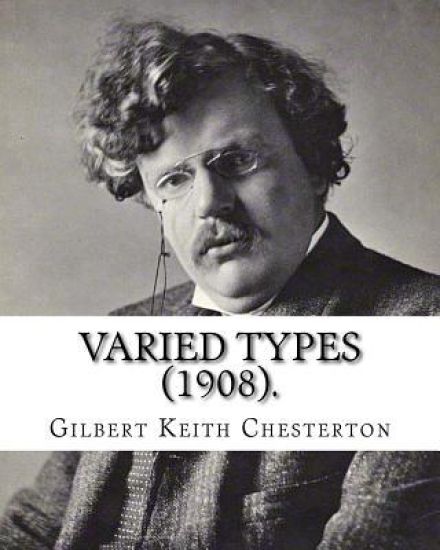
Varied Types (1908). By: Gilbert Keith Chesterton: Speculative fiction

Varied Types (1908). By: Gilbert Keith Chesterton: Speculative fiction

G. K. Chesterton

Createspace Independent Publishing Platform
2017
nidottu
These essays, with some alterations & additions, are reprinted from the Daily News & the Speaker. The 1st 12 were published in London, by A.L. Humphreys, 1903, as Twelve Types. Charlie Bront William Morris & his school The optimism of Byron Pope & the art of satire Francis Rostand Charles II Stevenson Thomas Carlyle Tolstoy & the cult of simpliccity The position of Sir Walter Scott Bret Harte Alfred the great Maeterlinck Ruskin Queen Victoria The German emperor Tennyson Elizabeth Barrett Browning. Gilbert Keith Chesterton, KC*SG (29 May 1874 - 14 June 1936), better known as G. K. Chesterton, was an English writer, poet, philosopher, dramatist, journalist, orator, lay theologian, biographer, and literary and art critic. Chesterton is often referred to as the "prince of paradox". Time magazine has observed of his writing style: "Whenever possible Chesterton made his points with popular sayings, proverbs, allegories-first carefully turning them inside out." Chesterton is well known for his fictional priest-detective Father Brown, and for his reasoned apologetics. Even some of those who disagree with him have recognised the wide appeal of such works as Orthodoxy and The Everlasting Man.Chesterton, as a political thinker, cast aspersions on both Progressivism and Conservatism, saying, "The whole modern world has divided itself into Conservatives and Progressives. The business of Progressives is to go on making mistakes. The business of the Conservatives is to prevent the mistakes from being corrected."Chesterton routinely referred to himself as an "orthodox" Christian, and came to identify this position more and more with Catholicism, eventually converting to Catholicism from High Church Anglicanism. George Bernard Shaw, Chesterton's "friendly enemy" according to Time, said of him, "He was a man of colossal genius."Biographers have identified him as a successor to such Victorian authors as Matthew Arnold, Thomas Carlyle, Cardinal John Henry Newman, and John Ruskin.
Tremendous Trifles (1909). By: Gilbert Keith Chesterton: (World's classic's)

Tremendous Trifles (1909). By: Gilbert Keith Chesterton: (World's classic's)

G. K. Chesterton

Createspace Independent Publishing Platform
2017
nidottu
Gilbert Keith Chesterton, KC*SG (29 May 1874 - 14 June 1936), better known as G. K. Chesterton, was an English writer, poet, philosopher, dramatist, journalist, orator, lay theologian, biographer, and literary and art critic. Chesterton is often referred to as the "prince of paradox". Time magazine has observed of his writing style: "Whenever possible Chesterton made his points with popular sayings, proverbs, allegories-first carefully turning them inside out." Chesterton is well known for his fictional priest-detective Father Brown, and for his reasoned apologetics. Even some of those who disagree with him have recognised the wide appeal of such works as Orthodoxy and The Everlasting Man.Chesterton, as a political thinker, cast aspersions on both Progressivism and Conservatism, saying, "The whole modern world has divided itself into Conservatives and Progressives. The business of Progressives is to go on making mistakes. The business of the Conservatives is to prevent the mistakes from being corrected."Chesterton routinely referred to himself as an "orthodox" Christian, and came to identify this position more and more with Catholicism, eventually converting to Catholicism from High Church Anglicanism. George Bernard Shaw, Chesterton's "friendly enemy" according to Time, said of him, "He was a man of colossal genius."Biographers have identified him as a successor to such Victorian authors as Matthew Arnold, Thomas Carlyle, Cardinal John Henry Newman, and John Ruskin.Chesterton was born in Campden Hill in Kensington, London, the son of Marie Louise, n e Grosjean, and Edward Chesterton.He was baptised at the age of one month into the Church of England, though his family themselves were irregularly practising Unitarians. According to his autobiography, as a young man Chesterton became fascinated with the occult and, along with his brother Cecil, experimented with Ouija boards. Chesterton was educated at St Paul's School, then attended the Slade School of Art to become an illustrator. The Slade is a department of University College London, where Chesterton also took classes in literature, but did not complete a degree in either subject.
The Victorian Age in Literature (1913). By: Gilbert Keith Chesterton: Victorian literature
'I was born a Victorian; and sympathise not a little with the serious Victorian Spirit.' In this engaging and extremely personal account G K Chesterton expounds his views on Victorian literature. Many of his opinions reflect the conventions of the age; however of the Victorian novel he refreshingly comments 'it is an art in which women are quite beyond controversy'. Gilbert Keith Chesterton, KC*SG (29 May 1874 - 14 June 1936), better known as G. K. Chesterton, was an English writer, poet, philosopher, dramatist, journalist, orator, lay theologian, biographer, and literary and art critic. Chesterton is often referred to as the "prince of paradox". Time magazine has observed of his writing style: "Whenever possible Chesterton made his points with popular sayings, proverbs, allegories-first carefully turning them inside out." Chesterton is well known for his fictional priest-detective Father Brown, and for his reasoned apologetics. Even some of those who disagree with him have recognised the wide appeal of such works as Orthodoxy and The Everlasting Man.Chesterton, as a political thinker, cast aspersions on both Progressivism and Conservatism, saying, "The whole modern world has divided itself into Conservatives and Progressives. The business of Progressives is to go on making mistakes. The business of the Conservatives is to prevent the mistakes from being corrected."Chesterton routinely referred to himself as an "orthodox" Christian, and came to identify this position more and more with Catholicism, eventually converting to Catholicism from High Church Anglicanism. George Bernard Shaw, Chesterton's "friendly enemy" according to Time, said of him, "He was a man of colossal genius."Biographers have identified him as a successor to such Victorian authors as Matthew Arnold, Thomas Carlyle, Cardinal John Henry Newman, and John Ruskin.
The Reminiscences of Vice Adm. Robert Taylor Scott Keith, USN (Ret.)
A 1928 graduate of the Naval Academy, Admiral Keith spent much of his active career in battleships and destroyers such as the USS Utah (BB-31), Arizona (BB-39), Overton (DD-239), and Aylwin (DD-355). He was the commanding officer of the destroyer USS Nicholas (DD-449) during combat in the Pacific in World War II. A substantial part of the memoir recounts his command of the battleship USS Missouri (BB-63) in 1954. He spent three tours on the staff of the Naval Academy, including duty as Commandant of Midshipmen in the mid-1950s. As a flag officer, he commanded the naval base at Subic Bay, the Pacific Fleet Cruiser-Destroyer Force, and the First Fleet.
The Reminiscences of Vice Adm. Robert Taylor Scott Keith, USN (Ret.)
A 1928 graduate of the Naval Academy, Admiral Keith spent much of his active career in battleships and destroyers such as the USS Utah (BB-31), Arizona (BB-39), Overton (DD-239), and Aylwin (DD-355). He was the commanding officer of the destroyer USS Nicholas (DD-449) during combat in the Pacific in World War II. A substantial part of the memoir recounts his command of the battleship USS Missouri (BB-63) in 1954. He spent three tours on the staff of the Naval Academy, including duty as Commandant of Midshipmen in the mid-1950s. As a flag officer, he commanded the naval base at Subic Bay, the Pacific Fleet Cruiser-Destroyer Force, and the First Fleet.
Memorials of the Hon. Ion Keith-Falconer, M.A.

Memorials of the Hon. Ion Keith-Falconer, M.A.

Robert Sinker; Ion Grant Neville Keith-Falconer

Hansebooks
2017
pokkari
Memorials of the Hon. Ion Keith-Falconer, M.A. - Late Lord's Almoner's Professor of Arabic in the University of Cambridge, and Missionary to the Mohammedans of Southern Arabia. Sixth Edition is an unchanged, high-quality reprint of the original edition of 1890. Hansebooks is editor of the literature on different topic areas such as research and science, travel and expeditions, cooking and nutrition, medicine, and other genres. As a publisher we focus on the preservation of historical literature. Many works of historical writers and scientists are available today as antiques only. Hansebooks newly publishes these books and contributes to the preservation of literature which has become rare and historical knowledge for the future.
Mildred at Roselands; A Sequel to Mildred Keith
Mildred at Roselands; A Sequel to Mildred Keith by Martha Finley has been regarded as significant work throughout human history, and in order to ensure that this work is never lost, we have taken steps to ensure its preservation by republishing this book in a contemporary format for both current and future generations. This entire book has been retyped, redesigned, and reformatted. Since these books are not made from scanned copies, the text is readable and clear.
History of the Mortified Lands of Edinaich, in the Parish of Keith, Etc.

History of the Mortified Lands of Edinaich, in the Parish of Keith, Etc.

James Lawrence

British Library, Historical Print Editions
2011
pokkari
Title: History of the Mortified Lands of Edinaich, in the Parish of Keith, etc.Publisher: British Library, Historical Print EditionsThe British Library is the national library of the United Kingdom. It is one of the world's largest research libraries holding over 150 million items in all known languages and formats: books, journals, newspapers, sound recordings, patents, maps, stamps, prints and much more. Its collections include around 14 million books, along with substantial additional collections of manuscripts and historical items dating back as far as 300 BC.The HISTORY OF BRITAIN & IRELAND collection includes books from the British Library digitised by Microsoft. As well as historical works, this collection includes geographies, travelogues, and titles covering periods of competition and cooperation among the people of Great Britain and Ireland. Works also explore the countries' relations with France, Germany, the Low Countries, Denmark, and Scandinavia. ++++The below data was compiled from various identification fields in the bibliographic record of this title. This data is provided as an additional tool in helping to insure edition identification: ++++ British Library Lawrence, James; 1884. 75 p.; 8 . 10369.d.25.
His Double Self; Or, the Transformation of Keith Winstanley.

His Double Self; Or, the Transformation of Keith Winstanley.

E Curtis

British Library, Historical Print Editions
2011
pokkari
Title: His Double Self; or, the Transformation of Keith Winstanley.Publisher: British Library, Historical Print EditionsThe British Library is the national library of the United Kingdom. It is one of the world's largest research libraries holding over 150 million items in all known languages and formats: books, journals, newspapers, sound recordings, patents, maps, stamps, prints and much more. Its collections include around 14 million books, along with substantial additional collections of manuscripts and historical items dating back as far as 300 BC.The GENERAL HISTORICAL collection includes books from the British Library digitised by Microsoft. This varied collection includes material that gives readers a 19th century view of the world. Topics include health, education, economics, agriculture, environment, technology, culture, politics, labour and industry, mining, penal policy, and social order. ++++The below data was compiled from various identification fields in the bibliographic record of this title. This data is provided as an additional tool in helping to insure edition identification: ++++ British Library Curtis, E.; 1897. 283 p.; 8 . 012626.l.39.