Kirjahaku
Etsi kirjoja tekijän nimen, kirjan nimen tai ISBN:n perusteella.
1000 tulosta hakusanalla Patricia Springborg
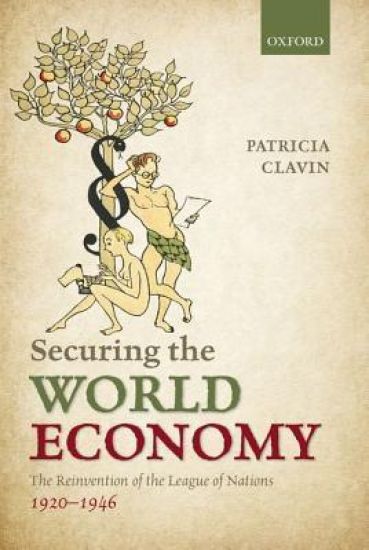
Securing the World Economy explains how efforts to support global capitalism became a core objective of the League of Nations. Based on new research drawn together from archives on three continents, it explores how the world's first ever inter-governmental organization sought to understand and shape the powerful forces that influenced the global economy, and the prospects for peace. It traces how the League was drawn into economics and finance by the exigencies of the slump and hyperinflation after the First World War, when it provided essential financial support to Austria, Hungary, Greece, Bulgaria, and Estonia and, thereby, established the founding principles of financial intervention, international oversight, and the twentieth-century notion of international 'development'. But it is the impact of the Great Depression after 1929 that lies at the heart of this history. Patricia Clavin traces how the League of Nations sought to combat economic nationalism and promote economic and monetary co-operation in a variety of, sometimes contradictory, ways. Many of the economists, bureaucrats, and policy-advisors who worked for it played a seminal role in the history of international relations and social science, and their efforts did not end with the outbreak of the Second World War. In 1940 the League established an economic mission in the United States, where it contributed to the creation of organizations for the post-war world - the United Nations Organization, the IMF, the World Bank, the UN Food and Agriculture Organization - as well as to plans for European reconstruction and co-operation. It is a history that resonates deeply with challenges that face the Twenty-First Century world.

Science: A Four Thousand Year History rewrites science's past. Instead of focussing on difficult experiments and abstract theories, Patricia Fara shows how science has always belonged to the practical world of war, politics, and business. Rather than glorifying scientists as idealized heroes, she tells true stories about real people - men (and some women) who needed to earn their living, who made mistakes, and who trampled down their rivals in their quest for success. Fara sweeps through the centuries, from ancient Babylon right up to the latest hi-tech experiments in genetics and particle physics, illuminating the financial interests, imperial ambitions, and publishing enterprises that have made science the powerful global phenomenon that it is today. She also ranges internationally, illustrating the importance of scientific projects based around the world, from China to the Islamic empire, as well as the more familiar tale of science in Europe, from Copernicus to Charles Darwin and beyond. Above all, this four thousand year history challenges scientific supremacy, arguing controversially that science is successful not because it is always right - but because people have said that it is right.
The Institutional Logics Perspective
Patricia H. Thornton; William Ocasio; Michael Lounsbury
Oxford University Press
2012
sidottu
How do institutions influence and shape cognition and action in individuals and organizations, and how are they in turn shaped by them? Various social science disciplines have offered a range of theories and perspectives to provide answers to this question. Within organization studies in recent years, several scholars have developed the institutional logics perspective. An institutional logic is the set of material practices and symbolic systems including assumptions, values, and beliefs by which individuals and organizations provide meaning to their daily activity, organize time and space, and reproduce their lives and experiences. This approach affords significant insights, methodologies, and research tools, to analyze the multiple combinations of factors that may determine cognition, behaviour, and rationalities. In tracing the development of the institutional logics perspective from earlier institutional theory, the book analyzes seminal research, illustrating how and why influential works on institutional theory motivated a distinct new approach to scholarship on institutional logics. The book shows how the institutional logics perspective transforms institutional theory. It presents novel theory, further elaborates the institutional logics perspective, and forges new linkages to key literatures on practice, identity, and social and cognitive psychology. It develops the microfoundations of institutional logics and institutional entrepreneurship, proposing a set of mechanisms that go beyond meta-theory, integrating this work with macro theory on institutional logics into a cross-levels model of cultural heterogeneity. By incorporating current psychological understanding of human behaviour and linking it to sociological perspectives, it aims to provide an encompassing framework for institutional analysis, and to be an essential and accessible reference for scholars and advanced students of organizational behaviour, organization and management theory, business strategy, and cultural sociology.
The Institutional Logics Perspective
Patricia H. Thornton; William Ocasio; Michael Lounsbury
Oxford University Press
2012
nidottu
How do institutions influence and shape cognition and action in individuals and organizations, and how are they in turn shaped by them? Various social science disciplines have offered a range of theories and perspectives to provide answers to this question. Within organization studies in recent years, several scholars have developed the institutional logics perspective. An institutional logic is the set of material practices and symbolic systems including assumptions, values, and beliefs by which individuals and organizations provide meaning to their daily activity, organize time and space, and reproduce their lives and experiences. This approach affords significant insights, methodologies, and research tools, to analyze the multiple combinations of factors that may determine cognition, behaviour, and rationalities. In tracing the development of the institutional logics perspective from earlier institutional theory, the book analyzes seminal research, illustrating how and why influential works on institutional theory motivated a distinct new approach to scholarship on institutional logics. The book shows how the institutional logics perspective transforms institutional theory. It presents novel theory, further elaborates the institutional logics perspective, and forges new linkages to key literatures on practice, identity, and social and cognitive psychology. It develops the microfoundations of institutional logics and institutional entrepreneurship, proposing a set of mechanisms that go beyond meta-theory, integrating this work with macro theory on institutional logics into a cross-levels model of cultural heterogeneity. By incorporating current psychological understanding of human behaviour and linking it to sociological perspectives, it aims to provide an encompassing framework for institutional analysis, and to be an essential and accessible reference for scholars and advanced students of organizational behaviour, organization and management theory, business strategy, and cultural sociology.
'Rich in gold and cloths'? This is the first full-length study of the history of medieval maritime republic of Amalfi that addresses both the internal political, social, and economic history of Amalfi - as an independent city-state, under Norman rule and as part of the Kingdom of Sicily - and the history of its diaspora, those Amalfitans who left temporarily or permanently and whose activities contributed to the image of their home city as a thriving centre specialising in the luxury end of the market. In reuniting these two disparate strands of its history, Patricia Skinner argues that, instead of being seen in opposition to each other, the very different evidence presented by the internal documentary archives and the narrative accounts of external observers can and should be utilised to reconstruct the ties which bound the emigrants to their home city. By taking a prosopographical approach, she reveals the presence of Amalfitans in many parts of the Italian peninsula and further afield in the Mediterranean. At the same time, she critically re-examines some of the externally-generated views of Amalfitan wealth, suggesting that these may have as much - or more - to do with literary and patronage networks as with the actual situation on the ground.
Hyper-Organization offers an institutional explanation for the expansion of formal organization in the contemporary era-in numbers, internal complexity, social domains, and national contexts. Much expansion is hard to justify in terms of technical production or political power, it lies in areas such as protecting the environment, promoting marginalized groups, or behaving with transparency. The authors argue that expansion is supported by widespread cultural rationalization characterized by scientism, rights and empowerment discourses, and an explosion of education. These cultural changes are transmitted through legal, accounting, and professionalization principles, driving the creation of new organizations and the elaboration of existing ones. The resulting organizations are constructed to be proper social actors, as much as functionally effective entities. They are painted as autonomous and integrated but depend heavily on external definitions to sustain this depiction. So expansion creates organizations that are, whatever their actual effectiveness, structurally arational. This book advances theories of social organization in three main ways. First, by giving an account of the expansive rise of 'organization' rooted in rapid worldwide cultural rationalization. Second, explaining the construction of contemporary organizations as purposive actors, rather than passive bureaucracies or loose associations. Third, showing how the expanded actorhood of the contemporary organization, and the associated interpenetration with the environment, dialectically generate structures far removed from instrumental rationality.
Evidence-Based Practice in Educating Deaf and Hard-of-Hearing Students
Patricia Elizabeth Spencer; Marc Marschark
Oxford University Press Inc
2010
nidottu
Debates about methods of supporting language development and academic skills of deaf or hard-of-hearing children have waxed and waned for more than 100 years: Will using sign language interfere with learning to use spoken language or does it offer optimal access to communication for deaf children? Does placement in classrooms with mostly hearing children enhance or impede academic and social-emotional development? Will cochlear implants or other assistive listening devices provide deaf children with sufficient input for age-appropriate reading abilities? Are traditional methods of classroom teaching effective for deaf and hard-of-hearing students? Although there is a wealth of evidence with regard to each of these issues, too often, decisions on how to best support deaf and hard-of-hearing children in developing language and academic skills are made based on incorrect or incomplete information. No matter how well-intentioned, decisions grounded in opinions, beliefs, or value judgments are insufficient to guide practice. Instead, we need to take advantage of relevant, emerging research concerning best practices and outcomes in educating deaf and hard-of-hearing learners. In this critical evaluation of what we know and what we do not know about educating deaf and hard-of-hearing students, the authors examine a wide range of educational settings and research methods that have guided deaf education in recent years--or should. The book provides a focus for future educational and research efforts, and aims to promote optimal support for deaf and hard-of-hearing learners of all ages. Co-authored by two of the most respected leaders in the field, this book summarizes and evaluates research findings across multiple disciplines pertaining to the raising and educating of deaf children, providing a comprehensive but concise record of the successes, failures, and unanswered questions in deaf education. A readily accessible and invaluable source for teachers, university students, and other professionals, Evidence-Based Practice in Educating Deaf and Hard-of-Hearing Students encourages readers to reconsider assumptions and delve more deeply into what we really know about deaf and hard-of-hearing children, their patterns of development, and their lifelong learning.
Adolescence and Beyond
Patricia K. Kerig; Marc S. Schulz; Stuart T. Hauser
Oxford University Press Inc
2012
sidottu
While the period of transition from adolescence to adulthood has become a recent focus for developmental psychologists and child mental health practitioners, the full role of the family during this period is only beginning to be explored. Many compelling questions, of interest to anyone involved in adolescence research, remain unanswered. To what extent do family experiences influence the way one navigates through emerging adulthood? How do we begin to understand the interplay between adolescents' contexts and their development and well-being? Adolescence and Beyond: Family Processes and Development offers an accessible synthesis of research, theories, and perspectives on the family processes that contribute to development. Chapters from expert researchers cover a wide variety of topics surrounding the link between family processes and individual development, including adolescent romantic relationships, emotion regulation, resilience in contexts of risk, and socio-cultural and ethnic influences on development. Drawing on diverse research and methodological approaches that include direct family observations, interviews, and narrative analyses, this volume presents cutting-edge conceptual and empirical work on the key developmental tasks and challenges in the transition between adolescence and adulthood. Researchers, practitioners, and students in social, developmental, and clinical psychology--as well as those in social work, psychiatry, and pediatrics--will find this book an invaluable summary of important research on the link between family process and individual development.
Kant's discussion of the relations between cognition and self-consciousness lie at the heart of the Critique of Pure Reason, in the celebrated transcendental deduction. Although this section of Kant's masterpiece is widely believed to contain important insights into cognition and self-consciousness, it has long been viewed as unusually obscure. Many philosophers have tried to avoid the transcendental psychology that Kant employed. By contrast, Patricia Kitcher follows Kant's careful delineation of the necessary conditions for knowledge and his intricate argument that knowledge requires self-consciousness. She argues that far from being an exercise in armchair psychology, the thesis that thinkers must be aware of the connections among their mental states offers an astute analysis of the requirements of rational thought. The book opens by situating Kant's theories in the then contemporary debates about 'apperception,' personal identity and the relations between object cognition and self-consciousness. After laying out Kant's argument that the distinctive kind of knowledge that humans have requires a unified self- consciousness, Kitcher considers the implications of his theory for current problems in the philosophy of mind. If Kant is right that rational cognition requires acts of thought that are at least implicitly conscious, then theories of consciousness face a second 'hard problem' beyond the familiar difficulties with the qualities of sensations. How is conscious reasoning to be understood? Kitcher shows that current accounts of the self-ascription of belief have great trouble in explaining the case where subjects know their reasons for the belief. She presents a 'new' Kantian approach to handling this problem. In this way, the book reveals Kant as a thinker of great relevance to contemporary philosophy, one whose allegedly obscure achievements provide solutions to problems that are still with us.
High Quality Psychotherapy Research
Patricia A. Arean; Helena Chmura Kraemer
Oxford University Press Inc
2013
sidottu
Although psychotherapy research shares many of the same methodological issues that pharmacology trials do, psychotherapy research poses unique challenges, including the difficulty (if not near impossibility) of keeping participants blind to treatment assignment, the need for a replicable manual and therapist training procedure, the importance of outside observation of therapy quality ratings, and the problems researchers face in measuring the active ingredients of psychotherapy. High Quality Psychotherapy Research is for all psychotherapy investigators who wish to learn state-of-the-art psychotherapy research methods. Organized developmentally, the book explains the conceptualization of the trial, discusses the pilot study and the large scale study, and concludes with instructions for designing a multi-site trial. Topics specific to psychotherapy research are examined in detail, including innovations in data analysis, how to conduct multi-site psychotherapy trials, mediation of treatment outcomes, the transportability of evidence-based behavioral interventions in community practice, training community providers to be study therapists, and recruiting hard-to-reach populations. High Quality Psychotherapy Research is an informative, practical book appropriate for a broad range of readers, from junior investigators developing their first study idea to seasoned investigators who wish to take their research to a larger-scale level.
Knowing Body, Moving Mind investigates ritualizing and learning in introductory meditation classes at two Buddhist centers in Toronto, Canada. The centers, Friends of the Heart and Chandrakirti, are led and attended by Western (sometimes called "convert') Buddhists: that is, people from non-Buddhist familial and cultural backgrounds. Inspired by theories that suggest that rituals impart new knowledge or understanding, Patricia Campbell examines how introductory meditation students learn through formal Buddhist practice. Along the way, she also explores practitioners' reasons for enrolling in meditation classes, their interests in Buddhism, and their responses to formal Buddhist practices and to ritual in general. Based on ethnographic interviews and participant-observation fieldwork, the text follows interview participants' reflections on what they learned in meditation classes and through personal practice, and what roles meditation and other ritual practices played in that learning. Participants' learning experiences are illuminated by an influential learning theory called Bloom's Taxonomy, while the rites and practices taught and performed at the centers are explored using performance theory, a method which focuses on the performative elements of ritual's postures and gestures. But the study expands the performance framework as well, by demonstrating that performative ritualizing includes the concentration techniques that take place in a meditator's mind. Such techniques are received as traditional mental acts or behaviors that are standardized, repetitively performed, and variously regarded as special, elevated, spiritual or religious. Having established a link between mental and physical forms of ritualizing, the study then demonstrates that the repetitive mental techniques of meditation practice train the mind to develop new skills in the same way that physical postures and gestures train the body. The mind is thus experienced as both embodied and gestural, and the whole of the body as socially and ritually informed.
Despite their immense war-fighting capacity, the five most powerful states in the international system have failed to attain their primary political objective in almost 40% of their military operations against weak state and non-state targets since 1945. Why are states with tremendous military might so often unable to attain their objectives when they use force against weaker adversaries? More broadly, under what conditions can states use military force to attain their political objectives and what conditions limit the utility of military force as a policy instrument? Can we predict the outcome of a war before the fighting begins? Scholars and military leaders have argued that poor military strategy choices, domestic political constraints on democratic governments, or failure to commit sufficient resources to the war effort can explain why strong states lose small wars. In contrast, Who Wins? by Patricia L. Sullivan argues that the key to understanding strategic success in war lies in the nature of the political objectives states pursue through the use of military force. Sullvian does not deny the importance of war-fighting capacity, military strategies, or resolve as determinants of war outcomes. But she provides both a coherent argument and substantial empirical evidence that the effects of these factors are dependent on the nature of the belligerents' political objectives. The theory's predictions about the conditions under which states are able to attain their political objectives through the use of military force are tested against the most widely accepted alternative explanations of war outcomes with an abundance of historical data on violent conflicts. The results support Sullivan's argument and challenge both existing theories and conventional wisdom about the impact of factors like military strength, resolve, regime type, and war-fighting strategies on war outcomes.
In Frege's Conception of Logic Patricia A. Blanchette explores the relationship between Gottlob Frege's understanding of conceptual analysis and his understanding of logic. She argues that the fruitfulness of Frege's conception of logic, and the illuminating differences between that conception and those more modern views that have largely supplanted it, are best understood against the backdrop of a clear account of the role of conceptual analysis in logical investigation. The first part of the book locates the role of conceptual analysis in Frege's logicist project. Blanchette argues that despite a number of difficulties, Frege's use of analysis in the service of logicism is a powerful and coherent tool. As a result of coming to grips with his use of that tool, we can see that there is, despite appearances, no conflict between Frege's intention to demonstrate the grounds of ordinary arithmetic and the fact that the numerals of his derived sentences fail to co-refer with ordinary numerals. In the second part of the book, Blanchette explores the resulting conception of logic itself, and some of the straightforward ways in which Frege's conception differs from its now-familiar descendants. In particular, Blanchette argues that consistency, as Frege understands it, differs significantly from the kind of consistency demonstrable via the construction of models. To appreciate this difference is to appreciate the extent to which Frege was right in his debate with Hilbert over consistency- and independence-proofs in geometry. For similar reasons, modern results such as the completeness of formal systems and the categoricity of theories do not have for Frege the same importance they are commonly taken to have by his post-Tarskian descendants. These differences, together with the coherence of Frege's position, provide reason for caution with respect to the appeal to formal systems and their properties in the treatment of fundamental logical properties and relations.
Nurturing Language and Learning
Patricia Elizabeth Spencer; Lynne Sanford Koester
Oxford University Press Inc
2016
nidottu
Regardless of a child's hearing abilities, increasing parents' knowledge about their baby or toddler's expected development and their confidence in their parenting abilities supports positive early interactions and developmental progress. Fortunately, as early hearing screening has become widespread, more information is available about development of deaf and hard-of-hearing infants and ways to best support their developing learning and language abilities. This book combines a review of up-to-date research with theory and first-hand observations to provide a framework for parents and professionals as they promote developmental achievements of infants and toddlers with limited hearing. In what ways is development of deaf and hard-of-hearing babies and toddlers like that of those with typical hearing? What specific challenges are likely to be faced by child and parent - and when are they most likely to occur? What modifications in parenting and caregiver interactive behaviors can help avoid or overcome these challenges? A strong, supportive foundation for optimal learning throughout life grows from early, positive, and responsive interactive experiences. This book provides information and guidelines for professionals and parents helping deaf and hard-of-hearing infants and toddlers build that foundation.
Explores successful collaborations while discussing how motivational collaboration leads others to pool their talents
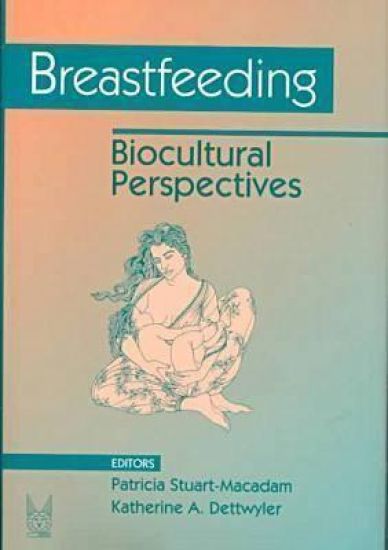
Breastfeeding is a biocultural phenomenon: not only is it a biological process, but it is also a culturally determined behavior. As such, it has important implications for understanding the past, present, and future condition of our species. In general, scholars have emphasized either the biological or the cultural aspects of breastfeeding, but not both. As biological anthropologists the editors of this volume feel that an evolutionary approach combining both aspects is essential. One of the goals of their book is to incorporate data from diverse fields to present a more holistic view of breastfeeding, through the inclusion of research from a number of different disciplines, including biological and social/cultural anthropology, nutrition, and medicine. The resulting book, presenting the complexity of the issues surrounding very basic decisions about infant nutrition, will fill a void in the existing literature on breastfeeding.