
Kirjahaku
Etsi kirjoja tekijän nimen, kirjan nimen tai ISBN:n perusteella.
1000 tulosta hakusanalla SWAMI RAM CHARRAN

Contemplations and Deliberations between Swami Vidyananda and John Brokaar
John Brokaar; Swami Vidyananda
Digital on Demand
2025
pokkari

I 00 Jahre Swami
BoD - Books on Demand
2025
sidottu

WHAT RELIGION IS IN THE WORDS OF SWAMI V
JOHN YALE; Christopher Isherwood; John (EDT) Yale
UNKNOWN
2007
sidottu

The Complete Works Of The Swami Vivekananda, Part 1 (1847)
Vivekananda
KESSINGER PUBLISHING, LLC
2009
pokkari

The Sweet Teachings of the Blessed Sankaracarya Swami Brahmananda Saraswati
LB Shriver; Translation by Cynthia Ann Humes
Lulu.com
2013
nidottu
In the late 1990's, LB Shriver traveled to India as a journalist-seeker to find answers to questions he had about Swami Brahmananda Saraswati. All proceeds from this book will go to Sacred Sun Ministries.



Shri Manache Shloka: English Translation of Smarath Swami Ramdas Shri Manache Shlok from Marathi
Geeta Sureshkumar Bhatt
Createspace Independent Publishing Platform
2014
nidottu
The most popular book 'Manache Shlok or Manobodh' includes 205 shloka with 4 lines each. Since the 17th century, 'Manache Schlok are being recited by common people in Maharashtra. Many have learnt them by heart, since the style of schlokas is unique, easy, beautiful and simple, though artistic and meaningful. Manache Shlok teaches your mind to change yourself gradually. The great saint Samartha Ramdas teaches us to have dialogue with our own mind. Your own mind is your friend, your enemy and your own mind can be also your Guru. Find out the reasons of your anger, jealousy, greed, sorrow, depression, fear, because these are the negative emotions, which you have to face constantly in your life. Convince your mind with Ramdas's words as he says, "O you, my coward mind, why are you afraid of worldly sorrows? Get rid of fear and hold courage".

Common platform for Science and Spirituality: Swami Vivekananda views on utility of Upanishad
Amrendra Narayan Pandey
Createspace Independent Publishing Platform
2016
nidottu
The science is in search of truth and gets many innovative concepts while discovering the truth. The spiritual masters or seers have already discovered the truth (supreme reality). Unless, they (scientist and spiritual master) exchange their views or findings in a scientific language, the benefit of both the domains will not be useful for human beings. A common platform is needed in the present era; for which Swami Vivekananda has given the sufficient explanations more than 150 years ago. Swami Vivekananda delivered his talk at London in 1896 (ref. complete works of swami Vivekananda, volume II Chapter 6) where he talked about i) Materialism ii) Meaning of duality iii) How dualism affects the researcher? iv) How Advaita can encircle the religions? v) Need of universal religion vi) How Advaita viewed by Buddha? vii) Importance of Advaita and viii) how scientific concept and Vedanta are parallel or closer? About more than 150 years ago, Swami Ji has visualized the common platform for the scientist and also for the spiritual masters to have a dialogue and exchange their views. The book describes the themes strengthening the common platform with the help of images exploring i)Researcher and Advaita ii)Why Advaita in Western World? iii) Religions and Advaita iv)Buddha and Advaita v)Buddha and Shankara (Advaita) vi)Importance of Advaita vii)Old concept of Materialism viii)How to solve the materialism? ix)Shankara Concept of Advaita x)Parallel between Science and Upanishad xi)Finding of Oneness by Upanishad xii)Universal Religions xiii)Why dualism is Popular? xiv)Common belief of Dualist xv)Vedanta is the need of Era The researcher of the West (Scientists) and East (Spiritual masters) can make use of the common platform for dialogue and discovery of the unknown from the transcendental body (the Supreme reality).
Privation and Hardships of Modern Monk -Swami Vivekananda
Vijayapadma
Createspace Independent Publishing Platform
2017
nidottu

The Socio-Political Philosophy of Swami Vivekananda
Bhaiya Subhash Chandra Prasad
Dissertation.com
1999
pokkari

Fun Affirmations for Children: A Little Swami Book for Kids
Marta Rodriguez; Laura Rather; Little Swami
Createspace Independent Publishing Platform
2018
nidottu
Little Swami's Book of Affirmations for Children is a book created for kids with affirmations set in fun rhymes to introduce and reinforce core beliefs about love, abundance, courage, self-confidence, purpose, and other important values that set the stage for healthy development. The more affirming positive, and well developed a child's belief system is, the easier it will be for them to stay confident, prosperous and happy throughout their life.
Monk's Musings: Gems from Swami Vivekananda's preachings
Cham Pavin
Createspace Independent Publishing Platform
2018
nidottu

Education In The Vision of Swami Vivekananda
Tirumalamba Koda
LAP Lambert Academic Publishing
2013
pokkari

Impact of Education and Social Philosophy of Swami Vivekananda
Prohlad Roy; Smrutirekha Dash
Lap Lambert Academic Publishing
2024
pokkari
Swami Vivekananda was a mysterious figure when he first came to the United States. Even in his nation, he was a nobody. Harvard University professor J.H. Wright had a private supper with Vivekananda and was so moved by the man's research that he wrote to several significant figures associated with the Parliament of Religion. In introducing Vivekananda, he wrote, "Here is a man who is more learned than all our learned professors put together." When they first started, they used to preach that India was a country entirely of heathens who needed to be saved by Christianity. The American press, on the other hand, started to argue that it was shameful for anyone to try to teach Indian religion and that instead, the world should come to her feet to study it. Vivekananda added that India needed material assistance more than religion. The missionaries now began embarrassing him in numerous ways. They even started spreading rumours about him. Strangely enough, a few of his fellow citizens joined them for independence. But as Vivekananda often said, "Truth alone prevails." He did not attempt to defend himself, while others fiercely objected and stood up for him.

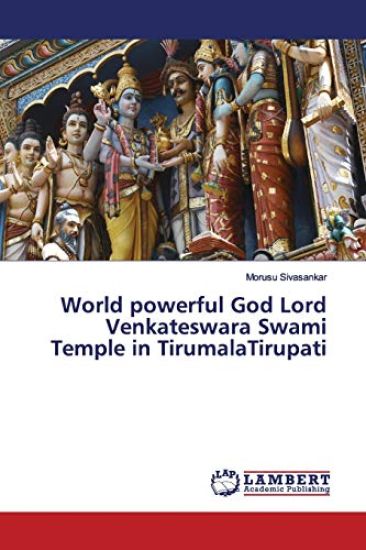
World powerful God Lord Venkateswara Swami Temple in TirumalaTirupati
Morusu Sivasankar
LAP Lambert Academic Publishing
2019
pokkari
Venkateswara literally means "Lord of Venkata". The word is a combination of the words Venkata (the name of a hill in Andhra Pradesh) and isvara ("Lord"). According to the Brahmanda and Bhavishyottara Puranas, the word "Venkata" means "destroyer of sins", deriving from the Sanskrit words vem (sins) and kata (power of immunity Venkateswara (Sanskrit: वेङ्कटेश्वर, IAST: Vēṅkaṭēśvara), also known as Śrīnivāsa, Bālājī, Vēṅkaṭa, Venkata Ramana, Vēṅkaṭāchalapati, Tirupati Timmappa and Govindha, is a form of the Hindu god Vishnu. Venkateswara's most prominent temple is the Tirumala Venkateswara Temple located in Tirupathi, Andhra Pradesh in Southern India.Every year, lakhs of devotees donate a large amount of wealth at the Tirumala Venkateswara Temple at Tirupati, Andhra Pradesh. Goddess Lakshmi, also referred as Sri, once had a fight with Lord Vishnu and left Vaikunta. She came and settled on earth in disguise. Lord Vishnu soon arrived on earth searching for Goddess Lakshmi. But He failed to find her and instead settled on Tirumala hills in the form of a forest gatherer and continued the search. During the search, Lord Vishnu met a beautiful girl named Padmavati who was the daughter
Auswirkungen der Bildungs- und Sozialphilosophie von Swami Vivekananda
Prohlad Roy; Smrutirekha Dash
Verlag Unser Wissen
2024
pokkari
Swami Vivekananda war eine geheimnisvolle Gestalt, als er zum ersten Mal in die Vereinigten Staaten kam. Selbst in seinem Land war er ein Niemand. Der Professor der Harvard University, J.H. Wright, nahm ein privates Abendessen mit Vivekananda ein und war von den Forschungen des Mannes so bewegt, dass er an mehrere bedeutende Pers nlichkeiten schrieb, die mit dem Parlament der Religionen verbunden waren. Als er Vivekananda vorstellte, schrieb er: "Hier ist ein Mann, der gelehrter ist als alle unsere gelehrten Professoren zusammen." Als sie anfingen, predigten sie, Indien sei ein Land voller Heiden, die durch das Christentum gerettet werden m ssten. Die amerikanische Presse hingegen begann zu argumentieren, dass es f r jeden eine Schande sei, zu versuchen, die indische Religion zu lehren, und dass stattdessen die Welt zu ihren F en kommen sollte, um sie zu studieren. Vivekananda f gte hinzu, dass Indien eher materielle Hilfe ben tige als Religion. Die Missionare begannen nun, ihn auf vielf ltige Weise zu blamieren. Sie begannen sogar, Ger chte ber ihn zu verbreiten. Seltsamerweise schlossen sich einige seiner Mitb rger ihnen f r die Unabh ngigkeit an. Aber wie Vivekananda oft sagte: "Die Wahrheit allein siegt." Er versuchte nicht, sich zu verteidigen, w hrend andere sich heftig wehrten und f r ihn eintraten.