Kirjojen hintavertailu. Mukana 12 016 292 kirjaa ja 12 kauppaa.

Kirjahaku

Etsi kirjoja tekijän nimen, kirjan nimen tai ISBN:n perusteella.

1000 tulosta hakusanalla Sinclair Lewis

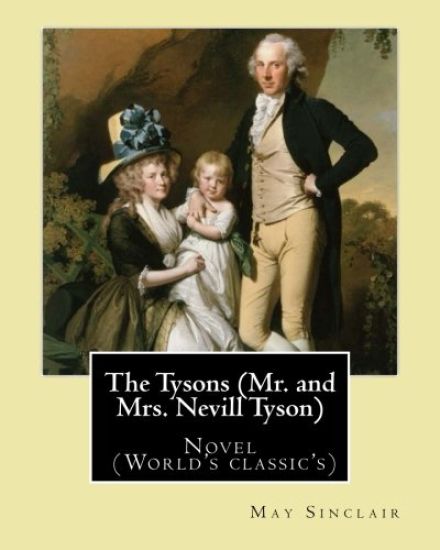
The Tysons (Mr. and Mrs. Nevill Tyson). By: May Sinclair: Novel (World's classic's)

The Tysons (Mr. and Mrs. Nevill Tyson). By: May Sinclair: Novel (World's classic's)

May Sinclair

Createspace Independent Publishing Platform
2017
nidottu
May Sinclair was the pseudonym of Mary Amelia St. Clair (24 August 1863 - 14 November 1946), a popular British writer who wrote about two dozen novels, short stories and poetry.She was an active suffragist, and member of the Woman Writers' Suffrage League. May Sinclair was also a significant critic in the area of modernist poetry and prose, and she is attributed with first using the term stream of consciousness in a literary context, when reviewing the first volumes of Dorothy Richardson's novel sequence Pilgrimage (1915-67), in The Egoist, April 1918. Early life: She was born in Rock Ferry, Cheshire. Her father was a Liverpool shipowner, who went bankrupt, became an alcoholic, and died before she was an adult. Her mother was strict and religious; the family moved to Ilford on the edge of London. After one year of education at Cheltenham Ladies College, she acted as caretaker for her brothers, as four of the five, all older, were suffering from a fatal congenital heart disease. Career: From 1896 she wrote professionally, to support herself and her mother, who died in 1901. An active feminist, Sinclair treated a number of themes relating to the position of women, and marriage. She also wrote non-fiction based on studies of philosophy, particularly German idealism. Her works sold well in the United States. Around 1913, at the Medico-Psychological Clinic in London, she became interested in psychoanalytic thought, and introduced matter related to Sigmund Freud's teaching in her novels.In 1914, she volunteered to join the Munro Ambulance Corps, a charitable organization (which included Lady Dorothie Feilding, Elsie Knocker and Mairi Chisholm) that aided wounded Belgian soldiers on the Western Front in Flanders. She was sent home after only a few weeks at the front; she wrote about the experience in both prose and poetry. She wrote early criticism on Imagism and the poet H. D. (1915 in The Egoist); she was on social terms with H. D. (Hilda Doolittle), Richard Aldington and Ezra Pound at the time. She also reviewed in a positive light the poetry of T. S. Eliot (1917 in the Little Review) and the fiction of Dorothy Richardson (1918 in The Egoist). It was in connection with Richardson that she introduced "stream of consciousness" as a literary term, which was very generally adopted. Some aspects of Sinclair's subsequent novels have been traced as influenced by modernist techniques, particularly in the autobiographical Mary Olivier: A Life (1919). She was included in the 1925 Contact Collection of Contemporary Writers. Sinclair was a believer in Spiritualism, and was also a member of the Society for Psychical Research from 1914. Sinclair wrote two volumes of supernatural fiction, Uncanny Stories (1923) and The Intercessor and Other Stories (1931).E. F. Bleiler called Sinclair "an underrated writer" and described Uncanny Stories as "excellent".Gary Crawford has stated Sinclair's contribution to the supernatural fiction genre, "small as it is, is notable".Jacques Barzun included Sinclair among a list of supernatural fiction writers that "one should make a point of seeking out".Brian Stableford has stated that Sinclair's "supernatural tales are written with uncommon delicacy and precision, and they are among the most effective examples of their fugitive kind." Andrew Smith has described Uncanny Stories as "an important contribution to the ghost story". From the late 1920s she was suffering from the early signs of Parkinson's disease, and ceased writing. She settled with a companion in Buckinghamshire in 1932.
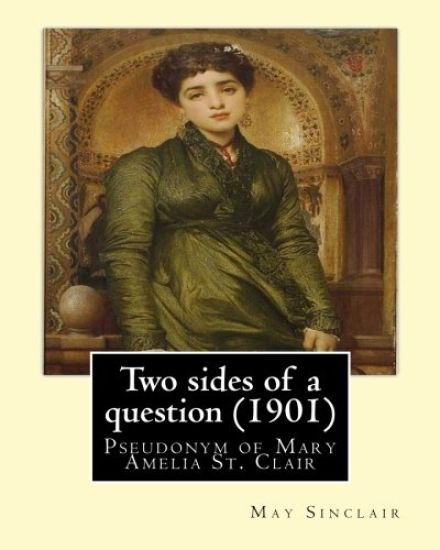
Two sides of a question (1901). By: May Sinclair: May Sinclair was the pseudonym of Mary Amelia St. Clair
May Sinclair was the pseudonym of Mary Amelia St. Clair (24 August 1863 - 14 November 1946), a popular British writer who wrote about two dozen novels, short stories and poetry.She was an active suffragist, and member of the Woman Writers' Suffrage League. May Sinclair was also a significant critic in the area of modernist poetry and prose, and she is attributed with first using the term stream of consciousness in a literary context, when reviewing the first volumes of Dorothy Richardson's novel sequence Pilgrimage (1915-67), in The Egoist, April 1918. Early life: She was born in Rock Ferry, Cheshire. Her father was a Liverpool shipowner, who went bankrupt, became an alcoholic, and died before she was an adult. Her mother was strict and religious; the family moved to Ilford on the edge of London. After one year of education at Cheltenham Ladies College, she acted as caretaker for her brothers, as four of the five, all older, were suffering from a fatal congenital heart disease. Career: From 1896 she wrote professionally, to support herself and her mother, who died in 1901. An active feminist, Sinclair treated a number of themes relating to the position of women, and marriage. She also wrote non-fiction based on studies of philosophy, particularly German idealism. Her works sold well in the United States. Around 1913, at the Medico-Psychological Clinic in London, she became interested in psychoanalytic thought, and introduced matter related to Sigmund Freud's teaching in her novels.In 1914, she volunteered to join the Munro Ambulance Corps, a charitable organization (which included Lady Dorothie Feilding, Elsie Knocker and Mairi Chisholm) that aided wounded Belgian soldiers on the Western Front in Flanders. She was sent home after only a few weeks at the front; she wrote about the experience in both prose and poetry. She wrote early criticism on Imagism and the poet H. D. (1915 in The Egoist); she was on social terms with H. D. (Hilda Doolittle), Richard Aldington and Ezra Pound at the time. She also reviewed in a positive light the poetry of T. S. Eliot (1917 in the Little Review) and the fiction of Dorothy Richardson (1918 in The Egoist). It was in connection with Richardson that she introduced "stream of consciousness" as a literary term, which was very generally adopted. Some aspects of Sinclair's subsequent novels have been traced as influenced by modernist techniques, particularly in the autobiographical Mary Olivier: A Life (1919). She was included in the 1925 Contact Collection of Contemporary Writers. Sinclair was a believer in Spiritualism, and was also a member of the Society for Psychical Research from 1914. Sinclair wrote two volumes of supernatural fiction, Uncanny Stories (1923) and The Intercessor and Other Stories (1931).E. F. Bleiler called Sinclair "an underrated writer" and described Uncanny Stories as "excellent".Gary Crawford has stated Sinclair's contribution to the supernatural fiction genre, "small as it is, is notable".Jacques Barzun included Sinclair among a list of supernatural fiction writers that "one should make a point of seeking out".Brian Stableford has stated that Sinclair's "supernatural tales are written with uncommon delicacy and precision, and they are among the most effective examples of their fugitive kind." Andrew Smith has described Uncanny Stories as "an important contribution to the ghost story". From the late 1920s she was suffering from the early signs of Parkinson's disease, and ceased writing. She settled with a companion in Buckinghamshire in 1932.
The Divine Fire (1904). By: May Sinclair: Novel (Original Classics)

The Divine Fire (1904). By: May Sinclair: Novel (Original Classics)

May Sinclair

Createspace Independent Publishing Platform
2017
nidottu
Did Horace "dare" take a risk on that poet Rickman? The poet dropped his aitches, for one thing. And there was the matter of that actress he doted on -- low-class Yet cousin Lucia kept asking about him . . . and Horace did think maybe, just maybe, Rickman was a genius. But could Horace introduce Rickman to his club? He yearned to -- and yet, as he told Lucia, "The burnt critic dreads the divine fire " In this witty 1904 novel of literary and social manners and foibles, May Sinclair demonstrates all the wit, perception and style that made her one of the most respected -- and most read -- novelists of her time. May Sinclair was the pseudonym of Mary Amelia St. Clair (24 August 1863 - 14 November 1946), a popular British writer who wrote about two dozen novels, short stories and poetry.She was an active suffragist, and member of the Woman Writers' Suffrage League. May Sinclair was also a significant critic in the area of modernist poetry and prose, and she is attributed with first using the term stream of consciousness in a literary context, when reviewing the first volumes of Dorothy Richardson's novel sequence Pilgrimage (1915-67), in The Egoist, April 1918. Early life: She was born in Rock Ferry, Cheshire. Her father was a Liverpool shipowner, who went bankrupt, became an alcoholic, and died before she was an adult. Her mother was strict and religious; the family moved to Ilford on the edge of London. After one year of education at Cheltenham Ladies College, she acted as caretaker for her brothers, as four of the five, all older, were suffering from a fatal congenital heart disease. Career: From 1896 she wrote professionally, to support herself and her mother, who died in 1901. An active feminist, Sinclair treated a number of themes relating to the position of women, and marriage. She also wrote non-fiction based on studies of philosophy, particularly German idealism. Her works sold well in the United States. Around 1913, at the Medico-Psychological Clinic in London, she became interested in psychoanalytic thought, and introduced matter related to Sigmund Freud's teaching in her novels.In 1914, she volunteered to join the Munro Ambulance Corps, a charitable organization (which included Lady Dorothie Feilding, Elsie Knocker and Mairi Chisholm) that aided wounded Belgian soldiers on the Western Front in Flanders. She was sent home after only a few weeks at the front; she wrote about the experience in both prose and poetry. She wrote early criticism on Imagism and the poet H. D. (1915 in The Egoist); she was on social terms with H. D. (Hilda Doolittle), Richard Aldington and Ezra Pound at the time. She also reviewed in a positive light the poetry of T. S. Eliot (1917 in the Little Review) and the fiction of Dorothy Richardson (1918 in The Egoist). It was in connection with Richardson that she introduced "stream of consciousness" as a literary term, which was very generally adopted. Some aspects of Sinclair's subsequent novels have been traced as influenced by modernist techniques, particularly in the autobiographical Mary Olivier: A Life (1919). She was included in the 1925 Contact Collection of Contemporary Writers. Sinclair was a believer in Spiritualism, and was also a member of the Society for Psychical Research from 1914. Sinclair wrote two volumes of supernatural fiction, Uncanny Stories (1923) and The Intercessor and Other Stories (1931).E. F. Bleiler called Sinclair "an underrated writer" and described Uncanny Stories as "excellent".Gary Crawford has stated Sinclair's contribution to the supernatural fiction genre, "small as it is, is notable"....
The Jungle by Upton Sinclair, Fiction, Classics
The book depicts working class poverty, the lack of social supports, harsh and unpleasant living and working conditions and a hopelessness among many workers. These elements are contrasted with the deeply rooted corruption of people in power. A review by the writer Jack London called it, "the Uncle Tom's Cabin of wage slavery."This is the novel that Upton Sinclair used to show horrific practices in the meatpacking industry in the first part of the twentieth century. Like most of Sinclair, the book ultimately becomes a paen to socialism. But the man could write, whatever his politics were, and ewww , the meatpackers were up to no damn good at all anyway. Highly recommended.
King Coal by Upton Sinclair, Fiction, Classics, Literary
A fellow determined to find the truth for himself about conditions in the mines, runs away from home and adopts the alias "Joe Smith." After being turned away by one coal mine for fear of Hal being a union organizer, he gets a job in another coal mine operated by the General Fuel Company, or GFC. In the mines he befriends many of the workers and realizes their misery and exploitation at the hands of the bosses. What he found there was abhorrent -- thus begins the tale of unionization and the advocacy workers' rights. Unionization, however, is easier spoken of than it is accomplished. It was a dangerous task -- for the leaders of the coal mines were hardened men, men who would not stop at petty threats and minor violence.Upton Sinclair is best known for writing The Jungle -- a novel that exposes the practices of the meat packing industry that lead to governmental investigations and changed food laws in America.
The Jungle by Upton Sinclair, Fiction, Classics
The book depicts working class poverty, the lack of social supports, harsh and unpleasant living and working conditions and a hopelessness among many workers. These elements are contrasted with the deeply rooted corruption of people in power. A review by the writer Jack London called it, "the Uncle Tom's Cabin of wage slavery."This is the novel that Upton Sinclair used to show horrific practices in the meatpacking industry in the first part of the twentieth century. Like most of Sinclair, the book ultimately becomes a paen to socialism. But the man could write, whatever his politics were, and ewww , the meatpackers were up to no damn good at all anyway. Highly recommended.
Literary King Coal by Upton Sinclair, Fiction, Classics

Literary King Coal by Upton Sinclair, Fiction, Classics

Upton Sinclair; Dr Georg Brandes

Aegypan
2007
nidottu
A fellow determined to find the truth for himself about conditions in the mines, runs away from home and adopts the alias "Joe Smith." After being turned away by one coal mine for fear of Hal being a union organizer, he gets a job in another coal mine operated by the General Fuel Company, or GFC. In the mines he befriends many of the workers and realizes their misery and exploitation at the hands of the bosses. What he found there was abhorrent -- thus begins the tale of unionization and the advocacy workers' rights. Unionization, however, is easier spoken of than it is accomplished. It was a dangerous task -- for the leaders of the coal mines were hardened men, men who would not stop at petty threats and minor violence.Upton Sinclair is best known for writing The Jungle -- a novel that exposes the practices of the meat packing industry that lead to governmental investigations and changed food laws in America.
The Metropolis by Upton Sinclair, Fiction, Classics, Literary
When an injustice befalls the poor, Allan is the first to fight for what is right. But as he continues his lawsuit, he begins to realize that the very people he's fighting with are the very people who rule New York. He must be wily and careful if he is to survive this pursuit of justice.Upton Sinclair is the Pulitzer Prize winning author of Dragon's Teeth. His best known work is The Jungle, a novel about the abhorrent practices of the meat packing industry at the time.
The Three Sisters by May Sinclair, Fiction, Literary, Romance
Author, poet, critic, and suffragist Mary Amelia St. Clair was a contemporary of and acquainted with Henry James, Thomas Hardy, Ford Madox Ford, T.S. Eliot, Ezra Pound, and Rebecca West, among others. She served as an ambulance driver in World War I, and produced poetry and fiction based on it.Her novel Mr. Waddington of Wyk was a social comedy. The Three Sisters is Sinclair's first psychological novel, drawing upon her interest in the work of Sigmund Freud. It an early example of the transition from classic realism to modernism, Influenced by Imagism, and structured around epiphanies, images and symbols. It's also considered a precursor to her later novels Mary Oliver and Harriet Frean, using knowledge of psychoanalysis and acknowledging the importance of the character's internal reality.
The Profits of Religion by Upton Sinclair, Fiction, Classics, Literary
Every reader of this refreshing book will go with Sinclair "romping down the vista of the ages, swatting every venerable head that shows itself -- beating the dust out of ancient delusions " With his acid-dipped pen the famous muckraker leaves no religious edifice standing -- whether Protestant, Roman Catholic, Theosophist, Christian Scientist, or Astrologist
The Divine Fire by May Sinclair, Fiction, Literary, Romance
Did Horace dare take a risk on that poet Rickman?The poet dropped his aitches, for one thing. And there was the matter of that actress he doted on -- low-class Yet cousin Lucia kept asking about him . . . and Horace did think maybe, just maybe, Rickman was a genius. But could Horace introduce Rickman to his club? He yearned to -- and yet, as he told Lucia, "The burnt critic dreads the divine fire "
Anne Severn and the Fieldings by May Sinclair, Fiction, Literary, Romance
The Fieldings are a family that tries to love her, tries to help her forget her sorrows -- and they try to take care of her. Too many things remind Anne of her dead mother, however, and so she has a difficult time returning the affections of the matriarch. When she finally begins to love them, she is sent off again for school. By the time she returns, she discovers that the family children have grown, as had she. They begin to love each other more than brother and sister. But will they survive the ravages of war to find their happily ever after?May Sinclair was an active member of the suffragette movement. Her best-known novels include The Three Sisters (based on the Bront sisters), and Life and Death of Harriet Frean. Anne Severn and the Fieldings is partly based on Sinclair's own experiences during World War I.
Upton Sinclair and the Other American Century
Praise for UPTON SINCLAIR and the other American Century""I look forward to all of Kevin Mattson's works of history and I've notbeen disappointed yet. Upton Sinclair is a thoughtful, well-researched, and extremely eloquently told excavation of the history of theAmerican left and, indeed, the American nation, as well as a testamentto the power of one man to influence his times. Well done.""--Eric Alterman, author of When Presidents Lie: A History of Official Deception and Its Consequences""A splendid read. It reminds you that real heroes once dwelt among us. Mattson not only captures Sinclair's character, but the world he inhabited, with deft strokes whose energy and passion easily match his subject's.""--Richard Parker, author of John Kenneth Galbraith: His Life, His Politics, His Economics""From the meat-packing houses of Chicago to the automobile factories of Detroit to the voting booths of California, Upton Sinclair cut a wide swath as a muckraking writer who exposed the injustices rendered by American industrial capitalism. Now Kevin Mattson presents a much-needed exploration of this complex crusader. This is a thoughtful, provocative, and gripping account of an important figure who appeared equal parts intellectual, propagandist, and political combatant as he struggled to illuminate the 'other American century' inhabited by the poor and powerless.""--Steven Watts, author of The People's Tycoon: Henry Ford and the American Century
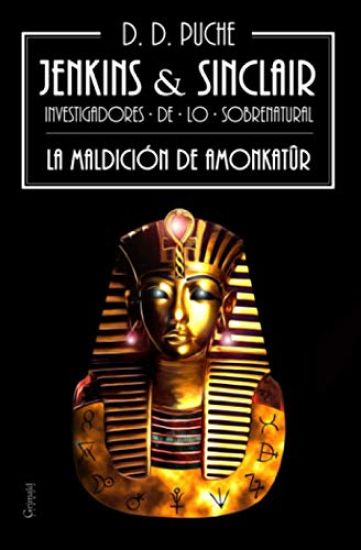
Jenkins & Sinclair: La maldición de Amonkatûr

Jenkins & Sinclair: La maldición de Amonkatûr

D. D. Puche

Independently Published
2019
nidottu
En su segundo caso juntos, la Dra. Jenkins y el Dr. Sinclair se ven envueltos en una investigaci n sobre seres del Antiguo Egipto. La exposici n del tesoro de un per odo desconocido, en el Museo Arqueol gico de la ciudad, se convierte en una peligrosa aventura cuando las momias resucitan y siembran de terror y muerte las calles. Los doctores tendr n que detenerlas antes de que acaben con todo el equipo de arque logos que las sacaron de su eterno sue o, a los cuales est n cazando. Para ello deber n poner en riesgo su propia vida y entrar en contacto con un desconocido horror milenario. El universo de Jenkins y Sinclair crece con renovadas dosis de misterio y terror, adem s de sus caracter sticos toques de humor y elementos steampunk.Segunda entrega de la serie 'Jenkins & Sinclair. Investigadores de lo sobrenatural'.
Anna Sinclair

Anna Sinclair

Rachel Redhead

Lulu.com
2020
pokkari
Twisted Books presents Anna Sinclair: The Evil Dad Anna Sinclair did the unthinkable, and turned against the Stelline, helping to end their nefarious scheme to control all of time and space in a vast reality war. Many want to put Anna on trial while others simply want to execute her. However, they find both options difficult as Anna is given protection by Julius Oxford himself. Under his tuition, Anna reassesses her past and comes to terms with her present. Meanwhile, the future is unfolding its plots and schemes, in the form of a sinister plot centred around Hope Fetch, whom the demon world considers their new dark messiah, the Antichrist. What unfolds is a complex plot by a mysterious being to seize control of the world and reshape humanity according to his design. Anna leads the charge against this shadowy being, assembling a team to help her along the way. Additionally, Judy, Leona, and Geokaizana have their own adventures to contend with...
Meet Sinclair the Water Bear

Meet Sinclair the Water Bear

Kelly Little

Tree Frog Publishing
2023
pokkari
In book #1, "Meet Sinclair the Water Bear," children are compelled to think further than the dirt or soil they see and play in and will gain a new appreciation for 'dirt'. It is a broad introduction to the microorganisms in the soil microbiome and why they are important to organic gardening. Children will meet a specific microorganism, Sinclair the Water Bear, who lives in water drops in the soil and discover how he is different from all the other soil critters. In this series, children will join Sinclair and his fashion-forward, colourful-hat-hoarding sidekick Ronnie Raven on a teaching adventure meant to "Convert the Dirt." Each book in this series will introduce young learners to key concepts about the micro-biome, composting, no-till gardening, companion planting, indicator plants and the difference between soil and dirt, to name a few."Sinclair the Water Bear Early Learning Series" is a fun and engaging introductory exploration of the Soil Food Web and Organic Horticulture. There is a vast amount of knowledge to learn about these topics. One all-encompassing book can overwhelm young learners and often gets lost on a shelf. A series becomes cherished. With that in mind, the author chose a series format to make it easier for your child to learn the concepts over time. Receiving new books creates excitement, ensures retention and keeps your child engaged longer. The information will stick, and your young learner will enjoy building a gardening book library they will continually refer to over time; as entertainment, study and reference If your children range in age, comprehension abilities and reading levels, this series is a must-have for your family The 'story' is written in fast-paced verse, which ensures retention. The second half of each book is designed for youth aged 7 to 12 and includes further learning and activities. Some books even include DIY science experiments that parents may enjoy as well This series is a fun addition to any classroom, school or home library. Teachers and parents might learn some things that surprise them too Sinclair can survive in almost any environment. He can even speak to people But can he survive teaching growers the benefits of breaking old habits and learning new, sustainable ones that support the Soil Food Web and Organic Horticulture? Other Books in the Series: Book 2. "Cranky Franky" - a story about a farmer who grows dandelions better than garden vegetables Sinclair and his friend must get creative to teach him a lesson Learning Concepts: Indicator Plants, Compaction, Mulch and Compost Tea, Tilling and Soil Structure and Recipes for Critter Tea. RELEASE DATE MAY 10 2023 - Book 3. "Petal and Sprout are Thirsty" - a momma daisy and her baby, Sprout, can't find any water to drink even though the gardener made sure they had some Learning Concepts: Soil Structure, Water Movement Through Soil, and Organic Matter. RELEASE DATE MAY 10 2023 - Book 4. "Squished Ghost in the Compost" - Willow's mom loves gardening, but she also loves fertilizer and pesticides Learning Concepts: Fungi, Natural Soil Enhancements, Beneficial Microorganisms. More books are on the way...
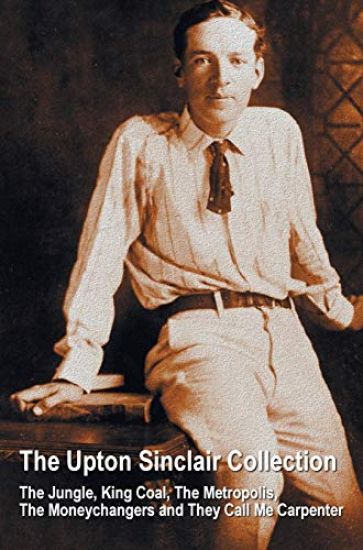
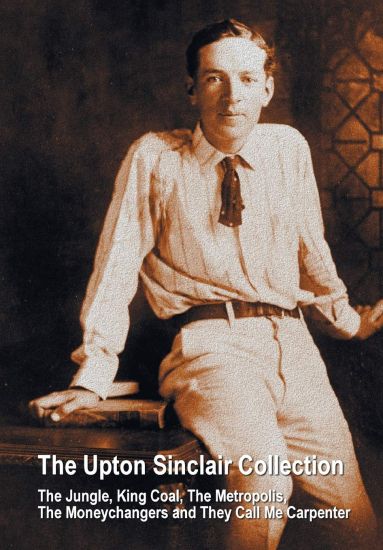
The Upton Sinclair Collection, including (complete and unabridged) The Jungle, King Coal, The Metropolis, The Moneychangers and They Call Me Carpenter
Hold on to your hats for a ride through the injustices of 1900s America courtesy of Upton Sinclair, (1878 - 1968), an American author and commentator who wrote nearly 100 books. Not only did he write amazing stories and expose dreadful truths, he changed America for good, the public uproar resulting from his books caused Laws to be passed and greater justice was the outcome. In 'The Jungle' we meet a young Lithuanian immigrant who arrives in America, hoping to find the land of opportunity. He