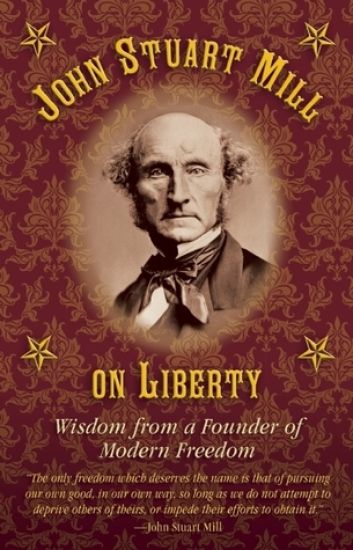
On Liberty is a philosophical work by English philosopher John Stuart Mill, originally intended as a short essay. The work, published in 1859, applies Mill's ethical system of utilitarianism to society and the state. Mill attempts to establish standards for the relationship between authority and liberty. He emphasizes the importance of individuality which he conceived as a prerequisite to the higher pleasures-the summum bonum of Utilitarianism. Furthermore, Mill criticized the errors of past attempts to defend individuality where, for example, democratic ideals resulted in the "tyranny of the majority"
Helen Stuart Campbell (born Helen Stuart; July 5, 1839 - July 22, 1918) was a social reformer and pioneer in the field of home economics. She wrote several important studies about women trapped in poverty, and the role that effective home economics could play in lifting women and families out of poverty.She was born in Lockport, New York to Jane E. (n e Campbell) and Homer H. Stuart. (She later changed her surname to favor her mother's maiden name.) She studied in Warren, Rhode Island and Bloomington, New Jersey. She worked as a professor of economics at the University of Wisconsin from 1893-96, and then as a professor of domestic science at Kansas State Agricultural College from 1896-97
Helen Stuart Campbell (born Helen Stuart; July 5, 1839 - July 22, 1918) was a social reformer and pioneer in the field of home economics. She wrote several important studies about women trapped in poverty, and the role that effective home economics could play in lifting women and families out of poverty.She was born in Lockport, New York to Jane E. (n e Campbell) and Homer H. Stuart. (She later changed her surname to favor her mother's maiden name.) She studied in Warren, Rhode Island and Bloomington, New Jersey. She worked as a professor of economics at the University of Wisconsin from 1893-96, and then as a professor of domestic science at Kansas State Agricultural College from 1896-97
John Stuart Mill's book Utilitarianism is a philosophical defense of utilitarianism in ethics. The essay first appeared as a series of three articles published in Fraser's Magazine in 1861; the articles were collected and reprinted as a single book in 1863. It went through four editions during Mill's lifetime with minor additions and revisions. Although Mill includes discussions of utilitarian ethical principles in other works such as On Liberty and The Subjection of Women, Utilitarianism contains Mill's only major discussion of the fundamental grounds for utilitarian ethical theory.
Elizabeth Stuart Phelps Ward (August 31, 1844 - January 28, 1911) was an early feminist American author and intellectual who challenged traditional Christian beliefs of the afterlife, challenged women's traditional roles in marriage and family, and advocated clothing reform for women. In 1868, three years after the Civil War ended, she published The Gates Ajar, which depicted the afterlife as a place replete with the comforts of domestic life and where families would be reunited-along with family pets-through eternity.
Anne Bradstreet was the first American female writer as well as the first American female poet to have her works published.Anne Bradstreet (March 20, 1612 - September 16, 1672), n e Dudley, was the most prominent of early English poets of North America and first writer in England's North American colonies to be published. She is the first Puritan figure in American Literature and notable for her large corpus of poetry, as well as personal writings published posthumously. Born to a wealthy Puritan family in Northampton, England, Bradstreet was a well-read scholar especially affected by the works of Du Bartas. A mother of eight children and the wife of a public officer in the New England community, Bradstreet wrote poetry in addition to her other duties. Her early works read in the style of Du Bartas, but her later writings develop into her unique style of poetry which centers on her role as a mother, her struggles with the sufferings of life, and her Puritan faith...... Helen Stuart Campbell (born Helen Stuart; pen name, "Mrs. Helen Weeks"; July 5, 1839 - July 22, 1918) was a social reformer and pioneer in the field of home economics. She wrote several important studies about women trapped in poverty, and the role that effective home economics could play in lifting women and families out of poverty. Biography: She was born in Lockport, New York to Jane E. (n e Campbell) and Homer H. Stuart. (She later changed her surname to favor her mother's maiden name.) She studied in Warren, Rhode Island and Bloomington, New Jersey. She worked as a professor of economics at the University of Wisconsin from 1893-96, and then as a professor of domestic science at Kansas State Agricultural College from 1896-97. Publications: In the 1860s and 70s, she wrote stories and children's books under the name "Mrs. Helen Weeks". In later life, divorced from husband Dr. Grenville Weeks, Campbell - her new pen name - wrote novels and nonfiction works dealing with home economics and relationships between the individual, the home, the workplace, physical well-being, and childhood. She was active in many organizations that advocated female empowerment and associated with many intellectuals and original thinkers, including writer Charlotte Perkins Gilman. Much of her writing was engaging and vigorous. Her pieces exposed Gilded Age social inequities and public health failures. She was the author of a biography of 17th century colonial American poet, Anne Bradstreet.
In addition to “On Liberty” and “On Representative Government,” this new selection of Mill’s writings includes, among others, a number of less known of his writings, such as: “Civilization,” “Perfectibility,” “The Negro Question,” “On Education,” “On Aristocracy,” “On Marriage,” “On Free Press,” “Socialism,” Mill’s review of Tocqueville’s “Democracy in America,” his letters to Tocqueville, and several other writings. If one can use a somewhat exaggerated language, Mill’s writings are to liberal-democracy what Marx and Engels’ writings were to Communism. Both systems gave expression to 19th century man’s longing for equality and justice, both promised to liberate him from the shackles of oppression, authority and tradition. Instead of liberating man, Communism created the most brutal system in human history, and its spectacular fall in 1989 is one of history’s greatest events. Western world today shows that liberal-democracy is no longer a benign doctrine, which advocates free market, minimum state and individual liberties, but, like Communism, is an all-encompassing ideology which forces an individual to abdicate his freedom and soul in favor of a Communist-like collective. As many critics of real Socialism could see the seeds of totalitarianism in the writings of Marx and Engels, so one can see the seeds of liberal totalitarianism in Mill’s writings. This new edition is intended to help readers to understand why democratic-liberalism came so close to its 19th century ideological rival.
In addition to “On Liberty” and “On Representative Government,” this new selection of Mill’s writings includes, among others, a number of less known of his writings, such as: “Civilization,” “Perfectibility,” “The Negro Question,” “On Education,” “On Aristocracy,” “On Marriage,” “On Free Press,” “Socialism,” Mill’s review of Tocqueville’s “Democracy in America,” his letters to Tocqueville, and several other writings. If one can use a somewhat exaggerated language, Mill’s writings are to liberal-democracy what Marx and Engels’ writings were to Communism. Both systems gave expression to 19th century man’s longing for equality and justice, both promised to liberate him from the shackles of oppression, authority and tradition. Instead of liberating man, Communism created the most brutal system in human history, and its spectacular fall in 1989 is one of history’s greatest events. Western world today shows that liberal-democracy is no longer a benign doctrine, which advocates free market, minimum state and individual liberties, but, like Communism, is an all-encompassing ideology which forces an individual to abdicate his freedom and soul in favor of a Communist-like collective. As many critics of real Socialism could see the seeds of totalitarianism in the writings of Marx and Engels, so one can see the seeds of liberal totalitarianism in Mill’s writings. This new edition is intended to help readers to understand why democratic-liberalism came so close to its 19th century ideological rival.
This is the second volume, following the well-received edition of Mill’s writing essential to understanding the liberal tradition. His commentary on a full spectrum of issues gives further insight into the strengths and vulnerabilities of liberal democratic theory in practice. Rare and difficult to locate material is here brought to attention and made available. The contribution of Mill’s most authoritative biographer, Nicholas Capaldi, is a singular and unmatched highlight. The tenor of St. Augustine’s Press volumed on Mill is distinct in its intention to place his work in the framework of political philosophy and the conversation of the viability of liberalism as a tradition of thought.
This is the second volume, following the well-received edition of Mill’s writing essential to understanding the liberal tradition. His commentary on a full spectrum of issues gives further insight into the strengths and vulnerabilities of liberal democratic theory in practice. Rare and difficult to locate material is here brought to attention and made available. The contribution of Mill’s most authoritative biographer, Nicholas Capaldi, is a singular and unmatched highlight. The tenor of St. Augustine’s Press volumed on Mill is distinct in its intention to place his work in the framework of political philosophy and the conversation of the viability of liberalism as a tradition of thought.
The United States was founded on the importance of civil liberties?protections for the individual against the control of others, whether those are other people or the government. Freedom for each person is a cornerstone of Western society. John Stuart Mill’s thoughts on liberty and the concept of freedom are among the most important frameworks on which we’ve built so much of modern society; our very ideas of limited government and personal freedom are rooted in the writings of this great political philosopher.John Stuart Mill on Liberty is a collection of some of the most important of his statements on the ideas of liberty and freedom. This book showcases his firm belief that each person should have the right to live as he or she wants to, so long as it does not harm anyone else. Much of what we now take for granted or still fight to maintain or advance, such as freedom of speech, the abolition of slavery, and the rights of women, are things Mill argued for. As you read his passionate entreaties for liberty, you’ll be amazed at how relevant and important they remain today.?In this age, the mere example of non-conformity, the mere refusal to bend the knee to custom, is itself a service.” ?John Stuart Mill