Kirjojen hintavertailu. Mukana 12 390 323 kirjaa ja 12 kauppaa.

Kirjahaku

Etsi kirjoja tekijän nimen, kirjan nimen tai ISBN:n perusteella.

577 tulosta hakusanalla Waverly Fitzgerald

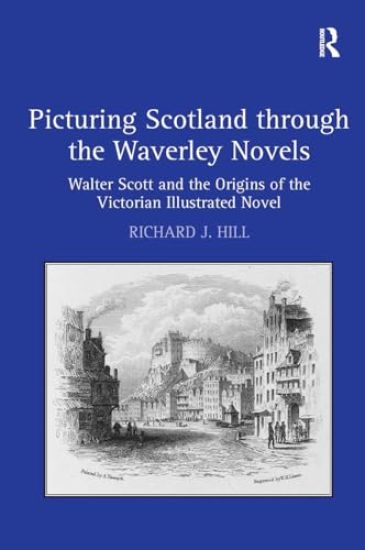
Picturing Scotland through the Waverley Novels

Picturing Scotland through the Waverley Novels

Richard J. Hill

TAYLOR FRANCIS LTD
2024
nidottu
Innovative and accessibly written, Picturing Scotland examines the genesis and production of the first author-approved illustrations for Sir Walter' Scott's Waverley novels in Scotland. Consulting numerous neglected primary sources, Richard J. Hill demonstrates that Scott, usually seen as disinterested in the mechanics of publishing, actually was at the forefront of one of the most innovative publishing and printing trends, the illustrated novel. Hill examines the historical precedents, influences, and innovations behind the creation of the illustrated editions, tracking Scott's personal interaction with the mechanics of the printing and illustration process, as well as Scott's opinions on visual representations of literary scenes. Of particular interest is Scott's relationships with William Allan and Alexander Nasmyth, two important early nineteenth-century Scottish artists. As the first illustrators of the Waverley novels, their work provided a template for one of the more lucrative publishing phenomena. Informed by meticulous close readings of Scott's novels and augmented by a bibliographic catalogue of illustrations, Picturing Scotland is an important contribution to Scott studies, the development of the illustrated novel, and publishing history.
A History of Waverley Abbey, in the County of Surrey.

A History of Waverley Abbey, in the County of Surrey.

Charles Kerry

British Library, Historical Print Editions
2011
pokkari
Title: A History of Waverley Abbey, in the county of Surrey.Publisher: British Library, Historical Print EditionsThe British Library is the national library of the United Kingdom. It is one of the world's largest research libraries holding over 150 million items in all known languages and formats: books, journals, newspapers, sound recordings, patents, maps, stamps, prints and much more. Its collections include around 14 million books, along with substantial additional collections of manuscripts and historical items dating back as far as 300 BC.The HISTORY OF BRITAIN & IRELAND collection includes books from the British Library digitised by Microsoft. As well as historical works, this collection includes geographies, travelogues, and titles covering periods of competition and cooperation among the people of Great Britain and Ireland. Works also explore the countries' relations with France, Germany, the Low Countries, Denmark, and Scandinavia. ++++The below data was compiled from various identification fields in the bibliographic record of this title. This data is provided as an additional tool in helping to insure edition identification: ++++ British Library Kerry, Charles; 1872. 4 . 10369.cc.9.
John Anderson: Viscount Waverley

John Anderson: Viscount Waverley

John Wheeler Wheeler-Bennett

Literary Licensing, LLC
2012
sidottu
John Anderson: Viscount Waverley is a biography of John Anderson, a British politician and scientist who served as the Chancellor of the Exchequer and Home Secretary during World War II. The book is written by John Wheeler-Bennett, a historian and biographer who was also a friend of Anderson. The book covers Anderson's life from his childhood in Scotland to his rise in politics and his role in the war effort. It explores his contributions to science, including his work on the development of radar, as well as his political career and his relationships with other prominent figures of the time, such as Winston Churchill.Wheeler-Bennett draws on a range of sources, including Anderson's personal papers and interviews with people who knew him, to provide a detailed and nuanced portrait of this important figure in British history. The book also examines Anderson's legacy, both in terms of his contributions to science and his impact on British politics and government.Overall, John Anderson: Viscount Waverley is a comprehensive and engaging biography of a fascinating figure in British history, providing insight into the man and his times.This scarce antiquarian book is a facsimile reprint of the old original and may contain some imperfections such as library marks and notations. Because we believe this work is culturally important, we have made it available as part of our commitment for protecting, preserving, and promoting the world's literature in affordable, high quality, modern editions, that are true to their original work.
Poetry from the Waverley Novels and Other Works
This scholarly edition offers the first reliably identified collection of Walter Scott's original poetry in the Waverley Novels, the letters and the Journal. Past editors of Scott found it hard to recognise what is and is not quotation; but thanks to modern databases the poems in this volume have been identified as almost certainly his own.This collection demonstrates, again, Scott's brilliant versatility in the handling of verse forms and his extraordinary range of voice. The poetry of the Waverley Novels is often dramatic, being uttered or sung by one of the characters; mottoes at the heads of chapters stand in a critical relationship to the narrative; the poetry of the letters and Journal is often quizzical and self-mocking; and there are many superb parodies.As part of the 'meaning' of these poems lies in their context, this collection succinctly contextualises each one. It also provides full textual and explanatory annotation and an essay which explores, among other things, the wavering boundary between new creation and quotation.
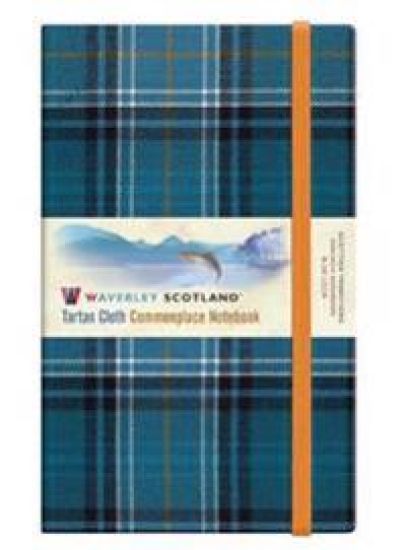
Blue Loch Waverley Tartan Notebook/Journal: Large: 21 x 13cm
This large notebook/journal (21cm x 13cm) with 192 pages (one side blank, one side ruled) is bound in authentic tartan cloth made in the UK and made from the Blue Loch Tartan. This tartan includes the blue and white of the Scottish saltire and other blues that reflect Scotland's lochs and rivers - iconic features of the Scottish landscape. The sky blue with gold over-check symbolises the beauty of Scotland on a fine summer's day. This series of Tartan Notebooks celebrates Scottish Traditions - the many unique features of Scotland and its people. History, clans and tartans, the landscape of Scotland - hills, glens, mountains, lochs and rivers guarded by the many castles and strongholds of Scotland, some ancient and ruined, but each one full of history, with a story to tell. Kinloch Anderson: The tartan cloth is supplied by and produced with the authority of Kinloch Anderson Scotland, holders of Royal Warrants of Appointment as Tailors and Kiltmakers to HM The Queen, HRH The Duke of Edinburgh and HRH The Prince of Wales. Kinloch Anderson has created its own exclusive range of tartans which are available to all. They are based on the sett of the Clan Anderson tartan. The name Anderson means son of Andrew and Kinloch means head of the loch. Commonplace notebooks date back to the Scottish Enlightenment. Many thinkers and writers used a Commonplace notebook for writing down ideas and knowledge. Adam Smith, Robert Burns, David Hume, and later, writers such as Sir Walter Scott, Arthur Conan Doyle, and Virginia Woolf used commonplace notebooks. About the notebook: This notebook is made with cloth woven in mills in the United Kingdom. Notebook pages and paper components are made with acid-free paper from sustainable forests. Boards used in the binding process are made of 100% recycled paper. This hardback notebook is bound in genuine British tartan cloth with an elastic closure, ribbon market, eight perforated end leaves and expandable inner note holder. It contains a removable booklet about the history of clan tartans, and a bookmark that gives information on the Blue Loch tartan.
Dress Tartan: Waverley Large Notebook/Journal (21cm x 13 cm)
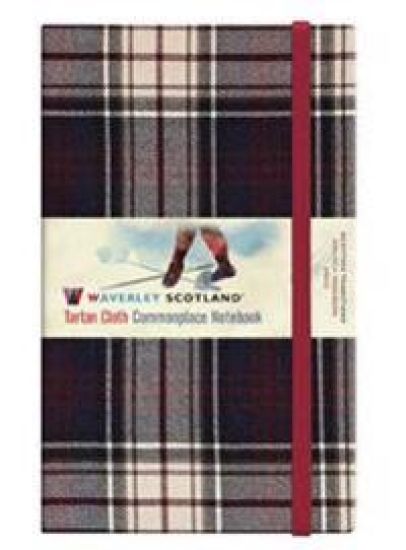
The Waverley Tartan large size hardback Dress tartan notebook/journal with 192 pages features white, navy, two shades of burgundy, moss green, cream and black. Bound in British cloth, this notebook shows the Hunting tartan. The paper is quality cream 80gsm with left hand side plain, right hand side lined. This series of Tartan Notebooks celebrates Scottish Traditions - the many unique features of Scotland and its people. History, clans and tartans, the landscape of Scotland - hills, glens, mountains, lochs and rivers guarded by the many castles and strongholds of Scotland, some ancient and ruined, but each one full of history, with a story to tell. Kinloch Anderson: The tartan cloth is supplied by and produced with the authority of Kinloch Anderson Scotland, holders of Royal Warrants of Appointment as Tailors and Kiltmakers to HM The Queen, HRH The Duke of Edinburgh and HRH The Prince of Wales. Kinloch Anderson has created its own exclusive range of tartans which are available to all. They are based on the sett of the Clan Anderson tartan. The name Anderson means son of Andrew and Kinloch means head of the loch. Commonplace notebooks date back to the Scottish Enlightenment. Many thinkers and writers used a Commonplace notebook for writing down ideas and knowledge. Adam Smith, Robert Burns, David Hume, and later, writers such as Sir Walter Scott, Arthur Conan Doyle, and Virginia Woolf used commonplace notebooks. About the notebook: This notebook is made with cloth woven in mills in the United Kingdom. Notebook pages and paper components are made with acid-free paper from sustainable forests. Boards used in the binding process are made of 100% recycled paper. This hardback notebook is bound in genuine British tartan cloth with an elastic closure, ribbon market, eight perforated end leaves and expandable inner note holder. It contains a removable booklet about the history of clan tartans, and a bookmark that gives information on the Dress tartan.
Last Train to Waverley

Last Train to Waverley

Malcolm Archibald

Fledgling Press
2014
pokkari
Last Train to Waverley is set in France in World War I, during one week in March 1918. The Germans launched their final major offensive of the war and pushed the British back thirty miles. One unit of the 20 Royal Scots were cut off. This book follows the fortunes of this unit, and the personal dilemmas of Douglas Ramsay, the officer in charge.