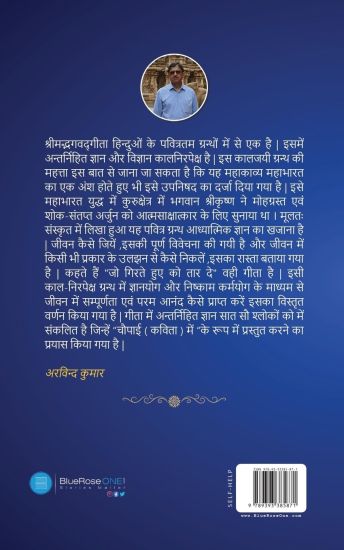
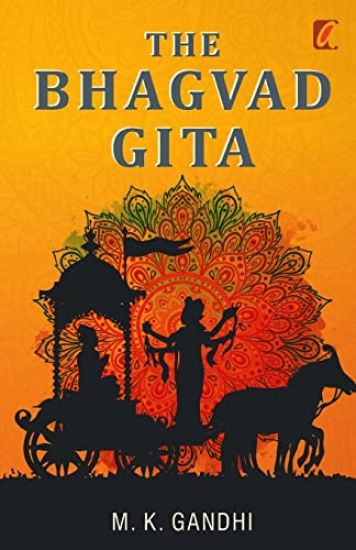
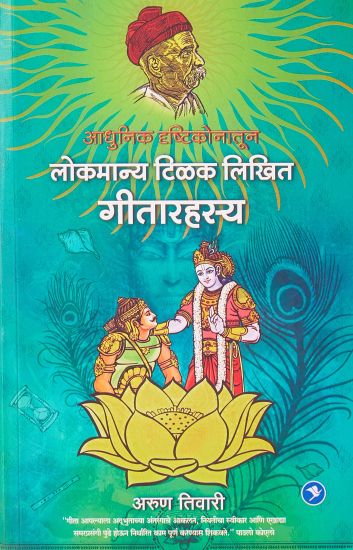
Shrimad Bhagavad Gita is one of the holiest texts of Hindus. The knowledge and science inherent in it are timeless. The importance of this classic text can be known from the fact that despite being only a part of the epic Mahabharata, it has been given the status of an Upanishad. This holy book is a treasure trove of spiritual knowledge. How to live a blissful life? How to get out of any kind of dilemma in life? The full explanation can be found in Shrimad Bhagavad Gita through Jnanayoga and Nishkaam Karmayoga. By reading it, understanding it, and applying it in our lives, life can be made more meaningful. Originally written in Sanskrit, this holy book has seven hundred verses. Nowadays, people have difficulty understanding the Sanskrit language, so through this book, Arvind Kumar has tried to present it in simple Hindi in the form of chaupai.
Shrimad Bhagawad Gita (or briefly the Gita) is one of the greatest scriptures that preaches a spiritual philosophy for all kinds of people at all kinds of stages of life. It is a part of the great epic, Mahabharat and is believed to have been preached by Lord Shri Krishna to his friend and disciple, Arjuna. Mahabharat is the story of feuding cousins, Kauravas and Pandavas, fighting for the kingdom. While Pandavas wanted a small share of the kingdom, the Kauravas refused to part with any. Ultimately, a stage came when the Pandavas decided to wage a war with Kauravas to assert their legitimate right. However, Arjuna, one of the Pandavas and their main warrior, suddenly got confused just before the battle was to start and was not sure whether they would be doing the right thing by indulging in such a great violence and the consequent loss to the society. Besides, he was aghast at the thought of having to kill his own cousins, gurus and other elders ranged against Pandavas. So, he dropped his weapons and requested Shri Krishna, his charioteer during the war, to guide him out of his confused mental state. That was when Shri Krishna preached the incomparable spiritual philosophy of Shrimad Bhagawad Gita which finally clears Arjuna's confusion and he gets ready to go into the war. The original Gita is in Sanskrit and hence it remained out of reach of the common masses. There have been many commentaries on it in many different languages by eminent saints and philosophers. One of the greatest and exhaustive commentaries is by Sant Dnyaneshwar who is regarded as Shri Krishna's incarnation just for the purpose of taking the Gita philosophy to the masses. He wrote his commentary named Bhavarth Deepika (more commonly known as Shri Dnyaneshwari) in Marathi language and after completing it, he took Samadhi at a tender age of just 21 years. The essence of the Gita philosophy presented in this book is primarily based on the author's reading and understanding of Bhavarth Deepika. Gita has some theoretical content that explains the nature of creation, the concept of Creator, human nature and life in this world and how to live life in a fulfilling manner without suffering. This book is an attempt by the author to put down his practical insight into some selected verses of the Gita with the idea of helping readers to develop the right attitude towards living their day to day life. The author has picked up only those verses that make practical sense to him. As such, many verses have been omitted that sound too theoretical or too expansive on a single concept. As a result, the book can be a compact practical guide to Gita philosophy. The book is organized as per the chapters of the original Gita. The first chapter of Gita is all about the formation of the rival armies and the warriors in them with some description of Arjuna's confused state and thinking. The book begins with the author's practical insight into it, so that it provides the necessary background for the real preaching that starts from verse 2:11. In each chapter, the selected verses are presented as small clusters with the literal meaning of the verses followed by the author's practical insight into them.
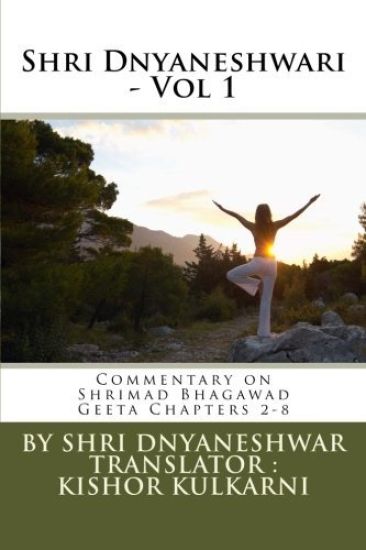
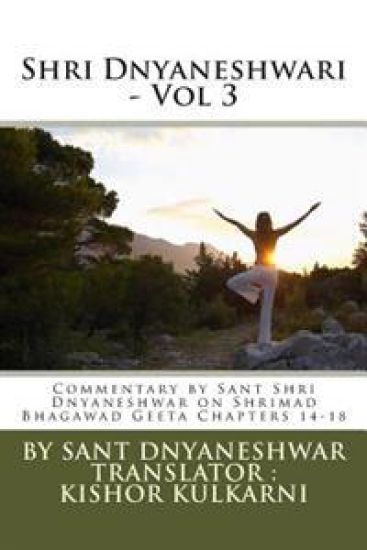
Shrimad Bhagawad Geeta (also referred to simply as Geeta) is the most revered of Indian scriptures that comprehensively presents the highest spiritual philosophy in the Indian tradition. It is believed to be told by Lord Shri Krishna to Arjuna on the Mahabharat battle field of Kurukshetra. Just before the epic war between Pandavas and Kauravas was to begin, Arjuna was suddenly overcome by confusion about whether it was right for him to fight his own cousins and other relatives as also his revered teachers (gurus) and other elders who were standing opposite him as his enemies. As a result, he dropped his weapons and sat down in his chariot in a completely distraught mood. It was then that Shri Krishna who had taken upon himself the job of being Arjuna's charioteer, preached the complete spiritual philosophy by way of Shrimad Bhagawad Geeta. It helped Arjuna understand clearly what this creation is and what the purpose of human life in it is. He could then proceed with fighting the Mahabharat war as a duty in a detached manner.Shrimad Bhagawad Geeta consists of 18 chapters and is originally in Sanskrit. There have been many explanatory commentaries on it by different philosophers and thinkers. The greatest of some of the most revered saints who lived during the 13th century in Maharashtra, Sant Shri Dnyaneshwar Maharaj, wrote an incomparable commentary on the Geeta titled Bhavarth Deepika, more popularly known as Shri Dnyaneshwari, in Marathi verse form. It is believed that Lord Shri Krishna Himself reincarnated as Sant Dnyaneshwar primarily to take the Geeta philosophy down to the less educated seekers who were unable to understand the original Geeta in Sanskrit language. Shri Dnyaneshwari is the result of that. Sant Shri Dnyaneshwar maharaj took samadhi at a tender age of 21 years soon after completing Dnyaneshwari, which confirms the belief that the primary purpose of his incarnation was delivering Geeta philosophy to the masses of ordinary people.The original Dnyaneshwari is organised exactly on the lines of Geeta in 18 chapters. Each of the shlokas (verses) of Geeta has many owis (Marathi verses) explaining the meaning of the particular shloka. Sant Shri Dnyaneshwar excels in putting across the underlying philosophy by way of many different metaphors and examples from the day-to-day life making it easy for a sincere reader to understand and digest it.The Dnyaneshwari owis are in old Marathi of the 13th century. This series of three books is an attempt by the author to take the Dnyaneshwari to non-Marathi seekers. It is a literal translation of the original "owis" rendered as modern English prose. It is presented in the following format - the original Sanskrit shloka of Geeta followed by its literal meaning in English and then the English translation of the related owis. At some places, more than one shloka are presented together if the meaning can be better understood that way. The reader is expected to have a reasonable degree of familiarity with Indian spiritual philosophy and the commonly used Sanskrit terms in respect of the various fundamental spiritual concepts.Chapter 1 and the first ten shlokas of Geeta describe the formation of armies on both the sides with the names and qualities of the various warriors gathered on the battle field. There is also a description of the distraught state of Arjuna's mind in this initial part. The actual philosophical preaching by Lord Shri Krishna starts from Chapter 2, shloka 11 and hence this book also starts from that point onwards. This translation of the complete Dnyaneshwari is presented in three volumes. The first volume covers chapters 2 to 8, second covers chapters 9-13 and the third covers chapters 14-18.
The book that inspired the movie, Extraordinary Measures, starring Harrison Ford, Brendan Fraser, and Keri Russell, The Cure by Pulitzer Prize-winning journalist Geeta Anand is the remarkable true story of one father's determination to find a cure for his terminally sick children even if it meant he had to build a business from scratch to do so. With three beautiful children, a new house, and financial security, John and Aileen Crowley were on top of the world--until their two youngest children, fifteen-month-old Megan and five-month-old Patrick, were diagnosed with Pompe disease and given only months to live. Refusing to accept a death sentence, John quit his financial consultant job and invested his life savings in a biotechnology start-up to research the disease and find a cure. Battling scientific setbacks, conflict of interest accusations, and business troubles, John and Aileen would be tested to their limits as they valiantly fought, and succeeded, in finding revolutionary new treatment for the disease--offering hope to Megan, Patrick, and the many children and families affected by Pompe disease around the world.
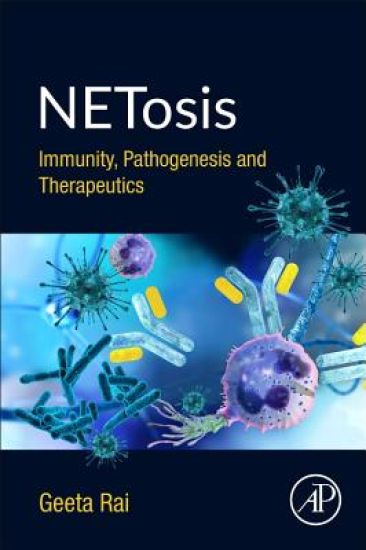
NETosis: Immunity, Pathogenesis and Therapeutics takes a focused approach to the clinical aspects of NETosis and drug development, bringing critical findings. Chapters introduce NETosis, consider mechanisms and antimicrobial strategies regulating NETosis, examine NETosis in neonates, explore the role of NETosis in autoimmunity, delve into NETosis and other diseases, and present therapeutic approaches for dysregulated NETosis. Since Brinkamm, et al, discovered an unrecognized neutrophil anti-microbial mechanism responsible for the extracellular killing of invading pathogens in 2004, the novel process in which nuclear chromatin de-condenses and DNA is ejected into the extra cellular environment, trapping and inactivating tissue pathogens has rapidly evolved.
Risky Bodies and Techno-Intimacy traverses disparate and uncommon routes to explore how people grapple with the radical uncertainties of their lives. In this edgy, evocative journey through myriad interleaved engagements—including the political economies of cinema; the emergent shapes taken by insurance, debt, and mortgages; gender and sexuality; and domesticity and nationalism—Geeta Patel demonstrates how science and technology ground our everyday intimacies. The result is a deeply poetic and philosophical exploration of the intricacies of techno-intimacy, revealing a complicated and absorbing narrative that challenges assumptions underlying our daily living.
Risky Bodies and Techno-Intimacy traverses disparate and uncommon routes to explore how people grapple with the radical uncertainties of their lives. In this edgy, evocative journey through myriad interleaved engagements—including the political economies of cinema; the emergent shapes taken by insurance, debt, and mortgages; gender and sexuality; and domesticity and nationalism—Geeta Patel demonstrates how science and technology ground our everyday intimacies. The result is a deeply poetic and philosophical exploration of the intricacies of techno-intimacy, revealing a complicated and absorbing narrative that challenges assumptions underlying our daily living.