Kirjojen hintavertailu. Mukana 12 467 247 kirjaa ja 12 kauppaa.

Kirjahaku

Etsi kirjoja tekijän nimen, kirjan nimen tai ISBN:n perusteella.

1000 tulosta hakusanalla James R Cook

The Gospel According to Luke

The Gospel According to Luke

James R Edwards

William B Eerdmans Publishing Co
2015
sidottu
In keeping with the Pillar New Testament Commentary's distinctive character, this volume by James R. Edwards on Luke gives special attention to the Third Gospel's vocabulary and historical setting, its narrative purpose and unique themes, and its theological significance for the church and believers today. Though Luke is often thought to have a primarily Gentile focus, Edwards counterbalances that perspective by citing numerous evidences of Luke's overarching interest in depicting Jesus as the fulfillment of God's providential work in the history of Israel, and he even considers the possibility that Luke himself was a Jew. In several excursuses Edwards discusses particular topics, including Luke's infancy narratives, the mission of Jesus as the way of salvation, and Luke's depiction of the universal scope of the gospel. While fully conversant with all the latest scholarship, Edwards writes in a lively, fluent style that will commend this commentary to ministers, students, scholars, and many other serious Bible readers.
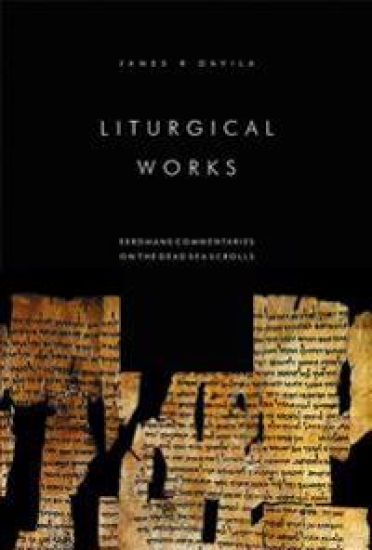
Liturgical Works

Liturgical Works

James R. Davila

William B Eerdmans Publishing Co
2001
nidottu
Among the invaluable manuscripts of the Dead Sea Scrolls are numerous fragments of liturgical texts pertaining to the ritual life of Jews living around the turn of the common era. These fascinating writings include prayers for annual festivals, a covenant renewal liturgy, a mystical liturgy for Sabbath sacrifices, a grace ceremony for mourners, daily and weekly prayers, liturgies of purification, and perhaps even a wedding ceremony. In this volume, the first to be published in the Eerdmans Commentaries on the Dead Sea Scrolls series, James Davila introduces, translates, and provides a detailed exegesis of these important documents. The book begins with a general introduction to the Qumran library and Jewish liturgical traditions. Davila then provides an introduction, translation, notes on the original Hebrew, and line-by-line commentary for each of the Qumran liturgical works. Davila's excellent translation work combines overlapping fragmentary manuscripts into a single, smoothly flowing text, and his commentary includes numerous fresh insights and observations on these writings. Giving full attention to parallel texts found in the Hebrew Bible and other Jewish and Christian writings through late antiquity, Davila firmly situates the Qumran liturgical works in their historical context in Second Temple Judaism and discusses their significance as background to the Jewish liturgy, Jewish mysticism, and Christian origins. Shedding light on a period of Jewish history whose ritual life formerly lay almost entirely in darkness, this volume makes--and subsequent ECDSS volumes will make--a valuable contribution to our understanding of the biblical world.
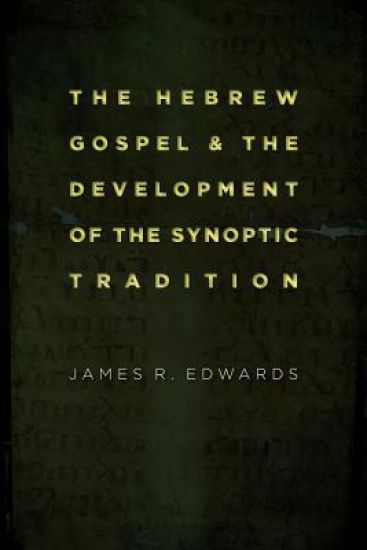
Hebrew Gospel and the Development of the Synoptic Tradition

Hebrew Gospel and the Development of the Synoptic Tradition

James R. Edwards

William B Eerdmans Publishing Co
2009
nidottu
This book offers a new explanation of the development of the first three Gospels based on a careful examination of both patristic testimony to the -Hebrew Gospel- and internal evidence in the canonical Gospels themselves. James Edwards breaks new ground and challenges assumptions that have long been held in the New Testament guild but actually lack solid evidence.
In the Beginning: A Commentary on Genesis and Its Reception in the New Testament

In the Beginning: A Commentary on Genesis and Its Reception in the New Testament

James R. Edwards

William B. Eerdmans Publishing Company
2026
sidottu
An innovative commentary on Genesis that illuminates the book's relationship to the rest of the biblical canon In the Beginning provides historical and critical exposition of the Hebrew text of Genesis while also explaining the book's theological significance within the biblical canon as a whole. The result is a beautifully nuanced perspective--not only of the memorable events and colorful characters within the first book of the Bible, but also of the book's place in the larger story of Scripture. For each chapter of Genesis, author James R. Edwards offers a faithful reading that includes three elements: synopsis, exegesis, and kerygma.The synopsis briefly outlines and introduces the contents of the chapter; the exegesis develops a full discussion of the history, meaning, and purpose of the chapter; and the kerygma explores the influence of the various elements of the chapter on later Jewish tradition in the Old Testament and especially on Christian tradition in the New Testament. The commentary thus attends to "the whole counsel of God" by expounding Genesis in the context of salvation history as fulfilled in the subsequent history of Israel and proclamation of the gospel of Jesus Christ in the New Testament. Distinctive for its combination of depth and breadth, In the Beginning will be a valuable resource for students, pastors, and general readers interested in the relationship between the Old and New Testaments.
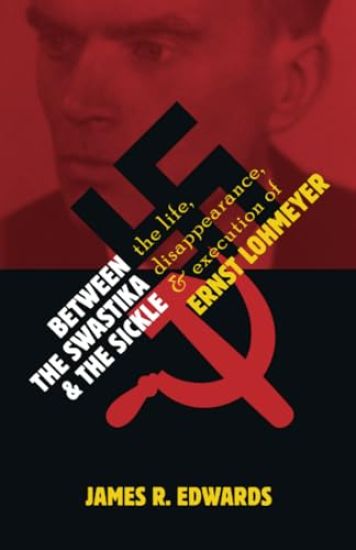
Between the Swastika and the Sickle

Between the Swastika and the Sickle

James R Edwards

William B. Eerdmans Publishing Company
2024
pokkari
The life, theological contribution, and mysterious disappearance of one of the more important New Testament scholars in the twentieth century On February 15, 1946, the Soviet NKVD raided the home of Ernst Lohmeyer just hours before his inauguration as the president of Greifswald University in Germany. Lohmeyer had survived active duty in both World War I and World War II. A New Testament scholar and theologian, he resisted the rise of Nazi fascism as a member of the Confessing Church. But the Soviet occupation of Germany was even more repressive than Nazi domination. With the exception of correspondence from prison, Lohmeyer was never heard from again. In Between the Swastika and the Sickle, James R. Edwards recounts the story of Lohmeyer's life, his theological achievements, his courageous resistance to the forces of political repression, and the events surrounding his death. But the book also includes Edwards's intrepid search for the legacy of this brilliant and courageous scholar, whose story is made even more compelling by the tumultuous interplay of faith and politics in twenty-first-century America.
How to Defend Humane Ideals

How to Defend Humane Ideals

James R. Flynn

University of Nebraska Press
2008
pokkari
One of the principal moral and psychological problems of our time is whether humane ideals can be defended. Loss of faith in the objectivity of ethics has encouraged a sense of hopelessness. The notion that no ideal is better than any other, that a humane commitment has no rational advantage over Nietzsche's contempt for ordinary people, has been accused of leaving our civilization without self-confidence or a purpose. James R. Flynn rejects attempts to salvage ethical objectivity as futile and counterproductive. Instead, he uses philosophical analysis to demonstrate the relevance of logic and evidence to moral debate. He then uses modern social science to refute racists, Social Darwinists, Nietzsche, and the meritocracy thesis of The Bell Curve. Flynn concludes that the great post-Enlightenment project—justice for all races and classes, the reduction of inequality, and the abolition of privilege—retains its moral dignity and relevance.
Crack of the Bat

Crack of the Bat

James R. Walker; Pat Hughes

University of Nebraska Press
2015
sidottu
The crack of the bat on the radio is ingrained in the American mind as baseball takes center stage each summer. Radio has brought the sounds of baseball into homes for almost one hundred years, helping baseball emerge from the 1919 Black Sox scandal into the glorious World Series of the 1920s. The medium gave fans around the country aural access to the first All-Star Game, Lou Gehrig’s farewell speech, and Bobby Thomson’s “Shot Heard ’Round the World.” Red Barber, Vin Scully, Harry Caray, Ernie Harwell, Bob Uecker, and dozens of other beloved announcers helped cement the love affair between radio and the national pastime. Crack of the Bat takes readers from the 1920s to the present, examining the role of baseball in the development of the radio industry and the complex coevolution of their relationship. James R. Walker provides a balanced, nuanced, and carefully documented look at radio and baseball over the past century, focusing on the interaction between team owners, local and national media, and government and business interests, with extensive coverage of the television and Internet ages, when baseball on the radio had to make critical adjustments to stay viable. Despite cable television’s ubiquity, live video streaming, and social media, radio remains an important medium through which fans engage with their teams. The evolving relationship between baseball and radio intersects with topics as varied as the twenty-year battle among owners to control radio, the development of sports as a valuable media product, and the impact of competing technologies on the broadcast medium. Amid these changes, the familiar sounds of the ball hitting the glove and the satisfying crack of the bat stay the same.
Center Field Shot

Center Field Shot

James R. Walker; Robert V. Bellamy

Bison Books
2008
pokkari
In Baseball Weekly's list of things that most affected baseball in the twentieth century, television ranked second—behind only the signing of Jackie Robinson. The new medium of television exposed baseball to a genuinely national audience; altered the financial picture for teams, owners, and players; and changed the way Americans followed the game. Center Field Shot explores these changes—all even more prominent in the first few years of the twenty-first century—and makes sense of their meaning for America's pastime. Center Field Shot traces a sometimes contentious but mutually beneficial relationship from the first televised game in 1939 to the new era of Internet broadcasts, satellite radio, and high-definition TV, considered from the perspective of businessmen collecting merchandising fees and advertising rights, franchise owners with ever more money to spend on talent, and broadcasters trying to present a game long considered "unfriendly" to television. Ultimately the association of baseball with television emerges as a reflection of—perhaps even a central feature of—American culture at large.
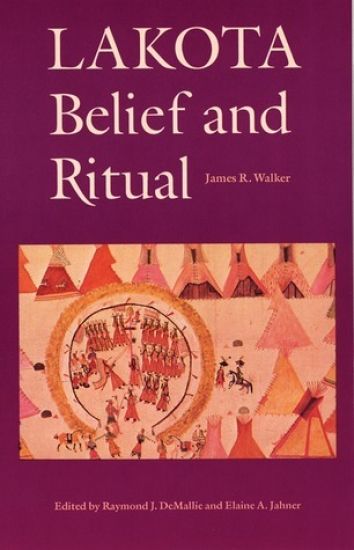
Lakota Belief and Ritual

Lakota Belief and Ritual

James R. Walker

University of Nebraska Press
1991
pokkari
A work of prime importance...its publication represents a major addition to our knowledge of the Lakotas.-Journal of American Folklore Provides raw narratives without any pretension of synthesis or analysis
Lakota Society

Lakota Society

James R. Walker

University of Nebraska Press
1992
pokkari
As agency physician on the Pine Ridge Reservation from 1896 to 1914, Dr. James R. Walker recorded a wealth of information on the traditional lifeways of the Oglala Sioux. Lakota Society presents the primary accounts of Walker's informants and his syntheses dealing with the organization of camps and bands, kinship systems, beliefs, ceremonies, hunting, warfare, and methods of measuring time.
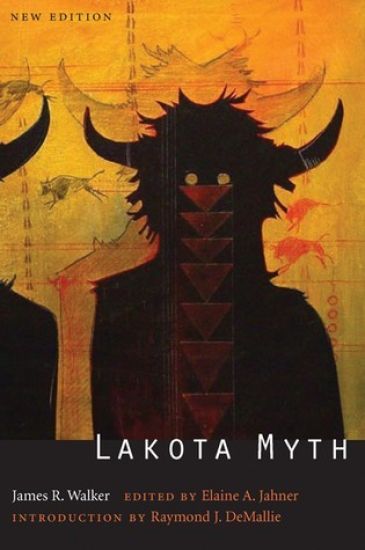
Lakota Myth

Lakota Myth

James R. Walker

Bison Books
2006
pokkari
James R. Walker was a physician to the Pine Ridge Sioux from 1896 to 1914. His accounts of this time, taken from his personal papers, reveal much about Lakota life and culture. This third volume of previously unpublished material from the Walker collection presents his work on Lakota myth and legend. This edition includes classic examples of Lakota oral literature, narratives that were known only to a few Oglala holy men, and Walker's own literary cycle based on all he had learned about Lakota myth. Lakota Myth is an indispensable source for students of comparative literature, religion, and mythology, as well as those interested in Lakota culture.
Respiratory Disease

Respiratory Disease

James R. Dexter; Robert L. Wilkins; Philip M. Gold

F.A. Davis Company
2006
nidottu
Now edited by a pulmonologist, the 3rd edition is still one of the most well-written texts for students learning to understand the assessment and treatment of patients with respiratory disease. Each chapter begins with a background of selected disorders, followed by a case study with questions and answers designed to stimulate critical thinking skills.
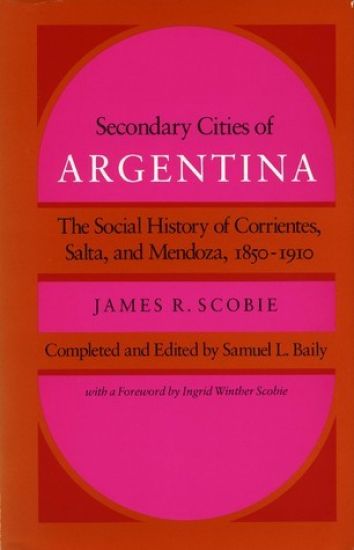
Secondary Cities of Argentina

Secondary Cities of Argentina

James R. Scobie

Stanford University Press
1988
sidottu
This study of three Argentine provincial capitals introduces a new concept in Latin American urban studies: the historical role of secondary cities, settlements large enough to possess all the elements commonly associated with urban areas and yet too small to figure among a country's major cities. The principal contribution of the book is to explain how and why smaller cities grew. What determined and shaped their growth? How did local inhabitants, and especially the dominant social elites, react to internal and external influences? To what extent were they able to control growth? What relationships developed with the surrounding regions and the outside world? The study shows that secondary cities linked rural economies and inhabitants with the outside world while insulating the traditional rural environment from the changing character of large urban centers. In this intermediate position, economic relationships and social structure changed slowly, and only in response to outside innovations such as railroads. Continuity within the secondary centers thus reinforced conservatism, accentuated the gap between the major cities and the rest of the country, and contributed to the resistance to change that characterizes much of Latin American today. The book is illustrated with photographs and maps.
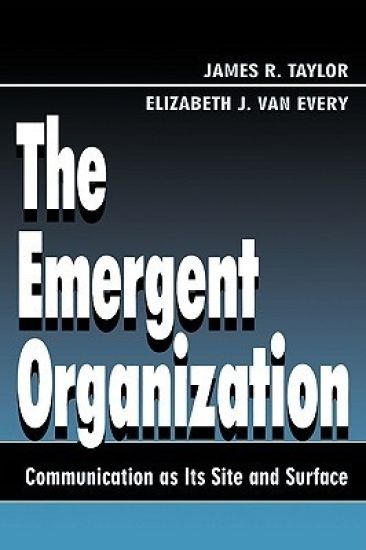
The Emergent Organization

The Emergent Organization

James R. Taylor; Elizabeth J. Van Every

Routledge Member of the Taylor and Francis Group
1999
sidottu
Today's organizations face a wide variety of challenges, including such contradictions as maintaining unity of action while becoming increasingly diverse. Even the definition of organization is changing and evolving. In this monograph, the authors apply their academic and professional experience to address the notion of "organization," setting forth communication as the essential modality for the constitution of organization--explaining how an organization can at the same time be both local and global, and how these properties which give organization continuity over time and across geographically dispersed situations also come to be manifested in the day-to-day of human interpersonal exchange. As a radical rethinking of the traditional discourse approaches in communication theory, this book develops a conceptual framework based on the idea that "organization" emerges in the mix of conversational and textual communicative activities that together construct organizational identity. Applying concepts from the philosophy of language, linguistics, semiotics, system design, sociology and management theory, the authors put forth a convincing argument demonstrating the materiality of language and its constructive role in organization and society.
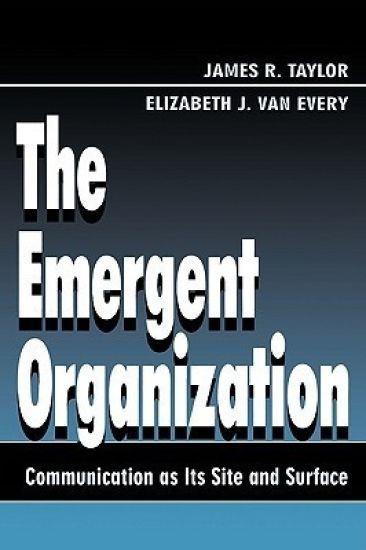
The Emergent Organization

The Emergent Organization

James R. Taylor; Elizabeth J. Van Every

Routledge Member of the Taylor and Francis Group
1999
nidottu
Today's organizations face a wide variety of challenges, including such contradictions as maintaining unity of action while becoming increasingly diverse. Even the definition of organization is changing and evolving. In this monograph, the authors apply their academic and professional experience to address the notion of "organization," setting forth communication as the essential modality for the constitution of organization--explaining how an organization can at the same time be both local and global, and how these properties which give organization continuity over time and across geographically dispersed situations also come to be manifested in the day-to-day of human interpersonal exchange. As a radical rethinking of the traditional discourse approaches in communication theory, this book develops a conceptual framework based on the idea that "organization" emerges in the mix of conversational and textual communicative activities that together construct organizational identity. Applying concepts from the philosophy of language, linguistics, semiotics, system design, sociology and management theory, the authors put forth a convincing argument demonstrating the materiality of language and its constructive role in organization and society.
Postconventional Moral Thinking

Postconventional Moral Thinking

James R. Rest; Darcia Narv ez; Stephen J. Thoma; Muriel J. Bebeau

Psychology Press
1999
sidottu
Although Lawrence Kohlberg provided major ideas for psychological research in morality for decades, today some critics regard his work as outmoded, beyond repair, and too faulty for anybody to take seriously. These critics suggest that research would advance more profitably by taking a different approach. Postconventional Moral Thinking acknowledges particular philosophical and psychological problems with Kohlberg's theory and methodology, and proposes a reformulation called "Neo-Kohlbergian." Hundreds of researchers have reported a large body of findings after having employed Kohlberg's theory and methods to the Defining Issues Test (DIT), therefore attesting to the relevance of his ideas. This book provides a coherent theoretical overview for hundreds of studies that have used the DIT. The authors propose reformulations in the underlying psychological and philosophical theories. This book pulls together the analysis of criticisms of a Kohlbergian approach, a rationale for DIT research, and new theoretical ideas and new research.
Oklahoma Politics

Oklahoma Politics

James R Scales; Danney Goble

University of Oklahoma Press
1982
nidottu
This book is the only published history focused on government in the Sooner State. Beginning with the elections of the territorial era, the authors narrate a definitive account of state politics through the early 1960s. A final chapter traces the contours of contemporary public affairs, identifying the chief elements that shape today's politics.Every major election in the state's history is included in the book, as well as biographical sketches of the state's foremost political figures. Further, the authors relate the recurrent controversies of the statehouse, where gubernatorial initiatives have often clashed with legislative ambitions. Appropriate attention is also given to the state's role in national affairs.Although comprehensive in scope, Oklahoma Politics is more than a compendium of political data. The authors view the history of the commonwealth as something of a model for understanding the evolution of state politics in general during this century. Oklahoma fits that purpose ideally. Born amid the Progressive reformation of traditional state government, the state has been host to every major subsequent force in American state politics. Grassroots agrarian radicalism, a potent Ku Klux Klan, the turmoil of the Great Depression, the post-World War II revolution in the federal relationship, the emergence of modern Republican conservatism - all these have made Oklahoma a laboratory of political change.Aware of the scholarly literature of political scientists and historians of other states, the authors have incorporated many of their findings to develop a new perspective from which to view Oklahoma's political history. Yet the color and excitement of state politics have not been lost in this careful analysis of how the system has evolved. The result is a book that speaks to those Oklahomans - indeed, those Americans - who seek to understand how state politics works or, on occasion, why it does not.
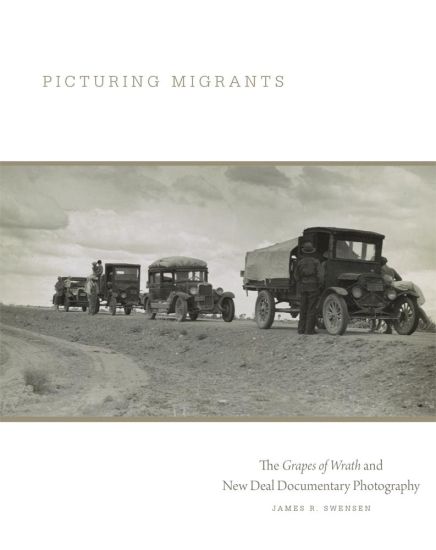
Picturing Migrants

Picturing Migrants

James R. Swensen

University of Oklahoma Press
2015
sidottu
As time passes, personal memories of the Great Depression die with those who lived through the desperate 1930s. In the absence of firsthand knowledge, John Steinbeck's The Grapes of Wrath and the photographs produced for the New Deal's Farm Security Administration (FSA) now provide most of the images that come to mind when we think of the 1930s. That novel and those photographs, as this book shows, share a history. Fully exploring this complex connection for the first time, Picturing Migrants offers new insight into Steinbeck's novel and the FSA's photography - and into the circumstances that have made them enduring icons of the Depression. Looking at the work of Dorothea Lange, Horace Bristol, Arthur Rothstein, and Russell Lee, it is easy to imagine that these images came straight out of the pages of The Grapes of Wrath. This should be no surprise, James R. Swensen tells us, because Steinbeck explicitly turned to photographs of the period to create his visceral narrative of hope and loss among Okie migrants in search of a better life in California. When the novel became an instant best seller upon its release in April 1939, some dismissed its imagery as pure fantasy. Lee knew better and traveled to Oklahoma for proof. The documentary pictures he produced are nothing short of a photographic illustration of the hard lives and desperate reality that Steinbeck so vividly portrayed. In Picturing Migrants, Swensen sets these lesser-known images alongside the more familiar work of Lange and others, giving us a clearer understanding of the FSA's work to publicize the plight of the migrant in the wake of the novel and John Ford's award-winning film adaptation. A new perspective on an era whose hardships and lessons resonate to this day, Picturing Migrants lets us see as never before how a novel and a series of documentary photographs have kept the Great Depression unforgettably real for generation after generation.
Picturing Migrants

Picturing Migrants

James R. Swensen

UNIVERSITY OF OKLAHOMA PRESS
2022
nidottu
As time passes, personal memories of the Great Depression die with those who lived through the desperate 1930s. In the absence of firsthand knowledge, John Steinbeck’s The Grapes of Wrath and the photographs produced for the New Deal’s Farm Security Administration (FSA) now provide most of the images that come to mind when we think of the 1930s. That novel and those photographs, as this book shows, share a history. Fully exploring this complex connection for the first time, Picturing Migrants offers new insight into Steinbeck’s novel and the FSA’s photography—and into the circumstances that have made them enduring icons of the Depression. Looking at the work of Dorothea Lange, Horace Bristol, Arthur Rothstein, and Russell Lee, it is easy to imagine that these images came straight out of the pages of The Grapes of Wrath. This should be no surprise, James R. Swensen tells us, because Steinbeck explicitly turned to photographs of the period to create his visceral narrative of hope and loss among Okie migrants in search of a better life in California. When the novel became an instant best seller upon its release in April 1939, some dismissed its imagery as pure fantasy. Lee knew better and traveled to Oklahoma for proof. The documentary pictures he produced are nothing short of a photographic illustration of the hard lives and desperate reality that Steinbeck so vividly portrayed. In Picturing Migrants, Swensen sets these lesser-known images alongside the more familiar work of Lange and others, giving us a clearer understanding of the FSA’s work to publicize the plight of the migrant in the wake of the novel and John Ford’s award-winning film adaptation. A new perspective on an era whose hardships and lessons resonate to this day, Picturing Migrants lets us see as never before how a novel and a series of documentary photographs have kept the Great Depression unforgettably real for generation after generation.