Kirjojen hintavertailu. Mukana 12 083 983 kirjaa ja 12 kauppaa.

Kirjahaku

Etsi kirjoja tekijän nimen, kirjan nimen tai ISBN:n perusteella.

1000 tulosta hakusanalla John L Cook

Field Guide to Grasshoppers, Katydids, and Crickets of the United States

Field Guide to Grasshoppers, Katydids, and Crickets of the United States

John L. Capinera; Ralph Scott; Thomas J. Walker

Comstock Publishing Associates
2004
pokkari
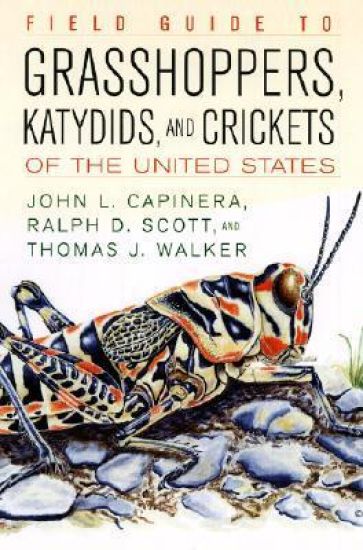
In much of North America, crickets and katydids provide the soundtrack to summer nights, and grasshoppers frequent the fields and roadsides of midsummer days. Although insects from this group have long been the bane of those who make their living from the land, grasshoppers, katydids, and crickets are themselves crucial food sources for many species of birds, reptiles and amphibians, and other creatures. Field Guide to Grasshoppers, Katydids, and Crickets of the United States introduces readers to the biology, behavior, and ecological significance of one of the most obvious (abundant, large, and colorful) and important (ecologically and economically significant) insect groups in North America, the order Orthoptera. A simple, illustrated identification guide assists the reader in distinguishing among the various groups and narrows down the options to expedite identification. The book treats more than a third of the species found in the United States and Canada in brief, easy-to-understand sections that provide information on distribution, identification, ecology, and similar species. Distribution maps accompany each profile, and 206 species are pictured in color. Black-and-white drawings highlight distinguishing characteristics of some of the more difficult-to-identify species. Sonograms provide a graphic representation of the insects' distinctive sounds, which may be heard on Thomas J. Walker's website: Singing Insects of North America. This is the first treatment of North American grasshoppers, katydids, and crickets to portray the insects in full color, and it will be the first time many amateur naturalists and students have the opportunity to see the amazing and colorful world of Orthoptera, because many are cryptically colored (their bright colors evident only in flight) or cryptic in behavior (nocturnal in their habits). John L. Capinera, Ralph D. Scott, and Thomas J. Walker designed their book for amateur naturalists who wish to know the local fauna, for students who seek to identify insects as part of entomology and natural history courses, and for professional biologists who need to identify invertebrates. This invaluable field guide will be a useful supplement for laboratory and field activities and a reference for classrooms at every level.
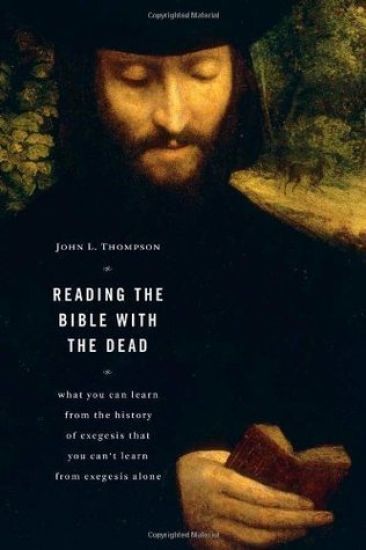
Reading the Bible with the Dead

Reading the Bible with the Dead

John L. Thompson

William B Eerdmans Publishing Co
2007
nidottu
Many Christians would describe themselves as serious and regular readers of the Bible. Yet, if we are honest, most of us have a tendency to stick with the parts of the Bible that we understand or are comforted by, leaving vast tracts of Scripture unexplored. Even when following a guide, we may never reach into the Bible's less-traveled regions -- passages marked by violence, tragedy, offense, or obscurity. What our modern minds shy away from, however, ancient, medieval, and Reformation commentators dove into. In fact, their writings often display strikingly contemporary interests and sensitivities to the meaning and moral implications of the Bible's difficult narratives. John Thompson here presents nine case studies in the history of exegesis -- including the stories of Hagar and Jephthah's daughter, the imprecatory psalms, and texts that address domestic relations, particularly divorce -- in order to demonstrate the valuable insights into Scripture that we can gain not only from what individual commentators say but from fifteen centuries' cumulative witness to the meaning of Scripture in the life of the church. Visit Dr. Thompson's companion website at: http: //purl.oclc.org/net/jlt/exegesis so access further features such as a list of commentary literature in English through the year 1700 and sample sermons that model a homiletic use of the history of interpretation.
Introduction to Israel's Wisdom Traditions

Introduction to Israel's Wisdom Traditions

John L. McLaughlin

William B Eerdmans Publishing Co
2018
nidottu
It can be a challenge to understand the Hebrew Bible's wisdom literature and how it relates to biblical history and theology, but John L. McLaughlin makes this complicated genre straightforward and accessible.This introductory-level textbook begins by explaining the meaning of wisdom to the Israelites and surrounding cultures before moving into the conventions of the genre and its poetic forms. The heart of the book examines Proverbs, Job, Qoheleth (Ecclesiastes), and the deuterocanonical Ben Sira and Wisdom of Solomon. McLaughlin also explores the influence of wisdom throughout the Old Testament and in the New Testament.Designed especially for beginning students--and based on twenty-five years of teaching Israel's wisdom literature to university students--McLaughlin's Introduction to Israel's Wisdom Traditions provides an informed, panoramic view of wisdom literature's place in the biblical canon.
Negotiating Cultures and Identities

Negotiating Cultures and Identities

John L. Caughey

University of Nebraska Press
2006
pokkari
Negotiating Cultures and Identities examines issues, methods, and models for doing life history research with individual Americans based on interviews and participant observation. John L. Caughey helps students and other researchers explore the ways in which contemporary Americans are influenced by multiple cultural traditions, including ethnic, religious, and occupational frames of reference. Using the example of Salma, a bicultural woman of Pakistani descent who lives in the United States, and the story of Gina, a multicultural American, Caughey examines how to capture the complexity of each situation, including step-by-step methods and exercises that lead the student interviewer through the process of locating and interviewing a research participant, making sense of the material obtained, and writing a cultural portrait. Arguing that comparison between the subject's life and one's own is an essential part of the process, the methodology also encourages the investigator to research his or her own social and cultural orientations along the way and to contrast these with those of the subject. The book offers a practical, manageable, and engaging form of qualitative research. It prepares the student to do grounded, experiential work outside the classroom and to explore important issues in contemporary American society, including ethnicity, race, identity, disability, gender, class, occupation, religion, and spirituality as they are culturally understood and experienced in the lives of individual Americans.
The Medical Interview

The Medical Interview

John L. Coulehan; Marian R. Block

F.A. Davis Company
2005
nidottu
Master the art of conducting a medical interview and in the process hone your communication skills. The authors have also created a downloadable interview organizer that can be used as a management tool for their first interviews.
Multiple Indicators

Multiple Indicators

John L. Sullivan; Stanley Feldman

SAGE Publications Inc
1980
nidottu
A presentation and critique of the use of multiple measures of theoretical concepts to assess both validity, using the multirait-multimethod matrix, and reliablity, using multiple indicators with a path analytic framework.
Psychophysiology

Psychophysiology

John L. Andreassi

Psychology Press
2006
sidottu
As new technology fuels the rapid growth of research in psychophysiology, it is essential that those new to the field receive a comprehensive introduction. Psychophysiology: Human Behavior and Physiological Response provides students with elementary information regarding the anatomy and physiology of various body systems, recording techniques, integrative reviews of literature, and concepts in the field. Highly accessible, this book fills a gap between edited handbooks that are often difficult for beginners, and journal articles that may also be a challenge to digest.In this new edition, John L. Andreassi incorporates:*a glossary of terms at the end of each chapter to help students learn definitions of novel terms introduced throughout the book;*a new chapter focusing on the proliferation of neuroimaging studies, including positron emission tomography (PET) and functional magnetic resonance imaging (fMRI); and*content changes in all chapters to cover new areas of research, as well as to update findings in traditional topics of interest.Upper level undergraduate and beginning graduate students in psychophysiology, biological psychology, cognitive neuroscience, and physiological psychology will benefit immensely from this important text, just as professionals new to psychophysiology will find this book exceptionally useful in their work.
Psychophysiology

Psychophysiology

John L. Andreassi

Psychology Press
2006
nidottu
As new technology fuels the rapid growth of research in psychophysiology, it is essential that those new to the field receive a comprehensive introduction. Psychophysiology: Human Behavior and Physiological Response provides students with elementary information regarding the anatomy and physiology of various body systems, recording techniques, integrative reviews of literature, and concepts in the field. Highly accessible, this book fills a gap between edited handbooks that are often difficult for beginners, and journal articles that may also be a challenge to digest.In this new edition, John L. Andreassi incorporates:*a glossary of terms at the end of each chapter to help students learn definitions of novel terms introduced throughout the book;*a new chapter focusing on the proliferation of neuroimaging studies, including positron emission tomography (PET) and functional magnetic resonance imaging (fMRI); and*content changes in all chapters to cover new areas of research, as well as to update findings in traditional topics of interest.Upper level undergraduate and beginning graduate students in psychophysiology, biological psychology, cognitive neuroscience, and physiological psychology will benefit immensely from this important text, just as professionals new to psychophysiology will find this book exceptionally useful in their work.
Maverick Town

Maverick Town

John L McCarty; C. L. Sonnichsen

University of Oklahoma Press
1968
nidottu
Once the rival of Dodge City and Cheyenne, for years Tascosa, Texas, lay a ghost town of crumbling adobes. Today almost all traces of frontier Tascosa are gone, replaced by the ultramodern stone buildings which make up a self-contained city of boys and administrative staff - Cal Farley's famed Boys Ranch.Maverick Town tells the story of the rise and decline of Old Tascosa, which epitomized the romance and danger of the early West. Tascosa's heyday was brief, yet it compressed into a few years the history of an era - that of the open range - which will never return.
Spain in the Southwest

Spain in the Southwest

John L. Kessell

University of Oklahoma Press
2003
nidottu
John L. Kessell's Spain in the Southwest presents a fast-paced, abundantly illustrated history of the Spanish colonies that became the states of New Mexico, Arizona, Texas, and California. With an eye for human interest, Kessell tells the story of New Spain's vast frontier--today's American Southwest and Mexican North--which for two centuries served as a dynamic yet disjoined periphery of the Spanish empire.Chronicling the period of Hispanic activity from the time of Columbus to Mexico's independence from Spain in 1821, Kessell traces the three great swells of Hispanic exploration, encounter, and influence that rolled north from Mexico across the coasts and high deserts of the western borderlands. Throughout this sprawling historical landscape, Kessell treats grand themes through the lives of individuals. He explains the frequent cultural clashes and accommodations in remarkably balanced terms. Stereotypes, the author writes, are of no help. Indians could be arrogant and brutal, Spaniards caring, and vice versa. If we select the facts to fit preconceived notions, we can make the story come out the way we want, but if the peoples of the colonial Southwest are seen as they really were--more alike than diverse, sharing similar inconstant natures--then we need have no favorites.
De Religione

De Religione

John L. Steckley

University of Oklahoma Press
2004
sidottu
De Religione, the longest-surviving text in the Huron, or Wendat, language, was written in the seventeenth century to explain the nature of Christianity to the Iroquois people, as well as to justify the Jesuits' missionary work among American Indians. In this first annotated edition of De Religione, linguist and anthropologist John L. Steckley presents the original Huron text side by side with an English translation.The Huron language, now extinct, was spoken originally by Huron Indians, who were settled in present-day southern Ontario. One group went to Quebec and another was later removed to the western United States, first to Kansas and then to Oklahoma. In the early 1670s, the author of De Religione, likely a Jesuit priest named Phillipe Pierson, chose to write his doctrine in Huron because it was a language understood by all five Iroquois nations: Mohawk, Oneida, Onondaga, Cayuga, and Seneca. For today's readers, the text offers valuable insight into how the missionaries actually communicated with American Indians.Amplified by Steckley's in-depth introduction and his fully annotated translation, De Religione provides a firsthand account of Catholic missionization among the Iroquois during the colonial period.
Pueblos, Spaniards, and the Kingdom of New Mexico

Pueblos, Spaniards, and the Kingdom of New Mexico

John L. Kessell

University of Oklahoma Press
2010
nidottu
For more than four hundred years in New Mexico, Pueblo Indians and Spaniards have lived ""together yet apart."" Now the preeminent historian of that region's colonial past offers a fresh, balanced look at the origins of a precarious relationship.John L. Kessell has written the first narrative history devoted to the tumultuous seventeenth century in New Mexico. Setting aside stereotypes of a Native American Eden and the Black Legend of Spanish cruelty, he paints an evenhanded picture of a tense but interwoven coexistence. Beginning with the first permanent Spanish settlement among the Pueblos of the Rio Grande in 1598, he proposes a set of relations more complicated than previous accounts envisioned and then reinterprets the Pueblo Revolt of 1680 and the Spanish reconquest in the 1690s. Kessell clearly describes the Pueblo world encountered by Spanish conquistador Juan de Oñate and portrays important but lesser-known Indian partisans, all while weaving analysis and interpretation into the flow of life in seventeenth-century New Mexico.Brimming with new insights embedded in an engaging narrative, Kessell's work presents a clearer picture than ever before of events leading to the Pueblo Revolt. Pueblos, Spaniards, and the Kingdom of New Mexico is the definitive account of a volatile era.
Miera y Pacheco

Miera y Pacheco

John L. Kessell

University of Oklahoma Press
2015
nidottu
Remembered today as an early cartographer and prolific religious artist, don Bernardo de Miera y Pacheco (1713-1785) engaged during his lifetime in a surprising array of other pursuits: engineer and militia captain on Indian campaigns, district officer, merchant, debt collector, metallurgist, luckless silver miner, presidial soldier, dam builder, and rancher. This long-overdue, richly illustrated biography recounts Miera's complex life in cinematic detail, from his birth in Cantabria, Spain, to his sudden and unexplained appearance at Janos, Chihuahua, and his death in Santa Fe at age seventy-one. In Miera y Pacheco, John L. Kessell explores each aspect of this Renaissance man's life in the colony. Beginning with his marriage to the young descendant of a once-prominent New Mexican family, we see Miera transformed by his varied experiences into the quintessential Hispanic New Mexican. As he traveled to every corner of the colony and beyond, Miera gathered not only geographical, social, and political data but also invaluable information about the Southwest's indigenous peoples. At the same time, Miera the artist was carving and painting statues and panels of the saints for the altar screens of the colony. Miera's most ambitious surviving map resulted from his five-month ordeal as cartographer on the Domínguez-Escalante expedition to the Great Basin in 1776. Two years later, with the arrival of famed Juan Bautista de Anza as governor of New Mexico, Miera became a trusted member of Anza's inner circle, advising him on civil, military, and Indian affairs. Miera's maps and his religious art, represented here, have long been considered essential to the cultural history of colonial New Mexico. Now Kessell's biography tells the rest of the story. Anyone with an interest in southwestern history, colonial New Mexico, or New Spain will welcome this study of Miera y Pacheco's eventful life and times.
De Religione

De Religione

John L. Steckley

University of Oklahoma Press
2021
nidottu
De Religione, the longest-surviving text in the Huron, or Wendat, language, was written in the seventeenth century to explain the nature of Christianity to the Iroquois people, as well as to justify the Jesuits' missionary work among American Indians. In this first annotated edition of De Religione, linguist and anthropologist John L. Steckley presents the original Huron text side by side with an English translation.The Huron language, now extinct, was spoken originally by Huron Indians, who were settled in present-day southern Ontario. One group went to Quebec and another was later removed to the western United States, first to Kansas and then to Oklahoma. In the early 1670s, the author of De Religione, likely a Jesuit priest named Phillipe Pierson, chose to write his doctrine in Huron because it was a language understood by all five Iroquois nations: Mohawk, Oneida, Onondaga, Cayuga, and Seneca. For today's readers, the text offers valuable insight into how the missionaries actually communicated with American Indians.Amplified by Steckley's in-depth introduction and his fully annotated translation, De Religione provides a firsthand account of Catholic missionization among the Iroquois during the colonial period.
Our Stewardship

Our Stewardship

John L Golv

Augsburg Fortress
2002
nidottu
Our Stewardship looks at how to identify, manage, and build up the assets needed for your congregation's mission and ministry (such as a building, grounds, equipment, information, and finances). God gives assets to each person and every congregation and calls us to grow in faith as we serve as stewards of these gifts. The book also talks about what to look for when selecting materials for a financial stewardship program.See Excerpts for reproducible tools that can be downloaded and customized.Who might find it helpfulPastors Church staff members Council presidents Strategic planning teams Stewardship committees Management committees Finance committees Property committees
Progress Compromised

Progress Compromised

John L. Glenn

Louisiana State University Press
2018
sidottu
In Progress Compromised, John L. Glenn examines how African American literature engages in debates about the political and cultural tensions prompted by black social movements during the 1950s and 1960s. Glenn presents detailed case studies of four major novels that illuminate specific periods crucial in the history of African American political struggles, including campaigns for racial integration, the zenith of the civil rights movement, black nationalism, and the immediate legacy of the civil rights era. His analysis provides a nuanced understanding of black postmodern culture and shows how writers use fiction to postulate new modes of resistance and selfhood that defy societal constraints.In Colson Whitehead's The Intuitionist, the first black female elevator inspector and her male counterparts reconsider their notions of what progress means for African Americans newly integrated into civil service and mass industry. Alice Walker's Meridian observes the novel's title character as she copes with the psychological distress experienced by activists participating in the civil rights movement, emphasizing how they bear the psychic and emotional weight of their struggle for equality. John Oliver Killens's satire The Cotillion; or, One Good Bull Is Half the Herd considers class stratification among black communities and social organizations by following the protagonists as they expose the biases of a society women's group, set against a backdrop of late-1960s black nationalism. Finally, Toni Morrison's Tar Baby concerns members of the post- civil rights generation who struggle to achieve self-renewal through introspection while confronting unresolved issues about racial identity and socioeconomic mobility.Progress Compromised showcases the discourse on black cultural politics circulating within late-twentieth-century African American literature, revealing how postmodern fiction investigates the effects of historical movements on individuals, their respective communities, and their efforts to resist social conformity and retain personal identity.
The African American Struggle for Secondary Schooling, 1940-1980

The African American Struggle for Secondary Schooling, 1940-1980

John L. Rury; Shirley A. Hill

Teachers' College Press
2011
nidottu
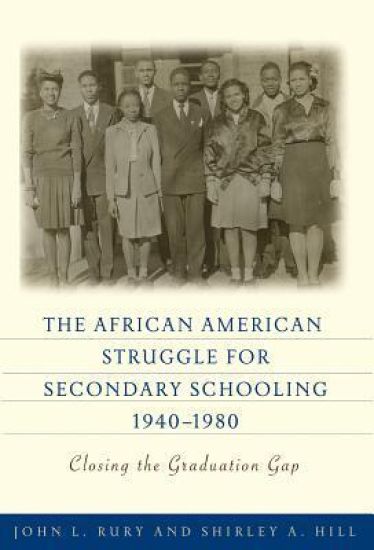
This is the first comprehensive account of African American secondary education in the postwar era. Drawing on quantitative datasets, as well as oral history, this compelling narrative examines how African Americans narrowed the racial gap in high school completion. The authors explore regional variations in high school attendance across the United States and how intraracial factors affected attendance within racial groups. They also examine the larger social historical context, such as the national high school revolution, the civil rights movement, campaigns to expand schooling and urging youth to stay in school, and Black migration northward. Closing chapters focus on desegregation and the "urban crisis" of the 1960s and 1970s that accelerated "White flight" and funding problems for urban school systems. The conclusion summarizes these developments and briefly looks at the period since 1980, when secondary attainment levels stopped advancing for Blacks and Whites alike. Book Highlights: A comprehensive history, drawing on statistical analysis, archival research, and interviews with African Americans who attended school in the 1940s and 1950s. Lessons from the past, showing how parents and local communities played the most direct and dynamic role in the fight for access to education. Today’s major challenges, including the growth of inner-city poverty and changing family structures.
Stride!

Stride!

John L. Fell; Terkild Vinding

Scarecrow Press
1999
sidottu
Stride! traces the stride piano style from its roots in minstrel shows and ragtime, through the contributions of itinerant entertainers, to its joyful birth in Harlem, where it became known as Harlem Piano. Stride developed over a period spanning World War I to the depression years, though younger players maintain its traditions today. It is a musical style marked by friendly rivalry and shared pleasures. Drawing on the authors' personal interviews and biographies, the book traces stride from generation to generation, from the originators Eubie Blake, Luckey Roberts, and James P. Johnson, through a succession of pianists like Willie the Lion Smith. Fell and Vinding also examine its influence on Duke Ellington, Fats Waller, Joe Sullivan, and Johnny Guarnieri, concluding with third and fourth generations that include Ralph Sutton, Dick Hyman, and Dick Wellstood. The authors describe the exceptional Donald Lambert from personal experience. Throughout, influences are traced and documented by way of CD and LP citations. Stride! finishes the tune with appendixes that itemize the compositions of Luckey Roberts, Fats Waller and Willie the Lion Smith.