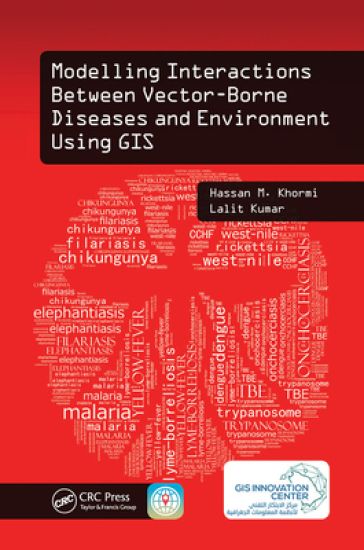
Master GIS Applications on Modelling and Mapping the Risks of DiseasesInfections transmitted by mosquitoes, ticks, triatomine bugs, sandflies, and black flies cause significant rates of death and disease, especially in developing countries. Why are certain places more susceptible to vector-borne diseases? Modelling Interactions Between Vector-Borne Diseases and Environment Using GIS reveals how using geographic information systems (GISs) can provide a greater understanding of how vector-borne diseases are spread and explores the use of geographical techniques in vector-borne disease monitoring, management, and control. This text provides readers with a better understanding of the vector-borne disease problem and its impact on public health. Introduces New Spatial Approaches Based on Location and EnvironmentThe book exposes readers to information on how to identify vector hotspots, determine when and where they can occur, and eliminate vector breeding sites. Utilizing simple illustrations based on real data, as well as the authors’ more than 20 years of experience in the field, this text combines key spatial analysis techniques available in modern GIS with real-world applications. It offers step-by-step instruction on developing vector-borne disease risk models at different spatial and temporal scales and helps practitioners formulate disease causation hypotheses and identify areas at risk. In addition, it addresses medical geography, GIS, spatial analysis, and modelling, and covers other factors related to the spread of vector-borne diseases.This book: Gives an overview of common vector-borne diseases, GIS-based mapping and modelling, impacts of climate change on vector distributions, and availability and importance of accurate epidemiologically relevant spatial dataDescribes modelling and simulating the prevalence of vector-borne diseases around the worldSummarizes some key spatial techniques and how they can be used to aid in the analysis of geographical and attributed dataDefines the concept of establishing and characterizing spatial data systems, including their quality, errors, references, and issues of scale, and building such a system from often quite separate, disparate sourcesShows how to develop weather-based predictive modelling, which can be used to predict the weekly trend of vector abundanceProvides a GIS case study for modelling the future potential distribution of vector-borne disease based on different climatic change scenariosModelling Interactions Between Vector-Borne Diseases and Environment Using GIS combines spatial analysis techniques available in modern GIS, together with real-world applications to provide you with a better understanding of ways to map, model, prevent, and control vector-borne diseases.
Master GIS Applications on Modelling and Mapping the Risks of DiseasesInfections transmitted by mosquitoes, ticks, triatomine bugs, sandflies, and black flies cause significant rates of death and disease, especially in developing countries. Why are certain places more susceptible to vector-borne diseases? Modelling Interactions Between Vector-Borne Diseases and Environment Using GIS reveals how using geographic information systems (GISs) can provide a greater understanding of how vector-borne diseases are spread and explores the use of geographical techniques in vector-borne disease monitoring, management, and control. This text provides readers with a better understanding of the vector-borne disease problem and its impact on public health. Introduces New Spatial Approaches Based on Location and EnvironmentThe book exposes readers to information on how to identify vector hotspots, determine when and where they can occur, and eliminate vector breeding sites. Utilizing simple illustrations based on real data, as well as the authors’ more than 20 years of experience in the field, this text combines key spatial analysis techniques available in modern GIS with real-world applications. It offers step-by-step instruction on developing vector-borne disease risk models at different spatial and temporal scales and helps practitioners formulate disease causation hypotheses and identify areas at risk. In addition, it addresses medical geography, GIS, spatial analysis, and modelling, and covers other factors related to the spread of vector-borne diseases.This book: Gives an overview of common vector-borne diseases, GIS-based mapping and modelling, impacts of climate change on vector distributions, and availability and importance of accurate epidemiologically relevant spatial dataDescribes modelling and simulating the prevalence of vector-borne diseases around the worldSummarizes some key spatial techniques and how they can be used to aid in the analysis of geographical and attributed dataDefines the concept of establishing and characterizing spatial data systems, including their quality, errors, references, and issues of scale, and building such a system from often quite separate, disparate sourcesShows how to develop weather-based predictive modelling, which can be used to predict the weekly trend of vector abundanceProvides a GIS case study for modelling the future potential distribution of vector-borne disease based on different climatic change scenariosModelling Interactions Between Vector-Borne Diseases and Environment Using GIS combines spatial analysis techniques available in modern GIS, together with real-world applications to provide you with a better understanding of ways to map, model, prevent, and control vector-borne diseases.
This book discusses our intimate relationship with and dependence on water, how the body regulates its water levels, and various pathophysiological states associated with impairments in body water homeostasis. The human body consists of 70–80% water. Therefore, concise control of water homeostasis is essential to survival and involves coordination of several systems, but primarily the brain and kidney systems. Water requirements of the average healthy human range between 2–4 L/d, and a major portion of this can come from food sources. The major hormonal regulator of water balance is the anti-diuretic hormone, vasopressin. Vasopressin, a 9–amino acid peptide, is produced in the hypothalamus, stored in the posterior pituitary, and secreted when plasma osmolality rises. Vasopressin acts on the kidney to conserve water. The kidneys filter ~180 L of blood per day, consisting of about 50–65% water, and reabsorb around 99% of this in the proximal tubule, distal tubule, and collecting duct, producing only 1–2 L of urine. The vasopressin-sensitive distal tubule and collecting duct are responsible for fine-tuning water reabsorption. Conditions exist, however, where urine cannot be concentrated effectively. This is known as diabetes insipidus and can lead to dehydration and failure to thrive. At the other extreme, hyponatremia (low serum sodium) is the inability to adequately dilute urine or get rid of free body water in excess of body needs, a serious and sometimes fatal condition.
Deliver end-to-end real-time distributed data processing solutions by leveraging the power of Elastic Stack 6.0 Key Features - Get to grips with the new features introduced in Elastic Stack 6.0 - Get valuable insights from your data by working with the different components of the Elastic stack such as Elasticsearch, Logstash, Kibana, X-Pack, and Beats - Includes handy tips and techniques to build, deploy and manage your Elastic applications efficiently on-premise or on the cloud Book Description The Elastic Stack is a powerful combination of tools for distributed search, analytics, logging, and visualization of data from medium to massive data sets. The newly released Elastic Stack 6.0 brings new features and capabilities that empower users to find unique, actionable insights through these techniques. This book will give you a fundamental understanding of what the stack is all about, and how to use it efficiently to build powerful real-time data processing applications. After a quick overview of the newly introduced features in Elastic Stack 6.0, you’ll learn how to set up the stack by installing the tools, and see their basic configurations. Then it shows you how to use Elasticsearch for distributed searching and analytics, along with Logstash for logging, and Kibana for data visualization. It also demonstrates the creation of custom plugins using Kibana and Beats. You’ll find out about Elastic X-Pack, a useful extension for effective security and monitoring. We also provide useful tips on how to use the Elastic Cloud and deploy the Elastic Stack in production environments. On completing this book, you’ll have a solid foundational knowledge of the basic Elastic Stack functionalities. You’ll also have a good understanding of the role of each component in the stack to solve different data processing problems. What you will learn - Familiarize yourself with the different components of the Elastic Stack - Get to know the new functionalities introduced in Elastic Stack 6.0 - Effectively build your data pipeline to get data from terabytes or petabytes of data into Elasticsearch and Logstash for searching and logging - Use Kibana to visualize data and tell data stories in real-time - Secure, monitor, and use the alerting and reporting capabilities of Elastic Stack - Take your Elastic application to an on-premise or cloud-based production environmentWho this book is for This book is for data professionals who want to get amazing insights and business metrics from their data sources. If you want to get a fundamental understanding of the Elastic Stack for distributed, real-time processing of data, this book will help you. A fundamental knowledge of JSON would be useful, but is not mandatory. No previous experience with the Elastic Stack is required.
A beginner's guide to storing, managing, and analyzing data with the updated features of Elastic 7.0Key FeaturesGain access to new features and updates introduced in Elastic Stack 7.0Grasp the fundamentals of Elastic Stack including Elasticsearch, Logstash, and KibanaExplore useful tips for using Elastic Cloud and deploying Elastic Stack in production environmentsBook DescriptionThe Elastic Stack is a powerful combination of tools for techniques such as distributed search, analytics, logging, and visualization of data. Elastic Stack 7.0 encompasses new features and capabilities that will enable you to find unique insights into analytics using these techniques. This book will give you a fundamental understanding of what the stack is all about, and help you use it efficiently to build powerful real-time data processing applications.The first few sections of the book will help you understand how to set up the stack by installing tools, and exploring their basic configurations. You’ll then get up to speed with using Elasticsearch for distributed searching and analytics, Logstash for logging, and Kibana for data visualization. As you work through the book, you will discover the technique of creating custom plugins using Kibana and Beats. This is followed by coverage of the Elastic X-Pack, a useful extension for effective security and monitoring. You’ll also find helpful tips on how to use Elastic Cloud and deploy Elastic Stack in production environments. By the end of this book, you’ll be well versed with the fundamental Elastic Stack functionalities and the role of each component in the stack to solve different data processing problems.What you will learnInstall and configure an Elasticsearch architectureSolve the full-text search problem with ElasticsearchDiscover powerful analytics capabilities through aggregations using ElasticsearchBuild a data pipeline to transfer data from a variety of sources into Elasticsearch for analysisCreate interactive dashboards for effective storytelling with your data using KibanaLearn how to secure, monitor and use Elastic Stack’s alerting and reporting capabilitiesTake applications to an on-premise or cloud-based production environment with Elastic StackWho this book is forThis book is for entry-level data professionals, software engineers, e-commerce developers, and full-stack developers who want to learn about Elastic Stack and how the real-time processing and search engine works for business analytics and enterprise search applications. Previous experience with Elastic Stack is not required, however knowledge of data warehousing and database concepts will be helpful.
This monograph brings together a collection of results on the non-vanishing of- functions.Thepresentation,thoughbasedlargelyontheoriginalpapers,issuitable forindependentstudy.Anumberofexerciseshavealsobeenprovidedtoaidinthis endeavour. The exercises are of varying di?culty and those which require more e?ort have been marked with an asterisk. The authors would like to thank the Institut d'Estudis Catalans for their encouragementof thiswork throughtheFerranSunyeriBalaguerPrize.Wewould also like to thank the Institute for Advanced Study, Princeton for the excellent conditions which made this work possible, as well as NSERC, NSF and FCAR for funding. Princeton M. Ram Murty August, 1996 V. Kumar Murty xi Introduction Since the time of Dirichlet and Riemann, the analytic properties of L-functions have been used to establish theorems of a purely arithmetic nature. The dist- bution of prime numbers in arithmetic progressions is intimately connected with non-vanishing properties of various L-functions. With the subsequent advent of the Tauberian theory as developed by Wiener and Ikehara, these arithmetical t- orems have been shown to be equivalent to the non-vanishing of these L-functions on the line Re(s)=1. In the 1950's, a new theme was introduced by Birch and Swinnerton-Dyer. Given an elliptic curve E over a number ?eld K of ?nite degree over Q,they associated an L-function to E and conjectured that this L-function extends to an entire function and has a zero at s = 1 of order equal to the Z-rank of the group of K-rational points of E. In particular, the L-function vanishes at s=1ifand only if E has in?nitely many K-rational points.
This monograph brings together a collection of results on the non-vanishing of L functions. The presentation, though based largely on the original papers, is suitable for independent study. A number of exercises have also been provided to aid in this endeavour. The exercises are of varying difficulty and those which require more effort have been marked with an asterisk. The authors would like to thank the Institut d'Estudis Catalans for their encouragement of this work through the Ferran Sunyer i Balaguer Prize. We would also like to thank the Institute for Advanced Study, Princeton for the excellent conditions which made this work possible, as well as NSERC, NSF and FCAR for funding. Princeton M. Ram Murty August, 1996 V. Kumar Murty Introduction Since the time of Dirichlet and Riemann, the analytic properties of L-functions have been used to establish theorems of a purely arithmetic nature. The distri bution of prime numbers in arithmetic progressions is intimately connected with non-vanishing properties of various L-functions. With the subsequent advent of the Tauberian theory as developed by Wiener and Ikehara, these arithmetical the orems have been shown to be equivalent to the non-vanishing of these L-functions on the line Re(s) = 1. In the 1950's, a new theme was introduced by Birch and Swinnerton-Dyer.