Kirjojen hintavertailu. Mukana 12 438 809 kirjaa ja 12 kauppaa.

Kirjahaku

Etsi kirjoja tekijän nimen, kirjan nimen tai ISBN:n perusteella.

1000 tulosta hakusanalla Max Morold

Max Weber and the New Century
The most profound and enduring social theorist of sociology's classical period, Max Weber speaks as cogently to concerns of the new century as he did to those of the past. Over the past seventy years, those special ideas that have become identified as "Weberian" have become especially pertinent to those who would analyze today's socioeconomic and cultural life. They offer the possibility of a more acute understanding of our immediate future than reliance on the ideas of any other social theorist in the pantheon. Alan Sica demonstrates Weber's preeminent position and lasting vitality within social theory by applying them to topics of contemporary concern. The result will appeal to experts and novices alike.Max Weber and the New Century documents the continuing usefulness of Weber's unrivalled social thought. Sica offers a series of linked studies that treat Weber's concept of rationalization as expressed in different cultural forms, the role of Weberian ideas in contemporary historiography, the uses of Weber's image in the popular imagination, the rhetorical structure of Economy and Society, and Weber's relationship to modern philosophical thought. Conceptually and practically, this volume is a companion piece to the author's forthcoming Max Weber: A Comprehensive Bibliography--a 3,600-item bibliography of works by and about Weber in English--which, for the first time, will allow scholars to explore the universe of Weberian analysis.Max Weber and the New Century is a valuable addition to the library of social scientists, historians, philosophers, economists, and students of intellectual history. It shows that Weber--the scholar as much as his ideas--continues to inspire fruitful social and cultural analyses.
Max Weber

Max Weber

Marianne Weber

Routledge
2017
sidottu
A founder of contemporary social science, Max Weber was born in Germany in 1864. At his death 56 years later, he was nationally known for his scholarly and political writings, but it was the international reception of his oeuvre over the last forty years that has made him world-famous. "The Protestant Ethic and the Spirit of Capitalism," "The Economic Ethics of the World Religions" and his magnum opus, "Economy and Society," with its treatment of the relations of economics, politics, law and religion, belong to the great achievements of 20th-century social science.The groundwork for the posthumous Weber reception was laid by Weber's widow Marianne, a well-known feminist writer, who followed up her edition of his collected works with one of the greatest biographies in a generation that produced many important accounts of itself. Although unavailable in English until a decade ago, the importance of Marianne Weber's 1926 work had been widely understood. Sociologist Robert A. Nisbet called it "a moving and deeply felt biographical memoir." Historian Gerhard Masur cited the book as "the foundation of all further inquiries into Max Weber's life and influence."Beginning with Max's ancestry and early years, Marianne Weber guides us through his life as student, young lawyer, scholar and political writer, quoting liberally from his voluminous correspondence. Her account of his nervous breakdown after 1897, which curtailed his academic career but ultimately strengthened his creative energies, provides deep insight into some of the personal tensions that troubled him to the end. In addition to her perceptive personal and intellectual life before the First World War, describing many scholars, social reformers, politicians and literary figures within and beyond the famous Heidelberg circle of the Webers. The new introduction by Guenther Roth situates Marianne Weber's own role in the contemporary setting and discusses the current state of Weber research and of the international Weber reception.
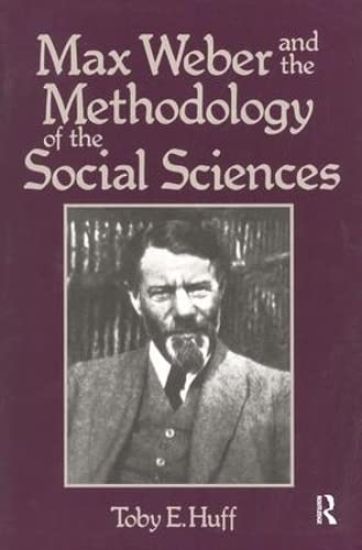
Max Weber and Methodology of Social Science
Huff provides a rare, full-scale study of the origins and development of Max Weber's methodology, which focuses on Weber's neglected early methodological essays that were not translated into English until the 1970s. He explores Weber's writings in light of developments in postempiricist philosophy of science, and shows that Weber was well aware of the epistemological foundations of the descriptive psychology school, whose intellectual heir was Husserl. This volume will help scholars and students understand in the broadest sense the issues central to the logic of social scientifi c explanation, and will appeal to philosophers, sociologists, political scientists, as well as scholars of Weber.
Max Klinger and Wilhelmine Culture

Max Klinger and Wilhelmine Culture

Marsha Morton

Routledge
2018
nidottu
The Wilhelmine Empire’s opening decades (1870s - 1880s) were crucial transitional years in the development of German modernism, both politically and culturally. Here Marsha Morton argues that no artist represented the shift from tradition to unsettling innovation more compellingly than Max Klinger. The author examines Klinger’s early prints and drawings within the context of intellectual and material transformations in Wilhelmine society through an interdisciplinary approach that encompasses Darwinism, ethnography, dreams and hypnosis, the literary Romantic grotesque, criminology, and the urban experience. His work, in advance of Expressionism, revealed the psychological and biological underpinnings of modern rational man whose drives and passions undermined bourgeois constructions of material progress, social stability, and class status at a time when Germans were engaged in defining themselves following unification. This book is the first full-length study of Klinger in English and the first to consistently address his art using methodologies adopted from cultural history. With an emphasis on the popular illustrated media, Morton draws upon information from reviews and early books on the artist, writings by Klinger and his colleagues, and unpublished archival sources. The book is intended for an academic readership interested in European art history, social science, literature, and cultural studies.
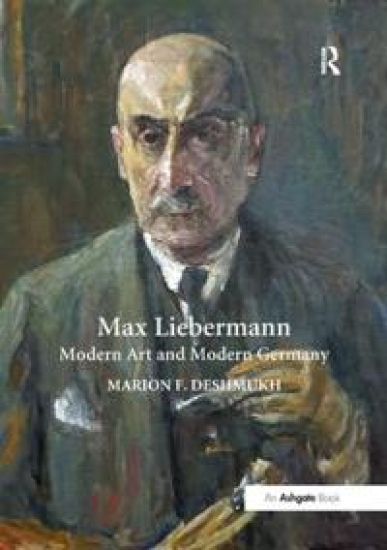
Max Liebermann

Max Liebermann

Marion F. Deshmukh

Routledge
2017
nidottu
Max Liebermann: Modern Art and Modern Germany is the first English-language examination of this German impressionist painter whose long life and career spanned nine decades. Through a close reading of key paintings and by a discussion of his many cultural networks across Germany and throughout Europe, this study by Marion Deshmukh illuminates Liebermann’s importance as a pioneer of German modernism. Critics and admirers alike saw his art as representing aesthetic European modernism at its best. His subjects included dispassionate depictions of the rural Dutch countryside, his colorful garden at the Wannsee, and his many portraits of Germany’s cultural, political, and military elites. Liebermann was the largest collector of French Impressionism in Germany - and his cosmopolitan outlook and his art created strong antipathies towards both by political and cultural conservatives throughout his life.
Max Weber's Interpretive Sociology of Law
This book presents a clear and precise account of the structure and content of Max Weber's sociology of law: situating its methodological and epistemological specificity in relation to other approaches to the sociology of law; as well as offering a critical evaluation of Weber's usefulness for contemporary socio-legal research. The book is divided into three parts. The first part deals with the methodological foundations of Weber's sociology of law. The second analyses the central theme of this sociology, the rationalisation of law, from the perspective of its internal logical coherence, its empirical validity, and finally its legitimacy. The third part questions the present-day relevance of the Weberian sociology of law for socio-legal research, notably with regard to legal pluralism. Max Weber, it is demonstrated, is not merely a 'founding father' of the sociology of law; rather, his methodology, concepts, and empirical analyses remain highly useful to the further development of work in this area.
Max Weber's 'Science as a Vocation'
Max Weber’s lecture ‘Science as a Vocation’ is a classic of social thought, in which central questions are posed about the nature of social and political thought and action. The lecture has often taken to be a summation of Weber’s thought. It can also be argued that, together with the responses of its admirers and critics, it provides a focus for discussion of the nature of modernity and its political consequences, and of the philosophical and political implications of the social or human sciences. This volume provides a full, clear, revised translation of the lecture, together with translations from the German of key contributions to the lively debate that followed its publication. The book concludes with a substantial essay on the current significance of the lecture, which discusses its relevance to the debates about the nature of science as a cultural phenomenon; the disjunction between science and nature; Weber’s conception of the disenchantment of the world; the division of scientific labour; and the fundamental nature and place of sociology.
Max Weber's 'Science as a Vocation'
Max Weber’s lecture ‘Science as a Vocation’ is a classic of social thought, in which central questions are posed about the nature of social and political thought and action. The lecture has often taken to be a summation of Weber’s thought. It can also be argued that, together with the responses of its admirers and critics, it provides a focus for discussion of the nature of modernity and its political consequences, and of the philosophical and political implications of the social or human sciences. This volume provides a full, clear, revised translation of the lecture, together with translations from the German of key contributions to the lively debate that followed its publication. The book concludes with a substantial essay on the current significance of the lecture, which discusses its relevance to the debates about the nature of science as a cultural phenomenon; the disjunction between science and nature; Weber’s conception of the disenchantment of the world; the division of scientific labour; and the fundamental nature and place of sociology.
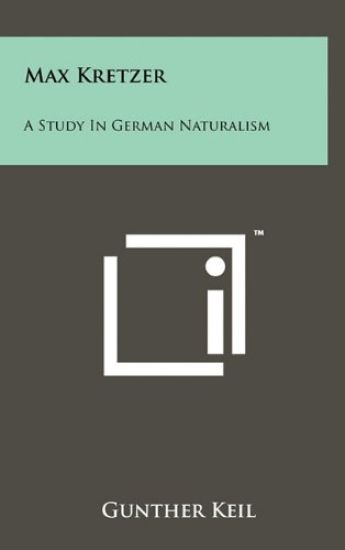
Max Kretzer: A Study in German Naturalism

Max Kretzer: A Study in German Naturalism

Gunther Keil

Literary Licensing, LLC
2011
sidottu
Max Kretzer: A Study in German Naturalism is a book written by Gunther Keil that explores the life and works of Max Kretzer, a German author and journalist who was part of the naturalist movement in literature. The book provides a comprehensive analysis of Kretzer's literary style and themes, as well as his social and political views. Keil examines Kretzer's major works, including his novels and short stories, and discusses how they reflect the naturalist philosophy of depicting reality as it is, without idealizing or romanticizing it. The book also delves into Kretzer's personal life, including his upbringing, education, and political activism, and how these experiences influenced his writing. Keil's study of Kretzer sheds light on the naturalist movement in German literature and provides valuable insights into the cultural and social context of the time. Overall, Max Kretzer: A Study in German Naturalism is a must-read for anyone interested in German literature, naturalism, and the cultural history of Germany in the late 19th and early 20th centuries.This scarce antiquarian book is a facsimile reprint of the old original and may contain some imperfections such as library marks and notations. Because we believe this work is culturally important, we have made it available as part of our commitment for protecting, preserving, and promoting the world's literature in affordable, high quality, modern editions, that are true to their original work.
Max Uhle, 1856-1944: A Memoir of the Father of Peruvian Archaeology
""Max Uhle, 1856-1944: A Memoir Of The Father Of Peruvian Archaeology"" is a biographical account of the life and work of Max Uhle, a German archaeologist who is often credited with being the founder of Peruvian archaeology. Written by John Howland Rowe, a fellow archaeologist and colleague of Uhle, the book provides a detailed and intimate portrait of Uhle's personal and professional life.The book begins with a brief overview of Uhle's early life and education in Germany before delving into his archaeological career. Uhle first became interested in archaeology while studying anthropology and ethnology at the University of Berlin. He went on to conduct several archaeological expeditions in Europe before moving to South America in 1892.In South America, Uhle quickly became fascinated with the ancient cultures of Peru and began conducting excavations at sites such as Pachacamac and Tiahuanaco. He made many important discoveries during his time in Peru, including the Nazca Lines and the Moche civilization.The book also discusses Uhle's personal life, including his marriage to an American woman and his eventual move to the United States. Despite facing challenges such as World War I and financial difficulties, Uhle continued to work tirelessly to advance the field of Peruvian archaeology until his death in 1944.Overall, ""Max Uhle, 1856-1944: A Memoir Of The Father Of Peruvian Archaeology"" is a fascinating and informative account of the life and work of one of the most important figures in the field of archaeology. It is a must-read for anyone interested in the history of archaeology or the ancient cultures of South America.University Of California Publications In American Archaeology And Ethnology, V46, No. 1, November 15, 1954.This scarce antiquarian book is a facsimile reprint of the old original and may contain some imperfections such as library marks and notations. Because we believe this work is culturally important, we have made it available as part of our commitment for protecting, preserving, and promoting the world's literature in affordable, high quality, modern editions, that are true to their original work.