Kirjojen hintavertailu. Mukana 12 390 323 kirjaa ja 12 kauppaa.

Kirjahaku

Etsi kirjoja tekijän nimen, kirjan nimen tai ISBN:n perusteella.

1000 tulosta hakusanalla Netta Syrett

The Yada Yada Prayer Group Gets Real

The Yada Yada Prayer Group Gets Real

Neta Jackson

Rutledge Hill Press,U.S.
2013
pokkari
The sisters of the Yada Yada Prayer Group are learning how to be real-with each other and with God. After a particularly exhausting year with the Yada Yada Prayer Group, all Jodi Baxter wants is a break. She even asks God for a little "dull and boring" in the new year. Instead she finds that when you're open to His plans, life is unpredictable-in the best and hardest ways. Jodi's life is suddenly full of changes, and they can be described as anything but boring. Out of all the Yada Yadas, God has Leslie "Stu" Stuart move into the Baxter's upstairs flat, which requires a lot of patience-and tongue-biting-on Jodi's part. She's continually unnerved by guilt stemming from the accident and dreads the day when she comes face-to-face with Hakim's mother. Plus, Bandana Woman, who was safely locked up in prison, has returned. Phew! Through prayer and friendship, the Yada Yadas are getting real. Dull and boring? Not a chance.
Handbook of Research on Higher Education in the MENA Region
As the Middle East and North Africa (MENA) region becomes increasingly intertwined in the global economy, investment continues to be made in the educational sector. Multidimensional approaches to higher education have greatly influenced the state of business and government in the region.Handbook of Research on Higher Education in the MENA Region: Policy and Practice examines the need for a paradigm shift in the area of post-secondary education and innovation in the emerging, yet relatively understudied, MENA region. This book is a comprehensive reference work for researchers, students, educators, and professionals who are interested in exploring how global higher education is influencing the prosperity and progress of the MENA region.
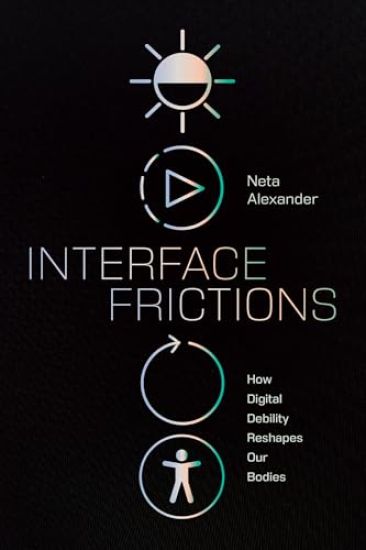
Interface Frictions: How Digital Debility Reshapes Our Bodies
In Interface Frictions, Neta Alexander explores how ubiquitous design features in digital platforms reshape, condition, and break our bodies. She shows that while features such as refresh, playback speed, autoplay, and night mode are convenient, they can lead to "digital debility"--the slow and often invisible ways that technologies may harm human bodies. These features all assume an able-bodied user and at the same time push users to ignore their bodily limitations like the need for rest, nourishment, or movement. Building on the lived experiences of people with disabilities, Alexander explores alternative design solutions that arise from a multisensorial approach to communication. She demonstrates what can be gained from centering the nonaverage user, such as blind people who pioneered ways to control the playback speed of media, and Netflix subscribers with invisible disabilities like PTSD who successfully pushed the company to redesign its previews autoplay feature. Drawing on artworks, video games, and creative hacking by users with disabilities, Alexander challenges our understanding of media consumption, the attention economy, and the digital interface.
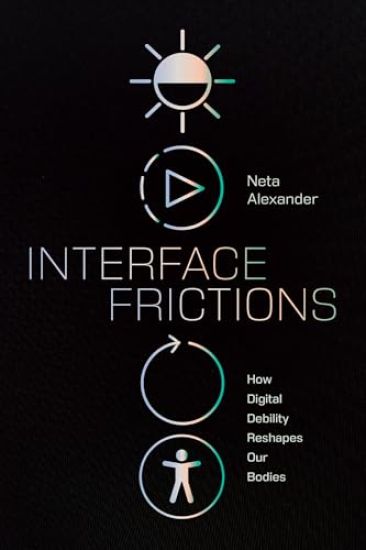
Interface Frictions: How Digital Debility Reshapes Our Bodies
In Interface Frictions, Neta Alexander explores how ubiquitous design features in digital platforms reshape, condition, and break our bodies. She shows that while features such as refresh, playback speed, autoplay, and night mode are convenient, they can lead to "digital debility"--the slow and often invisible ways that technologies may harm human bodies. These features all assume an able-bodied user and at the same time push users to ignore their bodily limitations like the need for rest, nourishment, or movement. Building on the lived experiences of people with disabilities, Alexander explores alternative design solutions that arise from a multisensorial approach to communication. She demonstrates what can be gained from centering the nonaverage user, such as blind people who pioneered ways to control the playback speed of media, and Netflix subscribers with invisible disabilities like PTSD who successfully pushed the company to redesign its previews autoplay feature. Drawing on artworks, video games, and creative hacking by users with disabilities, Alexander challenges our understanding of media consumption, the attention economy, and the digital interface.