Kirjojen hintavertailu. Mukana 12 390 323 kirjaa ja 12 kauppaa.

Kirjahaku

Etsi kirjoja tekijän nimen, kirjan nimen tai ISBN:n perusteella.

1000 tulosta hakusanalla Phyllis Murphy

Whose Birthday Is It Anyway?

Whose Birthday Is It Anyway?

Phyllis Maclay

CSS Publishing Company
1997
pokkari
For the small church that does not have a lot of time to prepare, here is an ideal Christmas program and worship service. It can be presented as part of a Sunday School program or Sunday worship service. The true message of Christmas is spoken through the words of "the friendly beasts," which include two donkeys, three doves, four cows, and four sheep. This program enables children to become involved in a Christmas project in which they share their Christmas ornaments and angel food cake with the congregation. Phyllis Maclay is a freelance writer living in Sinton, Texas. She has contributed to church publications and the magazine Country Woman. She is a children's choir director and delivers children's sermons in her home congregation. Phyllis has also written What's The Matter With Christmas? She and her husband are the parents of five children.
Psychological Trauma and the Developing Brain

Psychological Trauma and the Developing Brain

Phyllis Stien; Joshua C Kendall

Routledge Member of the Taylor and Francis Group
2003
sidottu
Explore interventions and treatment methods designed to help curb the alarming trend toward violence in today's youth! Written in jargon-free lucid prose, Psychological Trauma and the Developing Brain: Neurologically Based Interventions for Troubled Children specifically shows how positive early experiences enhance brain development and how traumatic life experiences, especially child abuse and neglect, can affect a child's brain and behavior. Through carefully selected case studies, the book offers basic principles of treatment and a broad range of interventions that target the multiple symptoms and problems seen in children with a history of childhood trauma. Offering a new psychobiological model of child development, this book incorporates the influence of both genes and the environment and conceptualizes normal and pathological development in terms of common underlying processes. For readers concerned with promoting healthy development in children and helping children recover from childhood trauma, this engagingly written book describes exactly how a child's social/interpersonal environment can positively or negatively influence brain development. Throughout the book, the authors highlight the interrelationship between neurobiology and psychology. They present basic information about brain development and organization, describe exactly what is going on inside the brain at each stage of development, and illustrate these concepts through a detailed case study of a preschooler with severe problems in communicating and relating. They discuss the pernicious effects that traumatic stress has on brain and behavior, differentiating between simple and complex PTSD, and review the specific brain impairments currently attributed to a childhood history of maltreatment. Using their unique psychobiological perspective and illustrative case studies, the authors evaluate the principles and strategies of treatment, showing how relationships and experiences can mitigate the effects childhood trauma. After fleshing out the shocking cost to society of child maltreatment, the authors offer broad policy prescriptions that promote healthy development, including basic strategies for prevention and early intervention. Psychological Trauma and the Developing Brain: Neurologically Based Interventions for Troubled Children will show you: how interpersonal experience shapes brain development what is going on in the brain during the critical first six years how therapeutic relationships and interpersonal experience can promote emotional and cognitive development how childhood maltreatment can damage the brain and impair the developing mind what types of experiences and therapeutic strategies can mitigate the effects of childhood trauma what policy prescriptions, programs, and early intervention strategies can be implemented to promote healthy development
Psychological Trauma and the Developing Brain

Psychological Trauma and the Developing Brain

Phyllis Stien; Joshua C Kendall

Routledge Member of the Taylor and Francis Group
2003
nidottu
Explore interventions and treatment methods designed to help curb the alarming trend toward violence in today's youth! Written in jargon-free lucid prose, Psychological Trauma and the Developing Brain: Neurologically Based Interventions for Troubled Children specifically shows how positive early experiences enhance brain development and how traumatic life experiences, especially child abuse and neglect, can affect a child's brain and behavior. Through carefully selected case studies, the book offers basic principles of treatment and a broad range of interventions that target the multiple symptoms and problems seen in children with a history of childhood trauma. Offering a new psychobiological model of child development, this book incorporates the influence of both genes and the environment and conceptualizes normal and pathological development in terms of common underlying processes. For readers concerned with promoting healthy development in children and helping children recover from childhood trauma, this engagingly written book describes exactly how a child's social/interpersonal environment can positively or negatively influence brain development. Throughout the book, the authors highlight the interrelationship between neurobiology and psychology. They present basic information about brain development and organization, describe exactly what is going on inside the brain at each stage of development, and illustrate these concepts through a detailed case study of a preschooler with severe problems in communicating and relating. They discuss the pernicious effects that traumatic stress has on brain and behavior, differentiating between simple and complex PTSD, and review the specific brain impairments currently attributed to a childhood history of maltreatment. Using their unique psychobiological perspective and illustrative case studies, the authors evaluate the principles and strategies of treatment, showing how relationships and experiences can mitigate the effects childhood trauma. After fleshing out the shocking cost to society of child maltreatment, the authors offer broad policy prescriptions that promote healthy development, including basic strategies for prevention and early intervention. Psychological Trauma and the Developing Brain: Neurologically Based Interventions for Troubled Children will show you: how interpersonal experience shapes brain development what is going on in the brain during the critical first six years how therapeutic relationships and interpersonal experience can promote emotional and cognitive development how childhood maltreatment can damage the brain and impair the developing mind what types of experiences and therapeutic strategies can mitigate the effects of childhood trauma what policy prescriptions, programs, and early intervention strategies can be implemented to promote healthy development
God and the Rhetoric of Sexuality

God and the Rhetoric of Sexuality

Phyllis Trible

Augsburg Fortress
1986
pokkari
Focusing on texts in the Hebrew Bible, and using feminist hermeneutics, Phyllis Trible brings out what she considers to be neglected themes and counter literature. After outlining her method in more detail, she begins by highlighting the feminist imagery used for God; then she moves on to traditions embodying male and female within the context of the goodness of creation. If Genesis 2-3 is a love story gone awry, the Song of Songs is about sexuality redeemed in joy. In between lies the book of Ruth, with its picture of the struggles of everyday life.
Rhetorical Criticism

Rhetorical Criticism

Phyllis Trible

Augsburg Fortress
1995
pokkari
Phyllis Trible examines rhetorical criticism as a discipline within biblical studies. In Part One she surveys the historical antecedents of the method from ancient times to the postmodern era: classical rhetoric, literary critical theory, literary study of the Bible, and form criticism. Trible then presents samples of rhetorical analysis as the art of composition and as the art of persuasion. In Part Two, formulated guidelines are applied to a detailed study of the book of Jonah. A close reading with respect to structure, syntax, style, and substance elicits a host of meanings embedded in text, enabling the relationship between artistry and theology to emerge with clarity. Rhetorical Criticism has many distinctive features. It is the first comprehensive treatment of biblical rhetorical criticism as it has emerged within the latter half of the twentieth century. a didactic treatise that combines theoretical discussion, practical guidelines, and detailed exegesis interdisciplinary in approach, engaging the rhetorical study of the Bible with expanding developments in secular literary criticism (structuralism, poetics, reader-response criticism, and deconstruction, for example) and in the similarly burgeoning field of contemporary rhetoric itself a model of the rhetorical analysis that it describes accessible both to the novice and to the scholar
The Great Emergence – How Christianity Is Changing and Why

The Great Emergence – How Christianity Is Changing and Why

Phyllis Tickle

Baker Books, a division of Baker Publishing Group
2012
nidottu
Rooted in the observation that massive transitions in the church happen about every 500 years, Phyllis Tickle shows readers that we live in such a time right now. She compares the Great Emergence to other "Greats" in the history of Christianity, including the Great Transformation (when God walked among us), the time of Gregory the Great, the Great Schism, and the Great Reformation. Combining history, a look at the causes of social upheaval, and current events, The Great Emergence shows readers what the Great Emergence in church and culture is, how it came to be, and where it is going. Anyone who is interested in the future of the church in America, no matter what their personal affiliation, will find this book a fascinating exploration.Study guide by Danielle Shroyer.
Purchasing Identity in the Atlantic World

Purchasing Identity in the Atlantic World

Phyllis Whitman Hunter

Cornell University Press
2001
sidottu
Americans have always had a love-hate relationship with possessions. Early Americans suspected luxuries as a corrupting force that would lead to an aristocracy. In Purchasing Identity in the Atlantic World, Phyllis Whitman Hunter demonstrates how elite Americans not only became infatuated with their belongings, but also avidly pursued consumption to shape their world and proclaim their success. In eighteenth-century New England harbor towns, the commercial gentry led their communities into full participation in a flourishing Anglo-American consumer culture. Affluent traders constructed roads, wharves, and warehouses, built mansions and assembly buildings, adopted new forms of sociability, and fostered the rise of the public sphere. Using case studies of influential merchant families, Hunter brings alive the process by which Boston and Salem evolved from Puritan towns dominated by families of English origin to Georgian provincial cities open to a diversity of religious affiliations and European ethnicities. Hunter then explores how revolutionary politics overturned polite society and transformed the meanings of possessions. Patriots threw tea to the fish in Boston Harbor, donned homespun at Harvard commencements, and transformed a silver punch bowl into an icon of liberty. The wealthy either espoused republican values and muted their material displays or fled to exile. Purchasing Identity in the Atlantic World,reveals a critical link in the complex relationship between capitalism and culture: the process by which material goods become symbols of profound social and cultural significance.
The Politics of Race in New York

The Politics of Race in New York

Phyllis F. Field

Cornell University Press
2009
pokkari
Black suffrage was a crucial and volatile issue in the North during the Civil War era. In The Politics of Race in New York, Phyllis F. Field studies the development of racial policies in the Empire State. Asserting that it is not possible to understand the move toward black suffrage by examining national trends and the actions of individual politicians, she takes a close look at the social context of reform.Field assesses popular reaction to the idea of black suffrage by systematically analyzing the results of a series of referenda on the issue held in New York State between 1846 and 1869. Tracing the relation between changes in public opinion and the positions taken by political parties, Field concludes that party leaders tried both to express the views of their constituents and to mold those views so as to strengthen and unify their own political organizations. Inevitably, this intrusion of political considerations in the issue of race had long-term consequences for the process of social change in the United States.The Politics of Race in New York shows clearly how, in 1870, black suffrage could be achieved even though the battle for black equality had yet to begin.
Stages of History

Stages of History

Phyllis Rackin

Cornell University Press
1990
pokkari
Phyllis Rackin offers a fresh approach to Shakespeare's English history plays, rereading them in the context of a world where rapid cultural change transformed historical consciousness and gave the study of history a new urgency. Rackin situates Shakespeare's English chronicles among multiple discourses, particularly the controversies surrounding the functions of poetry, theater, and history. She focuses on areas of contention in Renaissance historiography that are also areas of concern in recent criticism-historical authority and causation, the problems of anachronism and nostalgia, and the historical construction of class and gender. She analyzes the ways in which the perfoace of history in Shakespeare's theater participated—and its representation in subsequent criticism still participates—in the contests between opposed theories of history and between the different ideological interests and historiographic practices they authorize. Celebrating the heroic struggles of the past and recording the patriarchal genealogies of kings and nobles, Tudor historians provided an implicit rationale for the hierarchical order of their own time; but the new public theater where socially heterogeneous audiences came together to watch common players enact the roles of their social superiors was widely perceived as subverting that order. Examining such sociohistorical factors as the roles of women and common men and the conditions of theatrical performance, Rackin explores what happened when elite historical discourse was trans porteto the public commercial theater. She argues that Shakespeare's chronicles transformed univocal historical writing into polyphonic theatrical scripts that expressed the contradictions of Elizabethan culture.
Erotic Fantasies

Erotic Fantasies

Phyllis Kronhausen; Eberhard Kronhausen

Avalon Travel Publishing
1994
nidottu
Gathers erotic folklore and writings about homosexuality, transsexualism, bondage, sadomasochism, incest, and fetishism, and discusses the psychological aspects of sexual fantasies
Journal Keeper

Journal Keeper

Phyllis Theroux

Grove Press / Atlantic Monthly Press
2011
nidottu
The Journal Keeper is the openhearted and unflinchingly honest memoir of six years in writer Phyllis Theroux's life. As she ages into her sixties, Theroux uses regular journal entries to reflect on the void left by the passing of her remarkable mother and the thrill of allowing a new source of joy into her life. A natural storyteller, Theroux slips her arm companionably into yours, like an old friend going for a stroll. But Theroux's stride is long and her eye sharp, and she swings easily between subjects that occupy us all: love, loneliness, growing old, financial worries, spiritual growth, and caring for an aging parent. A compelling tale in journal form, The Journal Keeper is a rich feast from the writing life -- with an unexpected twist. After the death of her mother leaves Theroux feeling adrift, she finds the love that she believed was closed to a woman of her age. Not until Theroux sat down to edit her journals for publication did she realize, in her words, "that a hand much larger and more knowing than my own was guiding my life and pen across the page." She makes a good case for this being true for us all.
Northern Athabascan Survival

Northern Athabascan Survival

Phyllis A. Fast

University of Nebraska Press
2002
sidottu
The Northern Athabascan peoples of the Alaskan interior and the Yukon have survived centuries of contact and attempted domination by outsiders. Their lives today are rich in meaning and tradition yet are also complicated by numerous challenges such as poverty, alcoholism, domestic violence, suicide, and troubled leadership. Combining scholarly analysis, first-person accounts, and her own experiences and insights as a Koyukon Athabascan artist and anthropologist, Phyllis Ann Fast illuminates the modern Athabascan world. Her conversations with Athabascan women offer revealing glimpses of their personal lives and a probing assessment of their professional opportunities and limitations. Also showcased is the crucial but ambiguous role of Athabascan leaders, who are needed to champion reform and social healing but are often undermined by conflicting notions of decision making, personhood, and leadership in Athabascan society.A troubling observation of this study is the vast extent to which addiction—manifested as both substance abuse and economic dependency—pervades Northern Athabascan society and threatens to curtail its cohesion and aspirations. But Northern Athabascans are far from victims. As Fast discovers, Northern Athabascan men and women are well aware of these widespread social problems, and many have undertaken initiatives to deal with and heal them. Rigorous and compassionate, Northern Athabascan Survival provides an uncompromising view of a remarkable and troubled world.
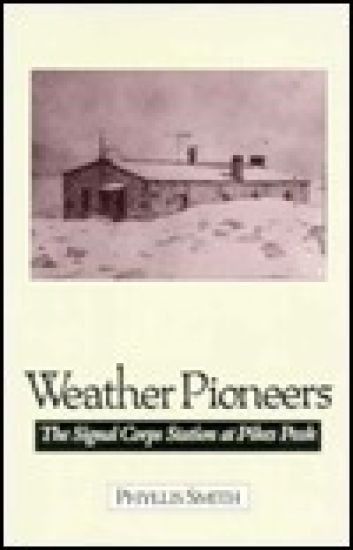
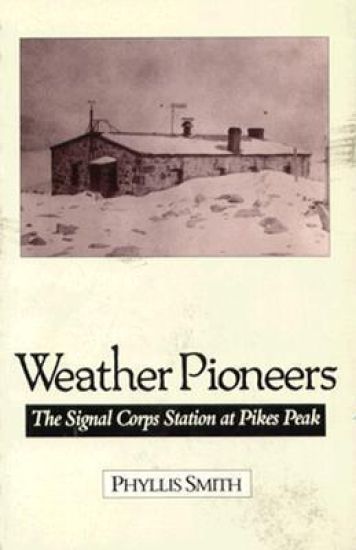
Weather Pioneers

Weather Pioneers

Phyllis Smith

Swallow Press
1993
sidottu
At 14,110 feet, the weather station atop Pikes Peak, Colorado, was the highest in the world in 1873. Young men trained by the Signal Corps took turns living year-round on the isolated mountain, where they endured loneliness, primitive living conditions, lack of financial support and appreciation, and deteriorating health. Most did so with dedication and good humor. Some suffered frostbitten hands, feet and ears when they became lost on the snowy mountain trail; others were jolted by lightning strikes. One man eventually died; another, evidently unsuited to the solitary life, went mad. Although weather records had been kept by private individuals and some universities since the early 1800s both here and abroad, a full U.S. weather reporting service had to await development and expansion of the electric telegraph. Both farmers and coastal shippers pressed the U.S. Congress to establish a weather prediction facility. By 1870 a network of such stations was in place. By late summer of 1873, workmen had finished the crude two-room station at the top of Pikes Peak. A telegraph line snaked through brush, trees, and boulders to the lofty summit. When daily logs and research records were completed, some of the Pikes Peak weather men amused themselves by writing tall tales, expanding on their already unusual adventures. Americans loved their stories and seldom disavowed the truth of sea monsters in Pikes Peak lakes, plagues of mountain rats, and mysterious volcanic eruptions. Their problems with governmental bureaucracy were at once humorous and sad. With fortitude and imagination these early meteorologists laid the groundwork for today’s sophisticated science of data-gathering satellites and computer models.
Weather Pioneers

Weather Pioneers

Phyllis Smith

Swallow Press
1993
pokkari
At 14,110 feet, the weather station atop Pikes Peak, Colorado, was the highest in the world in 1873. Young men trained by the Signal Corps took turns living year-round on the isolated mountain, where they endured loneliness, primitive living conditions, lack of financial support and appreciation, and deteriorating health. Most did so with dedication and good humor. Some suffered frostbitten hands, feet and ears when they became lost on the snowy mountain trail; others were jolted by lightning strikes. One man eventually died; another, evidently unsuited to the solitary life, went mad. Although weather records had been kept by private individuals and some universities since the early 1800s both here and abroad, a full U.S. weather reporting service had to await development and expansion of the electric telegraph. Both farmers and coastal shippers pressed the U.S. Congress to establish a weather prediction facility. By 1870 a network of such stations was in place. By late summer of 1873, workmen had finished the crude two-room station at the top of Pikes Peak. A telegraph line snaked through brush, trees, and boulders to the lofty summit. When daily logs and research records were completed, some of the Pikes Peak weather men amused themselves by writing tall tales, expanding on their already unusual adventures. Americans loved their stories and seldom disavowed the truth of sea monsters in Pikes Peak lakes, plagues of mountain rats, and mysterious volcanic eruptions. Their problems with governmental bureaucracy were at once humorous and sad. With fortitude and imagination these early meteorologists laid the groundwork for today’s sophisticated science of data-gathering satellites and computer models.
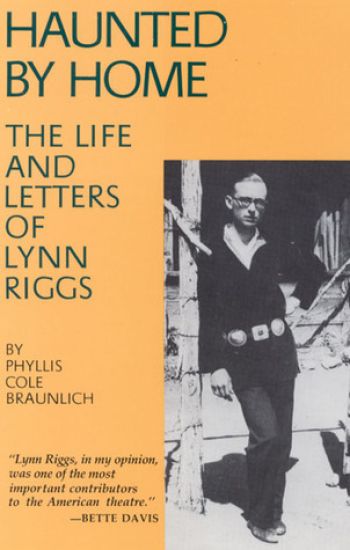
Haunted by Home

Haunted by Home

Phyllis Cole Braunlich

University of Oklahoma Press
2002
nidottu
Phyllis Cole Braunlich sketches the life story of Lynn Riggs (18991954), the playwright best known as the author of Green Grow the Lilacs, the play that formed the basis for the Rodgers and Hammerstein musical Oklahoma! Today Riggs is recognized as one of the twentieth century's most innovative playwrights.Santa Fe, Hollywood, New York, and Chapel Hill: these were the cities that Lynn Riggs, ""father of the folk play,"" called home, along with eastern Oklahoma, the scene of his memorable re-creations of Oklahoma Territory before statehood. Riggs traveled widely to make his living and his fame, and along the way he earned the friendship of many avant-garde writers and successful theatre people of his time. This biography is also a chronicle of literary and café society on both coasts and in New Mexico during the 1920s, ‘30s, and ‘40s.
N. Scott Momaday

N. Scott Momaday

Phyllis S. Morgan

University of Oklahoma Press
2010
sidottu
N. Scott Momaday, Pulitzer Prize-winning author of House Made of Dawn (1969) and National Medal of Arts awardee, is the elder statesman of Native American literature and a major twentieth-century American author. This volume marks the most comprehensive resource available on Momaday. Along with an insightful new biography, it offers extensive, up-to-date bibliographies of his own work and the work of others about him.Phyllis Morgan's account of Momaday's life and career and her chronology of his accomplishments, including his many awards and honors, are based on wide-ranging research and recent interviews in which she elicited Momaday's thoughts on topics and periods of his life that he has not previously touched on. The biography captures his formative years, expands on his academic career, and reflects a deep understanding of his work.The comprehensive annotated bibliography of Momaday's published work catalogs his output through mid-2009, including books, stories, essays, poems, newspaper columns, forewords and introductions, play scripts, and interviews. Morgan has also compiled an extensive listing of works about Momaday and his multifaceted output, including books, critical essays, reviews, newspaper articles, reference sources, online resources, and dissertations and theses. In the introduction, literary scholar Kenneth Lincoln offers additional insight into Momaday's poetry and prose.With Momaday having observed his 75th birthday in 2009, this book showcases his accomplishments as it captures his dedication to family and ancestors, to the sacredness of Earth, and to the traditions of Native and indigenous peoples. It is an indispensable and foundational research tool and a worthy tribute to a literary icon.
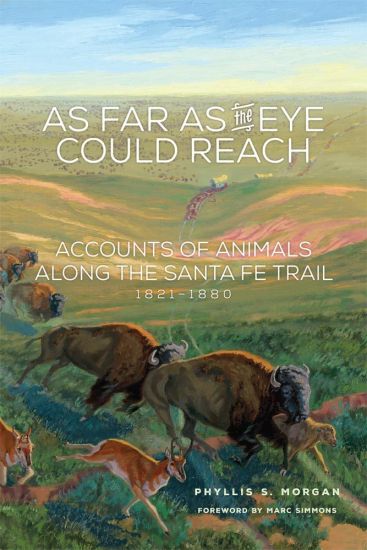
As Far as the Eye Could Reach

As Far as the Eye Could Reach

Phyllis S. Morgan; Marc Simmons

University of Oklahoma Press
2015
nidottu
Travelers and traders taking the Santa Fe Trail's routes from Missouri to New Mexico wrote vivid eyewitness accounts of the diverse and abundant wildlife encountered as they crossed arid plains, high desert, and rugged mountains. Most astonishing to these observers were the incredible numbers of animals, many they had not seen before - buffalo, antelope (pronghorn), prairie dogs, roadrunners, mustangs, grizzlies, and others. They also wrote about the domesticated animals they brought with them, including oxen, mules, horses, and dogs. Their letters, diaries, and memoirs open a window onto an animal world on the plains seen by few people other than the Plains Indians who had lived there for thousands of years. Phyllis S. Morgan has gleaned accounts from numerous primary sources and assembled them into a delightfully informative narrative. She has also explored the lives of the various species, and in this book tells about their behaviors and characteristics, the social relations within and between species, their relationships with humans, and their contributions to the environment and humankind. With skillful prose and a keen eye for a priceless tale, Morgan reanimates the story of life on the Santa Fe Trail's well-worn routes, and its sometimes violent intersection with human life. She provides a stirring view of the land and of the animals visible ""as far as the eye could reach,"" as more than one memoirist described. She also champions the many contributions animals made to the Trail's success and to the opening of the American West.
Fighting for Recovery

Fighting for Recovery

Phyllis Vine

BEACON PRESS
2022
sidottu
An essential history of the recovery movement for people with mental illness, and an inspiring account of how former patients and advocates challenged a flawed system and encouraged mental health activism This definitive people's history of the recovery movement spans the 1970s to the present day and proves to readers just how essential mental health activism is to every person in this country, whether you have a current psychiatric diagnosis or not. In Fighting for Recovery, professor and mental health advocate Phyllis Vine tells the history of the former psychiatric patients, families, and courageous activists who formed a patients' liberation movement that challenged medical authority and proved to the world that recovery from mental illness is possible.Mental health discussions have become more common in everyday life, but there are still enormous numbers of people with psychiatric illness in jails and prisons or who are experiencing homelessness - proving there is still progress to be made.This is a book for youA friend or family member of someone with serious psychiatric diagnoses, to understand the history of mental health reformA person struggling with their own diagnoses, to learn how other patients have advocated for themselvesAn activist in the peer-services network: social workers, psychologists, and peer counselors, to advocate for change in the treatment of psychiatric patients at the institutional and individual levelsA policy maker, clinical psychologist, psychiatric resident, or scholar who wants to become familiar with the social histories of mental illness
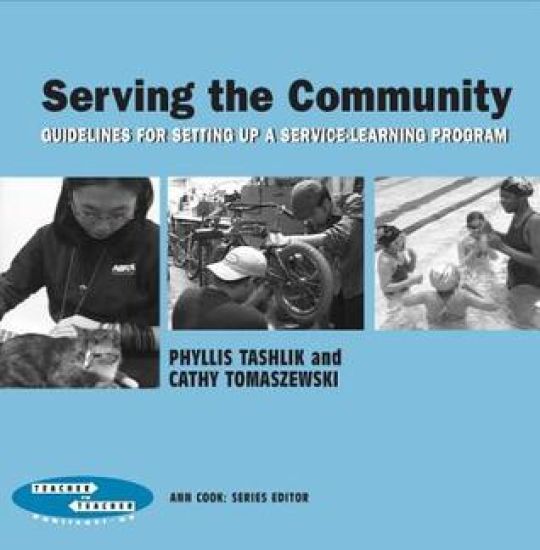
Serving the Community

Serving the Community

Phyllis Tashlik; Cathy Tomoszewski

Teachers' College Press
2006
muu
This resource offers the basics to help you set up and maintain a successful service-learning program in your school. The book answers questions that teachers and administrators might have about the nuts and bolts of the program and includes an array of ideas for school-wide discussions and activities that focus on the importance of serving the community. The DVD follows students as they attend a series of diverse sites in New York City, including a pre-K classroom, a museum, a kitchen in a homeless shelter, and an activist group that recycles bicycles for shipment to Third World countries. Book features include: strategies to help you match student interests and talents; sample midterm and final evaluation forms; lists of sample sites appropriate for teenagers; and, suggestions for discussion groups about community service.