Kirjojen hintavertailu. Mukana 12 083 983 kirjaa ja 12 kauppaa.

Kirjahaku

Etsi kirjoja tekijän nimen, kirjan nimen tai ISBN:n perusteella.

1000 tulosta hakusanalla Richard J. Walter

Pluralisms and Horizons: An Essay in Christian Public Philosophy

Pluralisms and Horizons: An Essay in Christian Public Philosophy

Richard J. Mouw; Sander Griffioen

William B. Eerdmans Publishing Company
1993
nidottu
How should Christians respond to pluralism in public life? Christians have often clashed with the pluralism that characterizes life in modern America. In this classic essay in political philosophy, Richard J. Mouw and Sander Griffioen show how Christians can engage with pluralism productively. Thoroughly engaging with leading voices in the debate, Mouw and Griffioen wrestle with pluralism and its consequences for Christian public life. Ultimately, the authors endorse cooperation and tolerance, without sliding into moral relativism. Christian readers will find their carefully reasoned argument a compelling solution toward promoting the common good.
Consulting the Faithful

Consulting the Faithful

Richard J. Mouw

William B Eerdmans Publishing Co
1994
pokkari
The president of Pasadena's Fuller Theological Seminary carefully assesses the relationship--or lack thereof--between "popular" religion and intellectual orthodoxy. Mouw argues that therapeutic and managerial "revolutions" can bring beneficial new sensitivities to Christian thought and practice.
He Shines in All That's Fair

He Shines in All That's Fair

Richard J. Mouw

William B Eerdmans Publishing Co
2002
nidottu
How do Christians account for the widespread presence of goodness in a fallen world? Different theological perspectives have presented a range of answers to this fundamental question over the centuries. In "He Shines in All That's Fair", Richard Mouw brings the historic insights of Calvinism to bear on this question and reinterprets them for a broader audience at the turn of the twenty-first century. Mouw examines long-standing Reformed arguments between those who champion the doctrine of common grace and those who emphasize an antithesis between the church and the world. Defenders of common grace account for the goodness in the world by insisting that God's grace goes beyond salvation to more general gifts of beauty, virtue, and excellence to all human beings - including those who do not believe in God. Those who reject the doctrine of common grace, on the other hand, emphasize the fallenness of the world and the need for the church to maintain a dramatic contrast to it. These divergent theological perspectives, while seemingly remote and abstract, lead to questions with very practical implications: What common ground do Christians share with those outside the faith?How should Christian treat their non-Christian neighbors?How should Christians relate to the world around them?Does God disapprove when Christians form close friendships with people who are "of the world"? Ought Christians to identify with the joys and sorrows of those who do not confess Christ as their Savior and Lord? In the course of this book Mouw looks at these topics, connecting the larger theological discussions to pressing issues in contemporary society. He insists that we have much to learn from thinkers who have rejected the idea of common (non-saving) grace, but he also defends the traditional common grace teachings, showing how they provide an important basis for wrestling with key challenges in present-day culture. Ultimately, Mouw argues forcefully for a Calvinism that is capable of standing in awe before the mysteries of God's gracious dealings with all human beings - and indeed the whole creation. Presented as the 2000 Stob Lectures at Calvin College and Calvin Theological Seminary, these soundly reasoned, elegantly written chapters offer an updated, robust understanding of common grace that will be of great value to anyone interested in the relation of church and culture.
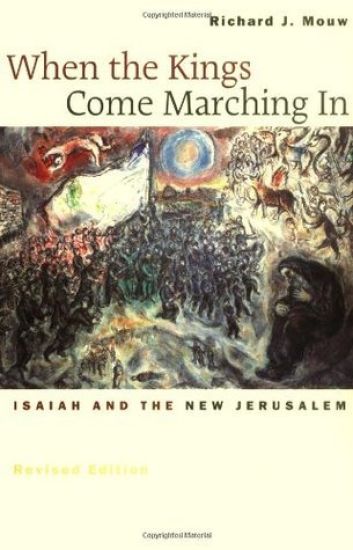
When the Kings Come Marching in

When the Kings Come Marching in

Richard J. Mouw

William B Eerdmans Publishing Co
2002
nidottu
Widely respected for his perspectives on faith in the modern world, Richard J. Mouw has long stood at the forefront of the -Christ and culture- debate. In When the Kings Come Marching In -- here revised and updated -- Mouw explores the religious transformation of culture as it is powerfully pictured in Isaiah 60. In Isaiah 60 the prophet envisions the future transformation of the city of Jerusalem, a portrayal of the Holy City that bears important similarities to John's vision of the future in Revelation 21 and 22. Mouw examines these and other key passages of the Bible, showing how they provide a proper pattern for cultural involvement in the present. Mouw identifies and discusses four main features of the Holy City: (1) -the wealth of the nations- is gathered into the city; (2) the -kings of the earth- march into the city; (3) people from many nations are drawn to the city; and (4) light pervades the city. In drawing out the implications of these striking features, Mouw treats a number of relevant cultural issues, including Christian attitudes toward the processes and products of commerce, technology, and art; the nature of political authority; race relations; and the scope of the redemptive ministry of Jesus Christ. The volume culminates in an invaluable discussion of how Christians should live in the modern world. Mouw argues that believers must go beyond a narrow understanding of the individual -pilgrim's progress- to a view of the Christian pilgrimage wherein believers work together toward solving the difficult political, social, and economic problems of our day.
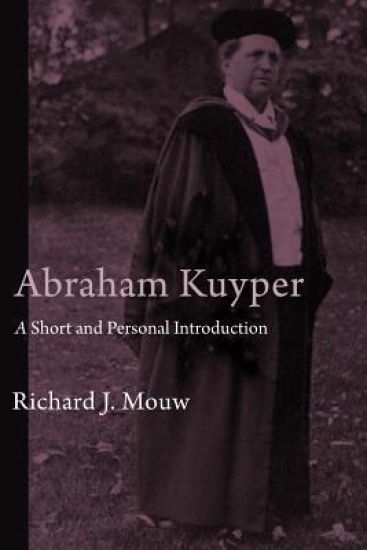
Abraham Kuyper

Abraham Kuyper

Richard J. Mouw

William B Eerdmans Publishing Co
2011
nidottu
Richard Mouw was first drawn to Abraham Kuyper's writings about public life in the turbulent 1960s. As he struggled to find the right Christian stance toward big social issues such as the civil rights movement and the Vietnam War, Mouw discovered Kuyper's Lectures on Calvinism -- and, with it, a robust vision of active Christian involvement in public life that has guided him ever since. In this -short and personal introduction- Mouw sets forth Kuyper's main ideas on Christian cultural discipleship, including his views on sphere sovereignty, the antithesis, common grace, and more. Mouw looks at ways to update -- and, in some places, even correct -- Kuyper's thought as he applies it to such twenty-first-century issues as religious and cultural pluralism, technology, and the challenge of Islam.
Challenges of Cultural Discipleship

Challenges of Cultural Discipleship

Richard J. Mouw

William B Eerdmans Publishing Co
2011
nidottu
Richard J. Mouw is well known for his incisive views on the intersection of culture and Christianity and for his efforts to make the thought of major Dutch theologian Abraham Kuyper accessible to average Christians. In this volume Mouw provides the scholarly -backstory- to his popular books as he interprets, applies, expands on -- and at times even corrects -- Kuyper's remarkable vision for faith and public life. In thirteen essays Mouw explores and develops the Kuyperian perspective on key topics in Christian cultural discipleship, including public theology, sphere sovereignty, education, creation, and more. He deftly articulates an ecumenically enriched neo-Calvinist -- or -neo-Kuyperian- -- perspective that appropriates and contextualizes the ideas and insights of this important theologian and statesman for new challenges in Christian thought and service.
Called to the Life of the Mind

Called to the Life of the Mind

Richard J. Mouw

William B Eerdmans Publishing Co
2014
nidottu
-I wasn't supposed to spend my life in the world of scholarship, - Richard Mouw acknowledges at the beginning of Called to the Life of the Mind. Yet he has indeed spent his career in the academy -- and has become one of the most widely respected evangelical Christian scholars of our time. In this wise little book Mouw defends Christian scholarship as an important and legitimate endeavor, responding in particular to those traditions that continue to be suspicious of intellectual pursuits. Writing in an inviting, conversational style, Mouw reflects candidly on the faithful Christian cultivation of the life of the mind and offers gentle advice on how Christians, especially evangelicals, might fruitfully navigate the world of the academy as followers of Jesus.
Talking with the Mormons

Talking with the Mormons

Richard J. Mouw

William B Eerdmans Publishing Co
2012
nidottu
For over a decade Fuller Seminary president Richard Mouw has participated in Mormon-evangelical dialogue with a view to developing a better understanding between the two groups. His participation in these discussions has drawn severe criticism and even anger from people who believe such talks are pointless or even dangerous. This brief, highly accessible book is his answer. Advocating humility, patience, and a willingness to admit our own shortcomings, Mouw shows why it is necessary to move beyond stark denunciation to a dialogue that allows both parties to express differences and explore common ground. Without papering over significantly divergent perspectives on important issues like the role of prophecy, the nature of God, and the creeds, Mouw points to areas in which Mormon-evangelical dialogue evidences hope for the future. In so doing, he not only informs readers but also models respectful evangelical debate.
The Kingdom of Golf in America

The Kingdom of Golf in America

Richard J. Moss

University of Nebraska Press
2013
sidottu
For golf’s true enthusiasts, the game is far more-and far more complex-than a simple hobby, commodity, or slice of the sports industry. It is a physical and mental place to be, a community. It has a history, a hierarchy, laws, a language, and a literature. And in Richard J. Moss, it has a chronicler. From its beginnings in the northeastern United States in the 1880s, golf has seen its popularity, and its fortunes, wax and wane, affected by politics and economics, reflecting tensions between aristocratic and democratic impulses. The Kingdom of Golf in America traces these ups and downs, ins and outs, in the growth of golf as a community. Moss describes the development of the private club and public course and the impact of wealth and the consumer culture on those who play golf and those who watch. He shows that factors like race, gender, technology, suburbanization, and the transformation of the South that shaped the nation also shaped golf. The result is a unique, and uniquely entertaining, work of cultural history that shows us golf as a community whose story resonates far beyond the confines of the course.
Vichy's Afterlife

Vichy's Afterlife

Richard J. Golsan

University of Nebraska Press
2000
pokkari
One of the distinctive features of the "Vichy Syndrome"—the persistence of the memory of the Vichy regime in French political and cultural life—is that it has been extremely difficult for an authoritative historical discourse to impose itself. Why does Vichy, and all that the name entails, fascinate and even obsess the French, inflecting not only discussions of the past but of the present as well? In Vichy's Afterlife, Richard J. Golsan explores the complexities of some of the most provocative episodes of Vichy's curious persistence in France's national consciousness. He argues that each of these episodes, events, and scandals constitutes a crossroads where history and "counterhistory"—different or competing versions of the past—encounter one another, often with explosive and even destructive consequences.
Generalizability Theory

Generalizability Theory

Richard J. Shavelson; Noreen M. Webb

SAGE Publications Inc
1991
nidottu
Accessible to any professional or researcher who has a basic understanding of analysis of variance, Shavelson and Webb offer an intuitive development of generalizability theory, a technique for estimating the relative magnitudes of various components of error variation and for indicating the most efficient strategy for achieving desired measurement precision. Covering a variety of topics such as generalizability studies with nested facets and with fixed facets, measurement error and generalizability coefficients, and decision studies with same and with different designs, the text includes exercises so the reader may practice the application of each chapter's material. By using detailed illustrations and examples, Shavelson and Webb clearly describe the logic underlying major concepts in generalizability theory to enable readers to apply these methods when investigating the consistency of their own measurements.
Measuring College Learning Responsibly

Measuring College Learning Responsibly

Richard J. Shavelson

Stanford University Press
2009
sidottu
Accrediting boards, the federal government, and state legislatures are now requiring a greater level of accountability from higher education. However, current accountability practices, including accreditation, No Child Left Behind, and performance reporting are inadequate to the task. If wielded indiscriminately, accountability can actually do more harm than good. This innovative work looks broadly at how accountability is being considered by campuses, accrediting boards, higher education organizations, and governments in the US and abroad. It explores how new demands for accountability and new technologies are changing the way student learning is assessed. The author, one of the most respected assessment researchers in the nation, provides a framework for assessing student learning and discusses historical and contemporary debates in the field. He details new directions in assessment, such as the Collegiate Learning Assessment he helped develop, analyzes exemplary campus assessment programs, and proposes considerations necessary for designing successful accountability systems.
Measuring College Learning Responsibly

Measuring College Learning Responsibly

Richard J. Shavelson

Stanford University Press
2009
pokkari
Accrediting boards, the federal government, and state legislatures are now requiring a greater level of accountability from higher education. However, current accountability practices, including accreditation, No Child Left Behind, and performance reporting are inadequate to the task. If wielded indiscriminately, accountability can actually do more harm than good. This innovative work looks broadly at how accountability is being considered by campuses, accrediting boards, higher education organizations, and governments in the US and abroad. It explores how new demands for accountability and new technologies are changing the way student learning is assessed. The author, one of the most respected assessment researchers in the nation, provides a framework for assessing student learning and discusses historical and contemporary debates in the field. He details new directions in assessment, such as the Collegiate Learning Assessment he helped develop, analyzes exemplary campus assessment programs, and proposes considerations necessary for designing successful accountability systems.
Control Theory for Humans

Control Theory for Humans

Richard J. Jagacinski; John M. Flach

CRC Press Inc
2002
sidottu
This textbook provides a tutorial introduction to behavioral applications of control theory. Control theory describes the information one should be sensitive to and the pattern of influence that one should exert on a dynamic system in order to achieve a goal. As such, it is applicable to various forms of dynamic behavior. The book primarily deals with manual control (e.g., moving the cursor on a computer screen, lifting an object, hitting a ball, driving a car), both as a substantive area of study and as a useful perspective for approaching control theory. It is the experience of the authors that by imagining themselves as part of a manual control system, students are better able to learn numerous concepts in this field. Topics include varieties of control theory, such as classical, optimal, fuzzy, adaptive, and learning control, as well as perception and decision making in dynamic contexts. The authors also discuss implications of control theory for how experiments can be conducted in the behavioral sciences. In each of these areas they have provided brief essays intended to convey key concepts that enable the reader to more easily pursue additional readings. Behavioral scientists teaching control courses will be very interested in this book.
Control Theory for Humans

Control Theory for Humans

Richard J. Jagacinski; John M. Flach

CRC Press Inc
2002
nidottu
This textbook provides a tutorial introduction to behavioral applications of control theory. Control theory describes the information one should be sensitive to and the pattern of influence that one should exert on a dynamic system in order to achieve a goal. As such, it is applicable to various forms of dynamic behavior. The book primarily deals with manual control (e.g., moving the cursor on a computer screen, lifting an object, hitting a ball, driving a car), both as a substantive area of study and as a useful perspective for approaching control theory. It is the experience of the authors that by imagining themselves as part of a manual control system, students are better able to learn numerous concepts in this field. Topics include varieties of control theory, such as classical, optimal, fuzzy, adaptive, and learning control, as well as perception and decision making in dynamic contexts. The authors also discuss implications of control theory for how experiments can be conducted in the behavioral sciences. In each of these areas they have provided brief essays intended to convey key concepts that enable the reader to more easily pursue additional readings. Behavioral scientists teaching control courses will be very interested in this book.
Composing a Teacher Study Group

Composing a Teacher Study Group

Richard J. Meyer; With Linda Brown; Elizabeth DeNino; Kimberly Larson; Mona McKenzie

Routledge Member of the Taylor and Francis Group
1997
sidottu
There has been a flurry of writing about teachers as inquirers and researchers as well as books about children as inquirers. This volume brings these two areas together -- teachers and students are inquiring at Ridgeway Elementary School. It demonstrates the importance of thought collectives as forums for student and teacher learning. The children in the primary classrooms in this book are working to understand the world around them and their place in it as literate individuals. Their teachers are studying themselves and the students. No other book describes the way this work affects children, teachers, and the ethos of the school in which the work occurs. In that sense, this book is groundbreaking in that it is an honest portrayal of the joys and sorrows, the successes and the stumbling blocks, the clear vision, and the obfuscating that teachers live as they enact a life of asking questions, being curious, wandering, and wondering. Acknowledging and honoring the many faces of inquiry in schools, this book demonstrates the children's inquiry, their teachers' inquiry, and the place of that inquiry in schools. It lays out the ways in which inquiry is fundamental to teaching and learning in a democracy in which all of the members of the community have a voice in deciding curricular directions and ways of presenting learning. Teachers are presented as thinkers and learners, not merely as technicians enacting others' views of what is to be learned and when. Readers will find teachers dealing with the real issues of life in schools; they will see how teachers can use their existing situations as points of departure for their growth and their students' learning.
Composing a Teacher Study Group

Composing a Teacher Study Group

Richard J. Meyer; With Linda Brown; Elizabeth DeNino; Kimberly Larson; Mona McKenzie

Routledge Member of the Taylor and Francis Group
1997
nidottu
There has been a flurry of writing about teachers as inquirers and researchers as well as books about children as inquirers. This volume brings these two areas together -- teachers and students are inquiring at Ridgeway Elementary School. It demonstrates the importance of thought collectives as forums for student and teacher learning. The children in the primary classrooms in this book are working to understand the world around them and their place in it as literate individuals. Their teachers are studying themselves and the students. No other book describes the way this work affects children, teachers, and the ethos of the school in which the work occurs. In that sense, this book is groundbreaking in that it is an honest portrayal of the joys and sorrows, the successes and the stumbling blocks, the clear vision, and the obfuscating that teachers live as they enact a life of asking questions, being curious, wandering, and wondering. Acknowledging and honoring the many faces of inquiry in schools, this book demonstrates the children's inquiry, their teachers' inquiry, and the place of that inquiry in schools. It lays out the ways in which inquiry is fundamental to teaching and learning in a democracy in which all of the members of the community have a voice in deciding curricular directions and ways of presenting learning. Teachers are presented as thinkers and learners, not merely as technicians enacting others' views of what is to be learned and when. Readers will find teachers dealing with the real issues of life in schools; they will see how teachers can use their existing situations as points of departure for their growth and their students' learning.
A Primer of Multivariate Statistics

A Primer of Multivariate Statistics

Richard J. Harris

Psychology Press
2001
sidottu
Drawing upon more than 30 years of experience in working with statistics, Dr. Richard J. Harris has updated A Primer of Multivariate Statistics to provide a model of balance between how-to and why. This classic text covers multivariate techniques with a taste of latent variable approaches. Throughout the book there is a focus on the importance of describing and testing one's interpretations of the emergent variables that are produced by multivariate analysis. This edition retains its conversational writing style while focusing on classical techniques. The book gives the reader a feel for why one should consider diving into more detailed treatments of computer-modeling and latent-variable techniques, such as non-recursive path analysis, confirmatory factor analysis, and hierarchical linear modeling. Throughout the book there is a focus on the importance of describing and testing one's interpretations of the emergent variables that are produced by multivariate analysis.
Phonics Exposed

Phonics Exposed

Richard J. Meyer

Routledge Member of the Taylor and Francis Group
2001
sidottu
What are the implications of teaching phonics via a systematic direct intense program that mandates all children to experience the same scripted lesson at the same time? This book addresses the question through an in-depth play-by-play description of a phonics lesson as it occurred in a real classroom, followed by chapters that look at it from different angles by "zooming in" on one facet to analyze it closely: *Reading. What is reading? What definition of reading is presented (implicitly) in the phonics lesson? What do competing definitions from the reading research literature say about how important phonics rules are and how they are used by readers and teachers of reading? *Teacher knowledge. What is the role and the place of teacher knowledge as it relates to the lesson? What are the skills a teacher has and needs to use in a lesson that is completely scripted ? *The children. What are their roles and positions during the lesson? What are they learning? *Curriculum. Where does the phonics curriculum come from? Curriculum in general? Who does it serve and how? What is its purpose? * Culture. What is the role of culture in the lesson? How do cultural differences and culturally relevant pedagogy relate to the scripted phonics lesson? *Politics and ideology. Why and how is everything that happens in schools political? How are scripted lessons and resistance to them, forms of political action? *Teacher professionalism. How can teachers act in order to maintain academic freedom expressed as professional decision making in classrooms? The author of this book is not neutral. He presents the difficulties a teacher encounters in implementing mandated systematic, direct, intense phonics instruction and children who are confused and frustrated by it. But at the same time he constantly presents hope in the form of smart teachers, curious children, and possibilities for taking action that can lead to change. His direct, accessible writing style stimulates thought and discussion.