Kirjojen hintavertailu. Mukana 12 016 292 kirjaa ja 12 kauppaa.

Kirjahaku

Etsi kirjoja tekijän nimen, kirjan nimen tai ISBN:n perusteella.

1000 tulosta hakusanalla Thomas Sharp

The Dramatic Works of Thomas Dekker

The Dramatic Works of Thomas Dekker

Thomas Dekker; George Dekker

Cambridge University Press
2009
pokkari
Originally published in 1953, this was the first edition of Dekker's plays to appear in print since the late nineteenth century. Thus, for many years prior, Dekker had been the least accessible of the prominent Elizabethan dramatists, with the result that his anthologized plays had received undue attention at the expense of other highly readable works of the second rank. Professor Fredson Bowers here presents a critical old-spelling text of the ordinarily accepted canon, together with a few works not collected previously but which seem to merit inclusion in an edition of Dekker's plays. The text of the complete plays is in four volumes and a complementary four-volume set contains detailed introductions and notes to all the plays. In a general textual introduction Professor Bowers sets forth a reasoned account of his editorial method and procedures for a critical edition according to bibliographical principles.
The Dramatic Works of Thomas Dekker

The Dramatic Works of Thomas Dekker

Thomas Dekker

Cambridge University Press
2009
pokkari
This was the first edition of Dekker's plays to appear in print since the late nineteenth century. Thus, for many years prior, Dekker had been the least accessible of the prominent Elizabethan dramatists, with the result that his anthologized plays had received undue attention at the expense of other highly readable works of the second rank. Professor Fredson Bowers here presents a critical old-spelling text of the ordinarily accepted canon, together with a few works not collected previously but which seem to merit inclusion in an edition of Dekker's plays. The text of the complete plays is in four volumes and a complementary four-volume set contains detailed introductions and notes to all the plays. In a general textual introduction Professor Bowers sets forth a reasoned account of his editorial method and procedures for a critical edition according to bibliographical principles. Separate introductions provide textual analyses of the individual plays, including the circumstances of publication and of textual transmission. Apparatus for each play consists of textual notes, tables of press-variants derived from collation of a substantial number of copies of original editions, lists of editorial emendations to the copy-text, and historical collations of all early editions.
The Dramatic Works of Thomas Dekker

The Dramatic Works of Thomas Dekker

Thomas Dekker

Cambridge University Press
2009
pokkari
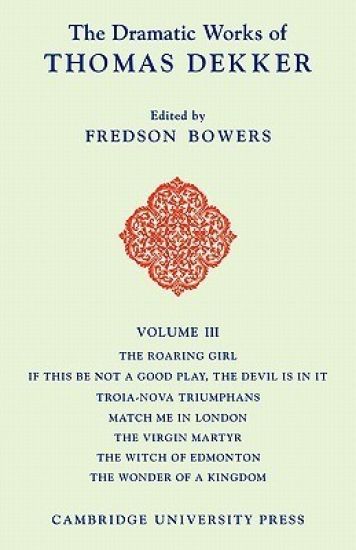
Volume III of the Cambridge Dekker contains The Roaring Girl, If this be not a Good Play..., Troia-Nova Triumphans, Match me in London, The Virgin Martyr, The Witch of Edmonton and The Wonder of a Kingdom. Professor Bowers's edition is recognized as a model critical old-spelling text, where the techniques of strong textual and bibliographical study have been methodically applied to one of the least accessible of the Elizabethan dramatists. The introductions to each play provide textual analyses which set out the circumstances of publication and transmission. The critical apparatus gives press variants derived from collations, editorial emendations to the copy-text and other textual notes.
Thomas Browne and the Writing of Early Modern Science

Thomas Browne and the Writing of Early Modern Science

Preston Claire

Cambridge University Press
2009
pokkari
Claire Preston argues that Thomas Browne's work can be fully understood only within the range of disciplines and practices associated with natural philosophy and early modern empiricism. Early modern methods of cataloguing, collecting, experimentation and observation organised his writing on many subjects from medicine and botany to archaeology and antiquarianism. Browne framed philosophical concerns in the terms of civil behaviour, with collaborative networks of intellectual exchange, investigative selflessness, courtesy, modesty and ultimately the generosity of the natural world itself, all characterising the return to 'innocent' knowledge, which, for Browne, is the proper end of human enquiry. In this major evaluation of Browne's oeuvre, Preston examines how the developing essay form, the discourse of scientific experiment, and above all Bacon's model of intellectual progress and cooperation determined the unique character of Browne's contributions to early modern literature, science and philosophy.
Thomas Arnold on Education

Thomas Arnold on Education

Cambridge University Press
2009
pokkari
Thomas Arnold, headmaster of Rugby School from 1828 till his death, is famous as the reformer of public schools. Dr Bamford sees this reputation as a misleading one and in his introduction he presents Arnold as a paradoxical figure. 'He had a very large family, but did not really understand children at all, he ran a public school but his heart was in the religious and social struggles outside the gates. Again, he adored the classics and despised the moderns but thought that the future hope of mankind lay with industry. As a headmaster it was his duty to educate and prepare boys for the professions and yet openly he despised these occupations. Even after he died the paradox remains, for he is said to have reformed the public schools whereas in fact there is precious little evidence of it.' In this book, a selection of his writings on education is presented to students of education. The writings are preceded by a full introduction which describes Arnold's social, religious and educational ideas and evaluates his influence.
Thomas Hollis of Lincoln's Inn

Thomas Hollis of Lincoln's Inn

W. H. Bond

Cambridge University Press
2009
pokkari
Thomas Hollis, a connoisseur and collector of art and antiquities, devoted the greater part of his substance and his energy to promoting the ideals of civil and religious liberty. Hollis is best known to modern bibliophiles for the distinctive bindings that he commissioned for the many books he distributed in Britain, the American colonies, and all over Europe. This book contains the first comprehensive catalogue and interpretation of his emblematic binding tools and a discussion of the several binders who worked for him. It also explores other activities that are less well known: his patronage of writers, printers, publishers, and artists, and his work as a designer of books and medals. This study should encourage a re-evaluation of Hollis's influence in the Age of Enlightenment and the Age of Revolution.
Thomas Jefferson and Executive Power

Thomas Jefferson and Executive Power

Jeremy D. Bailey

Cambridge University Press
2010
pokkari
By revisiting Thomas Jefferson's understanding of executive power this book offers a new understanding of the origins of presidential power. Before Jefferson was elected president, he arrived at a way to resolve the tension between constitutionalism and executive power. Because his solution would preserve a strict interpretation of the Constitution as well as transform the precedents left by his Federalist predecessors, it provided an alternative to Alexander Hamilton's understanding of executive power. In fact, a more thorough account of Jefferson's political career suggests that Jefferson envisioned an executive that was powerful, or 'energetic', because it would be more explicitly attached to the majority will. Jefferson's Revolution of 1800, often portrayed as a reversal of the strong presidency, was itself premised on energy in the executive and was part of Jefferson's project to enable the Constitution to survive and even flourish in a world governed by necessity.
Thomas Gray

Thomas Gray

Ketton-Cremer

Cambridge University Press
2011
pokkari
This biography of the renowned English eighteenth-century poet and scholar Thomas Gray (1716–1771) was originally published in 1955. The text contains extensive quotations from Gray's literary work and correspondence which are counterpoised by a highly readable narrative of his life, most of which was spent at Cambridge University. Whilst Gray's poetic output was limited for various reasons, including an extremely self-critical attitude towards his own work, he remains a figure of great importance in eighteenth-century literature. This book reflects that importance, and it will be of value to anyone with an interest in English poetry, literary biography, or the cultural environment of the 1700s.
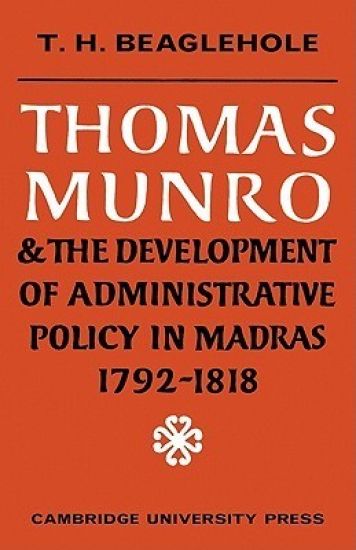
Thomas Munro and the Development of Administrative Policy in Madras 1792–1818
This book was originally published in 1966. The great territorial acquisitions made by the British in South India at the end of the eighteenth century called for an administrative system differing in many ways from that in use in Bengal. These changes influenced subsequent administrative practice not only in Madras but in the whole of British India. Although it had long been recognised that Thomas Munro was in part responsible for the changes, this was the first full study of how his ideas developed and how much they were his alone. Dr Beaglehole's study added greatly to the knowledge of the personality and ideas of one of the key figures in British India. The analysis of the controversy and discussion which took place at the time also provided an insight into the nature of British rule in India.
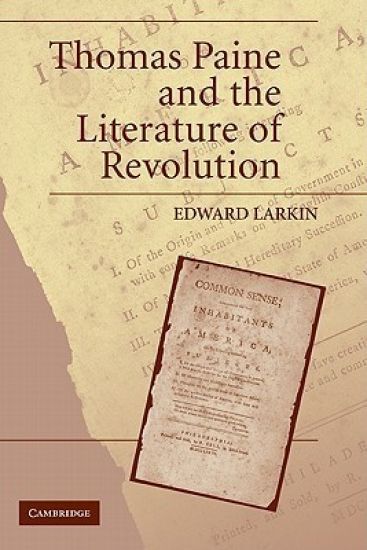
Thomas Paine and the Literature of Revolution

Thomas Paine and the Literature of Revolution

Edward Larkin

Cambridge University Press
2010
pokkari
Although the impact of works such as Common Sense and The Rights of Man has led historians to study Thomas Paine's role in the American Revolution and political scientists to evaluate his contributions to political theory, scholars have tacitly agreed not to treat him as a literary figure. This book not only redresses this omission, but also demonstrates that Paine's literary sensibility is particularly evident in the very texts that confirmed his importance as a theorist. And yet, because of this association with the 'masses', Paine is often dismissed as a mere propagandist. Thomas Paine and the Literature of Revolution recovers Paine as a transatlantic popular intellectual who would translate the major political theories of the eighteenth century into a language that was accessible and appealing to ordinary citizens on both sides of the Atlantic.
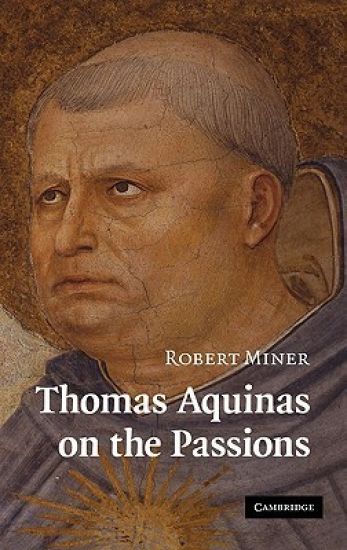
Thomas Aquinas on the Passions

Thomas Aquinas on the Passions

Robert Miner

Cambridge University Press
2011
pokkari
The Summa Theologiae is Thomas Aquinas' undisputed masterwork, and it includes his thoughts on the elemental forces in human life. Feelings such as love, hatred, pleasure, pain, hope and despair were described by Aquinas as 'passions', representing the different ways in which happiness could be affected. But what causes the passions? What impact do they have on the person who suffers them? Can they be shaped and reshaped in order to better promote human flourishing? The aim of this book is to provide a better understanding of Aquinas' account of the passions. It identifies the Aristotelian influences that lie at the heart of the Summa Theologiae, and it enters into a dialogue with contemporary thinking about the nature of emotion. The study argues that Aquinas' work is still important today, and shows why for Aquinas both the understanding and attainment of happiness requires prolonged reflection on the passions.
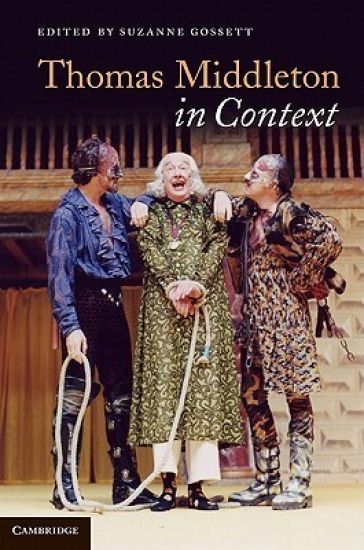
Thomas Middleton in Context

Thomas Middleton in Context

Cambridge University Press
2011
sidottu
The redefinition of the Thomas Middleton canon has led to an explosion of interest in this quintessential Jacobean. Middleton's best-known plays, such as Women Beware Women and The Changeling, are now staged, filmed and rewritten for modern audiences. But Middleton also wrote religious poetry, satires, historical allegory, prose and less familiar plays, collaborating frequently, even with Shakespeare. His works are rooted in his historical and cultural environment, from the Overbury scandal to the fall of the boys' companies. Here, experts in literature, theatre, history, law and religion analyze the complex contexts of Middleton's works, clarifying debates over his religious and political affiliations. Divided into sections presenting new interpretations of the world in which Middleton wrote - as a Londoner, citizen, dramatist and early modern man - and concluding with a section on performance history, the essays cover the full range of his works, from the frequently performed to the newest attributions.
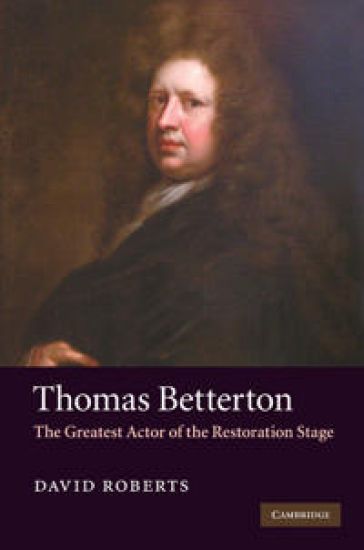
Thomas Betterton

Thomas Betterton

David Roberts

Cambridge University Press
2010
sidottu
Restoration London's leading actor and theatre manager Thomas Betterton has not been the subject of a biography since 1891. He worked with all the best-known playwrights of his age and with the first generation of English actresses; he was intimately involved in the theatre's responses to politics, and became a friend of leading literary men such as Pope and Steele. His innovations in scenery and company management, and his association with the dramatic inheritance of Shakespeare, helped to change the culture of English theatre. David Roberts's entertaining study unearths new documents and draws fresh conclusions about this major but shadowy figure. It contextualizes key performances and examines Betterton's relationship to patrons, colleagues and family, as well as to significant historical moments and artefacts. The most substantial study available of any seventeenth-century actor, Thomas Betterton gives one of England's greatest performing artists his due on the tercentenary of his death.
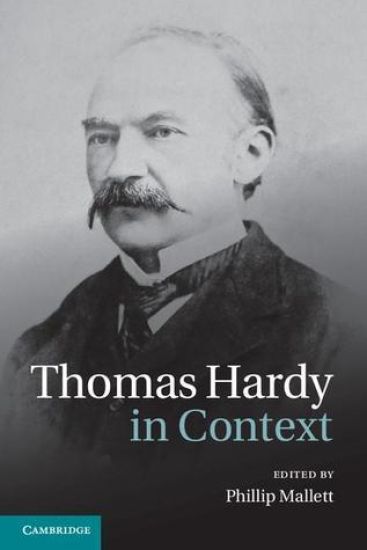
Thomas Hardy in Context

Thomas Hardy in Context

Cambridge University Press
2013
sidottu
This collection covers the range of Thomas Hardy's works and their social and intellectual contexts, providing a comprehensive introduction to Hardy's life and times. Featuring short, lively contributions from forty-four international scholars, the volume explores the processes by which Hardy the man became Hardy the published writer; the changing critical responses to his work; his response to the social and political challenges of his time; his engagement with contemporary intellectual debate; and his legacy in the twentieth century and after. Emphasising the subtle and ongoing interaction between Hardy's life, his creative achievement and the unique historical moment, the collection also examines Hardy's relationship to such issues as class, education, folklore, archaeology and anthropology, evolution, marriage and masculinity, empire and the arts. A valuable contextual reference for scholars of Victorian and modernist literature, the collection will also prove accessible for the general reader of Hardy.
Thomas Young: Natural Philosopher 1773–1829

Thomas Young: Natural Philosopher 1773–1829

Alexander Wood

Cambridge University Press
2011
pokkari
Originally published in 1954, this biography was the result of many years' labour by its author, Alexander Wood. At the time of Dr Wood's death, he had completed the first ten chapters and left notes for the remaining two, which were finished by Frank Oldham. The volume traces the life of the famous English natural philosopher Thomas Young (1773–1829) from his precocious childhood through his later career as a physician and his accomplishments in the study of optics and languages. As Mr Oldham notes in the preface, 'Young forms a fascinating subject in the field of biography, not only from his amazing scientific record and his wide classical learning combined with his remarkable depth of knowledge in philosophy, but also as a humanist working disinterestedly in the cause of truth.' The book is richly illustrated and contains a memoir of the late author by his acquaintance Professor Charles E. Raven.
Thomas Mann

Thomas Mann

Thomas Mann; Erich Heller

Cambridge University Press
1981
pokkari
In this book, which was first published in 1958 and reissued in 1981, Professor Heller sees Mann as the late heir of the central tradition of modern German literature and also as one of the most ironic writers within that tradition. He offers a detailed study of the major works of fiction, Buddenbrooks, Tonio Kröher, Death in Venice, The Magic Mountain, Joseph and His Brothers, Doctor Faustus and Felix Krull, as well as a discussion of Mann's most significant political essay, 'Meditations of a Non-Political Man'. Beyond this, Heller's book is a profound commentary on Mann by a mind attuned to (and mouded by) precisely the intellectual and cultural traditions which are so much part of Mann's creative make-up.
Thomas Stearns Eliot: Poet

Thomas Stearns Eliot: Poet

Moody A. David

Cambridge University Press
1995
pokkari
A. David Moody's Thomas Stearns Eliot: Poet was published to acclaim in 1979, with a successful paperback following in 1980. This carefully revised and corrected second edition, with a specially written preface and a new appendix, meets the demand for one of the classic studies of the twentieth century's best-known poet.
Thomas Starkey and the Commonwealth

Thomas Starkey and the Commonwealth

Thomas Mayer

Cambridge University Press
2002
pokkari
Thomas Starkey (c. 1495–1538) was the most Italianate Englishman of his generation. This book places Starkey into new and more appropriate contexts, both biographical and intellectual, taking him out of others in which he does not belong, from displaced Roundhead to follower of Marsilio of Padua. Beginning with his native Cheshire, it traces his career through Oxford, Padua, Paris, Avignon, Padua again, and finally England, where he spent the last four years of his life trying to fulfil his ambition to serve the commonweal. Most of Starkey’s career revolved around his patron Reginald Pole, scion of the highest nobility, but Starkey (and many other Englishmen) managed to balance loyalty to Pole with allegiance to Henry VIII. Out of favour with the king’s secretary after the middle of 1536, Starkey turned increasingly to religion, continuing to cling to his conciliarist and Italian Evangelical opinions until his death.